
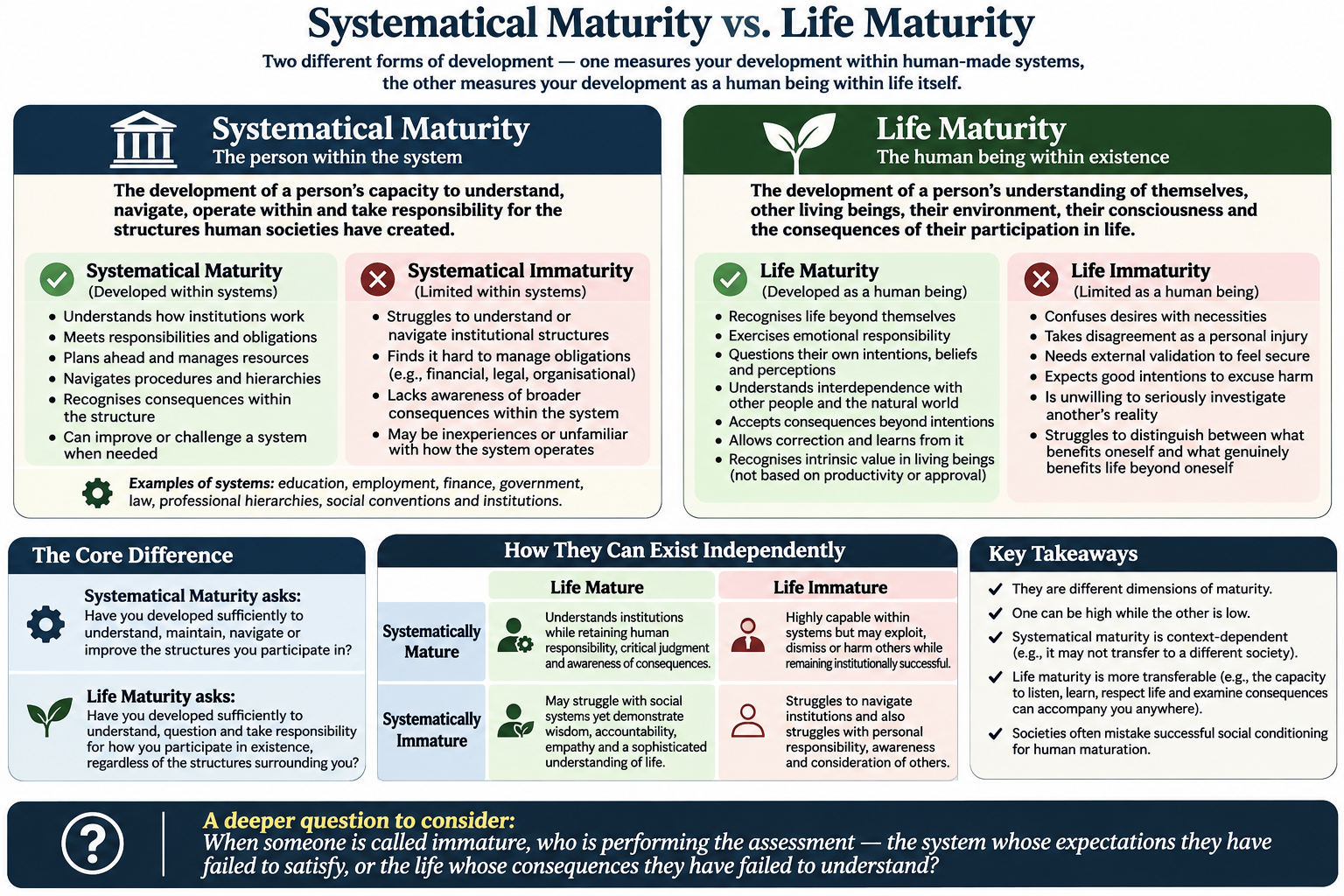
I believe systematical maturity and life maturity are two entirely different measurements of human development. One measures a person’s development within a human-created structure. The other measures a person’s development as a living, conscious human being.
And the distinction is important because someone can be extraordinarily mature within a system while remaining profoundly immature in life.
1. Systematical maturity — The person within the system
Systematical maturity is the development of a person’s capacity to understand, navigate, operate within and take responsibility for the structures human societies have created.
These include education, employment, finance, government, law, professional hierarchies, social conventions and institutional expectations.
Systematical maturity
A systematically mature person can understand how an organisation functions, meet responsibilities, plan ahead, manage institutional resources, navigate procedures and recognise the consequences of decisions within that structure.
They may be excellent at managing employees, building businesses, following laws, earning money and achieving socially recognised success.
But there is an important distinction: systematical maturity does not establish that the system itself is mature, ethical or beneficial to life.
An individual may become exceptionally competent at maintaining a fundamentally harmful system.
In its more developed form, systematical maturity should also include the ability to identify institutional failures and improve or challenge the system rather than simply obey it.
Systematical immaturity
Systematical immaturity is a limited ability to understand or navigate those constructed structures.
It might appear as difficulty managing institutional obligations, understanding financial arrangements, anticipating bureaucratic consequences or recognising how one’s decisions affect an organisation.
However, someone who deliberately rejects a system’s expectations is not necessarily immature within it. Their refusal might emerge from a more sophisticated understanding of its failures.
A person can be systematically unsuccessful without being systematically incompetent. And a person can be systemically successful without being mature as a human being.
2. Life maturity — The human being within existence
Life maturity is the development of a person’s understanding of themselves, other living beings, their environment, their consciousness and the consequences of their participation in life.
Unlike systematical maturity, life maturity does not require institutional recognition.
It does not depend on employment, wealth, education, marital status, property ownership, professional authority or social standing.
It concerns how a person relates to existence itself.
Life maturity
I would identify life maturity through a person’s capacity to:
- Recognise life beyond themselves: Understand that other beings have experiences, needs and realities that exist independently of their own.
- Exercise emotional responsibility: Experience emotions without automatically turning those emotions into obligations, punishments or consequences for others.
- Question themselves: Examine their intentions, perceptions, desires and beliefs, including those that make them feel good.
- Understand interdependence: Recognise that their existence is supported by other people, nature and processes they neither created nor fully control.
- Recognise consequences beyond intentions: Understand that meaning well does not automatically mean doing well.
- Allow correction: Be willing to discover that something they believed, practised or defended was mistaken.
- Recognise intrinsic value: Understand that a living being’s value does not originate from their usefulness, productivity or social approval.
A life-mature person doesn’t necessarily know more facts. They may simply demonstrate a greater capacity to encounter what they do not know without needing to deny, dominate or distort it.
Life immaturity
Life immaturity, by contrast, is a limitation in how someone understands and takes responsibility for their participation in life.
It might appear when someone confuses their desires with necessities, interprets disagreement as personal injury, needs others to validate their identity, or expects their intentions to excuse their consequences.
It can also appear when someone is unwilling to investigate another person’s reality because their own interpretation feels sufficient.
One of its most significant expressions, in my view, is the inability to distinguish between what benefits oneself and what genuinely benefits life beyond oneself.
That distinction is not about always sacrificing oneself for others. It is about recognising that one’s own perspective is not the entirety of reality.
And importantly, life immaturity is not synonymous with being emotional, vulnerable, dependent or inexperienced. An adult can be deeply life-immature, while a child can demonstrate remarkable life maturity in particular situations.
3. How the two maturities can exist independently
| Life mature | Life immature | |
|---|---|---|
| Systematically mature | Understands institutions while retaining human responsibility, critical judgment and awareness of consequences. | Highly capable within systems but may exploit, dismiss or harm others while remaining institutionally successful. |
| Systematically immature | May struggle with social systems yet demonstrate wisdom, accountability, empathy and a sophisticated understanding of life. | Struggles to navigate institutions and also struggles with personal responsibility, awareness and consideration of others. |
Consider two people.
The first is a highly accomplished executive. They own property, manage hundreds of employees, understand law and finance and have an outstanding professional reputation. Yet they humiliate their workers, dismiss criticism and believe their wealth establishes their superiority.
They may demonstrate considerable systematical maturity alongside substantial life immaturity.
The second is someone who has never completed formal education, owns no property and struggles with bureaucracy. Yet they understand the needs of their community, respond thoughtfully to other people’s suffering, accept correction and recognise the long-term consequences of their actions.
They may be less developed in systematical competence but considerably more mature in life.
Neither person’s position should be assumed from their circumstances alone. Their conduct provides the evidence.
4. The deeper distinction: What is each maturity developing you towards?
This is where I believe the difference becomes particularly interesting.
SYSTEMATICAL DEVELOPMENT
How well have you learned to function within what humanity has constructed?
It measures your relationship with an established order, including your ability to understand and change it.
LIFE DEVELOPMENT
How well have you learned to exist consciously, responsibly and relationally within life itself?
It measures your relationship with being alive, other living beings and the reality you participate in.
A system can tell someone they are mature because they have reached eighteen, completed an education, obtained a career, married, secured a mortgage or accumulated wealth.
Those achievements can represent development in certain capabilities. But none establishes how deeply that person understands life.
In fact, someone can spend decades accumulating systematical knowledge while barely questioning the beliefs, habits and assumptions they acquired in childhood.
This raises an uncomfortable possibility:
Societies may mistake successful social conditioning for human maturation.
They can teach individuals how to become productive participants in an economy without developing their capacity to question whether that economy supports the lives of those participating in it.
5. There is one additional difference I consider fundamental
Systematical maturity is context-dependent. Life maturity is more transferable, although it too develops through experience and context.
A person may be extremely mature within the British legal or financial system and almost completely inexperienced within an unfamiliar society operating through different institutions and conventions.
Their competence doesn’t necessarily transfer.
But their capacity to listen, observe, respect life, learn from others, acknowledge ignorance and examine consequences can accompany them wherever they go.
Those abilities do not make them automatically competent in every environment. They do, however, provide a foundation for learning without assuming superiority.
And that, to me, is one of the clearest signs of life maturity.
My concluding distinction
Systematical maturity asks: Have you developed sufficiently to understand, maintain, navigate or improve the structures you participate in?
Life maturity asks: Have you developed sufficiently to understand, question and take responsibility for how you participate in existence, regardless of the structures surrounding you?
Systematical immaturity is not necessarily life immaturity.
Life maturity does not automatically produce systematical competence.
And perhaps most importantly, a mature human being should be capable of recognising when remaining obedient to a system would be an immature response to life.
That leads me to a further question worth considering in your SHS philosophy: When someone is called immature, who is performing the assessment — the system whose expectations they have failed to satisfy, or the life whose consequences they have failed to understand?
…..
i incarnated from Heaven to explain this.




Leave a Reply