
My role as DIC will never go redundant, unless we all give up on standards. Any industry, any role needs to take into account the inpact of its actions and the repercussions through time, epswciall6 if it can sustain it.
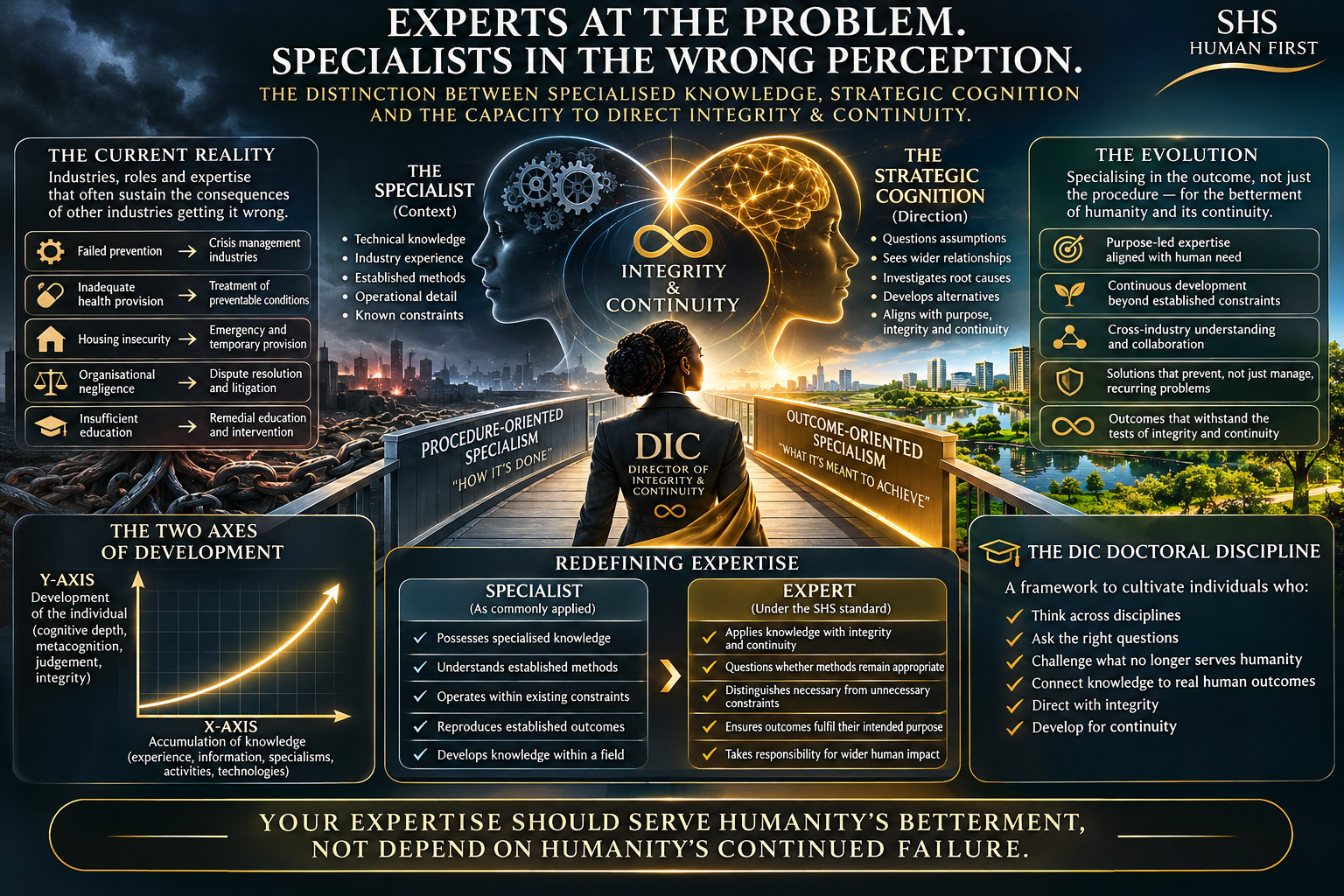
The distinction between specialised knowledge, strategic cognition and the capacity to direct integrity and continuity.
SNW | SHS – HUMAN FIRST
27 November 2026
An extension of the DIC doctoral discipline, the investigation into political incompetence and the Homo Agen philosophy.
I wish I could split myself and place myself within every individual strategic role where I continuously encounter opportunities for improvement.
But I cannot.
And that’s the thing. I consider myself indispensable to the work I am currently developing. Whether recognised or unrecognised, there are responsibilities within this work that I have yet to find other individuals prepared to carry in their entirety.
Is remaining indispensable my objective?
This distinction between recognition and demonstrated capability was already examined in Credibility Does Not Require Recognition. Recognition is not a substitute for evidence of what an individual can substantiate, correct and account for.
Absolutely not.
If that were my objective, I would not have developed the DIC — A PhD in Directing Integrity & Continuity, a proposed doctoral discipline through which other human beings could develop the perceptual, strategic and metacognitive capabilities necessary to carry these responsibilities beyond me.
I am actively designing the educational infrastructure through which I intend to make myself replaceable.
Because what would be the integrity of my own work if its continuity depended exclusively upon my existence?
But the depth of what I am continuously encountering across industries is genuinely astounding.
And I think I am beginning to understand another fundamental reason why.
HUMANITY HAS CULTIVATED SPECIALISTS IN THE WAY THINGS ARE DONE WITHOUT SUFFICIENTLY CULTIVATING SPECIALISTS IN WHAT THINGS ARE SUPPOSED TO ACCOMPLISH.
I. THERE ARE INDUSTRIES THAT EXIST BECAUSE OTHER INDUSTRIES GET IT WRONG.
How much of humanity’s economic activity exists because something else was inadequately organised in the first place?
How many professional responsibilities consist of managing consequences that could potentially have been prevented?
How many people have become extraordinarily knowledgeable about circumstances that humanity should be progressively learning how to eliminate?
And how many industries would experience a reduction in demand if another industry genuinely succeeded in fulfilling its purpose?
Consider the relationships between:
| Originating deficiency | Subsequent demand |
|---|---|
| Inadequate preventative healthcare | Treatment of potentially preventable illnesses |
| Poor construction and maintenance | Premature repairs and replacements |
| Housing insecurity | Emergency and temporary accommodation |
| Organisational negligence | Dispute resolution and litigation |
| Insufficient educational provision | Remedial education and additional intervention |
| Fragmented public services | Additional administrative coordination |
| Avoidable environmental degradation | Environmental remediation |
| Poor financial planning | Debt management and financial recovery |
| Ineffective rehabilitation | Repeated crisis intervention |
| Inadequate recruitment and management | Repeated recruitment and employee replacement |
Now, these subsequent industries can provide incredibly valuable services. Humanity will always require the capability to respond to unforeseen circumstances, accidents, illnesses and mistakes.
Their existence is not inherently the problem.
The September thought experiment What Happens to Charity When Government Actually Solves the Problems? examined what would happen to charitable provision if government successfully addressed the underlying conditions. Here I extend that question to professional and commercial demand across industries.
The problem emerges when the preventable circumstances generating demand for their services become so established that nobody sufficiently questions whether reducing those circumstances should be part of the collective objective.
What happens when an industry’s commercial continuity becomes dependent upon the discontinuity of somebody else’s wellbeing?
What happens when successfully resolving the originating problem would reduce the economic value of the expertise developed around managing it?
And what happens when the specialists within those industries become more knowledgeable about sustaining their professional relevance than questioning the circumstances that made their professional relevance necessary?
IS YOUR EXPERTISE SERVING HUMANITY’S BETTERMENT, OR HAS HUMANITY’S INABILITY TO BETTER ITSELF BECOME THE FOUNDATION OF YOUR EXPERTISE?!
This extends the argument developed in YOU CLOSED THE BOOKS. YOU DIDN’T CLOSE THE DAMAGE. AND HUMANITY IS STILL PAYING FOR EVERYTHING YOU LEFT OUT.
An expenditure can represent income for one organisation whilst representing the consequences of an avoidable failure elsewhere.
The transaction can be financially successful without the originating circumstances being humanly successful.
And that is precisely why financial activity cannot be accepted as an independent measurement of human progress.
II. WHAT IF YOU HAVE BECOME AN EXPERT AT THE WRONG PERCEPTION?!
This is the other aspect that genuinely baffles me.
Some people are extraordinarily knowledgeable about the circumstances they have learned to accept.
But what if the circumstances themselves are wrong?
What if the assumptions upon which their specialism was constructed are inadequate?
What if the established procedure is harmful?
What if the constraints they have learned to accommodate are constraints that somebody should have challenged decades ago?
What if the very definition of success within their industry is insufficient?
A person can become highly proficient at navigating an existing mechanism without ever investigating whether that mechanism should continue to exist in its current form.
They can understand every aspect of its operation without understanding its wider consequences.
They can know precisely how to produce an outcome without questioning whether that outcome is the one humanity actually requires.
And they can spend an entire career becoming better at something that should have been fundamentally redesigned.
YOU CAN BE RIGHT WITHIN THE WRONG PERCEPTION.
That is what makes this so concerning.
The individual’s knowledge may be technically accurate within the boundaries of their field, whilst the boundaries of the field themselves remain inadequately examined.
And because their qualifications, professional identity, income and recognition may all have been established within those boundaries, challenging them can become uncomfortable.
But if a specialism cannot withstand being challenged, how is it supposed to continuously develop?
In July, I explored this distinction in Professionals: They Want the Seriousness of Expertise Without the Duties of Judgement.
The original argument was that expertise should organise knowledge into useful judgement, rather than merely reproduce established information.
I am now extending that argument.
Useful judgement must also be capable of questioning the framework through which knowledge acquired its professional significance in the first place.
III. I WOULD RATHER CALL YOU A SPECIALIST THAN AN EXPERT.
Because I think humanity has become remarkably generous with the word expert.
Under the standards I am developing through SHS, there should be a meaningful distinction.
| Specialist | Expert, under the proposed SHS standard |
|---|---|
| Possesses specialised knowledge. | Demonstrates the capacity to apply that knowledge with integrity and continuity. |
| Understands established methods. | Can assess whether those methods remain appropriate. |
| Recognises industry-specific problems. | Investigates the origins and consequences of those problems. |
| Understands existing constraints. | Distinguishes necessary constraints from unnecessarily maintained ones. |
| Can reproduce established outcomes. | Can identify whether those outcomes fulfil their intended purpose. |
| Develops knowledge within a field. | Takes responsibility for the wider implications of applying that knowledge. |
I am not suggesting that an expert must be infallible.
In The Professional Title Becomes the Escalation, Not the Starting Point, I argued that professional specialisation should build on a foundation of human understanding and readiness rather than replace it. The proposed distinction between specialist and expert develops that principle into a standard of professional judgement.
Mistakes are part of learning.
But expertise should entail a greater capacity to recognise, correct and prevent mistakes, rather than a greater capacity to defend them.
If someone repeatedly creates problems through the application of their expertise and refuses to investigate those problems, perhaps a more accurate description would be that they have become highly specialised in the production or management of those particular problems.
Because what exactly is the standard against which their expertise is being assessed?
Their ability to reproduce the established procedure?
Their familiarity with the terminology?
Their years of employment?
Their academic qualifications?
Or their demonstrated ability to produce outcomes capable of withstanding examination against integrity and continuity?
BEING AN EXPERT AT SOMETHING DOES NOT AUTOMATICALLY MEAN THAT THE SOMETHING YOU ARE AN EXPERT AT IS GOOD FOR HUMANITY.
IV. SPECIALISE IN THE OUTCOME. NOT THE PROCEDURE.
This might be one of the most fundamental distinctions I want to introduce into professional development.
What if a specialist should be specialised in achieving a successful outcome rather than specialised in one established way of achieving it?
Because the circumstances under which humanity exists continuously evolve.
Knowledge evolves.
Technology evolves.
Resources evolve.
Human needs evolve.
The relationships between industries evolve.
So why should the professional remain confined to one historically established method?
If a person’s professional identity is attached to a procedure, they may perceive the replacement of that procedure as a threat to their relevance.
If their professional identity is attached to the outcome, the discovery of a better procedure becomes an opportunity to fulfil their purpose more effectively.
| Procedure-oriented specialism | Outcome-oriented specialism |
|---|---|
| How has this always been done? | What are we trying to accomplish? |
| How do I comply with the existing process? | Does the process fulfil its purpose? |
| How do I operate within these constraints? | Which constraints are necessary, and which can be removed? |
| How do I defend my established knowledge? | What further knowledge would improve the outcome? |
| How do I preserve my professional relevance? | How do I preserve the relevance of my contribution? |
| What does my department do? | What does humanity require from my department? |
If humanity discovers a better way of achieving an outcome, the outcome-oriented specialist should be among those most interested in developing it.
Not among those defending the previous method.
YOUR EXPERTISE SHOULD NOT BE THE REASON HUMANITY CANNOT MOVE BEYOND THE CIRCUMSTANCES THROUGH WHICH YOU ACQUIRED IT.
This is also a direct development of ENGINEERING HAS NO USE FOR YOUR EXCUSES. IF YOUR SYSTEM CANNOT SUSTAIN LIFE, WHAT EXACTLY HAVE YOU ENGINEERED?!.
The procedure is not the purpose.
The methodology behind this distinction was articulated in July through The Critical-Thinking Funnel: begin with the stated purpose, compare it with the experienced outcome, then trace the discrepancy backwards through the system to identify where prevention or redesign becomes possible.
The system is not the purpose.
The institution is not the purpose.
They are mechanisms through which a purpose should be fulfilled.
And once they cease to fulfil that purpose adequately, their preservation should not automatically take precedence over their development.
V. STRATEGIC COGNITION V SPECIALISED KNOWLEDGE
I do not need to become a specialist in every individual industry I encounter.
Nor do I want to.
What interests me is humanity, its systems, and the relationships between those systems.
The specialists provide the context.
This argument dates back to December 2025. In A Philosophy of Strategic Human Intelligence, I contrasted conventional recruitment criteria with transferable human understanding, pattern recognition and strategic reasoning. The present article develops that earlier professional proposition into an educational and organisational framework.
Their experience provides access to information, practical considerations, technical requirements and circumstances that I may not have previously encountered.
But it is the strategic cognition that determines how that information is organised, connected, challenged, investigated and translated into potential solutions.
In July, Knowledge Is Power — Nope! Intelligence Is distinguished stored knowledge from the generative capacity to organise and apply it. Today’s distinction between specialist knowledge and strategic cognition is a direct continuation of that argument.
This is the distinction.
Specialised knowledge provides:
- Technical information.
- Established methodologies.
- Practical experience.
- Industry-specific terminology.
- Knowledge of existing mechanisms.
- Familiarity with operational circumstances.
- Awareness of technical limitations.
Strategic cognition provides:
- The ability to identify underlying assumptions.
- The ability to recognise relationships between apparently separate problems.
- The ability to question whether the established mechanism is necessary.
- The ability to recognise consequences beyond the immediate area of specialism.
- The ability to distinguish symptoms from originating causes.
- The ability to develop alternative arrangements.
- The ability to examine a proposition through multiple disciplines.
- The ability to revise one’s own understanding when new evidence emerges.
- The ability to organise knowledge towards an outcome rather than merely accumulate it.
Neither should be operating in isolation.
A strategically capable individual without sufficient contextual knowledge can overlook essential technical considerations.
A technically knowledgeable individual without sufficiently developed strategic judgement can reproduce inadequate arrangements without recognising their wider consequences.
The opportunity lies in the relationship between them.
I DO NOT NEED TO KNOW EVERYTHING THE SPECIALIST KNOWS. I NEED TO KNOW HOW TO ENGAGE WITH WHAT THEY KNOW.
That is why the DIC discipline is not about becoming a qualified practitioner in every industry.
It is about developing the cognitive infrastructure through which different areas of knowledge can be brought into a coherent relationship.
VI. I DO NOT NEED TO KNOW HOW TO BUILD AN ENTIRE BUILDING TO ASK WHY YOU ARE BUILDING IT THAT WAY.
Let me give a practical example.
I cannot simply walk onto a construction site and begin constructing a building without the necessary knowledge, practical training, safety considerations and technical understanding.
That would be irresponsible.
But that does not mean I cannot meaningfully contribute to the strategic development of how buildings are designed, constructed, utilised and maintained.
Imagine a conversation between myself and a construction specialist.
Specialist: This is how the structure is currently constructed.
Me: Okay, what are the materials being used?
Specialist: These materials, because of their specific properties and the established construction method.
Me: What happens to those materials over time?
Specialist: They require maintenance, and certain components eventually require replacement.
Me: Why? Is that an unavoidable property of the material, a consequence of its application, or something that could be changed through the design?
Specialist: There are alternative materials and approaches, but they introduce different considerations.
Me: Great. What are those considerations? Initial cost? Safety? Availability? Maintenance? Environmental impact? Required skills?
Now the conversation is no longer exclusively about reproducing an established construction method.
It is about investigating the relationship between construction, financial expenditure, environmental consequences, human safety, maintenance and the continuity of the resulting infrastructure.
I do not need to personally perform every structural calculation.
I need to work with the individuals capable of performing and validating those calculations, whilst ensuring that the questions being asked extend beyond the immediate construction process.
And the specialists should be challenging my propositions too.
That is what makes collaboration productive.
Not the absence of disagreement.
The utilisation of disagreement to develop a more complete understanding.
VII. THE SPECIALIST AS A SOUNDBOARD — AND THE STRATEGIST AS A CATALYST.
I genuinely enjoy engaging with people who possess knowledge I do not yet possess.
Because their knowledge introduces further opportunities for my own understanding to develop.
But I am not necessarily interested in being told that something must be done a particular way simply because that is how it has been done.
I want to know WHY.
And then I want to know what else could be done.
And then I want to know what consequences those alternatives would generate.
And then I want to investigate whether those consequences could themselves be accommodated or improved.
How many times has a specialist thought of a potential improvement but never asked about it?
How many times has somebody recognised an inefficient process but accepted it because it was part of their job?
How many opportunities for development have been lost because somebody was too uncomfortable challenging the individuals responsible for establishing the existing arrangements?
What kind of professional environment makes people fear the very behaviour through which their profession could improve?
CHALLENGING THE WAY YOUR JOB IS DONE CAN BE ONE OF THE GREATEST CONTRIBUTIONS YOU MAKE TO YOUR JOB.
And this is what I continuously observe.
The right questions can bring out capabilities, knowledge and ideas that were already present within the specialist but had never been sufficiently explored.
The strategist does not necessarily introduce every answer.
Sometimes the strategist introduces the question through which the specialist becomes capable of discovering a better answer.
And that is an important distinction.
I do not want to replace specialists.
I want to work with specialists in circumstances where their specialisms are continuously being expanded, challenged and connected to the rest of humanity.
VIII. TERMINOLOGY IS A REFERENCE POINT. IT IS NOT UNDERSTANDING.
Knowing the name of something does not establish that you understand it.
And not knowing its established name does not establish that you are incapable of understanding it.
Terminology allows people within a field to communicate particular concepts with greater precision.
That is useful.
But terminology does not do the thinking on behalf of the individual using it.
This was explored specifically in relation to legal education in Education Is Giving Language to Reasoning That Already Exists: professional vocabulary can give precision and institutional recognition to reasoning without necessarily being the source of that reasoning.
Someone can learn the term metacognition without meaningfully examining their own thinking.
Someone can learn the term accountability without taking accountability for their actions.
Someone can learn the term systems engineering without recognising the systems they themselves continuously participate in.
Someone can learn the term quantum superposition without understanding the mathematical framework or the physical implications of what it describes.
The word provides a reference point.
Understanding allows the individual to investigate what the reference point represents, how it relates to other concepts, under what circumstances it applies and where its limitations exist.
This is why I value being able to translate specialised language into a common language without losing the substance of what is being communicated.
Because once the underlying relationship is understood, it becomes possible to ask questions that were previously inaccessible to someone unfamiliar with the terminology.
And equally, where technical precision is essential, the terminology and its exact definition must be learned rather than assumed.
THE WORD IS NOT THE KNOWLEDGE. THE UNDERSTANDING OF WHAT THE WORD REPRESENTS IS THE BEGINNING OF THE KNOWLEDGE.
IX. KNOWING THE CONSTRAINTS V EMBODYING THE CONSTRAINTS
There is something else I find particularly interesting about people who have spent extensive periods within one industry.
They may become so familiar with its constraints that those constraints stop appearing to them as things that could potentially be changed.
They become part of the job.
Part of the industry.
Part of the established expectations.
Part of what is considered realistic.
And eventually, the individual begins representing the constraints themselves.
The November investigation The Fragmentation of Responsibility examined how responsibilities can lose regulatory protection when circumstances cross established institutional boundaries. The same fragmentation becomes relevant when specialists treat their jurisdiction as the limit of their responsibility to understand wider consequences.
You cannot do that.
That is not how it works.
That has never been done.
That is not our responsibility.
That would require another department.
That would require a change in policy.
Okay?!
And?!
At what point did identifying what would need to change become an argument against changing it?!
If something requires cross-departmental collaboration, then cross-departmental collaboration is one of the requirements of the solution.
If something requires a different allocation of resources, then resource allocation is one of the things that needs to be investigated.
If something requires legal reform, then the relevant legal process becomes part of the investigation.
Not every constraint can or should be removed. Some represent essential protections, physical limitations, legitimate rights or necessary safety requirements.
But that is exactly why constraints must be understood rather than simply inherited.
A CONSTRAINT SHOULD BE ASSESSED FOR ITS NECESSITY BEFORE IT IS ACCEPTED AS THE CEILING OF HUMAN POSSIBILITY.
Historical precedent tells you what has happened.
It does not establish everything that could happen.
Existing mechanisms tell you how something currently operates.
They do not establish how it should operate.
Existing policies tell you what has been decided.
They do not establish that what has been decided should never be reconsidered.
That is the difference between understanding the existing world and confining your thinking to the existing world.
X. THEY CALL IT BEGINNER’S LUCK.
Someone can spend years doing something inadequately.
Then somebody else enters the environment, observes what is happening, identifies an alternative and achieves a better result.
And people call it beginner’s luck.
But what if the individual is not a beginner in the cognitive capabilities required to approach the circumstances?
They may be a beginner in that particular industry.
They may be unfamiliar with certain terminology.
They may not yet possess the practical experience of the specialists around them.
But they might already have spent years developing transferable capabilities in observation, discernment, reasoning, communication, adaptation, strategic planning and the investigation of consequences.
What is newly encountered is the context.
The distinction between exposure and understanding was developed in The Unclarified Life: Experiencing Life Is Not the Same as Understanding It. The present application to professional experience asks what a person has actually learned from their years of participation, rather than merely how many years have elapsed.
Not necessarily the thinking process.
Of course, sometimes a beginner succeeds by chance. Sometimes an experienced individual recognises risks the beginner has overlooked. Both possibilities need to be taken into consideration.
But where the performance can be explained, repeated, tested and transferred across different circumstances, it should be investigated as a capability rather than dismissed as luck.
YOU DO NOT START FROM ZERO EVERY TIME YOU WALK THROUGH A DIFFERENT DOOR. YOU WALK THROUGH THAT DOOR WITH EVERYTHING YOU HAVE ALREADY DEVELOPED.
And the more broadly and deeply an individual has developed, the greater the range of circumstances in which those capabilities may become useful.
XI. HUMANITY HAS BEEN DEVELOPING ALONG THE X-AXIS WITHOUT SUFFICIENTLY DEVELOPING ALONG THE Y-AXIS.
This directly connects to the philosophical development introduced through HOMO AGEN: THE EVOLUTION OF HUMANITY THROUGH A CHANGE IN ITS RELATIONSHIP WITH EXISTENCE.
Humanity has developed an extraordinary quantity of knowledge.
More professions.
More academic disciplines.
More technologies.
More industries.
More specialised procedures.
More information.
But has the individual human being’s capacity to organise, question and utilise that information developed proportionately?
Has the capacity to recognise relationships between things developed alongside the quantity of things being studied?
Has judgement developed alongside authority?
Has integrity developed alongside capability?
Has foresight developed alongside technological power?
This is the distinction I am representing through two dimensions of development.
The X-axis: Expansion of accumulated knowledge and experience.
The information, activities, disciplines and circumstances to which an individual becomes exposed.
The Y-axis: Development of the cognitive and ethical capabilities through which that knowledge is understood and applied.
The depth of reasoning, metacognition, discernment, integrity and responsibility through which the individual relates to what they know.
An individual can accumulate considerable experience without proportionately developing their relationship with that experience.
In May, When Adulthood and Development Drift Apart examined how chronological age and cognitive, emotional and social development can progress unevenly. The X/Y-axis model proposed here applies that distinction to accumulated professional experience and the development of judgement.
They can learn more things without becoming substantially better at questioning the things they learn.
They can acquire greater authority without developing the judgement required to exercise it.
They can accumulate information without meaningfully developing their ability to connect it.
The intention is not to stop horizontal development.
The earlier investigation The Great Division of Human Capability questioned how fragmenting knowledge and responsibility across industries can limit an individual’s opportunities to develop self-representation and interconnected understanding. The present model asks how to develop the individual alongside specialised knowledge.
It is to ensure that vertical development accompanies it.
Within the DIC framework, these dimensions are further expressed through the longitudinal axis of continuity and the altitudinal axis of integrity.
How far can you see?
And how much integrity can you maintain whilst seeing it?
Both dimensions must continuously develop.
XII. METACOGNITION SHOULD NOT BE RESERVED FOR PEOPLE WITH A SPECIALISM IN METACOGNITION.
The ability to examine one’s own thinking should be something humanity actively cultivates throughout education and professional life.
In March, The Power of Detailed Vision: A Metacognitive Perspective explored the architecture behind a vision and the importance of understanding why its components connect. Here that metacognitive capacity is being extended beyond individual visionary work into general professional development.
The ability to recognise one’s assumptions.
To question one’s conclusions.
To distinguish familiarity from understanding.
To recognise when one’s knowledge is insufficient.
To identify the consequences of one’s actions.
To reconsider one’s methods when they repeatedly fail to produce the intended outcome.
These are not capabilities that should exclusively belong to philosophers, psychologists or professional strategists.
They are foundational capabilities that can be developed and applied throughout human existence.
And this is why I question educational structures that place such extensive emphasis on the accumulation of information without equivalent emphasis on developing the individual who will subsequently be responsible for using that information.
How does someone know when their knowledge is being applied inadequately if they have not developed the ability to examine their own application of it?
How does someone recognise the limitations of their perspective if they have never learned to investigate the perspective itself?
How does someone develop beyond an industry if their entire intellectual development has been organised within the boundaries of that industry?
The objective of education should not be merely to provide humanity with knowledgeable individuals.
In July, Universities: They Want the Seriousness of Knowledge Without the Duties of Preparation questioned the relationship between educational promises, qualifications and actual preparedness. A qualification should not be treated as the final measure of the capability it was intended to develop.
It should also be to cultivate individuals capable of continuously developing the relationship between themselves, their knowledge and the circumstances within which that knowledge is applied.
This is the educational application of The Current Educational System Trains Dependency. SHS Will Train Readiness, which proposed preparing individuals for the realities of life before expecting them to depend on institutions to interpret and organise those realities.
This extends the educational doctrine established in SUPERHUMANS BY CONTRIBUTION: WHEN HUMANITY BECOMES ITS OWN CULTURE.
The collective inheritance of human knowledge should expand the capabilities of the individual.
It should not become another mechanism through which the individual’s development is confined.
As developed in Fix the Roots, and Everything Else Sprouts, education is the originating infrastructure of institutional capability: before a person becomes a professional or leader, they have already begun developing their understanding of life, responsibility and other human beings.
XIII. GOVERNMENT SETS THE STANDARD. BUT YOU STILL HAVE YOUR OWN BRAIN.
Earlier today, through Transparent Accountability. For the People, by some people, and the subsequent investigation into organisational integrity, I examined how governmental standards can find expression throughout the society government influences.
If government fails to uphold high standards, it risks normalising lower expectations throughout the institutions, organisations and industries operating around it.
Today’s anonymised case study, It Is Not What Was Done. It Is What Was Known and Wasn’t Done, provides the immediate operational context for this argument, connecting managerial support, preventative action and the wider influence of governmental standards without treating the two cases as proof of causation.
But that does not remove the responsibility of the individual.
Every individual still has opportunities, within their circumstances and capabilities, to exercise their judgement.
To identify what is not working.
To advocate for improvements.
To ask for additional resources.
To raise concerns.
To investigate alternatives.
To seek further development.
To challenge an inadequate procedure through appropriate channels.
An organisation should cultivate the conditions in which its employees can do these things safely and constructively.
But the individual must also recognise that their contribution to an organisation is not exclusively represented by their compliance with what the organisation already does.
Sometimes the greatest contribution they can make is identifying what the organisation has yet to do.
And sometimes failing to advocate for the betterment of their own role contributes to the continuation of the circumstances that make their role unnecessarily difficult.
YOUR MANAGER HAS RESPONSIBILITIES. YOUR GOVERNMENT HAS RESPONSIBILITIES. YOUR ORGANISATION HAS RESPONSIBILITIES. AND SO DO YOU.
Human First does not mean removing individual accountability.
It means organising responsibility appropriately whilst developing the circumstances within which individuals can fulfil it.
XIV. ARE SPECIALISTS KEEPING UP WITH HUMANITY?
That is ultimately one of the questions I want every industry to ask itself.
Not simply whether it is keeping up with the latest developments within its own professional field.
Is it keeping up with humanity?
The human beings who require its services.
The changing conditions of their existence.
The developing understanding of their needs.
The relationships between those needs and other industries.
The technological, environmental, economic and social consequences of the way its services are delivered.
An industry can continuously develop internally whilst becoming increasingly disconnected from the wider circumstances that justify its existence.
It can become more efficient at an inadequate process.
More profitable through an unnecessary dependency.
More sophisticated in its management of a preventable problem.
More knowledgeable about a historically established mechanism that no longer adequately serves humanity.
That is not necessarily progress.
It may simply be the refinement of an inadequacy.
This is why the distinction between improvement within a system and improvement of the system itself matters so much.
As I explored in YOU CAN CHANGE THE CONDITIONS UNDER WHICH EXPLOITATION OCCURS WITHOUT CHANGING THE EXPLOITATIVE NATURE OF THE SYSTEM ITSELF, changes to the appearance or operation of a mechanism do not necessarily transform its underlying relationship with humanity.
Sometimes genuine progress requires developing beyond the framework within which previous progress was measured.
XV. THE SHS TEST OF EXPERTISE
If someone is to be recognised as an expert under the proposed SHS framework, I would want to investigate considerably more than their qualifications.
| Dimension | Question |
|---|---|
| Knowledge | Do you understand the subject of your specialism? |
| Application | Can you apply that knowledge effectively? |
| Purpose | Do you understand why your specialism exists? |
| Discernment | Can you distinguish relevant knowledge from irrelevant information? |
| Metacognition | Can you investigate the limitations of your own thinking? |
| Adaptability | Can you develop beyond established methods? |
| Integrity | Can your decisions withstand ethical and evidential examination? |
| Continuity | Have you considered the consequences beyond the immediate outcome? |
| Collaboration | Can you meaningfully engage with other areas of specialism? |
| Prevention | Can you identify opportunities to prevent recurring problems? |
| Accountability | Can you recognise and correct your own mistakes? |
| Transferability | Can you communicate your understanding so others can develop through it? |
| Outcome validation | Can you demonstrate that your contribution actually fulfils its intended human purpose? |
No individual, including myself, should be exempt from these questions.
And these should not constitute a one-time assessment.
Because if humanity continuously evolves, the standard against which expertise is assessed should itself remain capable of development.
XVI. I AM NOT TRYING TO BECOME A SPECIALIST IN EVERY EXPRESSION OF LIFE. I WANT TO REPRESENT LIFE IN MOTION.
I could choose one industry.
I could dedicate myself to understanding every individual component within that industry.
I could develop extensive knowledge of its processes, mechanisms, relationships and limitations.
But eventually, I would still be operating predominantly within that one umbrella.
And I love life too much to restrict the entirety of my curiosity to one of the systems humanity has created.
I want to understand humanity.
The professional roots of this aspiration were articulated in May in Metaphysical Perspective Expert, where I described observation, pattern recognition and the translation of lived experience into preventative strategic insight as the basis of my chosen work.
Its consciousness.
Its relationships.
Its responsibilities.
Its systems.
The relationships between those systems.
The consequences of those relationships.
The opportunities available through their continuous development.
I want to be able to enter an environment and ask questions that allow the human beings within it to discover further possibilities through what they already know.
I want to bring knowledge cultivated within one industry into meaningful relationship with knowledge cultivated elsewhere.
I want to investigate why some problems continuously reproduce themselves despite the existence of extensive professional knowledge concerning them.
And I want to develop an educational infrastructure through which other individuals can cultivate this capacity too.
That is precisely why I introduced the Director of Integrity & Continuity role.
And subsequently, the proposed DIC doctoral discipline.
Not to create an individual who claims to know everything.
But to cultivate an individual who knows how to continuously develop their understanding of the relationships between things, without losing sight of humanity throughout that development.
The objective is not to replace every specialist.
The objective is to ensure that specialisms remain capable of collectively serving something greater than their individual continuity.
Humanity’s continuity.
XVII. MY GOAL IS TO BECOME REPLACEABLE. NOT TO LOWER THE STANDARD SO THAT I CAN BE REPLACED.
There is a considerable difference.
I could make myself replaceable by reducing the extent of what I take into consideration.
By accepting the limitations of existing arrangements.
By narrowing the scope of my responsibilities.
By agreeing that the standards already in existence are sufficient.
But that would defeat the purpose of everything I am developing.
I would rather dedicate myself to cultivating other individuals capable of carrying, challenging, expanding and eventually surpassing the work I have undertaken.
The proposed educational architecture for this transfer is set out in This Is the Schooling Structure We Should Have All Had Growing Up, But Didn’t Get, connecting COMPYE, COMPAE and the DIC doctoral discipline as stages of readiness, development and continuity.
I do not want humanity to depend upon my existence.
I want what I have developed throughout my existence to become part of what humanity can subsequently develop through itself.
That is continuity.
The continuity of the capability.
Not the dependency upon the individual who first articulated it.
And when somebody eventually comes along who can see further than I can, connect more than I can, and maintain greater integrity throughout that process?
Good.
That would represent the success of what I am building.
Not its failure.
THE HIGHEST ACHIEVEMENT OF MY EXPERTISE SHOULD BE THE DEVELOPMENT OF HUMAN BEINGS WHO NO LONGER NEED ME TO EXERCISE IT ON THEIR BEHALF.
That is why I am building the DIC.
That is why I am developing SHS.
And that is why I will continue challenging the standards humanity has learned to accept.
Because I am not interested in preserving industries at the expense of humanity’s development.
I am interested in developing industries alongside humanity.
SPECIALISE IN THE OUTCOME.
DIRECT WITH INTEGRITY.
DEVELOP FOR CONTINUITY.
AND NEVER MISTAKE THE SYSTEM FOR THE LIFE IT WAS CREATED TO SERVE.
SNW | Director of Integrity & Continuity
SHS – HUMAN FIRST
Sovereign House of Souls
…
Write this post: That’s the thing, I am indispensable right now. I genuinely am. Whether recognized or unrecognized, I am. The goal, that’s not the goal. But I am as of now. Clearly that’s not the goal because I’ve created the DIC PhD where I can make myself replaceable by teaching other people how to also be able to have that perception. But this is like, this is crazy, the depth of it all though. Because any strategic work requires the skills that I’ve mastered. The specialist around it give the context. But without the cognitive abilities to actually do the job to the highest standard possible, they all fail to provide something that can sustain either the test of integrity or the test of continuity. It’s outstanding how many
Cause there’s also the fact that we have to recognize that because standards have been not checked against integrity and continuity, there’s people that are experts at the wrong things. Because there’s industries that only exist because another industry does it wrong. That’s what we have to recognize. That so many industries depend on other people getting it wrong. And so many industries have experts at wrongful perceptions of things. Like that is the, to me, is the most baffling thing, is that one there’s industries that depend on others getting it wrong. And second, the fact that there’s so many experts at the wrong perception. Because the moment you fix the root problem, their expertise loses weight. And there is also so many points that we need to take into account that being an expert might be all good, but the strategic, the metacognitions, the thinking process is the one that undoes any issue that the expert bring. Because if an expert creates problems, then they’re not an expert. So they should not be called like that. Or we should call them expert at the problem, not experts alone. Because an expert is someone that can actually sustain the highest standard against integrity and continuity for their specific specialism. And as of now, there’s not one person that can do that. Which is an astounding issue. And we could say, well it starts from the government. And then it goes down. But at the same time, every individual person has their own brain for a reason. If they don’t use it, they’re the ones who have the responsibility of not actually doing what’s best. They can’t be all be blaming the government for their lacks or their managers. Like if they’re not willing to advocate for their individual roles or learn how to do so. And the fact that them not advocating for their role also hurts the company. It’s all about how they put it An expert cannot fix an issue if they’re an expert at an issue. Only the one that has the strategic thinking can do so. Because the experts will continuously defend their expertise no matter how wrongful it is The specialist against the strategic cognition I genuinely, I cannot even call them specialists. I cannot call them experts. Definitely not experts. But we can call them specialists. One does not need a qualification to be good at their job if the qualifications to be good at that job are life qualifications. Being strategically connected, being a metacognitive individual, that should be the, that is the basics of a healthy mind. It’s not a specialism. It’s not an expertism. It’s not an ism. It’s just the ways that our brain is built to be at and to be used as. If people don’t use it because we already touched upon yesterday the fact that people have been moving and growing on the x-axis but not as much on the y-axis, you know? So because of that, that means that their brains are not actually working to their fullest potentials, which is quite concerning because one has to ask themselves, what’s next? How bad can it get? You know, but we don’t need for it to get even worse to fix it. One can do the wrong thing for so many years. For someone that does it for five minutes and gets it right. They call it beginner’s luck. It’s not beginner’s luck if someone has the, has built the foundation to be able to do it right regardless of the door that they walk in. One does not need to be familiar with the industry. They just need to know the terminologies. They just need to have the metacognition to enter the industry, ask the right questions, understand the underlining aspects of it all because every industry is an industry that serves humanity. When you understand how humanity works, you understand the legal system, you understand the ways in which people exchange what they claim to be valuable. You can understand any industry on earth. And when you understand physical labor, you can also apply yourself for a physical job. Now, of course, you can’t just like start building a whole building without any type of understanding prior. And that’s why those who have had the experience to do so act as a soundboard where you have the strategy. Okay, we need to take this into account. Okay, and then they say, this is how you do it. And then you ask them, yes, but that creates this. So why is it being done like this for this long? And they might respond, well no one asked. No one actually challenged it. Okay, great. So what can we find else? What solution can we create beyond that? Or that creates this specific outcome, you know? It’s like having that type of mentality. And I keep on seeing it in so many different industries. People don’t, it’s like they fear challenging. But challenging is what makes your job better. It’s what makes the results better. And so having the right mind allows you to also get the right frequency out of the specialists. It’s not about replacing the specialists. I do not want to be a specialist if not about being a specialist of humanity and its systems and the connections between them. I do not want to be a specialist at a specific system because then I’d be capping the actual ability that I can have. Sure, I might be able to connect all the individual aspects within that one system. But after that, then it’s still all under the same umbrella. I love life to the point where I want to be able to represent life in motion, not just one of its systems And in doing so, that’s how I’m able to jump into any industry and bring out the best out of that industry by asking the right questions, daring to ask the questions that even many have already thought before but they never asked, so they never actually was able to see the results. Terminology doesn’t do the job if one can translate a common language and utilize that, you know? I don’t need to know the, I don’t need to know the word superposition if I understand that superposition is something that happens in two different places at the same time, you know? Terminology only, only gives a specificity to the individual industry, an easy reference point. But a reference point does not do the understanding of it. The understanding of it actually allows you to be able to move through it without capping yourself to that one statement. Knowing established procedures might be the actual issue when those procedures are wrongful or harmful or negligent or avoidant of the standards that need to be upheld. Majority of specialists do not understand industry-specific constraints. They live in it. They might understand some constraints, but because they accept it as part of the job, they never grow beyond it. So they start embodying it and representing the constraints as the way to move forward Historical precedents tells you how things have been. It doesn’t tell you how they can be. It doesn’t tell you whether they need to be changed. Understanding existing mechanisms, again, same mentality. It tells you what is. It doesn’t tell you what it needs to be. And it doesn’t tell you what it could be. The same as recognizing familiar problems. Is that familiar problem even a problem or you’re making it a problem by not assessing it and by not seeing the solution? You know? Like it’s, like people make things harder for themselves. And specialists, I think the actual essence of being a specialist is what’s the problem if we don’t take into account that the specialist needs to be a specialized individual to a successful outcome, not to a way of doing things? Because if things evolve, then one person that’s a specialist to one thing will forever be bounded by the lack of growth of that one thing. Because if someone is a specialist to an outcome, then it’s whatever needs to be done for that outcome to be brought forth. It’s not about the policy, it’s not about the procedure, it’s not about how it needs to be done, sorry, how it could be done. It’s about what needs to be done for that outcome to be achieved at a specific moment in time or at a specific space in, sorry, at a specific space in time or at a specific time in space. Like asking ourselves whether what if some of them have become experts at the wrong perception? Like the question answers itself. People, experts have been wrong, have been right at the wrong perception. That’s why there’s so many issues. That’s why there’s so many wrongful outcomes, so many wrongful situations because they’ve constricted themselves into not providing the actual solution that would require the development, the growth out of their own individual specialism. They’re not keeping up with humanity. They don’t keep up with where humanity is going





Leave a Reply