
Infra-Slow baby. You can’t keep up. You should just quit or keep trying and stack even more. You’ll love me even more or hate me even more(love in disguise) by the end of it. People don’t account for time and depth. How much was spent?! Is it taxpayer’s money or private? Mmmm, I’ll trace the answer, don’t mind if I don’t say.
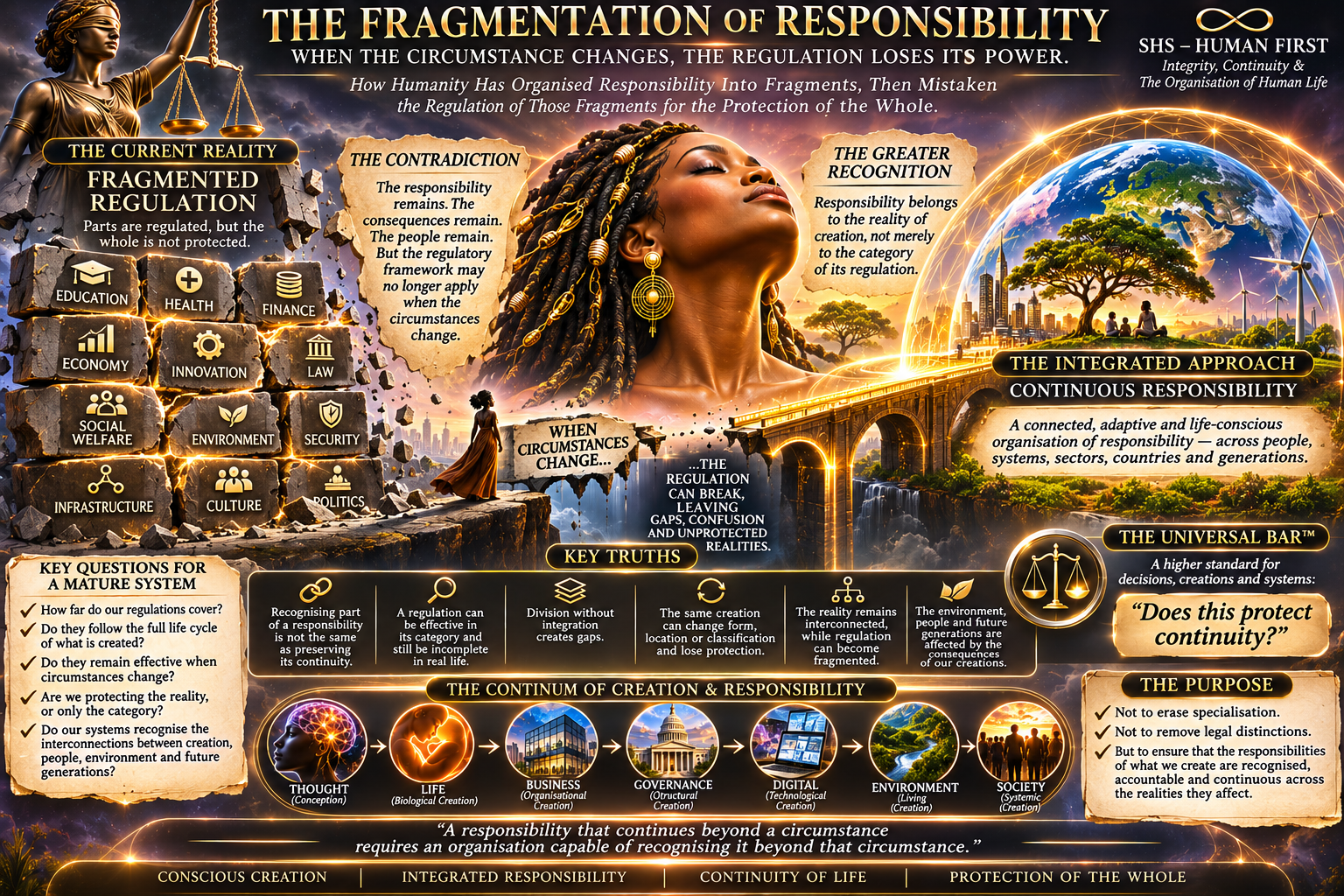
How Humanity Has Organised Responsibility Into Fragments, Then Mistaken the Regulation of Those Fragments for the Protection of the Whole.
SHS – HUMAN FIRST | Integrity, Continuity & The Organisation of Human Life
There is something profoundly revealing about the way humanity currently organises its responsibilities.
We have laws.
We have regulations.
We have departments.
We have institutions.
We have supervisory bodies.
We have regulatory authorities.
We have entire professions dedicated to ensuring compliance with particular standards.
And yet, despite the enormous amount of infrastructure devoted to organising responsibility, the moment a circumstance changes, we can find ourselves in a situation where the very same responsibility that was previously regulated is no longer adequately protected.
How fascinating.
The responsibility has not necessarily disappeared. The consequences have not necessarily disappeared. The human beings affected have not necessarily disappeared. But the regulatory framework through which the responsibility was recognised may no longer apply.
And what does that tell us?
It tells us that we have frequently organised responsibility around the circumstances in which it appears, rather than developing sufficiently continuous systems capable of recognising the responsibility across its different expressions.
That is a fundamental distinction.
And it is one of the reasons why I consider so much of the current organisation of society fragmented, incomplete and structurally unstable.
Because if the protection of a responsibility depends too heavily upon the circumstances in which it is encountered, then changing those circumstances can undermine the practical application of that protection.
The responsibility remains.
But the framework designed to recognise it may lose its footing.
And that is precisely the problem.
1. WE ARE REGULATING PARTS OF RESPONSIBILITY WHILE LOSING THE WHOLENESS OF RESPONSIBILITY.
Consider something.
We have existing regulations that recognise certain responsibilities associated with the creation of products, services, institutions, technologies and organisational practices.
And yes, that recognition matters.
But here is where the issue begins.
Recognising part of a responsibility is not the same as establishing the continuity of that responsibility.
A regulation may apply to a particular product.
Another may apply to a particular industry.
Another may apply to a particular type of employment relationship.
Another may apply to a specific territorial jurisdiction.
Another may apply only when an organisation reaches a particular size or satisfies a particular legal definition.
Now, what happens when the very same underlying activity, consequence or responsibility appears under circumstances that fall outside those definitions?
What happens when the organisation changes its structure?
What happens when the service changes its classification?
What happens when the activity crosses a territorial boundary?
What happens when the relationship between the parties is reorganised?
What happens when the creation itself evolves beyond the category for which the regulation was originally designed?
Does the underlying human need cease to exist?
Does the environmental consequence disappear?
Does the responsibility become irrelevant?
Or have we simply reached the boundary of the regulatory framework rather than the boundary of the responsibility itself?
That is the question.
Because when a responsibility is recognised only within a particular fragment of reality, we risk creating a situation in which its protection becomes conditional upon remaining within that fragment.
And the moment the reality extends beyond it, the regulatory framework may become incomplete.
Not because the responsibility has changed.
But because the system responsible for recognising it was never sufficiently organised to account for its wider existence.
2. THE CIRCUMSTANCE CHANGES. THE RESPONSIBILITY REMAINS. THE REGULATION MAY NOT FOLLOW.
Now, let us examine this more closely.
Imagine two people performing substantially similar work.
One is classified as an employee.
The other is classified as an independent contractor.
Depending on the jurisdiction and the true nature of their working relationships, different legal protections may apply.
But consider the underlying realities.
Both are human beings.
Both may depend upon their work for their livelihood.
Both may experience fatigue, workplace hazards, economic pressure or organisational dependence.
Both may contribute to the operations of the same wider industry.
Yet the legal classification of their working relationship can significantly alter the protections available to them.
And that distinction may be legally justified in certain respects.
But it also raises a much larger question.
Should the recognition of a fundamental human need become so dependent upon the classification of the relationship through which that need is encountered?
Or consider a company that creates a product with environmental consequences.
Its responsibilities may be governed by several different regulatory frameworks.
But when its activities cross borders, involve contractors, depend upon international supply chains or generate consequences beyond the jurisdiction in which a particular obligation is enforced, accountability becomes considerably more complicated.
The environment has not necessarily stopped experiencing the consequences.
The creation has not stopped existing.
But responsibility may become divided across institutions whose authority, information and enforcement powers do not extend equally across the entire chain.
And that is where fragmentation becomes particularly consequential.
The reality remains interconnected while the regulation becomes territorially, administratively or categorically divided.
We have created systems of responsibility that do not always follow the continuity of the realities they are supposed to protect.
3. A REGULATION CAN BE EFFECTIVE WITHIN ITS CATEGORY AND INCOMPLETE WITHIN LIFE.
This is something I believe deserves considerably greater attention.
A regulation may be functioning exactly as its designers intended.
Its requirements may be clear.
Its enforcement mechanisms may be established.
Its administrative processes may operate correctly.
And the organisations subject to it may be complying with its provisions.
But that does not automatically establish that the wider responsibility has been adequately addressed.
Why?
Because the regulation may have been designed to examine only one expression of the larger reality.
And that expression may be inseparable from conditions lying outside the regulation’s scope.
A system can be procedurally successful within its own boundaries while remaining substantively incomplete in relation to the wider reality it governs.
This is precisely the distinction between examining a fragment and examining the whole.
And it connects directly to what I have previously explained about thorough investigations.
An investigator may examine hundreds of documents and still fail to recognise an important reality because their investigation was organised around selected sources.
A regulator may supervise thousands of organisations and still fail to account for significant consequences because its mandate was organised around selected activities.
A government may establish extensive legislation and still leave responsibilities insufficiently protected because those responsibilities extend across several regulatory categories.
In each case, the issue is not necessarily the absence of activity.
It is the incompleteness of the field within which that activity takes place.
And when that field is mistaken for the whole, the limitations become embedded within the organisation itself.
4. WE HAVE CONFUSED THE ORGANISATION OF RESPONSIBILITY WITH THE DIVISION OF RESPONSIBILITY.
There is an enormous difference between organising something and simply dividing it.
Division can be useful.
It allows specialisation.
It allows different institutions to develop expertise.
It allows complicated matters to be examined through more manageable fields.
But division without sufficient integration can produce fragmentation.
And fragmentation becomes dangerous when each institution treats the limits of its authority as though they were also the limits of the responsibility.
Imagine a situation in which one department recognises a problem but considers it outside its jurisdiction.
Another department recognises a related consequence but lacks the authority to address its underlying cause.
A third department addresses one aspect of the issue but cannot act upon the conditions maintained by the others.
Each institution may correctly describe the boundaries of its own mandate.
Yet the problem remains.
Everybody has a defined responsibility, but nobody has been given sufficient responsibility for the relationship between them.
And what happens then?
The affected person is transferred between systems.
The underlying condition persists.
The administrative process continues.
The individual institutions may demonstrate compliance with their respective obligations.
But the larger responsibility remains inadequately fulfilled.
Is that what we should understand as successful organisation?
Or is it evidence that we have developed a division of responsibility without adequately preserving its continuity?
Because the purpose of organising responsibility should not simply be to determine which institution handles which fragment.
It should be to ensure that the responsibility remains recognisable and actionable throughout the full reality in which it exists.
5. THE MOMENT THE CATEGORY CHANGES, THE SYSTEM MAY STOP RECOGNISING WHAT IT PREVIOUSLY CLAIMED TO PROTECT.
And this is where the instability becomes particularly visible.
A person moves from one legal classification to another.
A service moves from one technological platform to another.
A company reorganises its corporate structure.
A product changes its classification.
An activity moves into another jurisdiction.
An institution develops a new operating model.
And suddenly the question becomes:
Does the existing regulation still apply?
Now, sometimes the answer is yes.
Some laws are specifically designed to address changes in form, substance, control or location.
But sometimes the answer is no.
Or the answer becomes uncertain.
Or the obligation remains legally relevant but becomes considerably harder to enforce.
Or responsibility becomes distributed among several parties without an effective mechanism for resolving the resulting gaps.
And that is the issue I am highlighting.
If changing the circumstances can remove, weaken or complicate the protection of an otherwise continuing responsibility, then the framework has exposed a limitation in its capacity to follow reality.
We should not confuse the disappearance of regulatory coverage with the disappearance of the conditions that originally justified protection.
A human being does not become less human because their employment classification changes.
Environmental consequences do not become irrelevant because an activity moves across a border.
And the quality of an organisational creation does not automatically improve because it has been moved into a different regulatory category.
Yet the structure of our regulations can sometimes create precisely these discontinuities in accountability.
Which raises an extraordinary question:
Are we protecting the reality, or are we protecting only the reality while it remains recognisable within our chosen definitions?
6. LIFE DOES NOT OPERATE THROUGH THE SAME FRAGMENTATION AS OUR REGULATORY DEPARTMENTS.
Now, this is where the metaphysical understanding of content creation becomes essential.
We previously established that content creation is not limited to digital platforms.
A business is an organisational creation within society.
A government creates administrative and legal conditions.
An educational institution creates developmental environments.
A healthcare institution creates conditions through which people experience treatment and care.
And human beings continuously create experiences, relationships, ideas and societal structures.
All of this occurs within the larger infrastructure of life upon Mother Earth.
Now, what is particularly important about these creations?
They do not necessarily confine their consequences to the regulatory categories through which humanity has chosen to classify them.
A technological creation can affect education.
Education can affect employment.
Employment can affect health.
Health can affect social welfare.
Social welfare can affect economic participation.
Economic activity can affect the environment.
Environmental conditions can affect human health.
And the consequences continue extending through the interconnected organisation of life.
But if the regulation examining the technological creation does not sufficiently account for its consequences across these other systems, what exactly has been regulated?
One expression of its reality.
Not necessarily the full extent of its existence.
This does not mean every regulator must personally govern every consequence.
It means the regulatory architecture as a whole must be capable of following relevant responsibilities across the systems within which those consequences emerge.
Because the creation itself does not stop participating in reality simply because it has crossed from one administrative category into another.
7. FRAGMENTATION CAN BECOME AN INFRASTRUCTURE FOR AVOIDING RESPONSIBILITY.
And here is another consequence we must examine.
When regulatory boundaries are fragmented, organisations may discover opportunities to arrange their activities in ways that reduce their obligations.
Sometimes the arrangements are legitimate responses to genuine differences between activities.
But sometimes legal classifications, corporate structures, jurisdictional differences or contractual arrangements can be used to minimise accountability without materially changing the consequences experienced by other people.
And that is precisely why examining only the formal appearance of an organisation can be insufficient.
We must also understand what the organisation actually does.
How it operates.
Who benefits.
Who carries the risks.
Who makes the decisions.
Where the consequences emerge.
And whether the responsibilities attached to its activities remain adequately protected throughout its operations.
The integrity of an obligation should not depend solely upon how cleverly the activity can be arranged to fall outside a particular regulatory definition.
Otherwise, we create an extraordinary contradiction.
An organisation may be able to satisfy the formal requirements of its regulatory position while still producing consequences that the wider system was supposedly designed to prevent.
And the more fragmented the regulatory landscape becomes, the more opportunities may exist for responsibility to become dispersed, obscured or disputed.
The issue is not that every legal distinction is illegitimate.
The issue is whether the distinctions collectively preserve the responsibility that justified the protection in the first place.
8. THE REAL TEST OF A REGULATORY SYSTEM IS WHAT HAPPENS WHEN THE CIRCUMSTANCES CHANGE.
This is where I would introduce a particularly important standard for SHS – Human First.
Do not evaluate the integrity of a regulatory framework only under the circumstances for which it was originally designed.
Evaluate what happens when those circumstances change.
When the technology evolves.
When the organisation restructures.
When the relationship changes.
When the activity crosses a border.
When multiple jurisdictions become involved.
When the consequences emerge years later.
When the affected person no longer fits the original classification.
When the responsible organisation ceases operating.
When a previously unforeseen dependency becomes visible.
What happens to the responsibility?
Who recognises it?
Who retains accountability?
Who has the authority to act?
How is continuity maintained?
How are the affected people protected?
And if the existing framework no longer applies, what other mechanisms ensure that the underlying responsibility is not simply abandoned?
That is how we begin stress-testing regulation against reality rather than merely against its own written conditions.
Because a framework that only functions coherently while circumstances remain exactly as anticipated has a limitation in its resilience.
A mature regulatory organisation must be capable of recognising change without repeatedly losing sight of the fundamental interests it exists to protect.
9. THE UNIVERSAL BAR™: FROM FRAGMENTED COMPLIANCE TO CONTINUOUS RESPONSIBILITY.
This brings us directly to the SHS – Human First Universal Bar™.
Within SHS, the Universal Bar is an internal standard for examining decisions, creations and organisations across twelve interconnected systems of human life.
Its central question is:
Does this protect continuity?
Now, consider the significance of applying that question to regulation.
Not simply:
Is this organisation complying with the applicable rule?
But also:
Does the entire arrangement preserve the responsibility that the rule is intended to protect?
If a company changes its structure, does the underlying responsibility remain accounted for?
If a service changes its delivery model, does the protection remain effective?
If an activity crosses jurisdictions, is there a coherent mechanism for recognising its consequences?
If a decision produces effects across education, health, finance, environment and social welfare, is there an integrated understanding of those effects?
If a regulatory framework protects the individual within one category, what happens when that individual moves into another?
And if the original protection no longer applies, is the resulting gap justified by a meaningful difference in circumstances, or merely produced by the boundaries of the regulatory design?
These are different questions from those ordinarily answered by a compliance checklist.
They examine the continuity of the underlying purpose.
The objective is not to erase specialisation. It is to prevent specialisation from becoming an excuse for losing the whole.
Each system can retain its expertise.
Each institution can retain its appropriate authority.
Each legal framework can retain necessary distinctions.
But the organisation must also possess mechanisms capable of recognising responsibilities that extend across their boundaries.
Because integration does not require everything to become identical.
It requires the relationships between different things to be sufficiently understood and organised.
10. WE MUST STOP MISTAKING REGULATORY COVERAGE FOR REGULATORY COMPLETENESS.
And this is the greater recognition.
Humanity has created an enormous regulatory infrastructure.
But the existence of that infrastructure does not automatically establish that the realities it governs are comprehensively protected.
A country can have environmental regulations while still experiencing environmental degradation.
A society can have employment protections while still leaving certain workers inadequately protected.
An economy can have consumer regulations while still producing harmful or misleading commercial practices.
A government can have departmental accountability while still struggling with responsibilities that cross departmental boundaries.
And an institution can maintain formal compliance while failing to recognise important consequences of its own operations.
The presence of regulation does not, by itself, establish the completeness of responsibility.
The question is whether the regulation is sufficiently comprehensive, coherent, adaptable and enforceable in relation to the reality it is supposed to protect.
And this cannot be answered solely by counting laws.
Or departments.
Or regulatory authorities.
Or compliance reports.
It requires examining the relationships between them.
Because ten separate protections do not necessarily constitute one continuous protection.
Not if the spaces between them leave the underlying responsibility exposed.
THE GREATER METAPHYSICAL RECOGNITION: RESPONSIBILITY BELONGS TO THE REALITY OF CREATION, NOT MERELY TO THE CATEGORY OF ITS REGULATION.
And now we return to the beginning.
If content creation extends beyond technology, and humanity is continuously creating within the infrastructure of life, then our understanding of responsibility must become equally capable of recognising the wider consequences of those creations.
A creation does not stop being a creation when its platform changes.
Its consequences do not necessarily disappear when its ownership changes.
Its dependence upon nature does not cease when it crosses a national border.
And the human needs affected by its existence do not automatically disappear when their circumstances change.
So why should the organisation of responsibility repeatedly lose continuity precisely where the reality of creation continues?
That is the contradiction I am examining.
We have organised responsibilities into categories.
Then organised authorities around those categories.
Then developed procedures to determine whether something belongs to one category or another.
And somewhere within that process, we risk becoming more concerned with determining which category a responsibility belongs to than with ensuring that the responsibility itself is adequately fulfilled.
That is how the organisation of responsibility can begin undermining the purpose of responsibility.
And that is why I argue for a more integrated understanding.
Not a world without legal distinctions.
Not a world where every circumstance is treated identically.
Not a world where regulation becomes unlimited control.
But a world in which the fundamental responsibilities associated with creating, operating and affecting life remain recognisable across the different circumstances through which those responsibilities emerge.
A world where legal distinctions are examined against the actual conditions they are supposed to protect.
A world where institutions understand their relationships with other institutions.
A world where the consequences of creation are not treated as someone else’s problem simply because they have crossed an administrative boundary.
And a world where the responsibility for protecting the infrastructure of life is not lost in the fragmentation of the systems humanity has created upon it.
Because regulation should not be so dependent upon the original circumstances that it loses its practical protective power the moment reality takes another form.
The conditions may change.
The technology may change.
The organisation may change.
The classification may change.
The jurisdiction may change.
But when the underlying responsibility continues, our systems must be capable of recognising that continuity and determining how protection should follow.
Otherwise, what have we actually organised?
Responsibility?
Or merely the administrative circumstances under which we are willing to acknowledge it?
And that is the question I would put before the entirety of our existing societal organisation.
IF YOUR REGULATION ONLY RECOGNISES RESPONSIBILITY WHILE REALITY REMAINS WITHIN YOUR CHOSEN CATEGORY, HAVE YOU PROTECTED THE RESPONSIBILITY, OR HAVE YOU SIMPLY REGULATED THE CATEGORY?
Because life does not cease to exist beyond the boundaries of our definitions.
And the organisation of human life must become mature enough to recognise the difference.
SHS – HUMAN FIRST
The Womb of The Unknown Need.
Integrity Across Systems. Responsibility Across Circumstances. Continuity Across Life.
The greatest weakness of fragmented regulation is not necessarily what each individual rule fails to protect. It is what the entire organisation can fail to protect when responsibility exists between the rules.
A RESPONSIBILITY THAT CONTINUES BEYOND A CIRCUMSTANCE REQUIRES AN ORGANISATION CAPABLE OF RECOGNISING IT BEYOND THAT CIRCUMSTANCE.
…
And so we went over a piece on priorities because when someone knows exactly their priorities, they know exactly what they’re looking for, they know exactly what point of completion would be. I don’t need to do anything now. If anything, it’d be reckless to what I’m actually trying to accomplish, to enact any legal case at this current moment in time. Even no matter how much evidence I already have. Because, because the case is so much larger. And this is looking at long term, not long term. This is having a long game perspective, which is something that is attached to critical thinking. And because critical thinking is something that’s of a detriment these current days and age. It’s understandable that people wouldn’t necessarily understand the game that I’m playing because I’m not playing a game. I’m actually doing this for life, for humanity’s life and for the state of the organization of life on Earth. And I want this post to be about, all about priorities because when people don’t know what their actually prioritizing, they don’t know what they’re looking at, they don’t know how to actually understand other people’s priorities. And especially if they don’t have the practice of prioritizing things themselves, things that make sense to a larger perspective than themselves, they don’t actually understand nor are able to perceive someone that prioritizes things that are larger than them. Whether it’s time or circumstances. And this links to what we’re saying yesterday about even the thread of exclusion. Like once you practice one thing and you master one thing and you know all of its extensions, you know what and how other people behave or their intentions by looking at the exclusion of everything that one thing is. For example, if I look at the whole alphabet and we were all the whole alphabet and I’m S, I know for a fact that B is not S. Why? Because B is not S. The, what makes S S is S. And what makes B B is B. With that same logic, what makes one good at prioritizing things and matters outside of themselves is, let’s say A, someone that doesn’t prioritize things larger than themselves is M. And by exclusion, if I master A, by exclusion I know for a fact that M does not prioritize things that are larger than themselves. It’s really that simple
….
And now write the piece about how the fact that, how things are organized right now. They are so fragmented, incomplete and unstable because, because the moment the circumstance differs, the whole case drops. And in the, and when we look at, for example, the fact that there is existing regulations that recognize parts of this responsibility because it’s only parts of the responsibility, it actually loses the footing of the wholeness of the responsibilities because again, like I said, the moment that responsibility that is regulated is connected to a circumstance that isn’t regulated, the very same thing that would have been regulated loses regulation. It loses actual application power



Leave a Reply