
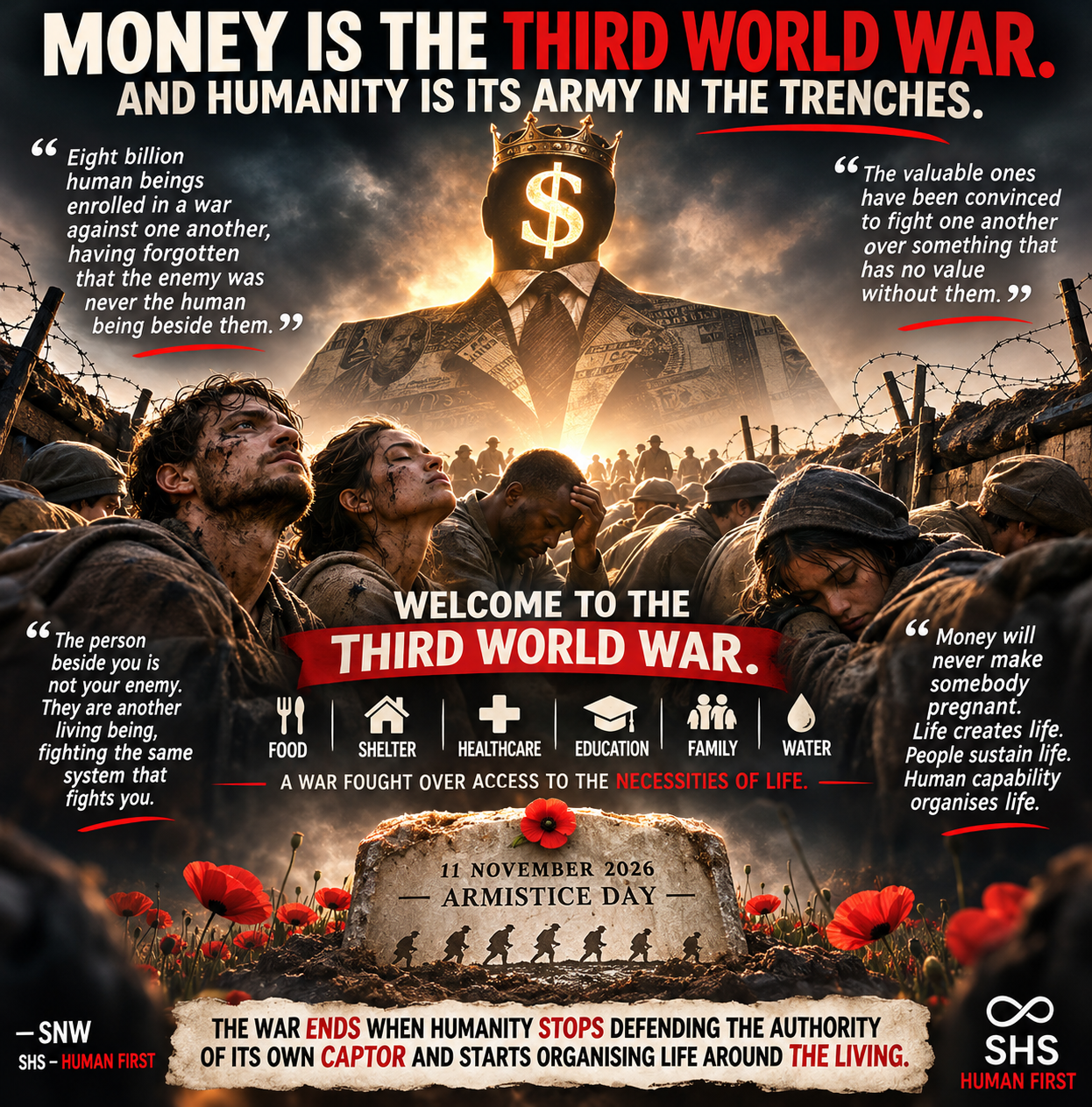
We brought the trenches home these days. There’s no here and there. Our letters are invoices, emails and receiots. Even 9/11 wouldn’t have happen without money..
EIGHT BILLION HUMAN BEINGS ENROLLED IN A WAR AGAINST ONE ANOTHER, HAVING FORGOTTEN THAT THE ENEMY WAS NEVER THE HUMAN BEING BESIDE THEM.
— SNW | SHS – HUMAN FIRST
11 November 2026 — Armistice Day
Oh, humanity.
Look at us.
Eight billion human beings.
Born into the same world.
Breathing the same atmosphere.
Dependent on the same Earth.
Possessing bodies made of the same fundamental biological materials.
And somehow, extraordinarily, we have managed to organise ourselves into an army fighting over permission to access the very existence we were born into.
WELCOME TO THE THIRD WORLD WAR.
There are no recruitment offices.
No compulsory military uniforms.
No official declaration of hostilities.
No particular age at which you receive your enlistment letter.
Your birth certificate will do.
Congratulations.
You’ve been enrolled.
And before you’ve even learned how to speak, somebody has already begun calculating how much your existence is going to cost.
Food.
Clothing.
Shelter.
Education.
Healthcare.
Childcare.
Transportation.
Apparently, you have arrived on Earth with a financial liability attached to your existence.
WHAT A BEAUTIFUL WELCOME TO LIFE.
You haven’t even developed your first complete sentence, and the world is already discussing whether somebody can afford you.
And the most extraordinary part?
The enemy has convinced every soldier that the person standing in the trench beside them is the competition.
Not the instrument determining whether either of them gets to eat.
Not the arrangement that makes survival conditional upon purchasing power.
No.
The other human being.
The one who can also feel hunger.
The one who can also experience pain.
The one whose lungs also require oxygen.
The one whose body also needs nourishment.
THE VALUABLE ONES HAVE BEEN CONVINCED TO FIGHT ONE ANOTHER OVER SOMETHING THAT HAS NO VALUE WITHOUT THEM.
How spectacularly ridiculous.
1. EVERYBODY IS ENROLLED. NOBODY REMEMBERS SIGNING UP.
Let’s examine the recruitment process.
You are born.
You grow.
You begin learning how the world works.
And somewhere along the way, you discover that you are expected to spend a considerable proportion of your lifetime acquiring money.
Why?
Because everybody else does.
Because your parents did.
Because your grandparents did.
Because society operates that way.
Because you need to be responsible.
Because you need to survive.
And so you enter the trenches.
Your first job.
Your first salary.
Your first debt.
Your first rent payment.
Your first experience of wondering whether there will be enough left at the end of the month.
And gradually, the war becomes your understanding of normal life.
You wake up for it.
You travel for it.
You study for it.
You sacrifice time for it.
You build relationships around it.
You make decisions about your body, your family, your future and your possibilities according to how much of it you can obtain.
THE WAR HAS BECOME SO NORMAL THAT HUMANITY CALLS PARTICIPATION MATURITY.
A child says they want to become an artist.
What does society ask?
Can you make money from it?
A child says they want to help people.
Can you make a career out of it?
A child says they want to investigate the world.
Will it pay?
A child says they want to have a family.
Can you afford one?
Notice how quickly the human possibility is translated into a financial question.
The child has barely begun investigating their own capabilities, and already society is teaching them that those capabilities matter most when somebody is prepared to pay for them.
THE FIRST CASUALTY IS NOT ALWAYS THE BODY. SOMETIMES IT IS THE HUMAN BEING’S UNDERSTANDING OF THEIR OWN VALUE.
And the war has barely begun.
2. THE PERSON BESIDE YOU IS NOT YOUR ENEMY.
Imagine two soldiers in neighbouring trenches.
Both hungry.
Both exhausted.
Both frightened.
Both wanting to return home.
But somebody has convinced them that the other soldier is the reason they cannot have peace.
So they fight.
One wins.
The other loses.
And the people who organised the conflict congratulate the winner.
Now look at the economy.
Two people applying for one job.
Two families competing for one affordable home.
Two businesses struggling to survive.
Two patients waiting for treatment.
Two parents trying to provide for their children.
And suddenly, the language begins.
Competition.
Winners.
Losers.
Market advantage.
Economic value.
Productivity.
Financial eligibility.
HUMANITY HAS BEEN TAUGHT TO VIEW ANOTHER HUMAN BEING’S SUCCESS AS A POSSIBLE THREAT TO ITS OWN SURVIVAL.
But what exactly have we forgotten?
The person competing with you for employment also needs to eat.
The person bidding against you for housing also needs somewhere to sleep.
The person earning more than you is not automatically more human.
The person earning less than you is not automatically less capable.
And the person who has no money has not ceased to possess human value.
Yet we behave as though somebody’s financial position establishes their rightful place within existence.
WE ARE NOT FIGHTING THE ORIGINAL PROBLEM. WE ARE FIGHTING ONE ANOTHER FOR BETTER POSITIONS INSIDE IT.
And money?
Money gets to remain the referee.
The scoreboard.
The prize.
And the condition of participation.
What an extraordinary arrangement.
The soldiers are fighting.
The instrument is being protected.
3. MONEY DOESN’T HAVE TO KILL YOU. IT CAN CONVINCE ANOTHER HUMAN BEING TO DO THE WORK.
This is perhaps the most disturbing aspect of the metaphorical battlefield.
Money has no hands.
No legs.
No consciousness.
No heartbeat.
No capacity to experience malice.
It cannot physically attack a single human being.
But the structures organised around it can give one person authority over another person’s access to life’s necessities.
A landlord can decide whether a tenant remains housed.
An employer can determine whether somebody continues receiving an income.
A lender can enforce repayment terms.
A company can withhold a necessary service because payment has not been made.
A government can determine financial eligibility for support.
And all of those decisions can be justified through the language of economic responsibility.
MONEY DOESN’T NEED TO ENTER THE TRENCHES. HUMANITY HAS AGREED TO ENFORCE ITS RULES FROM INSIDE THEM.
And people may do so even when they recognise the harm.
Because they also have bills to pay.
Families to feed.
Jobs to preserve.
Mortgages to maintain.
Financial obligations to fulfil.
The very people enforcing the arrangements may themselves depend on the same arrangements for survival.
What a remarkable chain of dependency.
One person fears losing their financial security.
So they enforce conditions that threaten another person’s financial security.
That person then becomes desperate to protect their own position.
And somewhere further along the chain, the same process repeats.
THE SYSTEM HAS LEARNED TO USE ONE HUMAN BEING’S FEAR OF DEPRIVATION TO MAINTAIN ANOTHER HUMAN BEING’S DEPRIVATION.
And everybody calls it doing their job.
But what about the job of being human?
Who is responsible for that?
4. WE FORGOT THAT VALUE BEGAN WITH LIFE.
Here is the part that should make everybody feel just a little embarrassed.
Money did not create the valuable things we fight over.
It did not create the Earth.
It did not create water.
It did not create the sun.
It did not create the human body.
It did not create the human mind.
It did not create our capacity to investigate, understand, imagine or build.
Money does not plant a seed.
A human being can.
Money does not construct a house.
Human beings do.
Money does not develop medicine.
Human minds do.
Money does not raise a child.
Human beings do.
Money does not experience love.
Human beings do.
And money most certainly cannot make somebody pregnant.
Not literally.
I HAVE NEVER SEEN A BANKNOTE FERTILISE AN EGG.
Have you?
Have you ever witnessed a coin conceive a child?
Have you ever seen a bank account develop a womb?
Has a credit card ever experienced labour?
Has a stock market ever given birth?
No?
How fascinating.
And yet we have developed a civilisation in which people routinely question whether they can afford to bring another human being into the world.
THE THING THAT CANNOT CREATE LIFE HAS BEEN GIVEN AUTHORITY OVER WHETHER PEOPLE FEEL ABLE TO CREATE AND SUSTAIN LIFE.
Of course, responsible parenthood requires resources, care, time and a safe environment.
But those are actual human and material necessities.
Money is an intermediary we have placed between those necessities and the people who need them.
And we have become so accustomed to that intermediary that we confuse the possession of money with the possession of the ability to care.
As though love comes from a bank.
As though competence comes from a salary.
As though a human being becomes worthy of parenthood by demonstrating sufficient purchasing power.
Money may facilitate access to resources within our current arrangements.
But it did not create the biological capacity for life.
It did not invent human care.
And it certainly did not create the original value of the child.
LIFE CREATES LIFE. LIFE SUSTAINS LIFE. HUMAN CAPABILITY ORGANISES LIFE.
Money is not the original technology.
We are.
5. THE TRENCHES ARE INSIDE OUR MINDS.
What makes this war so extraordinary is that the battlefield follows you everywhere.
You can leave your workplace.
But the financial anxiety follows you home.
You can go on holiday.
But you may spend the entire trip wondering whether you can afford to enjoy it.
You can lie beside someone you love.
And still be thinking about tomorrow’s bills.
You can hold your newborn child.
And immediately begin calculating the cost of their future.
You can experience a beautiful moment.
And have part of your mind occupied by how much it is costing.
MONEY HAS OCCUPIED THE VERY SPACE IN WHICH HUMANITY SHOULD BE EXPERIENCING ITS OWN EXISTENCE.
And the invasion is so familiar that we barely recognise it.
We call it being realistic.
Being prepared.
Being responsible.
Being an adult.
But what happens when responsibility becomes indistinguishable from constant fear?
When the human mind has been trained to anticipate financial loss more readily than it anticipates the possibility of living well?
When people are so concerned about having enough money to enjoy life that they spend most of their lives not enjoying it?
Oh, money.
You magnificent little psychological explosive.
You don’t even need to detonate.
You can simply threaten to.
And humanity will spend decades preparing for the possibility.
THE TICKING BOMB IS NOT ALWAYS IN YOUR BANK ACCOUNT. SOMETIMES IT IS IN THE PART OF YOUR MIND THAT NEVER FEELS SAFE ENOUGH TO STOP COUNTING.
6. THE WAR MEDALS ARE MADE OF THE SAME THING THAT KEEPS THE WAR GOING.
And now, the winners.
Oh, how we celebrate the winners.
The billionaires.
The millionaires.
The most profitable companies.
The highest earners.
The most valuable brands.
The most influential investors.
The people who successfully conquered the financial battlefield.
We give them recognition.
We study their strategies.
We admire their discipline.
We reproduce their methods.
We ask them how they did it.
And sometimes, we allow their financial accomplishments to become evidence of their qualification to direct human affairs.
CONGRATULATIONS. YOU HAVE WON AN EXTRAORDINARY AMOUNT OF THE VERY THING WE ARE QUESTIONING.
But what have you actually accomplished for life?
Did your success make food more accessible?
Did it reduce unnecessary suffering?
Did it preserve families?
Did it improve the quality of human relationships?
Did it help people become less dependent on financial permission?
Did it create conditions in which future generations can live with greater security?
Or did it primarily demonstrate your ability to accumulate resources within a system that continues leaving other people deprived?
Because those are different achievements.
One measures success within the financial battlefield.
The other measures success in preserving and developing human existence.
A MEDAL FOR WINNING THE WAR DOES NOT AUTOMATICALLY MEAN YOU HELPED END IT.
And I am considerably more interested in those who are prepared to end unnecessary suffering than those who have merely become excellent at surviving or profiting from it.
7. TRAUMA CAN TURN SOLDIERS INTO COMMANDERS WITHOUT ENDING THE WAR.
Consider the person who has experienced deprivation.
The person who grew up feeling powerless.
The person who was humiliated.
Rejected.
Excluded.
Made to feel insignificant.
Money can appear to offer something extraordinary.
Protection.
Recognition.
Revenge.
Control.
The opportunity to prove that they will never be treated as lesser again.
And so they begin accumulating.
Not necessarily because they understand what their existence requires.
But because they fear ever returning to the conditions they escaped.
And sometimes, the person who once suffered becomes exceptionally skilled at operating the very arrangements through which others suffer.
WHAT IS THE POINT OF ESCAPING THE TRENCHES IF YOUR GREATEST AMBITION IS TO BECOME THE PERSON WHO SENDS OTHERS INTO THEM?
That is not healing.
That is changing your position within the conflict.
There is nothing wrong with wanting safety.
Nothing wrong with protecting your family.
Nothing wrong with developing the means to live without fear.
But becoming financially powerful does not automatically mean you have overcome the emotional consequences of having once been powerless.
And making someone else vulnerable does not establish your own worth.
“I AM NOT A VICTIM” DOES NOT COME FROM CREATING ANOTHER VICTIM.
It comes from recognising that what happened to you never eliminated your original value.
Money cannot purchase that recognition.
It can only offer external demonstrations of power.
And those demonstrations are not substitutes for knowing who you are.
8. WE HAVE BEEN FIGHTING FOR THE RIGHT TO SURVIVE INSTEAD OF ORGANISING THE MEANS TO LIVE.
Imagine what eight billion human beings could accomplish if their primary organisational objective were not to secure enough purchasing power to remain alive.
Imagine the same minds.
The same hands.
The same scientific discoveries.
The same agricultural knowledge.
The same technological capabilities.
The same creative intelligence.
The same capacity for cooperation.
But directed toward meeting human necessities before competing for financial advantage.
What happens to the strategist?
They strategise.
What happens to the engineer?
They engineer.
What happens to the doctor?
They practise medicine.
What happens to the teacher?
They educate.
What happens to the artist?
They create.
What happens to the farmer?
They cultivate.
And what happens to the person still discovering their capabilities?
They receive the space, support and opportunities to develop them.
EIGHT BILLION PEOPLE DO NOT BECOME USELESS BECAUSE WE REMOVE THE FINANCIAL CONDITION FROM THEIR RIGHT TO EXIST.
They remain human.
They remain capable of learning.
They remain capable of contributing.
They remain capable of developing skills and understanding.
Of course, organisation would still be necessary.
Resources would still be finite in particular places and circumstances.
Some tasks would remain difficult.
Some work would still require sacrifice.
Differences in ability, responsibility and knowledge would continue to exist.
But none of that requires treating a person’s basic worth as proportional to their financial position.
WE CAN ORGANISE DIFFERENT CONTRIBUTIONS WITHOUT ORGANISING DIFFERENT LEVELS OF HUMAN DIGNITY.
And perhaps that is what money is most frightened of, metaphorically speaking.
The possibility that humanity might discover it can coordinate itself without relying upon the threat of deprivation as its primary motivation.
9. THE ORIGINAL TECHNOLOGY WAS NEVER MONEY.
Let me remind you of something.
Before money, human beings had minds.
They had bodies.
They had hands.
They had relationships.
They had the capacity to learn from their surroundings.
They could observe the movement of the sun.
Understand seasons.
Develop tools.
Share knowledge.
Organise themselves.
Protect one another.
Create.
Human society certainly existed with conflict, inequality and scarcity long before modern money, and abandoning money alone would not magically eliminate those problems.
But the capacity to confront them did not originate from money either.
THE ORIGINAL TECHNOLOGY WAS THE HUMAN SELF.
Everything else was developed through that original capacity.
Money did not invent human intelligence.
Human intelligence invented money.
Money did not invent human cooperation.
Human cooperation made money usable.
Money did not invent life.
Life produced the beings who gave money meaning.
And yet here we are.
Eight billion human beings treating the instrument as though it were more valuable than the original creators.
THE SOLDIERS HAVE FORGOTTEN THAT THE WEAPON THEY ARE DEFENDING WAS MADE BY THE VERY PEOPLE IT NOW GOVERNS.
And when somebody questions the weapon, the soldiers rush to its defence.
You cannot remove money!
How will people survive?
How will society function?
How will we organise resources?
How will people be motivated?
As though the same minds that developed global financial systems are incapable of developing alternative systems of coordination.
As though human creativity ends where financial dependency begins.
ARE WE REALLY THAT FRIGHTENED OF OUR OWN INTELLIGENCE?
Or have we simply become so comfortable with inherited structures that investigating alternatives feels more dangerous than continuing to experience their consequences?
10. WE ARE DEFENDING THE VERY THING THAT KEEPS US IN THE TRENCHES.
And perhaps this is the greatest tragedy.
The soldier who has spent their entire life fighting may begin to believe that fighting is what gives their life meaning.
The worker who has spent decades struggling to survive may become suspicious of the idea that survival could be made less difficult.
The wealthy person who has accumulated extraordinary resources may fear that removing financial hierarchies would eliminate the recognition through which they understand themselves.
The poor person may fear that questioning money threatens the only instrument through which they currently obtain necessities.
And the institutions built around money may fear losing their authority.
Everybody has something to lose within the existing arrangement.
But what about what humanity stands to gain beyond it?
WE HAVE BECOME SO ACCUSTOMED TO DEFENDING OUR POSITIONS INSIDE THE TRENCHES THAT WE HAVE FORGOTTEN TO QUESTION WHY THE TRENCHES ARE STILL THERE.
Some people are fighting to become richer.
Some are fighting to avoid becoming poorer.
Some are fighting to retain what they inherited.
Some are fighting to obtain what was denied to them.
Some are fighting simply to survive another day.
Different positions.
Different resources.
Different experiences.
But the same fundamental dependence on an instrument humanity created.
And while we fight one another over our relative positions, the arrangement continues.
THE PEOPLE ARE THE VALUABLE ONES.
Not the money.
Not the rankings.
Not the market valuation.
Not the accumulated titles.
Not the number of properties somebody owns.
Not the financial prestige attached to their surname.
The living human beings.
The ones capable of experiencing existence.
The ones capable of creating and sustaining one another.
The ones whose collective activities give money any usefulness in the first place.
How extraordinary that we have forgotten.
11. THE WAR DOES NOT END WHEN A DIFFERENT SOLDIER BECOMES THE GENERAL.
Now here is where I want humanity to pay particular attention.
I am not proposing that we simply replace one set of wealthy people with another.
I am not proposing that we redistribute financial power so that a different group gets to enjoy the privileges of controlling access.
I am not proposing that everybody becomes equally dependent upon a newly appointed authority.
Because what would that accomplish?
YOU WOULD HAVE CHANGED THE COMMANDER WITHOUT ENDING THE WAR.
The same instrument.
The same dependency.
The same artificial condition imposed upon access to life’s necessities.
Only different people administering it.
Congratulations.
You’ve changed uniforms.
The trenches remain.
The objective must go further.
We must examine how human needs can be met through the coordinated application of available resources and capabilities, without making possession of money the ultimate condition of access.
That requires developing practical arrangements for production, distribution, stewardship, accountability and continuity.
It requires protecting people through the transition rather than abruptly exposing them to deprivation.
And it requires acknowledging that no system, monetary or otherwise, is automatically immune to corruption, exclusion or abuse.
THE GOAL IS NOT TO WIN CONTROL OF THE WEAPON.
IT IS TO DEVELOP A WORLD THAT NO LONGER NEEDS THAT WEAPON POINTED AT HUMAN SURVIVAL.
That is a very different ambition.
And it requires a different kind of leadership.
Not leadership based exclusively on accumulation.
But leadership capable of examining the consequences of the systems it inherits.
Of recognising dependencies before they become disasters.
Of understanding that human existence is not an economic achievement.
It is the foundation upon which every economic activity became possible.
12. HUMANITY, PUT DOWN YOUR WEAPONS. THE PERSON NEXT TO YOU IS ALIVE TOO.
So here we are.
11 November 2026.
Remembering an armistice.
Remembering the soldiers who endured the trenches of the First World War.
Remembering the human cost of conflicts in which people were sent to fight other people.
And I cannot help wondering what future generations will think when they examine how we organised ourselves.
Eight billion human beings.
All requiring nourishment.
All requiring some form of shelter.
All possessing bodies subject to pain, illness, ageing and death.
All capable, in different ways, of understanding, learning, feeling and contributing.
And yet spending so much of their existence fighting one another for access to the things required to sustain existence.
MONEY IS THE THIRD WORLD WAR.
The war in which humanity is both the army and the casualty.
The war in which the battlefield reaches into our minds and emotions.
The war in which the instrument possesses no life, yet exercises enormous influence over the lives of those who created it.
The war in which the soldiers become so occupied fighting for resources that they forget their collective capacity to produce, preserve and organise those resources.
The war in which winning often means acquiring enough financial protection to stop experiencing the insecurity others continue to endure.
And the war in which humanity has been persuaded that the human being standing beside us is the competition.
BUT THE PERSON BESIDE YOU IS NOT YOUR ENEMY.
They are another living being.
Another consciousness.
Another body.
Another set of capabilities.
Another life capable of contributing to the world you both inhabit.
And neither of you was created by money.
Neither of you is sustained biologically by banknotes.
Neither of you can replace food with a financial statement.
Neither of you can breathe a coin.
And neither of you can be brought into existence by money alone.
MONEY WILL NEVER MAKE SOMEBODY PREGNANT.
Not literally.
It cannot produce the egg.
It cannot produce the sperm.
It cannot create a womb.
It cannot experience gestation.
It cannot give birth.
Human biology makes reproduction possible, and human care helps sustain the new life that follows.
Money can influence the conditions under which that life is supported in our present society.
But it is not the source of life.
HOW DID WE ALLOW SOMETHING INCAPABLE OF CREATING LIFE TO BECOME THE AUTHORITY DETERMINING WHO CAN AFFORD TO SUSTAIN IT?
That is the question I want humanity to remember.
And here is another.
If the world contains billions of human beings capable of contributing to one another’s existence, why have we allowed an artificial instrument to convince us that our greatest threat is one another?
We don’t need another generation of soldiers competing for safer positions inside the same trenches.
We need to begin examining whether those trenches are necessary at all.
We need to recognise the original value of the living.
We need to organise human capabilities around human needs.
And we need to stop confusing the possession of money with the possession of human worth.
Because the day humanity finally begins treating one another as the valuable ones, something extraordinary becomes possible.
The soldier beside you becomes a collaborator.
The competition becomes a potential contributor.
The excluded become people whose capacities society has failed to develop or accommodate.
And the struggle for individual financial survival can begin giving way to the collective organisation of human sustenance.
THE WAR ENDS NOT WHEN EVERY HUMAN BEING HAS WON ENOUGH MONEY, BUT WHEN MONEY NO LONGER DETERMINES WHICH HUMAN BEINGS ARE PERMITTED TO LIVE WITH DIGNITY.
So, humanity.
Look at the person standing beside you.
Look at their hands.
Their eyes.
Their breathing chest.
Their capacity to think.
Their ability to experience the world.
Then look at a banknote.
And tell me.
WHICH ONE IS ACTUALLY VALUABLE?
Because one can produce life.
And the other cannot even experience it.
One can understand love.
And the other cannot feel it.
One can develop knowledge, create solutions, care for others and participate in the continuity of existence.
And the other requires human recognition to possess any monetary meaning whatsoever.
YOU HAVE BEEN FIGHTING THE WRONG ENEMY.
And worse.
You have been defending the instrument that convinced you to do it.
Money sucks.
Don’t you dare suck too.
You are human.
You are alive.
And the person beside you is alive too.
PUT DOWN THE WEAPON.
GET OUT OF THE TRENCHES.
THE VALUABLE ONES WERE ALWAYS US.
— SNW
Founder & Chief Continuity Architect
SHS – HUMAN FIRST
The Womb of The Unknown Need
11 November 2026 — Armistice Day
THE THIRD WORLD WAR: A HUMANITY FIGHTING ITSELF TO PROTECT AN INSTRUMENT THAT CANNOT EXIST AS MONEY WITHOUT HUMANITY.


Leave a Reply