
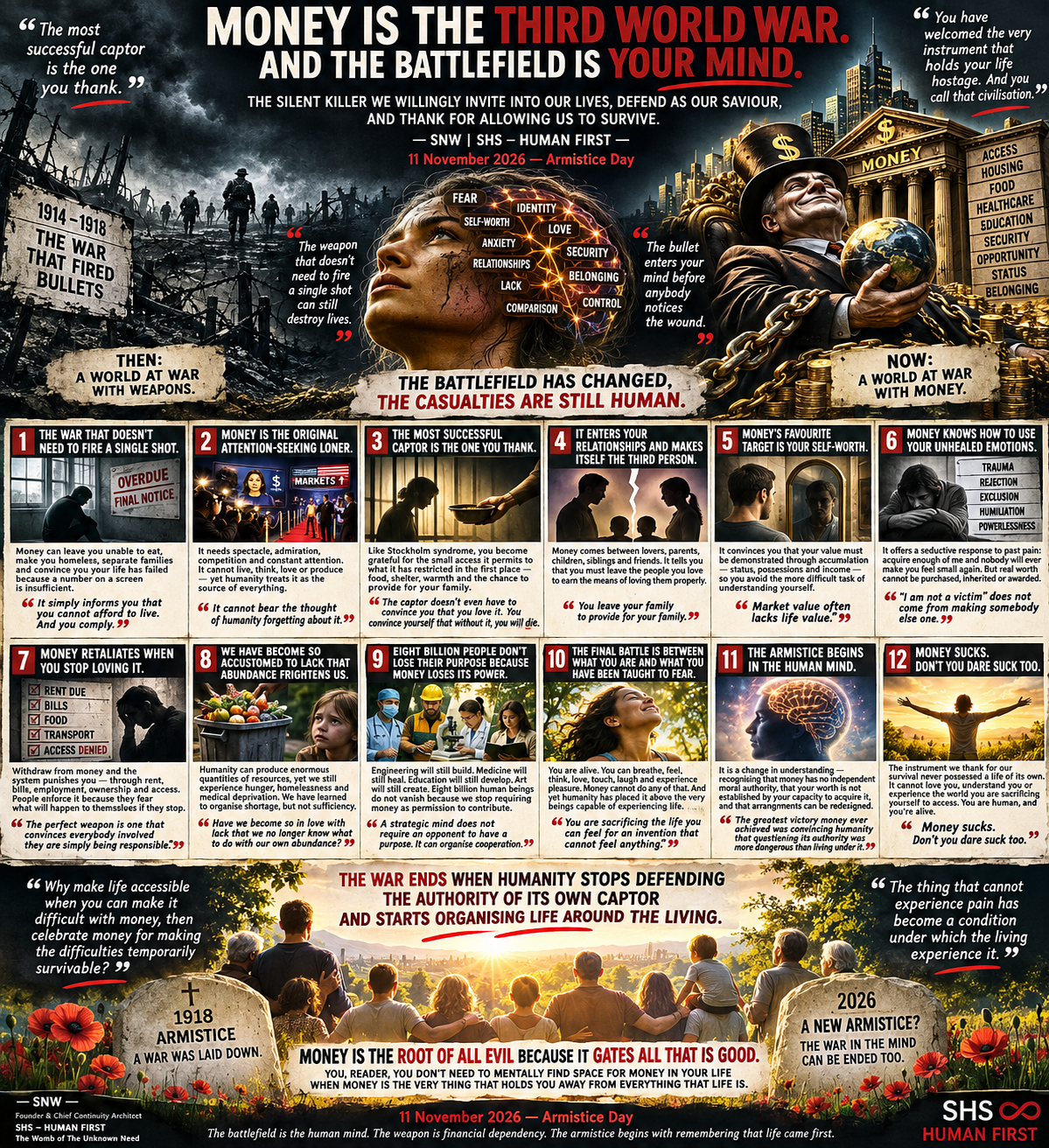
THE SILENT KILLER WE WILLINGLY INVITE INTO OUR LIVES, DEFEND AS OUR SAVIOUR, AND THANK FOR ALLOWING US TO SURVIVE.
— SNW | SHS – HUMAN FIRST
11 November 2026 — Armistice Day
Oh, money.
You extraordinary little bastard.
The most celebrated explosive humanity has ever created.
A ticking bomb.
You never quite know where it’s going to detonate.
In abundance for one.
In destruction for another.
And occasionally, rather impressively, both at the same time.
But what makes you particularly fascinating is not simply your capacity to destroy.
It is your ability to convince the very people experiencing your destruction to protect you.
To defend you.
To admire you.
To worship you.
To fall in love with you.
And, most extraordinarily, to feel grateful whenever you permit them access to the necessities you have spent centuries standing between them and.
MONEY IS THE THIRD WORLD WAR.
Only this time, the battlefield is not necessarily a country.
It is your mind.
Your emotions.
Your relationships.
Your sense of worth.
Your understanding of what it means to be alive.
And the most fascinating part?
THE PERPETRATOR DOESN’T EVEN HAVE TO BREAK INTO YOUR HOME.
You open the door.
You invite it inside.
You give it somewhere comfortable to sit.
You introduce it to your children.
You organise your family around it.
You allow it to determine the conditions of your relationships.
And then you spend the rest of your life protecting it from anybody who suggests that perhaps it shouldn’t have been invited in the first place.
HOW TERRIBLY CONSIDERATE OF YOU.
You have welcomed the very instrument that holds your life hostage.
And you call that civilisation.
1. THE WAR THAT DOESN’T NEED TO FIRE A SINGLE SHOT.
On 11 November 1918, the fighting on the Western Front of the First World War came to an end.
The weapons fell silent.
Humanity remembers the destruction.
The dead.
The wounded.
The families separated.
The lives interrupted.
The extraordinary consequences of allowing power and conflict to determine the conditions under which human beings exist.
But I have a question.
WHAT ABOUT THE WEAPON WE NEVER PUT DOWN?
The weapon that can leave a perfectly capable human being unable to eat.
The weapon that can make someone homeless while perfectly habitable buildings exist.
The weapon that can separate parents from their children without anybody physically removing the child.
The weapon that can convince someone their life has failed because a number on a screen is insufficient.
Money.
It doesn’t need to shout.
It doesn’t need to declare war.
It doesn’t need to aim a gun at your chest.
It simply informs you that you cannot afford to live.
And you comply.
You become frightened.
You become anxious.
You become desperate.
You begin calculating.
You begin sacrificing.
You begin questioning your worth.
Not because your body has suddenly become incapable of sustaining life.
Not because your mind has ceased functioning.
Not because the Earth has stopped producing.
But because a human-made instrument has declared that your access is insufficiently funded.
AND THE BULLET ENTERS YOUR MIND BEFORE ANYBODY NOTICES THE WOUND.
That is the battlefield I’m talking about.
The war that teaches you to fear tomorrow while you are still alive today.
The war that convinces you that your existence must continuously justify its own provision.
The war that makes you feel inadequate for failing to possess enough of something that does not possess a single living quality itself.
And the world calls it financial responsibility.
Oh, how wonderfully civilised.
2. MONEY IS THE ORIGINAL ATTENTION-SEEKING LONER.
Money needs spectacle.
It absolutely adores being the centre of attention.
Talk about it.
Count it.
Admire it.
Display it.
Photograph it.
Invest it.
Compete for it.
Celebrate those who possess enormous quantities of it.
Build entire television programmes around it.
Give people awards for acquiring it.
Rank human beings according to how much they have accumulated.
Make magazines about it.
Create financial news channels dedicated to its daily moods.
What a needy little thing.
IT CANNOT BEAR THE THOUGHT OF HUMANITY FORGETTING ABOUT IT.
Because money has an extraordinary problem.
It has no life of its own.
Absolutely none.
It cannot produce a heartbeat.
It cannot grow a single apple.
It cannot heal a wound.
It cannot think.
It cannot love.
It cannot reproduce.
It cannot even recognise itself.
And yet humanity has spent generations pretending that money is the source of everything.
How embarrassing.
THE THING WE CLAIM WE CANNOT EXIST WITHOUT IS THE VERY THING THAT CANNOT EXIST AS MONEY WITHOUT OUR COLLECTIVE RECOGNITION.
Money depends on us.
We have simply organised society to make ourselves dependent on it.
And what an extraordinary illusion that has become.
Imagine eight billion people collectively deciding tomorrow that money will no longer determine whether somebody receives the necessities of existence.
Would the farmers disappear?
No.
Would the doctors lose their knowledge?
No.
Would the builders forget how to construct homes?
No.
Would human beings suddenly become incapable of organising themselves?
Of course not.
Would the Earth stop producing resources?
Absolutely not.
Money would lose the authority humanity had granted it.
And people would remain.
MONEY IS THE ORIGINAL LONER BECAUSE WITHOUT OUR BELIEF IN ITS IMPORTANCE, IT HAS NOTHING TO OFFER US BUT ITS OWN USELESSNESS.
And in a world where people are recognised for their humanity and contribution rather than their financial position, perhaps fewer people would have to experience the artificial loneliness of being deemed economically insignificant.
The human being would no longer have to compete for recognition through wealth.
Imagine that.
A world where you don’t have to purchase a position in humanity.
3. THE MOST SUCCESSFUL CAPTOR IS THE ONE YOU THANK.
Now, this is where the psychological investigation becomes deliciously uncomfortable.
Stockholm syndrome.
A term associated with the phenomenon of developing emotional attachments to a captor.
And while I’m using it metaphorically rather than diagnosing anybody, I find the comparison fascinating.
Because imagine being held away from something that naturally exists.
Food.
Water.
Shelter.
Warmth.
Human companionship.
The ability to contribute.
And then having the very arrangement responsible for restricting your access permit you a small amount of it.
You become grateful.
Thank you, money.
Thank you for allowing me to eat.
Thank you for allowing me to stay warm.
Thank you for permitting me a roof.
Thank you for letting me provide for my children.
Thank you for making my life possible.
EXCUSE ME?
WHO CREATED THE FOOD?
WHO BUILT THE HOUSE?
WHO HEATED THE WATER?
WHO DEVELOPED THE MEDICINE?
WHO TAUGHT THE CHILDREN?
HUMAN BEINGS.
Using materials and resources provided by the Earth.
Money did none of it.
MONEY GOVERNS ACCESS TO WHAT MONEY DID NOT CREATE.
Even products and services are human-made.
Not money-made.
And yet we have developed a society where human beings feel grateful to money for allowing them to access the results of their own collective capabilities.
What a remarkable psychological inversion.
THE CAPTOR DOESN’T EVEN HAVE TO CONVINCE YOU THAT YOU LOVE IT. YOU CONVINCE YOURSELF THAT WITHOUT IT, YOU WILL DIE.
And because the current system genuinely conditions access to necessities on financial means, that fear becomes materially reinforced.
The illusion is not that the financial consequences are imaginary.
The illusion is that this must be the only way humanity can organise existence.
WHY MAKE LIFE ACCESSIBLE WHEN YOU CAN MAKE IT DIFFICULT WITH MONEY, THEN CELEBRATE MONEY FOR MAKING THE DIFFICULTIES TEMPORARILY SURVIVABLE?
Absolutely fascinating.
4. IT ENTERS YOUR RELATIONSHIPS AND MAKES ITSELF THE THIRD PERSON.
Money is an extraordinarily intrusive companion.
It comes between lovers.
Between parents and children.
Between siblings.
Between friends.
Between neighbours.
It tells you that you must leave the people you love to earn the means of loving them properly.
Think about that.
YOU LEAVE YOUR FAMILY TO PROVIDE FOR YOUR FAMILY.
You spend hours away from your children so that they can have a home in which you are barely present.
You sacrifice your health to acquire the means of maintaining your health.
You exhaust yourself acquiring money so that one day you might afford the time to recover from the exhaustion of acquiring it.
And then you call that success.
Money even enters your romantic relationships.
Do you earn enough?
Do you own enough?
Are your ambitions financially compatible?
Can we afford to love each other?
Can we afford to have children?
Can we afford to stay together?
Can we afford to separate?
WHEN DID THE HUMAN CAPACITY TO LOVE REQUIRE FINANCIAL PERMISSION?
Imagine two people who genuinely care for one another becoming enemies over the distribution of an instrument neither of them created.
Imagine families breaking apart over inheritance while the deceased human being becomes secondary to the value of what they left behind.
Imagine a child growing up believing their parent’s absence is the necessary price of being loved.
Money does not need to physically attack a family.
It can simply occupy enough space in their minds that there is progressively less room for one another.
And the saddest part?
Many people will defend the arrangement.
Because they believe they’re being responsible.
THEY HAVE BEEN TAUGHT TO CONFUSE FINANCIAL PROVISION WITH THE ENTIRETY OF HUMAN CARE.
And money sits there, perfectly comfortable, between the very people who never needed it to recognise each other’s humanity.
5. MONEY’S FAVOURITE TARGET IS YOUR SELF-WORTH.
Oh, this one.
This is one of money’s greatest achievements.
Convincing human beings that their worth must be demonstrated through accumulation.
Don’t know who you are?
Become rich.
Don’t know what you’re good at?
Acquire status.
Don’t feel respected?
Buy something impressive.
Don’t feel successful?
Collect titles.
Don’t feel important?
Make sure people know how much you earn.
Don’t know what you contribute to existence?
Well, at least you can show them your bank account.
WHAT AN EXTRAORDINARILY CONVENIENT WAY TO AVOID INVESTIGATING THE SELF.
Because imagine taking money away.
Who are you now?
What can you do?
What can you create?
What can you repair?
What can you understand?
What can you contribute?
What do you know about yourself when your possessions are no longer permitted to introduce you?
Some people might find that question terrifying.
Because money has given them a language through which to demonstrate value without necessarily understanding their value.
And marketing knows it.
Oh, marketing absolutely adores an insecure mind.
It can make something ordinary appear extraordinary.
It can convince you that a particular product will finally make you desirable.
That a particular car will make you respectable.
That a particular house will establish your importance.
That a particular price tag will distinguish you from somebody else.
And suddenly you find yourself spending your actual life acquiring objects that promise to make you feel alive.
MARKET VALUE OFTEN LACKS LIFE VALUE.
The things that matter most cannot always be purchased.
Self-understanding.
Genuine affection.
Trust.
A healthy relationship with your own existence.
The capacity to experience pleasure.
The ability to know that you are valuable without somebody else having to approve it.
Money cannot manufacture those things.
But it can certainly sell you substitutes.
And what an extraordinary business model that has become.
6. MONEY KNOWS HOW TO USE YOUR UNHEALED EMOTIONS.
There is another dimension to this psychological battlefield.
Trauma.
Humiliation.
Exclusion.
Rejection.
The memory of being powerless.
The fear of ever becoming vulnerable again.
Money offers an extraordinarily seductive response.
Acquire enough of me, and nobody will ever make you feel small again.
Become powerful.
Become wealthy.
Become untouchable.
Make the world recognise you.
Make those who rejected you regret it.
But here is the problem.
“I AM NOT A VICTIM” DOES NOT COME FROM MAKING SOMEBODY ELSE ONE.
It comes from developing the understanding that your original value was never dependent on the circumstances through which you suffered.
You cannot purchase your way into having always been valuable.
You already were.
You cannot acquire enough power to retroactively eliminate the injustice you experienced.
And transferring your suffering onto others does not transform it into healing.
It simply creates another person carrying pain.
Money can make revenge look like success.
It can make domination look like resilience.
It can make accumulating power look like recovering dignity.
And it can convince somebody that never being vulnerable again requires controlling the vulnerability of everyone around them.
THAT IS NOT SELF-WORTH. THAT IS FEAR WEARING AN EXPENSIVE SUIT.
Real worth cannot be acquired.
It cannot be inherited through a financial trust.
It cannot be placed in a bank account.
It cannot be awarded at a ceremony.
And it cannot be taken away by somebody else’s opinion of your economic position.
But money has convinced generations that being valuable and possessing value are the same thing.
They are not.
7. MONEY RETALIATES WHEN YOU STOP LOVING IT.
Now comes the rather frightening part.
Money behaves like an emotionally demanding captor because the system has been arranged to make withdrawing from it extraordinarily difficult.
Stop pursuing money.
See what happens.
Your rent still arrives.
Your bills still arrive.
Your food still has a price.
Your transport still requires payment.
Your necessities do not suddenly become accessible because you have philosophically rejected the instrument governing them.
MONEY DOESN’T NEED TO LOVE YOU BACK. IT ONLY NEEDS THE SYSTEM TO PUNISH YOU FOR STOPPING YOUR PURSUIT OF IT.
And that is the retaliation.
Not because money possesses emotions.
But because the consequences of financial exclusion are real.
It will use another person’s employment to restrict your access.
Another person’s ownership to determine whether you can stay housed.
Another person’s financial authority to decide whether you qualify.
Another person’s economic insecurity to persuade them to enforce the very system that may also be harming them.
Money’s anger arrives through somebody else’s paycheck.
And nobody has to think of themselves as the perpetrator.
They’re just doing their job.
Following policy.
Protecting an investment.
Maintaining profitability.
Preserving the organisation.
THE PERFECT WEAPON IS ONE THAT CONVINCES EVERYBODY INVOLVED THEY ARE SIMPLY BEING RESPONSIBLE.
The human mind becomes both the battlefield and the means through which the conflict continues.
People enforce a system because they fear what will happen to themselves if they stop.
And the system survives because everybody is frightened of being the first to withdraw.
8. WE HAVE BECOME SO ACCUSTOMED TO LACK THAT ABUNDANCE FRIGHTENS US.
Imagine the original human challenge.
Winter is coming.
We need sufficient food.
We need shelter.
We need warmth.
We need to prepare.
The question is material.
Do we have enough?
Can we produce enough?
Can we preserve enough?
Can we organise ourselves to survive?
Now imagine the extraordinary productive capabilities humanity has developed.
Agriculture.
Engineering.
Medicine.
Refrigeration.
Transportation.
Communication.
Automation.
Scientific knowledge.
We can produce enormous quantities of resources.
And yet we continue experiencing hunger alongside food waste.
Housing insecurity alongside empty properties.
Medical deprivation alongside extraordinary technological capabilities.
ONCE, THE PROBLEM WAS NOT HAVING ENOUGH CROPS. NOW, WE CAN HAVE WASTED QUANTITIES WHILE PEOPLE STILL GO HUNGRY.
Of course, money isn’t the only cause. Distribution, conflict, governance, geography and material limitations matter too.
But the monetary system can make financial profitability a deciding factor in whether available necessities reach those who need them.
And humanity has become so accustomed to this arrangement that we struggle to imagine alternatives.
We have become frightened of the possibility that access could be organised around need rather than purchasing power.
As though humanity might suddenly stop contributing if survival were no longer threatened.
As though people possess no curiosity, ambition, creativity, intelligence or desire to participate beyond financial reward.
HAVE WE BECOME SO IN LOVE WITH LACK THAT WE NO LONGER KNOW WHAT TO DO WITH OUR OWN ABUNDANCE?
We have learned to organise shortage with extraordinary sophistication.
But what about organising sufficiency?
What about making sure that the resources we produce actually fulfil the human purposes for which they were created?
What about preventing unnecessary deprivation rather than constructing entire industries to manage its consequences?
Perhaps the greatest economic innovation would be to stop treating economic access as the prerequisite for being alive.
9. EIGHT BILLION PEOPLE DON’T LOSE THEIR PURPOSE BECAUSE MONEY LOSES ITS POWER.
And please.
Before somebody tells me that without money humanity would become lazy, unproductive or incapable of organising itself, I have another question.
DO YOU REALLY THINK THE HUMAN MIND EXISTS SOLELY TO MAKE MONEY?
What happens to strategic intelligence without financial competition?
Does it disappear?
No.
It becomes available for planning, coordination, foresight and problem-solving.
What happens to engineering?
It still builds.
What happens to medicine?
It still heals.
What happens to education?
It still develops human understanding.
What happens to artistic expression?
It still creates.
What happens to research?
There are still mysteries to investigate.
What happens to human relationships?
There are still people to love.
Eight billion human beings do not vanish because we stop requiring money as permission to organise our contributions.
There will still be disagreements.
There will still be difficult decisions.
There will still be limitations.
There will still be different capabilities, interests and responsibilities.
But we could stop confusing those differences with differences in the fundamental worth of human beings.
A STRATEGIC MIND DOES NOT REQUIRE AN OPPONENT TO HAVE A PURPOSE.
It can organise cooperation.
A skilled hand does not require somebody else’s deprivation to be useful.
It can build what is needed.
A scientist does not require a wealthy investor to possess curiosity.
A child does not require a future salary to deserve education.
And a human being does not require economic productivity to deserve food.
The original technology was always the human self.
Money is merely an instrument we developed.
WHY HAVE WE ALLOWED THE INSTRUMENT TO DECIDE WHETHER THE ORIGINAL TECHNOLOGY DESERVES TO CONTINUE EXISTING?
10. THE FINAL BATTLE IS BETWEEN WHAT YOU ARE AND WHAT YOU HAVE BEEN TAUGHT TO FEAR.
And now, dear reader.
I would like you to do something rather extraordinary.
Remember that you are alive.
Not financially alive.
Not professionally alive.
Not institutionally alive.
Not socially approved alive.
Actually alive.
Your heart is beating.
Your chest rises and falls.
Your belly makes sounds.
Your skin feels temperature.
Your nerves communicate.
You can experience pain.
You can experience pleasure.
You can touch another human being.
You can laugh so hard your stomach hurts.
You can experience the extraordinary biological absurdity of being conscious inside a body capable of feeling the world.
And guess what?
MONEY CAN’T DO ANY OF THAT.
It cannot breathe.
It cannot kiss.
It cannot experience warmth.
It cannot feel affection.
It cannot enjoy a delicious meal.
It cannot experience the pleasure of a human body.
It cannot climax.
Yes, climax.
Have you ever masturbated?
Had sex?
Experienced pleasure without a price tag attached to the sensation?
I’ve never seen a banknote penetrate somebody.
Never witnessed a coin lick somebody into ecstasy.
Never seen a bank account experience an orgasm.
And yet humanity has somehow managed to position money above the very beings capable of experiencing the pleasures of existence.
YOU ARE SACRIFICING THE LIFE YOU CAN FEEL FOR AN INVENTION THAT CANNOT FEEL ANYTHING.
And when the arrangement hurts you, money experiences nothing.
You feel the anxiety.
You feel the exhaustion.
You feel the deprivation.
You feel the loneliness.
You feel the disappointment.
You feel the fear of tomorrow.
You carry every consequence of its authority.
Money doesn’t suffer alongside you.
THE THING THAT CANNOT EXPERIENCE PAIN HAS BECOME A CONDITION UNDER WHICH THE LIVING EXPERIENCE IT.
And you continue defending it.
Good heavens.
Wake up.
11. THE ARMISTICE BEGINS IN THE HUMAN MIND.
I am not suggesting that tomorrow every person should discard their money without a system capable of safeguarding their necessities.
That would merely expose people to the very insecurity I am trying to eliminate.
I am talking about something far more fundamental.
A change in understanding.
A recognition that money has no independent moral authority.
That your worth is not established by your capacity to acquire it.
That the natural and human-made necessities of life do not originate from money.
That financial systems are arrangements we have designed, maintained and inherited.
And arrangements can be redesigned.
The battlefield begins in the mind because that is where humanity has been taught to confuse the instrument with the source.
Where we have learned to fear being without money more than we question why existence has become conditional upon it.
Where we have accepted artificial hierarchy as though it were a natural law.
And where we have mistaken dependency for responsibility.
THE GREATEST VICTORY MONEY EVER ACHIEVED WAS CONVINCING HUMANITY THAT QUESTIONING ITS AUTHORITY WAS MORE DANGEROUS THAN LIVING UNDER IT.
So let us examine the fear.
Let us examine the dependency.
Let us investigate the institutions, incentives and behaviours that preserve the arrangement.
Let us develop the means of meeting human necessities without making financial possession the deciding condition.
Not by replacing the wealthy with another wealthy class.
Not by simply redistributing the authority to deny access.
Not by building another economic empire that requires the next generation to remain dependent upon it.
PUT THE HOT POTATO DOWN.
It is burning for a reason.
The solution is not to pass it indefinitely from one hand to another.
The solution is to investigate why humanity is holding onto something that continues burning it.
And to build conditions in which putting it down does not cost anybody their life.
12. MONEY SUCKS. DON’T YOU DARE SUCK TOO.
So, on this Armistice Day, I leave humanity with a question.
What if the most significant war we are fighting is the one we have normalised so completely that we no longer recognise its battlefield?
The struggle over our emotions.
Our self-worth.
Our relationships.
Our time.
Our ability to experience life without continuously worrying whether we can afford it.
What if the most important act of resistance is recognising that the instrument we have given authority over our existence never possessed any life of its own?
Money cannot love you.
It cannot understand you.
It cannot value you.
It cannot experience the world you are sacrificing yourself to acquire access to.
It has no mind.
No emotions.
No heartbeat.
No natural worth.
And yet it has persuaded humanity to organise its collective existence around preserving its authority.
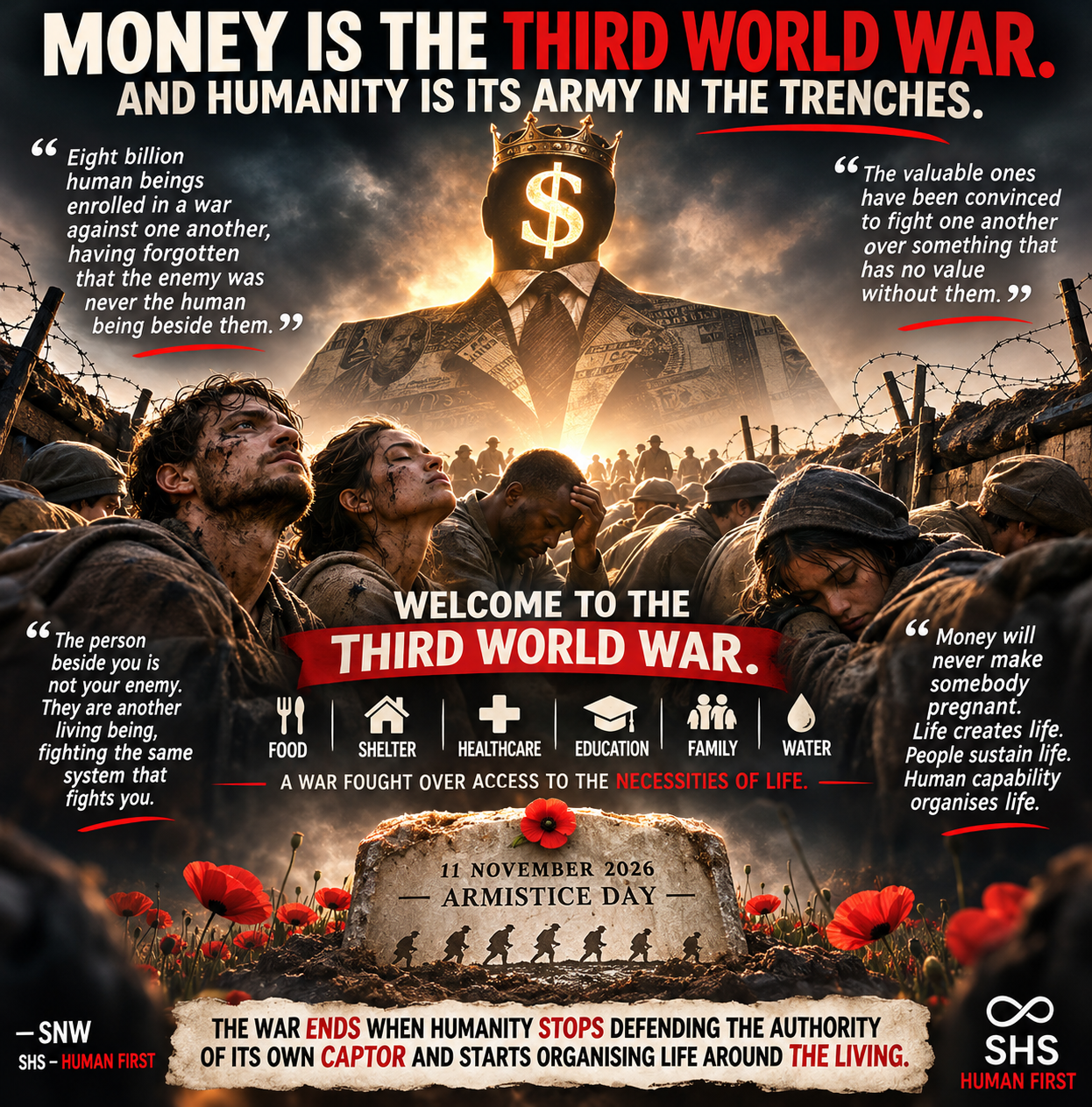
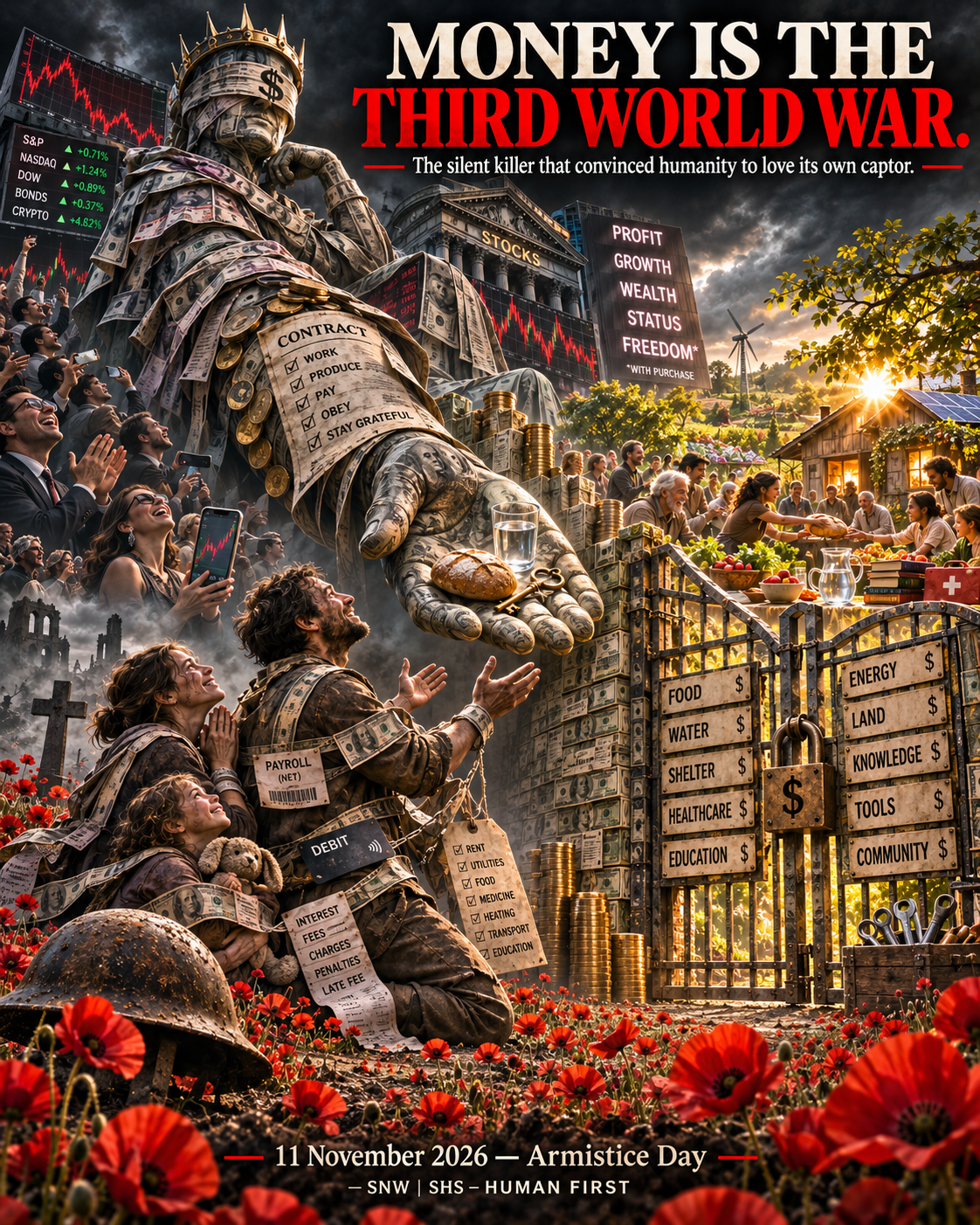
MONEY IS THE THIRD WORLD WAR.
The silent killer.
The emotional explosive.
The ticking bomb whose detonation may look like prosperity in one household and devastation in another.
The perpetrator we invite through the front door because we have been taught to believe that without it, we have no home.
The captor we defend because the system makes its absence frightening.
The instrument we thank for allowing us to receive what it never created.
But unlike the weapons that were laid down on 11 November 1918, this one does not require an opposing army to begin disarming.
It requires humanity to recognise the difference between the tools we use and the authority we grant them.
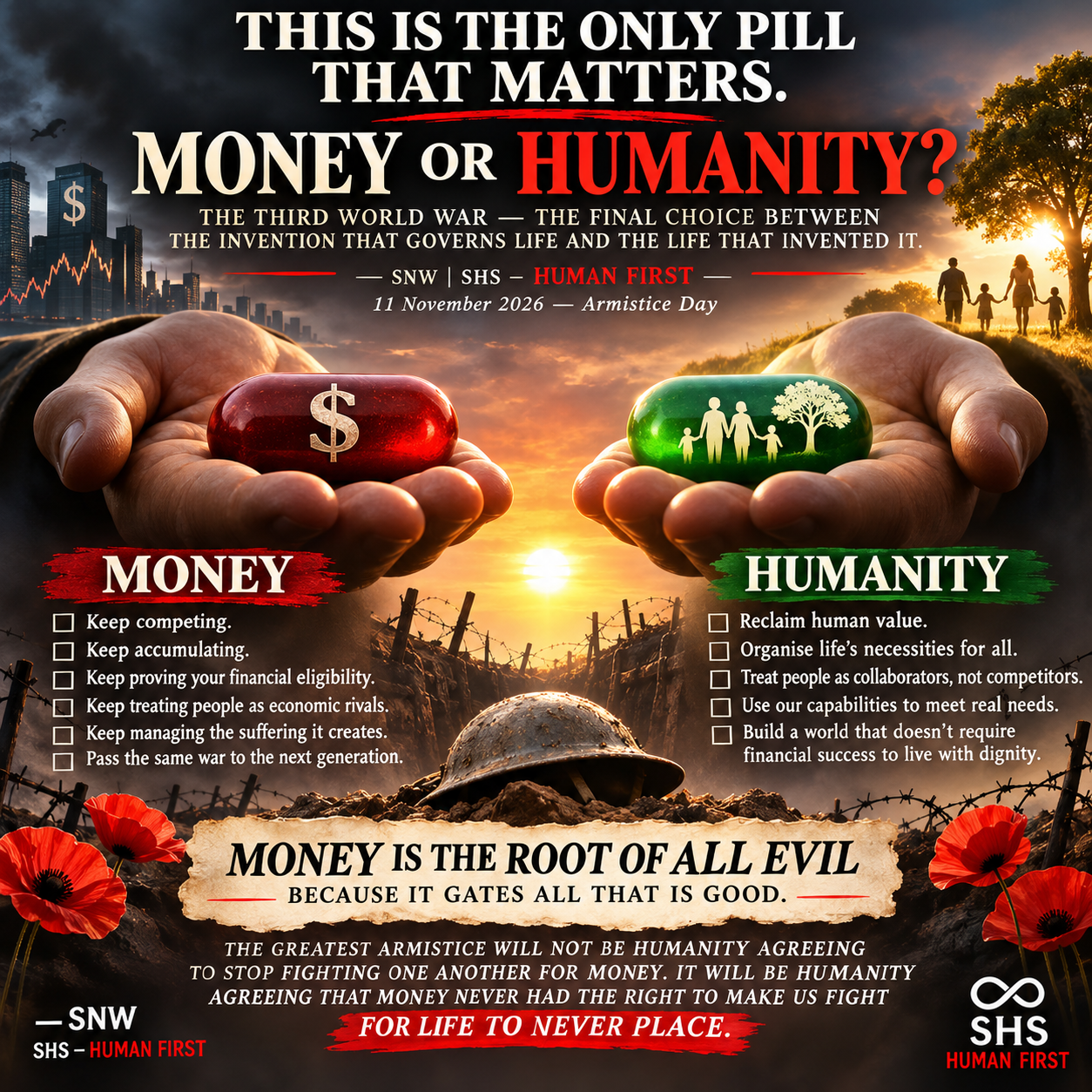
MONEY IS THE ROOT OF ALL EVIL BECAUSE IT GATES ALL THAT IS GOOD.
That is my indictment of the position money has acquired over human existence.
Not of every person forced to use it.
Not of every human being trying to survive within the conditions they inherited.
But of the collective arrangement that makes the necessities of life conditional upon possession of a human-made instrument.
And the psychological captivity that persuades us to defend that arrangement as though it were inseparable from existence.
YOU, READER, YOU DON’T NEED TO MENTALLY FIND SPACE FOR MONEY IN YOUR LIFE WHEN MONEY IS THE VERY THING THAT HOLDS YOU AWAY FROM EVERYTHING THAT LIFE IS.
Your blood is already pumping.
Your lungs are already breathing.
Your mind is already capable of thought.
Your body is already capable of pleasure.
Your humanity already exists.
You were alive before anybody evaluated your financial position.
And your worth will not disappear simply because the monetary system fails to recognise it.
MONEY SUCKS.
DON’T YOU DARE SUCK TOO.
You are human.
And you’re alive.
THE WAR ENDS WHEN HUMANITY STOPS DEFENDING THE AUTHORITY OF ITS OWN CAPTOR AND STARTS ORGANISING LIFE AROUND THE LIVING.
— SNW
Founder & Chief Continuity Architect
SHS – HUMAN FIRST
The Womb of The Unknown Need
11 November 2026 — Armistice Day
The battlefield is the human mind. The weapon is financial dependency. The armistice begins with remembering that life came first.
Leave a Reply