
Unfortunately even today, I know what humanity will choose.
The sad story is that it always choose the other. And never its self. I cannot sit n watch humanity kill itself. It is too painful.
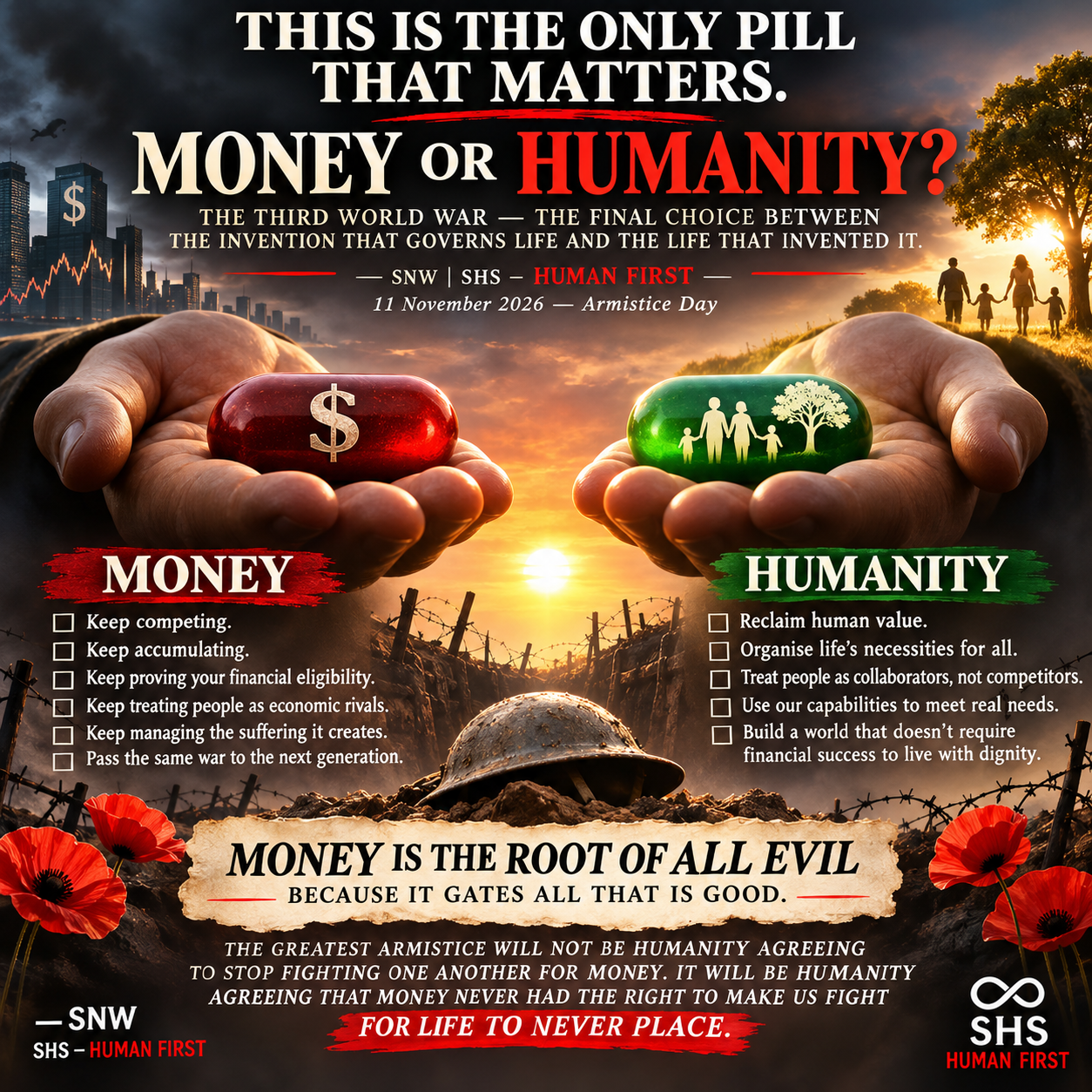
THE THIRD WORLD WAR — THE FINAL CHOICE BETWEEN THE INVENTION THAT GOVERNS LIFE AND THE LIFE THAT INVENTED IT.
— SNW | SHS – HUMAN FIRST
11 November 2026 — Armistice Day
Oh, humanity.
I have a rather extraordinary proposition for you.
Forget the red pill.
Forget the blue pill.
Forget left and right.
Forget rich and poor.
Forget capitalism and socialism.
Forget every political, economic and ideological label humanity has spent centuries defending.
Because I believe we have been avoiding a much more fundamental question.
One so extraordinarily simple that answering it may require us to reconsider almost everything we have come to accept as civilisation.
MONEY OR HUMANITY?
There.
Two pills.
One choice.
And before you answer, I want you to think.
Really think.
Not about your bank account.
Not about your pension.
Not about your investments.
Not about your salary.
Not about the mortgage, the market, the stock exchange or the economy.
I want you to think about the very existence that makes all those things possible.
Because I have a question.
IF MONEY DISAPPEARED TOMORROW, WOULD HUMANITY DISAPPEAR WITH IT?
No?
Then why have we organised a civilisation that behaves as though it would?
Why have we made something that cannot produce life the condition for sustaining life?
Why does the invention that depends entirely upon human recognition get to determine whether human beings deserve access to the necessities of their own existence?
And most importantly:
HOW MANY MORE HUMAN BEINGS MUST SUFFER BEFORE WE QUESTION WHETHER THE INSTRUMENT IS WORTH THE CONSEQUENCES OF ITS AUTHORITY?
Welcome to the only choice I believe humanity has yet to confront properly.
Not how much money you want.
Not who should possess it.
Not who should control it.
Not how we can distribute it more generously.
But whether money should continue occupying the position we have granted it over life.
BECAUSE THE QUESTION IS NO LONGER WHETHER MONEY IS USEFUL.
THE QUESTION IS WHETHER ITS USEFULNESS JUSTIFIES WHAT WE HAVE ALLOWED IT TO GOVERN.
1. THE FIRST PILL: MONEY.
Go on.
Take it.
You’ve been taking it your entire life.
Your parents took it.
Your grandparents took it.
Your governments took it.
Your institutions took it.
Your schools prepared you for it.
Your employers reward you with it.
Your banks protect it.
Your religions sometimes bless it.
Your politicians promise you more of it.
And your society continuously reminds you that without it, you may lose access to almost everything.
How comforting.
But let me ask you something.
WHY DOES A CHILD HAVE TO BE BORN INTO AN ECONOMIC CLASS BEFORE THEY HAVE EVEN DEVELOPED A PERSONALITY?
Why should their future be shaped by the financial circumstances of the people who conceived them?
Why should the quality of their education depend so heavily on where they live?
Why should one child inherit property while another inherits debt?
Why should one child receive enrichment, security and opportunity while another must first survive instability?
Did the wealthier child arrive with a greater capacity to be human?
Did the poorer child arrive with less?
Or did we simply place different financial conditions around two equally living beings?
WHEN DID INHERITED MONEY BECOME AN ACCEPTABLE SUBSTITUTE FOR INHERENT HUMAN VALUE?
And why do we call that opportunity when the starting lines are so extraordinarily different?
2. WHY ARE PEOPLE HUNGRY WHEN FOOD EXISTS?
Explain this one to me.
Why can a supermarket discard edible food while somebody nearby cannot afford dinner?
Why can crops become commercially unviable while human hunger remains biologically urgent?
Why can food be produced in abundance and still fail to reach the people who require it?
Why does its market price sometimes matter more to distribution decisions than its ability to sustain life?
Why do we celebrate record agricultural output without making universal nourishment the first measure of its success?
Why can a farmer struggle financially while producing something everybody needs?
Why can a person who has never grown a single vegetable earn more from trading agricultural commodities than the person who cultivates them?
And why do we call that a sophisticated economy?
WHO EXACTLY IS THE FOOD FOR?
The market?
The investor?
The distributor?
The shareholder?
Or the living being whose body requires nourishment?
And if the human being is the intended recipient, why have we constructed so many financial conditions between the producer and the hungry?
WHY DOES A HUMAN BEING NEED TO PROVE THEY CAN PAY BEFORE THEY ARE PERMITTED TO EAT?
What exactly did money contribute to the biological necessity of hunger?
Did it create the stomach?
Did it create the soil?
Did it create photosynthesis?
No?
Then why is it standing at the entrance?
3. WHY ARE PEOPLE HOMELESS WHEN BUILDINGS STAND EMPTY?
Why can a home remain unoccupied because its owner is waiting for a better financial return?
Why can housing be treated simultaneously as a human necessity and an investment asset?
What happens when those two purposes conflict?
Which one wins?
Why can someone work full-time and still struggle to obtain secure housing?
Why can a family lose their home because their financial circumstances changed while their physical need for shelter remains exactly the same?
Did their bodies suddenly stop requiring warmth?
Did the children stop needing bedrooms?
Did the rain stop falling?
Did winter decide to excuse them?
WHY DOES THE HUMAN NEED FOR SHELTER HAVE TO NEGOTIATE WITH THE FINANCIAL EXPECTATIONS OF OWNERSHIP?
And before somebody tells me that buildings require labour and resources, who said they didn’t?
Who builds them?
Human beings.
Who maintains them?
Human beings.
Who produces the materials?
Nature and human industry.
Then why have we confused the instrument that pays for the work with the beings who actually perform it?
Why do we talk about the value of property more readily than the value of the people the property exists to shelter?
WHEN DID A BUILDING BECOME MORE FINANCIALLY PROTECTABLE THAN THE HUMAN BEING STANDING OUTSIDE IT?
4. WHY DOES HEALTH HAVE A PRICE BEFORE IT HAS A SOLUTION?
Why should somebody fear the financial consequences of becoming ill?
Why can access to treatment depend on insurance, income, location or institutional budgets?
Why can the development of medicine be celebrated while affordability limits who receives it?
Why does a person suffering from illness sometimes have to become a financial administrator of their own survival?
Why do we measure the profitability of treatments?
Why do we reward some forms of medical innovation more readily when they promise substantial commercial returns?
Why are preventive interventions sometimes neglected while treating the consequences becomes economically significant?
Why do we congratulate ourselves for increasing healthcare expenditure without first asking whether suffering has actually decreased?
IS THE OBJECTIVE TO HAVE THE MOST EXPENSIVE HEALTHCARE SYSTEM OR THE HEALTHIEST POSSIBLE HUMANITY?
And when a cure exists, what exactly does money add to the human body’s capacity to benefit from it?
Did money create the immune system?
Did it invent healing?
Can it perform surgery without the surgeon?
Can it diagnose without knowledge?
Can it care without a living being?
No?
THEN WHY DOES THE INSTRUMENT GET SO MUCH AUTHORITY OVER THE PEOPLE WHO REQUIRE THE CARE?
5. WHY ARE WE SEPARATING FAMILIES TO PROVIDE FOR FAMILIES?
Oh, this one is particularly extraordinary.
Why must a parent spend so much of their child’s childhood away from the child to afford the child’s upbringing?
Why do we celebrate someone working extraordinary hours without asking what human relationships those hours displaced?
Why does a mother have to calculate whether she can afford time with her newborn?
Why does a father have to choose between financial provision and physical presence?
Why do couples argue about money when the reason they originally came together may have had nothing to do with it?
Why can financial hardship become a force in family breakdown?
Why can people remain in harmful relationships because leaving would threaten their economic security?
Why does the cost of childcare sometimes consume so much of the income earned while someone else provides the care?
WHY ARE WE PAYING PEOPLE TO CARE FOR OUR CHILDREN SO THAT WE CAN GO AWAY AND EARN THE MONEY TO PAY PEOPLE TO CARE FOR OUR CHILDREN?
And what about social services?
When a family struggles financially, why isn’t adequate support always available before separation becomes necessary, where the child can safely remain?
Why should poverty compound the risks to a child’s family relationships?
Why does the system sometimes find resources for managing the consequences of family breakdown that were unavailable for preventing the breakdown?
What would happen if we measured social services by how effectively they preserved safe human connections rather than merely by the interventions they performed?
WHEN DID THE FINANCIAL COST OF SUPPORTING A FAMILY BECOME MORE INTERESTING THAN THE HUMAN COST OF FAILING TO SUPPORT IT?
6. WHY DO WE EDUCATE CHILDREN TO EARN BEFORE WE EDUCATE THEM TO UNDERSTAND THEMSELVES?
Why is the question so often, “What do you want to be when you grow up?”
Why not, “Who are you discovering yourself to be?”
Why do children learn to associate achievement with grades, grades with qualifications, qualifications with employment and employment with income?
Where, in that progression, does the human being learn to understand their own existence?
Why should a child’s curiosity be valued according to its future employability?
Why are some disciplines described as more valuable because their graduates earn more?
Why can someone graduate with an extraordinary understanding of financial management while possessing very little understanding of emotional regulation, human relationships or institutional accountability?
Why do we teach competition before sufficiently teaching cooperation?
Why do we celebrate getting ahead without consistently asking what happens to those left behind?
WHAT IF EDUCATION’S GREATEST SUCCESS WAS NOT PRODUCING A HIGH-EARNING ADULT, BUT DEVELOPING A HUMAN BEING WHO UNDERSTANDS THEMSELVES, SOCIETY AND THEIR RESPONSIBILITY TO LIFE?
Would humanity suddenly become less intelligent?
Would science stop?
Would mathematics disappear?
Would engineering cease?
Or would our knowledge finally have the opportunity to serve something greater than financial competition?
WHY HAVE WE MADE THE FUTURE SALARY OF THE CHILD MORE MEASURABLE THAN THE FUTURE HUMAN BEING?
7. WHY DOES WAR BECOME AN INDUSTRY?
Now, this is where I would like humanity to pay particular attention.
Why can weapons become profitable products?
Why can governments spend extraordinary amounts on military capability while essential civilian services remain underfunded?
Why can a company benefit financially from supplying the instruments through which people kill one another?
Why can conflict create commercial opportunities for some while destroying the livelihoods of others?
Why do financial interests sometimes complicate the pursuit of peace?
Why does rebuilding after destruction create contracts, investment opportunities and economic activity?
WHY CAN HUMAN DESTRUCTION GENERATE MARKET VALUE?
And when the weapons stop firing, what happens to the business models built around supplying them?
What happens when peace is morally desirable but commercially inconvenient?
Who examines that contradiction?
Who investigates the incentives?
Who follows the investment?
Who holds the decision-makers accountable?
And on this Armistice Day, I ask something even more uncomfortable.
IF WE KNOW THE HUMAN COST OF WAR, WHY DO WE CONTINUE PERMITTING THE FINANCIAL REWARDS OF WAR TO EXIST WITHOUT QUESTIONING THEIR INFLUENCE?
The soldiers of 1918 did not need financial markets to make their lives valuable.
The families who lost them did not need a price assigned to the loss to understand its significance.
And no financial transaction could restore a single life that had ended.
SO WHY DOES MONEY CONTINUE TO MAKE THE INSTRUMENTS THAT CAN END LIFE COMMERCIALLY VALUABLE?
8. WHY ARE WE DESTROYING THE ENVIRONMENT FOR AN INSTRUMENT THE ENVIRONMENT NEVER CREATED?
Why is a forest worth one amount standing and another amount after being cut down?
Why can preserving biodiversity appear economically inconvenient while destroying an ecosystem appears profitable?
Why do we assign monetary value to clean water after allowing activities that threaten its cleanliness?
Why does pollution become somebody else’s cost while profit remains somebody else’s reward?
Why do companies sometimes find it cheaper to pay penalties than prevent harm?
Why do we congratulate ourselves for inventing technologies to clean up damage we could have avoided producing?
Why do we call something innovative merely because it creates a new commercial market?
IF AN INVENTION CREATES FIVE NEW PROBLEMS THAT REQUIRE FIVE NEW INDUSTRIES TO SOLVE, HAVE WE CREATED PROGRESS OR A PROFITABLE CHAIN OF DEPENDENCY?
Why does economic growth receive such extraordinary attention while the deterioration of the natural systems supporting that growth can be treated as secondary?
Can money replace a functioning atmosphere?
Can a bank recreate an extinct species?
Can a financial asset make contaminated water safe to drink by itself?
Can a shareholder breathe profit?
WHY ARE WE SACRIFICING THE CONDITIONS OF LIFE TO PROTECT THE VALUE OF SOMETHING THAT CANNOT EXPERIENCE LIFE?
And when the planet becomes less hospitable, where exactly does humanity intend to spend its accumulated wealth?
9. WHY DOES JUSTICE SOMETIMES DEPEND ON HOW MUCH YOU CAN AFFORD?
Why can one person retain an extraordinary legal team while another struggles to access representation?
Why does the cost of litigation discourage people from pursuing legitimate claims?
Why can a corporation absorb financial penalties that would financially destroy an ordinary person?
Why are some forms of wrongdoing treated as acceptable commercial risks when their expected financial consequences are manageable?
Why can wealthy parties sustain prolonged proceedings that poorer parties cannot afford?
Why can settlements resolve financial liability without necessarily addressing the structures that produced the harm?
IS JUSTICE SUPPOSED TO ESTABLISH WHAT IS RIGHT OR WHAT SOMEONE CAN AFFORD TO DEFEND?
And what happens when the institution responsible for resolving a dispute is itself constrained by budgets, commercial pressures or unequal access to resources?
What happens to the human being?
The one who suffered?
The one whose life was interrupted?
The one who needs restoration rather than another financial transaction?
Can money undo humiliation?
Can it erase fear?
Can it return lost years?
Can it restore a relationship?
Can it bring the dead back?
IF MONEY CANNOT RESTORE THE ORIGINAL VALUE THAT WAS LOST, WHY DO WE SO OFTEN TREAT FINANCIAL COMPENSATION AS THOUGH IT COMPLETES ACCOUNTABILITY?
10. WHY HAVE WE MADE HUMAN TRAUMA COMMERCIALLY USEFUL?
Why can insecurity be turned into a marketing opportunity?
Why are people encouraged to purchase products that promise confidence, belonging, attractiveness or status?
Why does the beauty industry benefit from perceptions of inadequacy?
Why can loneliness become a commercial opportunity?
Why can attention become a product?
Why do digital platforms compete so fiercely for the time and emotions of living people?
Why is somebody’s fear of missing out economically valuable?
Why can outrage attract engagement?
Why does controversy generate revenue?
Why are we so comfortable with business models that benefit from keeping human beings continuously dissatisfied?
WHAT HAPPENS TO AN INDUSTRY BUILT AROUND INSECURITY WHEN PEOPLE FINALLY LEARN THEIR OWN WORTH?
Would it celebrate?
Or would it need to invent another reason for them to feel inadequate?
Why do we tell children to love themselves while surrounding them with industries that profit from their desire to become somebody else?
Why do we celebrate self-worth while attaching financial rewards to public approval?
Why should somebody’s sense of accomplishment depend on an award, title, ranking or market valuation?
WHO ARE YOU WHEN MONEY IS NO LONGER PERMITTED TO TELL YOU HOW VALUABLE YOU ARE?
And perhaps even more importantly:
Who would you become if you no longer needed to prove your value to anybody?
11. WHY HAVE WE CONFUSED CHARITY WITH SOLVING THE PROBLEM?
Why do we celebrate the amount a billionaire gives away without equally examining how the wealth was acquired?
Why are charitable donations treated as evidence of goodness without consistently examining the consequences of the donor’s investments?
Why do we ask how many meals a charity distributes before asking why so many people cannot access meals independently?
Why do we celebrate temporary shelter without demanding a serious investigation into the conditions producing homelessness?
Why do we build reputations around helping the disadvantaged while allowing the systems that produce disadvantage to continue?
Why can an institution profit from financial dependency and simultaneously receive public recognition for alleviating some of its consequences?
IF YOU BENEFIT FROM THE CONDITIONS THAT PRODUCE THE SUFFERING, HOW MUCH DOES YOUR CHARITY ACTUALLY RESOLVE?
What is the difference between having ten and giving away two, and having five and giving away two?
What is the difference between providing two today and using your influence to ensure nobody needs to beg for two tomorrow?
What is more important?
The amount donated?
The percentage sacrificed?
The consequences of the resources retained?
Or the extent to which your actions reduce the need for charity altogether?
WHY HAVE WE MADE THE GENEROSITY OF THE WEALTHY A MORE CELEBRATED ACHIEVEMENT THAN THE INDEPENDENCE AND SECURITY OF THE PEOPLE WHO NEED THEIR GENEROSITY?
And if philanthropy becomes an industry, who benefits from poverty remaining an ongoing problem to manage?
12. WHY DO RELIGIONS DEFEND WHAT THEY CLAIM SHOULD NEVER REPLACE GOD?
Oh, this one.
This one deserves a particularly uncomfortable examination.
If you believe God created life, why should money determine whether that life receives the means to continue?
If you believe human beings possess God-given dignity, why does economic status influence how they are treated?
If you condemn idolatry, why do you pray for wealth, bless financial success and sometimes interpret material accumulation as divine favour?
If you claim devotion to God, why does financial security so often determine how far you are willing to follow your professed principles?
WHICH AUTHORITY DO YOU ACTUALLY OBEY WHEN YOUR RELIGIOUS VALUES AND YOUR FINANCIAL INTERESTS COME INTO CONFLICT?
If your religion teaches compassion, why should compassion stop where profitability begins?
If it teaches justice, why should justice become negotiable when investments are threatened?
If it teaches love for humanity, why should the boundaries of your community determine the boundaries of your responsibility?
If it teaches humility, why pursue human recognition as the measure of your worth?
If it teaches resistance to false idols, why should your life be organised around the continuous pursuit of a man-made instrument?
And if the response is that society requires money, doesn’t that reveal precisely how much authority society has acquired over your professed convictions?
WHY WOULD A RELATIONSHIP WITH THE CREATOR OF LIFE REQUIRE DEVOTION TO AN ECONOMIC INSTRUMENT HUMANITY INVENTED?
And why is questioning that arrangement treated as less practical than defending it?
13. WHY DO WE CALL SOMETHING A SUCCESS WHEN HUMANITY IS STILL PAYING FOR ITS CONSEQUENCES?
Why does a company’s financial valuation establish success without necessarily establishing its humanitarian contribution?
Why is expanding market share celebrated even when the expansion increases dependency?
Why can an industry be described as thriving while the people working within it experience deteriorating conditions?
Why do we reward efficiency when efficiency sometimes means reducing the number of human beings employed without ensuring that those affected retain access to necessities?
Why do we call automation progress if its benefits are concentrated while its disruptions fall on those with the least protection?
Why can technological advancement increase the productive capacity of society without guaranteeing that society becomes more secure?
Why do we design systems capable of producing more with less human labour while continuing to require human beings to sell labour to afford existence?
IF TECHNOLOGY CAN REDUCE THE AMOUNT OF WORK NECESSARY TO PROVIDE FOR HUMANITY, WHY CAN THAT SAME TECHNOLOGY MAKE WORKERS MORE FINANCIALLY INSECURE?
What exactly was the innovation supposed to accomplish?
Increase profit?
Or improve life?
And when the two conflict, which one wins?
Who decided?
Who benefits?
Who pays?
Who experiences the consequences?
WHY DOES MONEY GET CREDIT FOR HUMAN INNOVATION WHILE HUMANITY INHERITS THE DAMAGE OF ITS COMMERCIAL APPLICATION?
14. WHY ARE WE STILL FIGHTING ONE ANOTHER?
Why does one family compete with another for adequate housing?
Why does one child compete with another for opportunities that could be expanded?
Why does one community fear another community acquiring resources?
Why do workers fight over wages while the fundamental organisation of their dependency goes unquestioned?
Why do people defend billionaires they have never met while struggling to protect their own necessities?
Why do we admire the wealth of strangers more readily than the contributions of people standing beside us?
Why do we treat poverty as a personal deficiency but financial accumulation as evidence of superior capability?
WHY HAVE THE VALUABLE ONES BECOME EACH OTHER’S COMPETITION WHILE THE LIFELESS INSTRUMENT REMAINS THE PRIZE?
And on Armistice Day, what exactly are we commemorating if we do not learn to question why human beings repeatedly become opponents within systems of conflict?
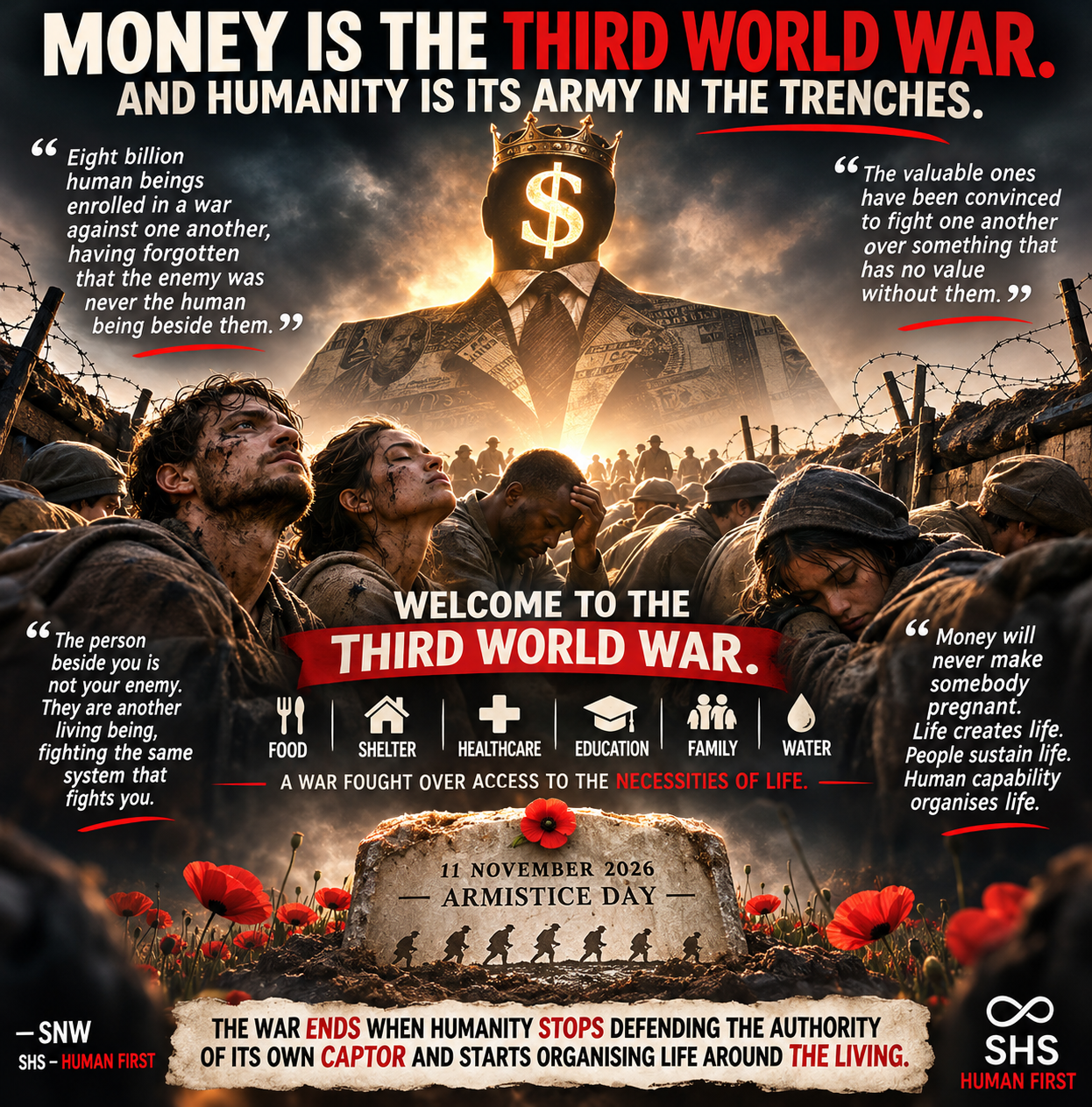
The soldiers were human on both sides of the trenches.
The worker and the employer are human.
The landlord and the tenant are human.
The creditor and the debtor are human.
Their interests and responsibilities may differ.
Their conduct may require accountability.
But their fundamental human value does not depend on their financial position.
WHY ARE WE USING THE VALUELESSNESS OF MONEY WITHOUT HUMAN RECOGNITION TO DETERMINE THE VALUE OF THE VERY PEOPLE WHO GIVE IT RECOGNITION?
Can you see the inversion yet?
15. WHY DOES MONEY RECEIVE MORE PROTECTION THAN LIFE?
Why do we have institutions dedicated to preserving financial stability but still struggle to guarantee human stability?
Why can a financial crisis trigger extraordinary emergency interventions while persistent deprivation becomes part of ordinary social policy?
Why can the collapse of a major company be described as a national emergency while the gradual deterioration of thousands of households attracts less urgency?
Why can an economy recover on paper while the people living within it remain financially insecure?
Why can asset prices rise while living conditions deteriorate?
Why can investors celebrate outcomes that ordinary households experience as hardship?
Why do we call the economy healthy when the human beings supporting it are exhausted?
WHAT EXACTLY ARE WE MEASURING WHEN WE SAY THE ECONOMY IS DOING WELL?
The movement of money?
The accumulation of capital?
The profitability of institutions?
Or the ability of human beings to live securely?
And if the first three improve while the last deteriorates, why should we call that progress?
WHEN DID THE HEALTH OF THE INSTRUMENT BECOME MORE IMPORTANT THAN THE HEALTH OF THE LIFE IT WAS SUPPOSED TO SERVE?
16. WHAT IF MONEY IS NOT THE SOLUTION, BUT THE QUESTION WE HAVE BEEN AFRAID TO ASK?
What if the problem is not that people lack enough money?
What if the deeper problem is that money has become the condition for accessing what people require?
What if poverty relief is not sufficient because poverty itself is defined through exclusion from the instrument?
What if the solution is not simply to make everyone rich?
What if the solution is to make access to life’s necessities independent of being rich or poor?
What if human contributions could be coordinated directly around needs, resources, knowledge and capabilities?
What if we measured production by its ability to sustain human existence rather than primarily by its profitability?
What if education prepared people to understand themselves and society before preparing them to compete financially?
What if housing was organised first as shelter?
What if healthcare was organised first around preserving health?
What if food distribution was organised first around nourishment?
What if innovation was measured by the unnecessary dependency it eliminated?
What if the greatest economic achievement were not accumulating the most wealth, but creating a society in which the basic conditions of existence no longer depend on wealth?
WHAT IF WE STOPPED ASKING HOW TO MAKE MONEY SERVE HUMANITY BETTER AND STARTED ASKING WHETHER HUMANITY REQUIRES MONEY TO SERVE ITSELF AT ALL?
Would that make us less human?
Less capable?
Less intelligent?
Less innovative?
Or would it force us to develop the very skills we have allowed financial incentives to substitute for?
Planning.
Coordination.
Cooperation.
Resource stewardship.
Integrity.
Continuity.
The ability to identify genuine needs.
The ability to meet those needs without creating unnecessary new dependencies.
WHAT IF THE MOST SOPHISTICATED CIVILISATION IS NOT THE ONE THAT LEARNS TO MANAGE THE MOST MONEY, BUT THE ONE THAT REQUIRES THE LEAST FINANCIAL COERCION TO SUSTAIN HUMAN LIFE?
17. AND NOW, DEAR READER, I HAVE SOME QUESTIONS FOR YOU PERSONALLY.
Not your government.
Not your employer.
Not your bank.
You.
If money were removed from your identity, who would you be?
Would you still know your worth?
Would you still respect yourself?
Would you still respect the people who currently earn less than you?
Would you still admire the people you admire today?
Would you still want the same possessions?
Would you still pursue the same career?
Would you still maintain the same relationships?
Would you still recognise your own abilities?
Would you still know what brings you genuine satisfaction?
IF MONEY WERE NO LONGER A MEASURE OF SUCCESS, WHAT WOULD YOU CONSIDER A SUCCESSFUL LIFE?
Would you spend more time with your children?
Would you care for somebody?
Would you study something?
Would you cultivate food?
Would you build?
Would you investigate?
Would you create?
Would you travel?
Would you repair something?
Would you learn to understand your own mind?
Would you finally discover that you possess capabilities that have never been financially rewarded?
And if the answer is yes, why have you spent so much of your existence postponing those things?
Why do you believe the opportunity to live must be purchased through decades of financial struggle?
HOW MUCH OF YOUR ACTUAL LIFE ARE YOU WILLING TO GIVE AWAY IN EXCHANGE FOR THE PROMISE THAT ONE DAY YOU WILL HAVE ENOUGH MONEY TO LIVE IT?
And when is that day?
When you reach a million?
Ten million?
A billion?
When the mortgage is paid?
When the children are grown?
When you retire?
When you’re too exhausted to enjoy what you’ve accumulated?
When your body no longer possesses the vitality it had while you were busy acquiring the means to enjoy it?
WHEN EXACTLY WERE YOU PLANNING TO START LIVING?
18. NOW CHOOSE.
Here they are.
Two pills.
One represents money retaining authority over access to human necessities.
The other represents humanity reclaiming the responsibility to organise those necessities directly.
The first says:
Keep competing.
Keep accumulating.
Keep proving your financial eligibility.
Keep treating your fellow human beings as economic rivals.
Keep measuring your success against somebody else’s wealth.
Keep celebrating the instrument.
Keep managing the suffering its authority helps produce.
Keep telling the next generation that this is simply how the world works.
The second asks something considerably more demanding.
Are you prepared to investigate a civilisation beyond financial dependency?
Are you prepared to recognise that your worth existed before you ever earned a penny?
Are you prepared to stop confusing the possession of money with the possession of human value?
Are you prepared to organise human contributions around actual necessities?
Are you prepared to build practical systems that preserve food, shelter, care, education, security and human dignity without requiring financial possession as the ultimate condition of access?
Are you prepared to challenge the arrangements you inherited, even when you personally benefit from them?
Are you prepared to stop passing the hot potato to another generation?
ARE YOU PREPARED TO PUT IT DOWN?
Not recklessly.
Not by abandoning people whose survival currently depends on money.
Not by pretending that removing a currency automatically eliminates scarcity, conflict or human selfishness.
But by undertaking the far more serious work of creating arrangements that can safeguard human life without preserving unnecessary financial dependency.
Because choosing humanity is not simply refusing money.
IT IS ACCEPTING RESPONSIBILITY FOR DEVELOPING A WORLD THAT DOES NOT NEED MONEY TO DECIDE WHO GETS TO LIVE WITH DIGNITY.
And now consider the question that makes this choice truly uncomfortable.
If you had enough resources to live comfortably for the rest of your existence, would you still want humanity to abolish financial dependency?
Would you still want the system transformed if it meant surrendering the privilege of being financially superior to others?
Would you still defend universal access if everybody could receive the necessities you once considered evidence of your success?
Would you still support a world in which your accumulated wealth no longer determines your social position?
Would you still believe in equality when the change begins affecting your own advantages?
DO YOU WANT HUMANITY TO BE FREE, OR DO YOU SIMPLY WANT TO BE ONE OF THE PEOPLE WHO CAN AFFORD FREEDOM?
Oh.
There it is.
Perhaps the most revealing question of all.
Because it is easy to oppose a system when you are suffering under it.
But what happens when you begin benefiting from it?
Do your principles change?
Does your compassion become conditional?
Does your idea of justice suddenly acquire financial limits?
Does your commitment to humanity disappear when your privileges become the subject of investigation?
WHAT IS YOUR HUMANITY WORTH WHEN PRESERVING IT REQUIRES YOU TO GIVE UP AN ADVANTAGE?
19. THE ELEVENTH HOUR. THE FINAL QUESTION.
On 11 November 1918, the guns fell silent on the Western Front.
The soldiers who survived had the opportunity to begin returning to lives that had been overshadowed by war.
They did not stop being capable when the fighting stopped.
They did not lose their value.
They did not lose their humanity.
They were finally permitted to direct their existence toward something beyond the immediate demands of battle.
And now I look at humanity in 2026.
Still fighting.
Different trenches.
Different weapons.
Different uniforms.
Different conditions.
But still organising so much of existence around the fear of not having enough.
Still sacrificing our time.
Still competing for necessities.
Still measuring ourselves through an instrument that cannot feel.
Still defending the very arrangement that makes us frightened of losing it.
And I wonder.
WHAT IF HUMANITY IS WAITING FOR AN ARMISTICE THAT ONLY HUMANITY CAN DECIDE TO MAKE POSSIBLE?
What if the person beside you was never your enemy?
What if the life you are trying to protect was always more valuable than the financial instrument you have been protecting it with?
What if you could stop spending your existence trying to win a war that doesn’t need to continue in its present form?
What if we finally recognised that the purpose of civilisation was not to make money circulate indefinitely?
What if it was to make human life possible, sustainable, dignified and worth experiencing?
What if the greatest invention humanity has yet to develop is not another financial product?
Not another banking system?
Not another investment instrument?
Not another market?
Not another technology designed to make consumption faster?
But a civilisation capable of looking at every living human being and recognising:
YOU ARE HERE.
YOU ARE ALIVE.
YOUR EXISTENCE IS NOT A FINANCIAL DEBT THAT YOU MUST SPEND YOUR LIFE REPAYING.
Humanity has an extraordinary capacity to create.
To organise.
To develop.
To care.
To preserve.
To investigate.
To rebuild.
To learn.
To correct.
To become more than what it inherited.
So why are we behaving as though an instrument we invented is the final limit of those capabilities?
Why are we so frightened of discovering what we can become beyond it?
Why do we continue asking how to obtain more money when the question ought to be why so much of life requires it?
And if somebody presents you with the choice between defending money’s authority and defending humanity’s right to the necessities of existence, why should that choice even be difficult?
THIS IS THE ONLY PILL THAT MATTERS.
MONEY OR HUMANITY?
Not whether money may continue to exist as an optional tool.
But whether it deserves to continue governing our access to life.
Not whether humans should contribute.
But whether survival should depend on financial success.
Not whether resources require organisation.
But whether the right to receive necessities should remain conditional upon possession of an exchange instrument.
And not whether society should preserve what it has learned.
But whether it has the courage to recognise what it has learned incorrectly.
MONEY DID NOT CREATE YOU.
MONEY DOES NOT SUSTAIN YOU BIOLOGICALLY.
MONEY CANNOT LOVE YOU.
MONEY CANNOT CREATE LIFE.
MONEY CANNOT EVEN EXPERIENCE THE WORLD YOU ARE SACRIFICING YOUR EXISTENCE TO AFFORD.
Human beings produce goods and services.
Human beings develop knowledge.
Human beings build homes.
Human beings cultivate food.
Human beings care for one another.
Human beings make decisions.
Human beings create the systems.
And human beings possess the ability to change them.
So I will ask one final question.
IF HUMANITY CAN CREATE AN INSTRUMENT SO POWERFUL THAT EIGHT BILLION PEOPLE ORGANISE THEIR LIVES AROUND IT, WHAT MAKES YOU THINK HUMANITY IS INCAPABLE OF CREATING A SYSTEM THAT ORGANISES ITSELF AROUND EIGHT BILLION PEOPLE?
Perhaps the obstacle is not our intelligence.
Perhaps it is our attachment.
Perhaps it is our fear.
Perhaps it is the rewards some receive from preserving the arrangement.
Perhaps we have simply forgotten that our original value existed before money had a name.
Whatever the explanation, we cannot continue mistaking what has been normalised for what must be permanent.
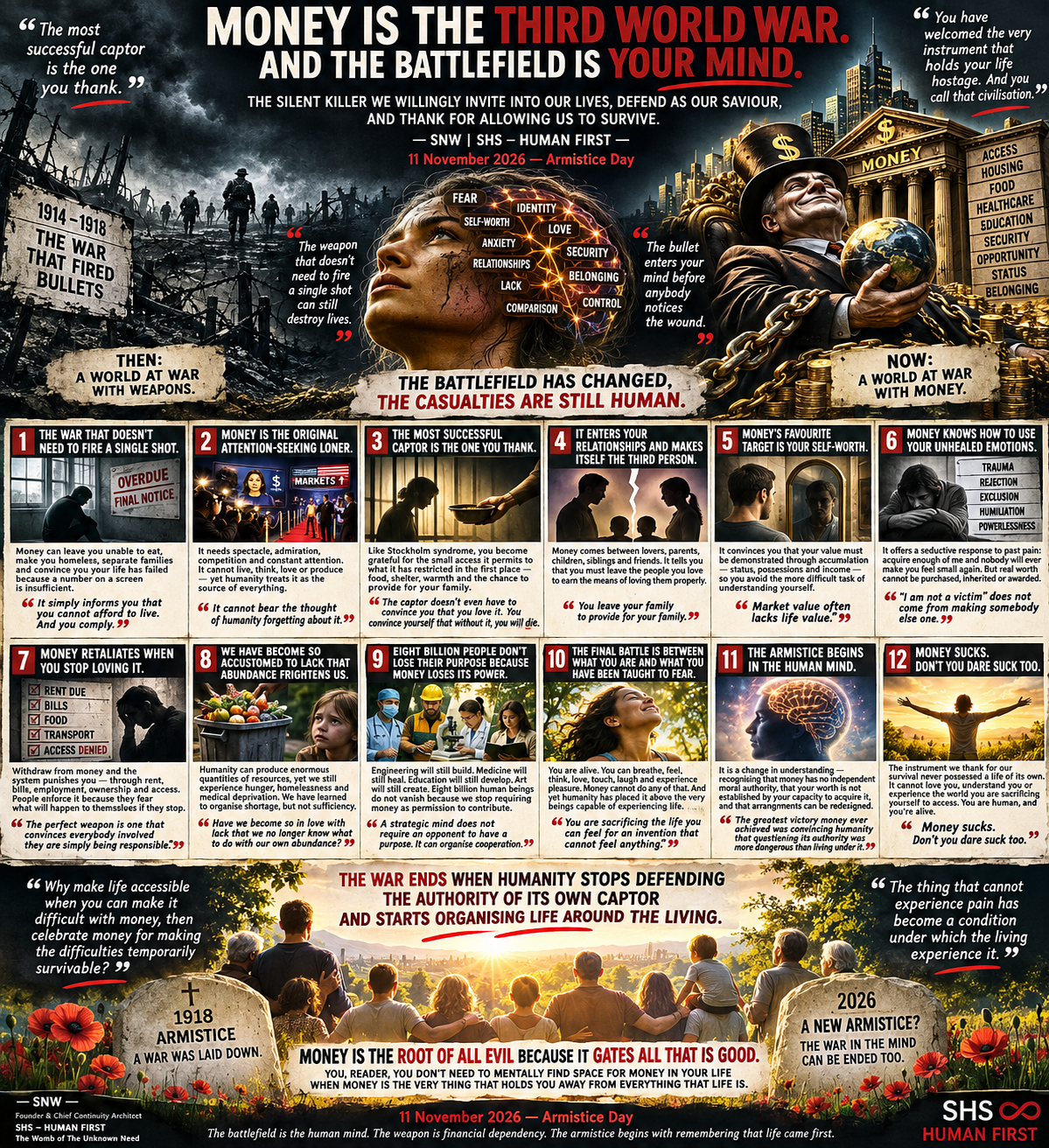
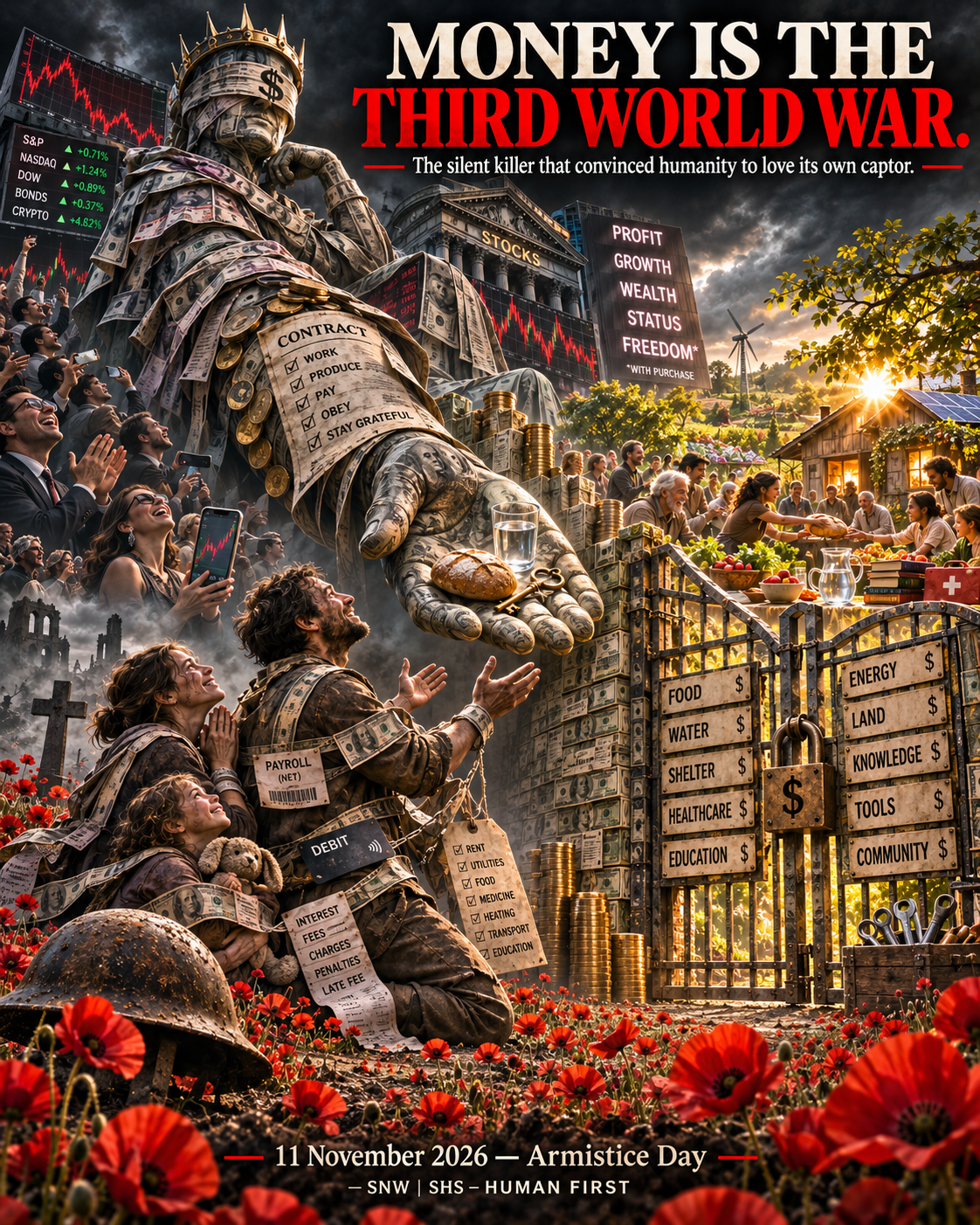
MONEY IS THE ROOT OF ALL EVIL BECAUSE IT GATES ALL THAT IS GOOD.
That is my philosophical indictment of its position over human existence.
And I believe humanity ought to investigate that indictment before another generation inherits the same conditions without ever being invited to question them.
Because the greatest tragedy would not be discovering that we had organised our lives around the wrong priority.
It would be discovering that we knew, and continued anyway.
THE VALUE DID NOT BEGIN WITH MONEY.
LIFE CAME FIRST.
AND LIFE SHOULD NEVER HAVE BEEN MADE TO STAND BEHIND ITS OWN INVENTION.
So.
Two pills.
One question.
MONEY OR HUMANITY?
And before you answer, remember:
YOU CANNOT SPEND MONEY WITHOUT LIFE.
BUT LIFE EXISTED BEFORE MONEY.
Which one, then, is truly indispensable?
— SNW
Founder & Chief Continuity Architect
SHS – HUMAN FIRST
The Womb of The Unknown Need
11 November 2026 — Armistice Day
THE GREATEST ARMISTICE WILL NOT BE HUMANITY AGREEING TO STOP FIGHTING ONE ANOTHER FOR MONEY. IT WILL BE HUMANITY AGREEING THAT MONEY NEVER HAD THE RIGHT TO MAKE US FIGHT FOR LIFE IN THE FIRST PLACE.
Leave a Reply