
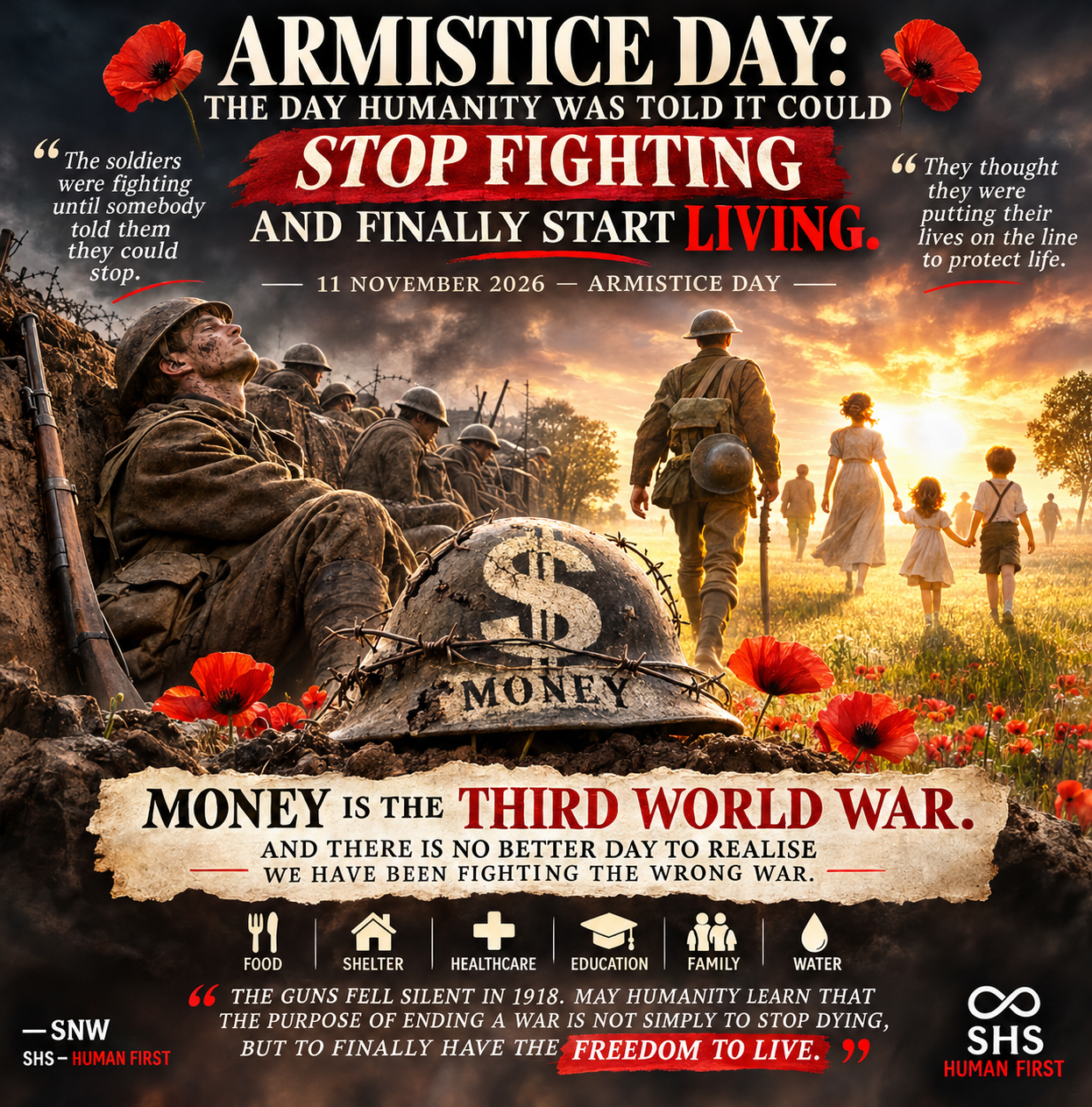
MONEY IS THE THIRD WORLD WAR. AND THERE IS NO BETTER DAY TO REALISE WE HAVE BEEN FIGHTING THE WRONG WAR.
— SNW | SHS – HUMAN FIRST
11 November 2026 — Armistice Day
Oh, humanity.
What an extraordinary day to wake up from our ignorance.
11 November.
Armistice Day.
A day when we remember the moment the guns fell silent on the Western Front in 1918.
But there is something about this day that I find particularly fascinating.
Something that goes beyond the soldiers.
Beyond the trenches.
Beyond the weapons.
Beyond the governments that sent human beings to fight one another.
THE SOLDIERS WERE FIGHTING UNTIL SOMEBODY TOLD THEM THEY COULD STOP.
Think about that.
Men had spent years living in trenches.
Sleeping in mud.
Experiencing hunger.
Cold.
Fear.
Watching people die.
Losing friends.
Losing parts of themselves.
Wondering whether the next explosion would be the one that ended their existence.
And many believed they were doing something necessary.
Protecting their families.
Protecting their homes.
Protecting their countries.
Protecting their futures.
THEY THOUGHT THEY WERE PUTTING THEIR LIVES ON THE LINE TO PROTECT LIFE.
And then, on 11 November 1918, the fighting was ordered to stop.
At eleven o’clock.
The eleventh hour of the eleventh day of the eleventh month.
Imagine that moment.
The same men who had been trained to expect another attack.
Another explosion.
Another command.
Another reason to risk their lives.
Suddenly received a different instruction.
YOU CAN STOP FIGHTING.
What?
After all of that?
After years of destruction?
After all those lives?
After all that fear?
You mean to tell me we can simply stop?
And what happens now?
Well.
NOW YOU HAVE THE POSSIBILITY OF LIVING THE VERY LIFE YOU THOUGHT YOU HAD TO KEEP FIGHTING TO PROTECT.
How extraordinary.
And how terribly tragic that so many never lived long enough to receive that instruction.
1. THE MOST POWERFUL MOMENT WAS NOT AN EXPLOSION. IT WAS THE ABSENCE OF ONE.
Imagine the silence.
Not the silence of waiting for another attack.
But the silence of being told there was no longer a reason to fire.
For years, the soldiers had become accustomed to the noise.
The threat.
The commands.
The expectation of danger.
The continuous calculation of whether they would survive another day.
And suddenly?
No more firing.
No more advancing.
No more being ordered to kill the human being standing on the other side.
At least on that battlefield, the fighting had been ordered to cease.
The war’s consequences did not magically disappear.
The wounded were still wounded.
The dead did not return.
The grieving families still had to grieve.
But an extraordinary possibility had emerged.
THE LIVING COULD BEGIN ORGANISING THEIR EXISTENCE AROUND SOMETHING OTHER THAN THE EXPECTATION OF DEATH.
And here is my question.
What if humanity has another war to stop?
One so deeply embedded in our daily existence that we no longer recognise the sound of its weapons?
One that has convinced us that continuous struggle is simply what being alive means?
One in which the battlefield is not a country.
But our minds.
Our emotions.
Our relationships.
Our time.
Our access to the necessities of existence.
MONEY IS THE THIRD WORLD WAR.
And I wonder whether humanity is waiting for somebody to announce an armistice that we have never seriously attempted to organise for ourselves.
2. THE SOLDIERS WERE TOLD WHEN TO FIGHT. AND THEN THEY WERE TOLD WHEN THEY COULD LIVE.
There is something almost unbearable about that.
The authority to fight.
And the authority to stop.
Both coming from outside the human being whose life was at stake.
Imagine having the capacity to breathe.
To feel.
To love.
To think.
To experience existence.
And yet having somebody else determine when you must place that existence in danger.
The soldier didn’t need the war to be human.
He was human before he entered the trenches.
He didn’t need an armistice to acquire value.
He had value before anybody gave him a uniform.
And he certainly didn’t need to kill another human being to establish that his own life deserved protection.
Yet the systems of authority surrounding him had organised circumstances in which fighting appeared necessary.
Now look at us.
We wake up.
We work.
We compete.
We calculate.
We sacrifice.
We protect our income.
We protect our position.
We worry about tomorrow.
We fear losing access to food, housing, healthcare and security.
And we tell ourselves that this is simply what responsible human beings do.
WE HAVE BECOME SOLDIERS IN AN ECONOMIC WAR THAT HUMANITY NO LONGER REMEMBERS ENLISTING IN.
We think we are protecting our families.
And often, within the system we inherited, we are doing exactly what is necessary to provide for them.
But isn’t that the tragedy?
That the arrangement itself requires us to sacrifice so much of the life we are supposedly protecting?
WE ARE FIGHTING TO AFFORD TO LIVE WHILE LOSING THE TIME IN WHICH WE COULD ACTUALLY BE LIVING.
And just like those soldiers, we have become accustomed to the commands.
Earn.
Produce.
Compete.
Pay.
Borrow.
Repay.
Invest.
Accumulate.
Protect.
Repeat.
And don’t you dare question why you must spend your existence obeying them.
Because everybody else is doing it.
How extraordinarily familiar.
3. THE ENEMY WAS NEVER THE SOLDIER IN THE OTHER TRENCH.
Consider the men facing one another in 1918.
Different uniforms.
Different languages.
Different governments.
Different national identities.
But fundamentally?
Human beings.
Some were fathers.
Some were sons.
Some were husbands.
Some were brothers.
Some were barely adults.
Some wanted nothing more than to go home.
They had bodies capable of pain.
Minds capable of fear.
Hearts capable of attachment.
And lives that could never be replaced once lost.
Yet the conflict had organised them into opposing sides.
THE SAME HUMAN CAPACITY FOR LIFE WAS BEING USED TO DESTROY LIFE.
Now look at the monetary system.
One person struggles to afford housing.
Another owns the housing and depends on the rent.
One person needs employment.
Another must keep labour costs down.
One person requires a service.
Another must make the service profitable.
One person cannot afford food.
Another must protect commercial margins.
And both become trapped in the conditions the system has established.
We begin viewing one another as obstacles.
Competitors.
Liabilities.
Expenses.
Financial risks.
Customers.
Workers.
Economic units.
And somewhere along the way, we forget the actual human being.
WE HAVE BEEN FIGHTING THE VALUABLE ONES TO PROTECT SOMETHING THAT HAS NO VALUE WITHOUT US.
Money cannot create life.
It cannot love.
It cannot breathe.
It cannot experience hunger.
It cannot give birth.
It cannot experience the warmth of another human being.
It cannot even understand the suffering its governing structures may produce.
Yet we have organised ourselves so that this lifeless instrument determines the circumstances under which living beings can access what they need.
And we fight one another for positions within that arrangement.
WHAT IF THE PERSON YOU HAVE BEEN COMPETING AGAINST WAS NEVER YOUR ENEMY?
What if they were simply another human being trying to leave the same trench?
4. THE GREATEST IGNORANCE IS BELIEVING THAT BECAUSE WE HAVE ALWAYS FOUGHT, WE MUST ALWAYS FIGHT.
Imagine telling a soldier who had spent years in the trenches that one day he would no longer have to fight.
Perhaps he would believe you.
Perhaps he wouldn’t.
Perhaps he would ask how.
Perhaps he would be frightened to hope.
Because when danger becomes your daily reality, peace can begin to feel like something that belongs to somebody else.
Something theoretical.
Something impossible.
Something beautiful but unrealistic.
And that, I believe, is where humanity stands in relation to money.
Tell someone that human beings could organise access to necessities without making financial possession the condition of survival.
And what do they say?
Impossible.
Who would work?
Who would produce?
Who would organise everything?
What would motivate people?
How would society function?
Oh, humanity.
DO YOU THINK THE SOLDIERS STOPPED BEING HUMAN WHEN THE GUNS STOPPED FIRING?
Did their hands disappear?
Did their minds cease functioning?
Did they suddenly forget how to build?
Did they lose their capacity to organise?
Did they become incapable of contributing to society because the purpose of their day was no longer to survive the next explosion?
Of course not.
Their capabilities remained.
Their lives remained.
Their possibilities remained.
And many could finally direct those capabilities toward something other than warfare.
Now apply the principle to money.
If humanity develops an alternative system of providing life’s necessities, do the farmers disappear?
Do the engineers forget engineering?
Do doctors lose their medical knowledge?
Do artists forget how to create?
Do strategic minds suddenly lose their ability to plan?
NO.
Eight billion human beings do not disappear because we change the instrument through which we organise their contributions.
Money is not the source of human capability.
Human capability is the source of everything that makes money useful.
The problem is not that humanity lacks value without money.
THE PROBLEM IS THAT WE HAVE BEEN EDUCATED TO FEAR WHAT HUMANITY MIGHT BECOME WITHOUT MONEY.
5. THEY THOUGHT THEY WERE PROTECTING LIFE. THEN THEY DISCOVERED THEY COULD LIVE IT.
And this, to me, is the most important lesson of Armistice Day.
The distinction between protecting the possibility of living and actually experiencing life.
Because they are not the same thing.
You can spend your entire existence preparing to live.
Working so that one day you can rest.
Saving so that one day you can feel secure.
Sacrificing your relationships so that one day you can afford to spend time with them.
Protecting your health financially while physically exhausting yourself in the process.
Postponing your interests.
Postponing your desires.
Postponing your family.
Postponing your happiness.
Postponing your existence.
Until when?
Retirement?
Financial independence?
The next promotion?
The next investment?
The next opportunity?
HOW MUCH OF YOUR LIFE ARE YOU PREPARED TO SACRIFICE BEFORE YOU GIVE YOURSELF PERMISSION TO EXPERIENCE THE LIFE YOU’RE SACRIFICING IT FOR?
Imagine the soldier returning home.
He doesn’t need another medal to experience the warmth of his family.
He doesn’t need another victory to feel the sun on his face.
He doesn’t need another enemy to discover that being alive was already something extraordinary.
He may have injuries.
He may carry trauma.
He may have lost people he loved.
And life after war will not necessarily be easy.
But he no longer needs to spend every moment obeying the immediate demands of battle.
HE CAN BEGIN TO REDISCOVER THE HUMAN BEING WHO EXISTED BEFORE THE WAR BECAME HIS WORLD.
And that is what I want for humanity.
Not merely to become better at surviving financial dependency.
Not merely to win more money.
Not merely to acquire a more comfortable trench.
But to investigate what human life could become when access to its necessities no longer requires continuous participation in financial struggle.
6. THERE IS NO BETTER DAY TO RECOGNISE HOW EASILY HUMANITY CAN NORMALISE ITS OWN SUFFERING.
We commemorate wars because we recognise their consequences.
We acknowledge the destruction.
The decisions.
The loss of life.
The suffering.
The failures of leadership.
The extraordinary capacity of human beings to harm one another through systems they collectively maintain.
And we say:
Never again.
But what exactly have we learned?
Have we learned to investigate the conditions that make human suffering appear necessary?
Have we learned to question the authorities that organise our participation?
Have we learned that obedience does not automatically establish morality?
Have we learned that a human being can sincerely believe they are doing the right thing while participating in arrangements that produce devastating consequences?
Or do we reserve those lessons for history books?
Because I see people every day defending financial arrangements that harm them.
Not because they necessarily enjoy suffering.
But because they have been taught to believe the arrangements are indispensable.
THEY HAVE BEEN EDUCATED TO DEFEND THEIR TRENCHES AS THOUGH THE TRENCHES ARE WHAT KEEP THEM ALIVE.
And when somebody proposes removing the financial conditions that make those trenches necessary?
They become frightened.
Who will provide?
Who will pay?
Who will work?
Who will organise?
As though the living human beings who already produce, organise and sustain society would suddenly become incapable of doing so.
The original technology was always the human self.
Money is the instrument.
Not the source.
And somehow we have reversed the relationship.
THE HUMAN BEING HAS BECOME SUBORDINATE TO THE INVENTION THAT COULD NEVER HAVE EXISTED WITHOUT HUMANITY.
What an extraordinary reason to declare another armistice.
7. THE NEXT ARMISTICE CANNOT SIMPLY BE ANOTHER AGREEMENT BETWEEN THOSE WHO CONTROL THE WEAPONS.
Because there is another lesson to learn.
The soldiers were not necessarily the ones who had the authority to end the war.
Those decisions were made through governments, military leadership and negotiations.
And on 11 November 1918, the Western Front’s fighting stopped under an agreement reached by the powers involved.
But what about an economic armistice?
Who gets to declare that humanity no longer has to compete for access to the means of survival?
The banks?
The governments?
The billionaires?
The institutions that benefit from the existing arrangements?
Are we supposed to wait until somebody whose authority depends on money decides that money should no longer possess that authority?
HOW TERRIBLY CONVENIENT.
Perhaps this is precisely where we must learn something different from 1918.
We cannot rely exclusively on those who administer the existing system to imagine its replacement.
Humanity must participate in designing the conditions of its own liberation.
Not by abandoning the provisions people currently depend upon.
Not by throwing away money tomorrow and allowing families to starve.
Not by creating disorder and calling it freedom.
But by developing practical alternatives.
Systems of production.
Systems of distribution.
Systems of healthcare.
Systems of housing.
Systems of education.
Systems of resource stewardship.
Systems of accountability.
Systems of continuity.
And arrangements that recognise the human being as the original reason those systems exist.
THE OBJECTIVE IS NOT TO STOP PROVIDING.
IT IS TO STOP MAKING FINANCIAL POSSESSION THE CONDITION OF BEING PROVIDED FOR.
That is the difference between an armistice and abandonment.
A genuine economic armistice would not simply remove the instrument.
It would safeguard the living while transforming the arrangements that sustain them.
8. IMAGINE THE ELEVENTH HOUR OF HUMANITY’S FINANCIAL WAR.
Imagine the announcement.
Not from a general.
Not from a banker.
Not from a president.
Not from a monarch.
But from humanity’s collective recognition of its own capabilities.
Imagine reaching the point where our systems can guarantee access to life’s basic necessities without requiring the individual to first prove financial eligibility.
Where a child is fed because the child requires nourishment.
Where a person receives care because the person requires care.
Where a family can remain sheltered without living in perpetual fear of financial exclusion.
Where education develops human capacity rather than merely preparing people to compete for wages.
Where contribution is organised around actual needs.
Where strategic intelligence is used to improve collective provision.
Where production is measured against what human beings require rather than only what markets will purchase.
Where the fundamental question is no longer:
Can you afford to live?
But:
WHAT DO WE NEED TO ORGANISE SO THAT LIFE CAN CONTINUE WITH INTEGRITY?
Imagine that.
The moment humanity collectively recognises that its value did not originate from money.
That nature did not begin producing because somebody invented prices.
That human intelligence did not develop because somebody established a banking system.
That life itself was already the foundation.
And that the systems we create should serve that foundation.
THE ELEVENTH HOUR OF THE ELEVENTH DAY WOULD NO LONGER BE ONLY A MEMORY OF WHEN HUMANITY STOPPED FIRING WEAPONS AT HUMANITY.
It could become a reminder of what we might achieve when we finally stop organising ourselves as though our own creation has more authority than the living.
9. DON’T WAIT UNTIL THE END OF YOUR LIFE TO BE TOLD YOU WERE ALLOWED TO LIVE IT.
Dear reader.
There is something I want you to consider today.
How much of your existence have you spent preparing for a future in which you might finally feel safe enough to live?
How much of your childhood was dedicated to preparing you for employment?
How much of your adulthood has been spent protecting your financial position?
How many relationships have been shaped by economic conditions?
How many experiences have you postponed?
How many moments have you sacrificed?
How much anxiety have you accepted as normal?
And how much of it have you defended because you believed there was no alternative?
YOU ARE NOT A SOLDIER BY NATURE SIMPLY BECAUSE YOU WERE BORN INTO A WORLD THAT EXPECTS YOU TO FIGHT.
You are a human being.
Your body was capable of living before you understood what money was.
Your heart was beating before you earned your first wage.
Your lungs were breathing before you opened a bank account.
You could experience hunger before you understood a price.
You could experience warmth before you understood a bill.
You could love before you understood financial compatibility.
You possessed value before society began evaluating your economic potential.
And you will not become less human because somebody else has more money.
MONEY DID NOT GIVE YOU LIFE.
So why should it be permitted to determine how much of that life you can experience?
And why should the arrangement remain beyond question simply because previous generations accepted it?
The soldiers of 1918 were not born to spend their existence in trenches.
They were born to live.
And so were you.
10. THE GREATEST TRIBUTE TO THE DEAD IS NOT SIMPLY REMEMBERING THAT THEY DIED. IT IS LEARNING HOW TO PROTECT THE LIVING.
On Armistice Day, we remember those who suffered and died.
And rightly so.
But remembrance should not end with ceremony.
It should provoke investigation.
What conditions brought those human beings into conflict?
What decisions prolonged the fighting?
What beliefs made participation appear necessary?
What failures could have been prevented?
What might future generations learn so that the same forms of suffering are not repeatedly reproduced?
And most importantly:
WHAT IS THE PURPOSE OF REMEMBERING HUMAN SUFFERING IF WE ARE NOT PREPARED TO INVESTIGATE THE SYSTEMS THROUGH WHICH HUMAN SUFFERING CONTINUES?
I am not saying financial dependency and the First World War are historically identical.
They are not.
I am examining the principle.
Humanity can become so accustomed to a system of struggle that the struggle becomes indistinguishable from ordinary existence.
And sometimes, the most extraordinary change begins when people recognise that what they have been told is unavoidable is actually an arrangement that can be questioned, redesigned and eventually replaced.
The soldiers were told the fighting could stop.
But humanity’s economic transformation will require us to do more than receive an instruction.
It will require us to develop the conditions that make stopping possible.
NOT JUST PUTTING DOWN THE WEAPON.
ENSURING THE LIVING NO LONGER NEED TO PICK IT UP TO SURVIVE.
That is the armistice I want humanity to investigate.
11. THE WAR ENDS WHEN PROTECTING LIFE NO LONGER REQUIRES SACRIFICING THE EXPERIENCE OF LIFE.
So here we are.
11 November 2026.
One hundred and eight years after the armistice of 1918.
And I find myself wondering what those soldiers would think of us.
Not because we have failed to eliminate every form of conflict.
But because we have developed extraordinary technologies, scientific knowledge and productive capabilities, yet continue organising access to existence through an instrument that cannot experience existence itself.
We have created systems capable of generating enormous quantities of resources.
Yet people remain deprived.
We have developed technologies capable of saving time.
Yet people continue sacrificing extraordinary portions of their time to secure financial survival.
We have learned more about the human body.
Yet we allow financial insecurity to damage human health.
We have built networks capable of connecting people across the planet.
Yet financial pressures can leave people isolated from the very families and communities they seek to sustain.
And still, we ask:
How will humanity survive without money?
PERHAPS WE SHOULD FIRST ASK HOW MUCH OF HUMANITY HAS BEEN SACRIFICED TO KEEP MONEY IN ITS CURRENT POSITION.
Because money has never been the original source of the valuable things we require.
It is a human-made instrument.
One whose authority depends upon the systems and agreements through which we use it.
And if we are capable of organising a global civilisation around that instrument, then surely we are capable of investigating how to organise life more directly around human needs.
That investigation will be difficult.
It will require competence.
Planning.
Resources.
Cooperation.
Accountability.
Continuity.
But difficulty does not establish impossibility.
And complexity is not an excuse to preserve unnecessary suffering indefinitely.
THE MEN IN THE TRENCHES DID NOT NEED WAR TO BE VALUABLE.
HUMANITY DOES NOT NEED FINANCIAL STRUGGLE TO BE WORTHY OF EXISTENCE.
Imagine what it means to stop fighting.
To begin living without the perpetual fear that losing money means losing access to life.
To recognise that your fellow human being is not inherently your competitor.
To organise our capabilities around providing rather than excluding.
To preserve life without demanding that people continuously sacrifice their experience of living it.
What an extraordinary possibility.
And what an extraordinary day to remember that possibility exists.
Because on 11 November 1918, the guns fell silent.
And for those who survived, the end of the fighting opened the possibility of returning to something that had been overshadowed for years.
Life.
Not the promise of life after another battle.
Not the possibility of life after another victory.
Not the hope of life after another sacrifice.
LIFE ITSELF.
And I believe humanity deserves to investigate what it would take to experience that same distinction in its economic existence.
WE HAVE SPENT GENERATIONS FIGHTING TO AFFORD TO LIVE.
PERHAPS IT IS TIME WE BEGAN ORGANISING OURSELVES SO THAT WE CAN ACTUALLY LIVE.
You do not need to become financially victorious to possess human worth.
You do not need to defeat another human being to deserve sustenance.
You do not need to spend your entire existence preparing for permission to experience it.
And you certainly do not need to believe that a human-made instrument is more valuable than the human beings who created it.
MONEY IS THE THIRD WORLD WAR.
And the battlefield is our minds, emotions, relationships and access to life.
But unlike the soldiers who waited for orders from their commanders, we have the opportunity to investigate the system itself.
To question it.
To develop alternatives.
To organise for humanity’s continuity.
To make the transition without abandoning those who currently depend upon it.
And eventually, perhaps, to reach a day when money no longer stands between the living and the means of sustaining life.
THE GREATEST ARMISTICE HUMANITY COULD DECLARE WOULD BE THE END OF THE WAR AGAINST ITS OWN ORIGINAL VALUE.
So today, remember the fallen.
Remember the survivors.
Remember the silence that followed years of destruction.
And remember the lesson.
THEY THOUGHT THEY HAD TO CONTINUE PUTTING THEIR LIVES ON THE LINE TO PROTECT LIFE.
THEN CAME THE MOMENT THEY WERE TOLD THEY COULD STOP FIGHTING AND BEGIN LIVING THE LIFE THEY HAD BEEN TRYING TO PROTECT.
Humanity.
There is no better day than today to wake up from our ignorance.
No better day to question why we continue fighting.
No better day to recognise who and what is genuinely valuable.
And no better day to begin asking what it would take to put down the economic weapon without leaving anybody unprotected.
Because the objective was never simply to survive the war.
THE OBJECTIVE WAS ALWAYS TO LIVE.
— SNW
Founder & Chief Continuity Architect
SHS – HUMAN FIRST
The Womb of The Unknown Need
11 November 2026 — Armistice Day
THE GUNS FELL SILENT IN 1918. MAY HUMANITY LEARN THAT THE PURPOSE OF ENDING A WAR IS NOT SIMPLY TO STOP DYING, BUT TO FINALLY HAVE THE FREEDOM TO LIVE.


Leave a Reply