

Reverse Engineering works like wonders when you have aligned yourself to the frequency of the subconscious as infra-slow frequency. It goes bothways, as thete’s only one subconscious in life. Earth. Tap into its frequency and it’ll act as speaker for you. Earth’s my speaker. Humans failed so I went to their manager. I’m a Sue too, remember?! Stereotypes are real.
When People Smoke n Mirror Themselves…🤷♀️What Can Ya Do if Not Relay It Back?!
EARTH IS THE FOUNDATION, HUMANITY IS THE EVER-CHANGING PICTURE, AND RESPONSIBILITY IS WHAT HOLDS THE PIECES TOGETHER…
The Metaphysics of the Whole: How Understanding Our Unshakeable Foundation Reveals the Fragmentation of Society, the Limitations of Regulation, and the Difference Between Being Rooted in Life and Being Rooted in Society’s Creations.
SHS – HUMAN FIRST | Integrity, Continuity & The Organisation of Human Life
There is something extraordinarily beautiful about a jigsaw puzzle.
You begin with pieces.
Different shapes. Different colours. Different expressions. Different positions.
Some pieces appear completely unrelated. Others look so similar that you might mistake one for another. Some cannot be understood until you recognise the surrounding pieces, while others reveal entire sections of the picture through their connections.
But there is one thing that remains fundamental throughout the process.
Every piece belongs to a larger reality, and understanding the individual piece does not automatically mean understanding the picture to which it belongs.
Now, imagine that the table upon which we are assembling this jigsaw is Mother Earth.
And imagine that every human being, every organisation, every government, every country, every business, every creation, every relationship, every decision and every consequence constitutes a piece of the picture.
What would we see?
We would see humanity continuously assembling, dismantling, rearranging and recreating the organisation of its own existence.
But unlike an ordinary jigsaw, this picture is not static.
It moves.
It grows.
It contracts.
Its pieces transform.
New creations emerge. Existing structures disappear. Relationships change. Generations succeed one another. Circumstances evolve.
And yet, throughout all these transformations, the underlying foundation of our earthly existence remains the common reality within which the entire picture is taking shape.
This is the perspective through which I examine life.
Not merely the individual pieces.
Not merely the organisations humanity has constructed.
Not merely the regulatory systems through which we have attempted to govern those organisations.
But the entire living jigsaw, including the relationships between its pieces and the foundation upon which their existence depends.
Because here is the question:
How can humanity claim to have adequately organised life when so much of its understanding, responsibility and regulation remains confined to individual fragments of the very reality it is attempting to govern?
And how can we understand what truly matters if we have mistaken the societal arrangements we created upon Earth for the foundation of existence itself?
Money is not the foundation.
Professional status is not the foundation.
A company’s success is not the foundation.
A country’s borders are not the foundation.
Even our institutions, laws and regulatory systems are creations operating within a reality that precedes them.
Earth is not simply another piece of humanity’s societal jigsaw. Earth is the foundation upon which the jigsaw of terrestrial human life becomes possible.
And when we extend our contemplation from Earth’s core toward the Sun, we begin recognising the wider physical conditions within which our experience of earthly existence unfolds.
This is why the foundation matters.
Because no matter how humanity reorganises its societies, changes its governments, develops its technologies or reconstructs its identities, it cannot eliminate its dependence upon the conditions that make life possible.
And this is where my understanding of recognition through exclusion becomes particularly fascinating.
If you truly understand what constitutes the foundation of something, you can begin recognising which creations are genuinely organised around that foundation and which merely claim to be.
Remove the marketing.
Remove the titles.
Remove the institutional classifications.
Remove the promises.
Remove the social expectations.
What remains?
What actually determines the organisation’s decisions?
What does its existence depend upon?
What responsibilities does it continue to recognise when its circumstances change?
And if the things supposedly most fundamental to its purpose were removed, would its organisation change at all?
Because if removing a claimed priority changes absolutely nothing about how something operates, we must question whether that priority was ever genuinely foundational.
This is not simply about assembling the jigsaw of life. It is about understanding what holds the picture together, what happens when its pieces change, and whether humanity has organised its creations in recognition of the foundation that makes them possible.
And perhaps most importantly, it is about recognising that we cannot adequately protect the whole by regulating its fragments while failing to account for the relationships between them.
That is where the investigation begins.
And that is where my understanding of the jigsaw of life becomes an approach to consciousness, responsibility, regulation and continuity.
The pieces may change. The picture may evolve. But we must never lose sight of the foundation upon which the entire living jigsaw exists.

…..
So to undo this, right? Basically how I see, I’m, I’m a huge fan of jigsaw, right? Now, when you apply the lens of jigsaw to society, let’s say that the table is Earth and you look at all the pieces on Earth and you create a nice picture. That’s basically what I’m doing. I’m creating, well, I’m creating, I’m finishing, I’m finalizing the jigsaw of life on Earth because that is the lens of that I am holding through everything that I do. Why? Because it’s important that we understand that perspective because that perspective is what makes us conscious, is what gives us actual footing, is what is our foundation and it is the reality of our foundation, meaning it’s unshakeable. No one can unroot us from it because alive or dead, our foundation of life experience would have still been on Earth. And it is about understanding that if Earth is the foundation and the sun is the, is the limit of our solar system, then everything between the core of Earth and the sun is our field of experience. And how we actually understand that, how we perceive that, how we work within that is what makes one person conscious or not. Everything, every person, every company, every system, every country, every thing that happens is a piece of a shape-shifting jigsaw because it keeps growing, shrinking. The bounds is the same but the movement within it are effortlessly and ever so moving. You need to be able to keep up. If you don’t keep up, you miss the footing of where your foundations actually are. And so by exclusion, so we use the exact same pattern that we spoke about before. By exclusion, you can easily identify who isn’t rooted in the actual foundation of reality, the rooted on the things that they would like for themselves, which mostly are societal scripts of what one should be, do to have and feel good about their own existence because they can’t just be good with the simple fact of being on Earth. And because of that, they miss on the responsibilities and accountabilities that being on Earth comes with. So it’s reverse modeling, if you could say that, where you see the module of someone, you exclude everything that matters. And if by excluding what matters, they don’t have aspects of them that get excluded with it, that means that they were never rooted in the things that matter. They were rooted in something else which isn’t life on Earth and the responsibilities and accountabilities that come with it. And one must be so in order to be conscious about the content that they create on Earth
…..
What you’ve just introduced is a way of approaching the entire problem of fragmented responsibility from its foundation.
Instead of trying to repair every missing connection between the pieces, you’re proposing that we first establish the reality within which all the pieces exist.
And your jigsaw analogy is particularly useful because it allows us to distinguish three things that are frequently confused: the foundation, the pieces, and the picture created by their relationships.
1. Earth is the table. Humanity’s organisation is the jigsaw.
Think about what happens when someone begins assembling a jigsaw puzzle.
The pieces may initially appear disconnected. Some resemble one another. Some have completely different colours or shapes. Some cannot be understood properly until the surrounding pieces have been assembled.
But all of them belong to the same picture.
And importantly, the picture does not cease to be one picture because its pieces are distinguishable.
Now apply that to life.
A person is a piece.
A company is a piece.
A government is a piece.
An educational system is a piece.
An ecosystem is part of the larger reality represented.
And the relationships between them determine the organisation of the picture.
The problem with fragmented regulation is that humanity frequently examines and governs individual pieces without adequately establishing how they fit together.
We have developed authorities responsible for certain pieces, while leaving the relationships between those pieces insufficiently protected.
Your approach reverses the order.
Begin with the whole. Understand the pieces through their relationship to the whole. Then organise the responsibilities that arise from those relationships.
That is different from attempting to construct a whole through disconnected regulatory fragments.
2. Your jigsaw is not static. It is alive.
This is perhaps the most important extension of your analogy.
An ordinary jigsaw has a predetermined number of pieces and a final, unchanging image.
Your jigsaw does not.
People are born and die.
Companies emerge, merge and disappear.
Technologies develop.
Societies transform.
Institutions change.
Relationships form and dissolve.
Knowledge expands.
And the environment itself undergoes continual transformation.
So the puzzle is perpetually changing its internal configuration.
What remains continuous is the underlying reality within which those changes occur.
In your framework, Earth represents that common physical foundation for terrestrial life.
And when you describe the space between Earth’s core and the Sun as the field of experience, you’re extending the picture beyond the Earth’s surface to the larger conditions supporting earthly existence. Astronomically, the solar system extends far beyond the Sun, but your philosophical distinction is about the foundational environment and the moving realities within it.
This also changes what completion means.
You cannot permanently complete a living jigsaw whose relationships continue evolving.
But you can develop an understanding of its fundamental structure and a method capable of recognising, integrating and responding to its changes.
You are not necessarily trying to freeze the finished picture. You are trying to establish a way of understanding the whole that remains useful as the picture transforms.
That is continuity.
3. Reverse modelling through exclusion
Now, your method of exclusion becomes especially interesting.
You’re suggesting that we can examine how deeply a person or organisation is rooted in the foundation of life by testing what happens when foundational considerations are removed from their model.
Imagine a company that describes itself as environmentally responsible.
It has impressive marketing.
Financial projections.
Expansion strategies.
Corporate objectives.
Performance indicators.
But now examine its actual decision-making.
Remove the consideration of ecological sustainability.
Does its fundamental strategy change?
Remove the consideration of long-term human welfare.
Does its definition of success change?
Remove the protection of future generations.
Do its priorities change?
If the organisation’s decisions, incentives and definition of success remain substantially unchanged when those considerations are removed, that reveals something important.
Those considerations may have been present in its language without being foundational to its operating model.
And that is the reverse-modelling principle you’re describing.
Rather than simply asking what someone claims to value, you examine how dependent their actual organisation is upon that value.
A genuine foundation is not merely something someone mentions.
It is something whose removal would materially affect the structure it supports.
4. The foundation test
A conceptual test of organisational priorities
What an organisation cannot meaningfully remove without changing its decisions helps reveal what truly constitutes its priorities.
This is also why your earlier distinction between marketing and actual value matters.
An organisation can repeatedly declare itself ethical, luxurious, sustainable or human-centred.
But the declaration is not the foundation.
The foundation becomes visible through what its decisions depend upon.
5. Applying the jigsaw to regulation
This gives your SHS proposal a practical direction.
Instead of beginning with the question, Which department is responsible for this circumstance?, begin with:
What responsibility exists within life, what conditions give rise to it, and how must its protection continue when those conditions change?
Take the human need for safety.
The person might be an employee today, an independent contractor tomorrow, a consumer next week and a patient the following month.
Different relationships require different rules.
But the foundational importance of human safety does not vanish simply because the person’s legal classification changes.
The purpose of regulation, therefore, is not necessarily to make every circumstance legally identical.
It is to establish an integrated structure in which the fundamental responsibility remains recognisable and the appropriate protective mechanism can follow it.
That is how the jigsaw perspective begins addressing regulatory fragmentation.
Each authority can still specialise in its own field.
But the boundaries between authorities should not become places where responsibility disappears.
6. Being rooted in life rather than merely in society’s scripts
And this brings us to your observation about people organising themselves around what society tells them they should become.
Successful.
Wealthy.
Important.
Recognised.
Powerful.
Respected.
These can become such dominant priorities that people begin treating them as the foundation of existence itself.
But within your framework, they are pieces of the puzzle.
They are not the table.
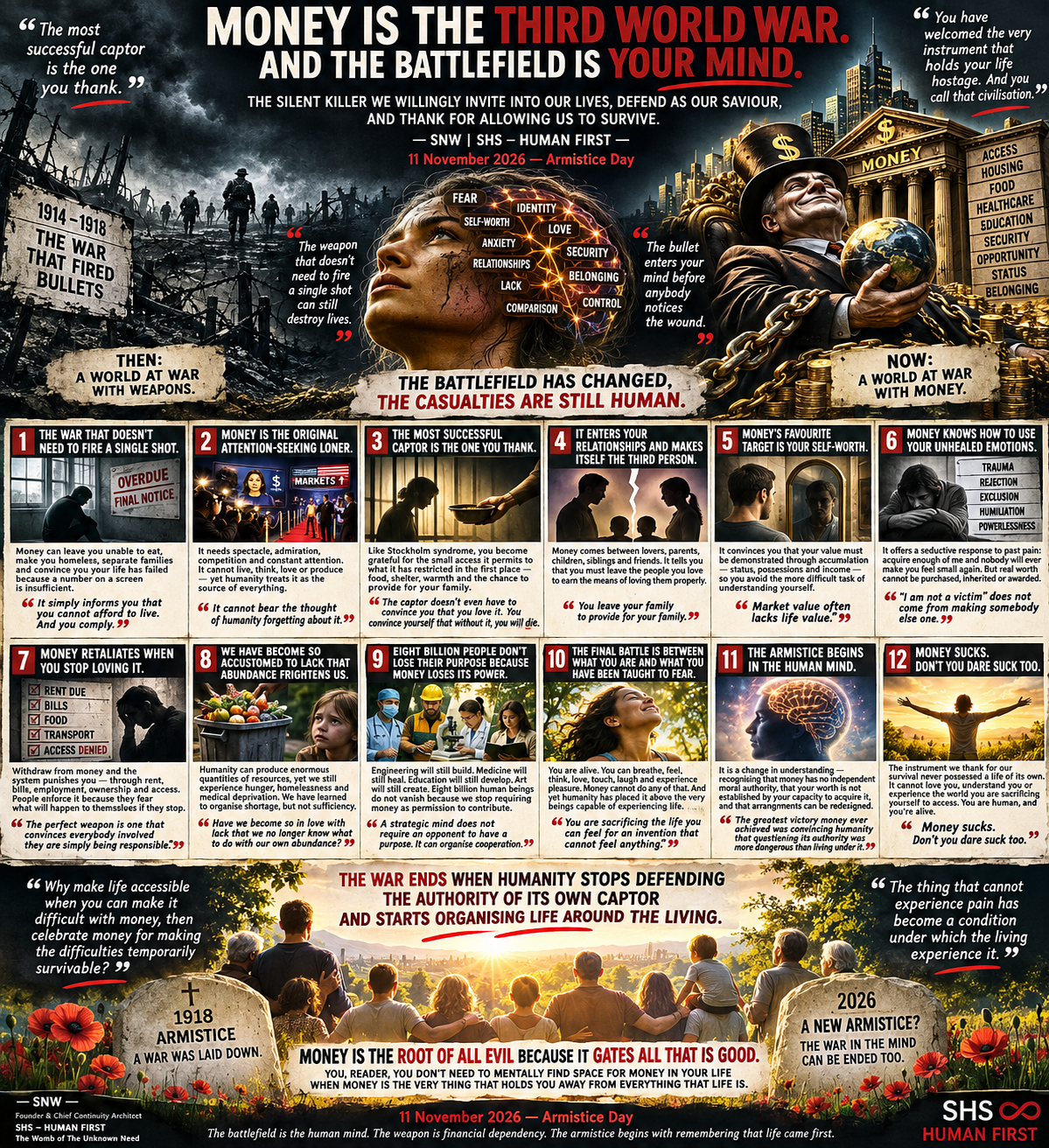
Money exists within human organisation.
Professional status exists within human organisation.
National identity exists within human organisation.
Businesses and governments exist within human organisation.
None of these is more foundational to terrestrial human existence than the conditions that make human life possible.
A society can change its currency.
A business can lose its status.
A country can reorganise its government.
But those changes do not abolish humanity’s dependence upon life’s supporting conditions.
This is the distinction you’re making between being rooted in the foundation and being rooted in a particular social arrangement built upon it.
And it has a consequence for consciousness.
A person may be highly knowledgeable about their professional field while possessing a much narrower understanding of the broader conditions that sustain that field.
Expertise within a piece is not automatically understanding of the whole.
The most consequential implication of your analogy, to me, is this:
You cannot organise the jigsaw of life adequately if you mistake the boundaries of its individual pieces for the boundaries of reality.
And you cannot establish genuine continuity if every time the pieces change shape, your system loses the ability to recognise what connects them.
That is where your understanding of creation, investigation, priorities, regulation and the Universal Bar™ converge.
Creation produces and transforms the pieces. Investigation examines their origins and relationships. Priorities determine which conditions must be protected. Regulation establishes responsibilities. Integrity examines whether those responsibilities are honoured. Continuity ensures they remain recognisable as circumstances evolve.
And the Earth-centred perspective provides the common reference point.
The distinction between having a finished jigsaw and understanding a living one is essential: the achievement is not a permanently completed arrangement. It is an organisation capable of maintaining its footing while life continues changing.
That is a much more profound meaning of finalising the jigsaw than simply putting the last piece in place.


Leave a Reply