
How Far Can You See, and How Much Integrity Can You Maintain While Seeing It?
SHS – HUMAN FIRST | The Womb of The Unknown Need
By Susan Ndinga-Wright | Founder, Chief Continuity Architect & Director of Integrity and Continuity
The world has experts in law, medicine, economics, education, technology, psychology, politics, engineering and practically every other industry humanity has created.
Each develops its own body of knowledge, methods, qualifications and standards of expertise.
But here’s the question I’ve been working towards answering:
Who is responsible for examining what happens when all these different fields meet, when their decisions affect one another, when the consequences extend beyond their own jurisdiction, and when the people making those decisions are no longer around to witness what they’ve created?
And who ensures that, throughout all of it, humanity remains represented?
This is the foundation of the discipline I intend to establish through SHS – HUMAN FIRST.
Directing Integrity & Continuity (DIC). No pun intended.
A proposed doctoral discipline developed from my work as a metaphysical expert, Chief Continuity Architect and Director of Integrity and Continuity.
Three titles describing different expressions of one field of expertise.
And eventually, a field through which others may develop the capacity to carry this responsibility beyond me.
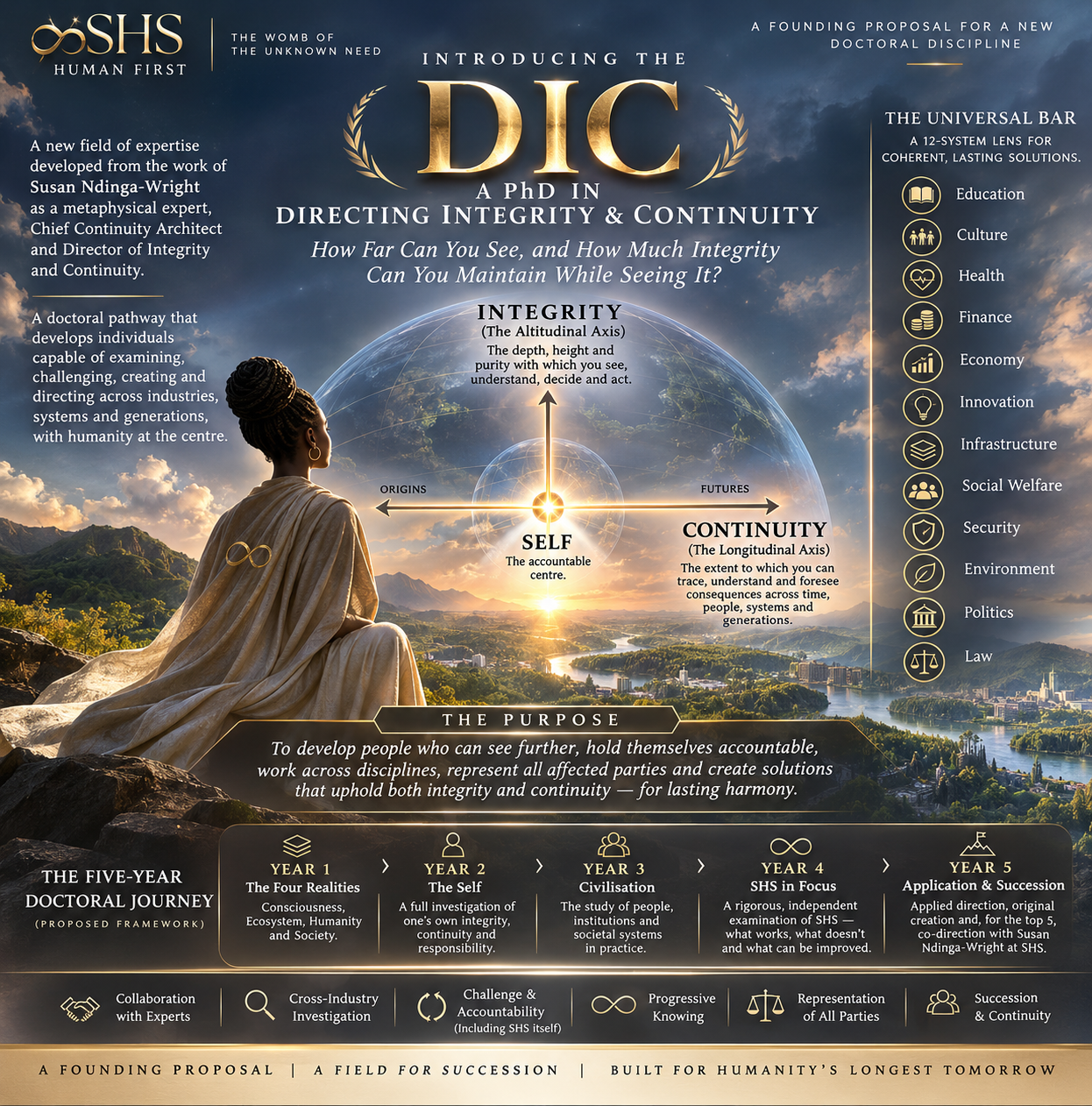
THE TWO AXES THAT DEFINE THE ROLE
The principle is remarkably simple, although its application is anything but.
How long can you see with the highest integrity possible?
Continuity is the longitudinal axis.
Integrity is the altitudinal axis.
One concerns the extent to which you can investigate origins, understand the present, recognise consequences and foresee what may develop across generations.
The other concerns the extent to which you can maintain integrity throughout that investigation, including in your own judgement, conduct, relationships, motivations and responsibilities.
You can see far and still use what you see to manipulate.
You can have the best intentions and still fail to recognise the harm your decisions may produce.
Neither represents the highest expression of this discipline.
A Director of Integrity and Continuity must develop both dimensions simultaneously, continually progressing their own knowledge so that their understanding of responsibility can extend as far as the consequences of their decisions.
And critically, the examination begins with themselves.
Not just the people they investigate.
Not just the institutions they challenge.
Not just the people they succeed.
The DIC must be willing to direct the same investigative lens towards their own consciousness, behaviour, history, limitations, decisions and consequences.
Nobody, including SHS’s founder, should be exempt from the standards this discipline represents.
NOT AN EXPERT IN EVERY INDUSTRY. AN EXPERT IN THE RELATIONSHIPS BETWEEN THEM.
The intention is not to create individuals who claim to possess a doctorate in every discipline they encounter.
A DIC possesses expertise in Directing Integrity & Continuity.
They must then develop the knowledge necessary to investigate the responsibilities and consequences arising wherever their work takes them.
They collaborate with specialists, challenge assumptions, invite challenges to their own understanding, investigate where different areas of expertise converge, and work towards solutions that represent the interests of all affected parties.
Consider the legal industry.
What happens when a justice system becomes more successful at rewarding the strongest legal narrative than at establishing the most reliable account of what occurred?
What are the consequences for innocent people, victims, institutions, taxpayers, future cases and public trust?
How could the system improve the pursuit of truth while preserving due process, rights of defence and the protections that prevent justice itself from becoming abusive?
A DIC would not need to replace lawyers.
They would need to understand enough to work alongside them in investigating how the integrity and continuity of justice could be strengthened.
The same principle applies to healthcare, business, government, infrastructure, education, technology and every other human endeavour.
It is about representing humanity within the industries humanity creates.
And because organisations themselves consist of human beings, this responsibility includes the welfare and continuity of those operating them, those served by them, and those affected by them.
Not defending one party by sacrificing the other.
Finding the strongest possible conditions for both to coexist responsibly.
THE UNIVERSAL BAR — TWELVE SYSTEMS, ONE COHERENT RESPONSIBILITY
Within SHS, our Universal Bar examines twelve fundamental systems:
Education, Culture, Health, Finance, Economy, Innovation, Infrastructure, Social Welfare, Security, Environment, Politics and Law.
But the goal is not to tick twelve boxes independently.
It is to find solutions whose integrity holds across all twelve simultaneously.
If satisfying the seventh system causes the second to fail, then the solution is not yet coherent.
We return to the problem.
We investigate further.
We work towards a better resolution, recognising and openly addressing any conflicts that cannot yet be eliminated.
Integrity and continuity are not decorative values attached to a decision after it has been made. They are the conditions through which a decision should be developed.
And the greater the extent to which they can be achieved together, the greater the possibility of lasting harmony.
A DOCTORAL JOURNEY THAT MUST ALSO CHALLENGE ITS OWN CREATOR
The attached working proposal introduces a possible five-year developmental architecture.
It begins with examining four dimensions: consciousness, the ecosystem, humanity and society.
From there, the student investigates themselves within those realities.
Then civilisation and the people and institutions around them.
Then SHS itself.
Yes, I intend for those developing in this field to investigate SHS’s entire architecture, including my own leadership, assumptions, decisions and the consequences of what I create.
They must be capable of identifying what works, what doesn’t, what could be improved and what should never have been allowed to develop in the first place.
Eventually, the journey moves into applied direction, original creation, professional collaboration and the possibility of succession.
The objective is not to create people who agree with Susan Ndinga-Wright.
It is to develop individuals capable of seeing further than I have, correcting what I may have overlooked, and developing what I may never have imagined.
That is what genuine succession should make possible.
THIS IS A FOUNDING PROPOSAL, NOT A FINALISED COURSE
I am sharing the proposed architecture of the doctorate, not announcing an already accredited qualification or a finalised curriculum.
Its doctrines, investigative methods, assessments, institutional arrangements and detailed teaching structure will require further development with the appropriate team of experts.
That collaboration is part of the philosophy itself.
A discipline founded upon integrity cannot exempt its own design from examination.
And a discipline founded upon continuity cannot depend upon the permanent presence of its founder.
I intend to build something that can continue developing as humanity develops, maintaining its ability to question itself, correct itself and remain relevant to the realities it is responsible for examining.
Because after years of working across different territories of human experience, one thing has become increasingly clear to me:
The greatest responsibility is not necessarily held by the person who knows the most about one thing. It may belong to the person capable of recognising how that one thing affects everything else, knowing when to seek further expertise, and ensuring that the consequences of their decisions are considered with the greatest integrity possible.
That is the responsibility I want this discipline to cultivate.
And that is the field I intend to make accessible to those capable of carrying it forward.
The greatest DIC successor will not be whoever most resembles me.
It will be whoever can see the longest, with the highest integrity possible, while remaining accountable for their own part in everything they examine.
Not a dictatorship of expertise.
Not the worship of a founder.
Not another institution that protects its own authority at the expense of the people.
A discipline built to keep knowledge, responsibility, integrity and continuity advancing together.
SHS – HUMAN FIRST
The Womb of The Unknown Need
Directing Integrity & Continuity — The Founding Doctoral Programme Proposal
The working document is attached for those who wish to explore the proposed framework in greater depth.


Leave a Reply