

What If the Greatest Expression of Self-Care Is Building Something That Continues to Care for Others Long After You Are Gone?
SHS – HUMAN FIRST | The Three Stages of Human Care | Consciousness, Creation, Mortality, Reincarnation & Legacy
I want to talk about something that I believe many people struggle to understand about the motivations behind human creation.
Not everybody builds something because they want to be seen building it.
Not everybody creates because they want recognition.
Not everybody contributes because they want to experience the rewards of their contribution.
Not everybody wants to become famous.
Not everybody needs a title.
Not everybody needs to be celebrated during their lifetime to understand the value of what they have created.
And perhaps most importantly:
Not everybody needs to participate in the future they’re building to consider that future worth creating.
Some people build because they want to participate.
Others build because they want to contribute.
And of course, some want both.
But there is an enormous difference between wanting to experience the outcome of your contribution and needing to experience it before you can recognise its worth.
That difference tells us something about how the individual perceives existence beyond themselves.
And it connects directly to the three stages of human care that I’ve been developing through SHS – Human First.
1. THE DIFFERENCE BETWEEN BUILDING TO PARTICIPATE AND BUILDING TO CONTRIBUTE
Let’s start with the first.
Someone has an idea.
They build a company.
They create an organisation.
They develop a product.
They write a book.
They establish a movement.
And part of their motivation is to experience what that creation brings into their life.
The recognition.
The money.
The opportunities.
The relationships.
The status.
The personal satisfaction.
The environment they now get to participate in.
There is nothing inherently wrong with that.
Participation is a perfectly legitimate human desire.
But now consider another type of motivation.
Someone sees something missing from the world.
They understand a need.
They envision a different way of organising life.
And they begin building.
Not because they need the world to acknowledge them.
Not because they need to stand at the opening ceremony.
Not because they need to personally enjoy every benefit.
But because they believe the thing they’re creating should exist.
The existence of the contribution becomes valuable independently of the creator’s ability to participate in it.
That’s a very different relationship with creation.
And here’s where perception becomes interesting.
Someone whose motivation is primarily personal participation may struggle to understand why another person would dedicate years of their life to creating something they may never fully experience.
They begin asking questions based on their own motivations.
What are you trying to gain?
Why are you doing all this?
Do you want to be famous?
Do you want power?
Do you want recognition?
Do you want to prove something?
But perhaps those are the reasons they would do it.
Not the reasons the creator is doing it.
And that is where people begin confusing their own psychological relationship with creation for somebody else’s.
They don’t necessarily see the creator.
They see themselves imagining what it would mean to be the creator.
Two completely different things.
2. YOU CANNOT UNDERSTAND EVERY CREATOR THROUGH YOUR OWN NEED FOR RECOGNITION
This is one of the greatest limitations of perception.
People often interpret another person’s ambitions through the motivations they themselves would have in the same circumstances.
If they would build something to become rich, they may assume your objective is wealth.
If they would seek political influence because they want authority over others, they may assume your objective is domination.
If they would dedicate years to a project only if they expected fame, they may assume you are secretly desperate for recognition.
If they would never work without guaranteed compensation, they may struggle to understand why someone contributes without knowing whether they will ever be rewarded.
And if they would consider a project unsuccessful unless they personally experienced its completion, they may interpret your willingness to continue without that guarantee as irrational.
But what if they’re examining the wrong person?
What if their interpretation tells us more about their own relationship with ambition than it tells us about yours?
What if the creator’s source of fulfilment is fundamentally different?
To understand another person’s motivation, you must be willing to investigate a reality that isn’t your own.
You have to ask.
You have to listen.
You have to consider the possibility that their understanding of achievement, reward, time and existence differs from yours.
And sometimes you have to accept that you may not possess the same emotional relationship with the world.
Understanding another human being requires more than imagining yourself in their position. It requires making room for the fact that they are not you.
3. THIS IS WHERE STAGE THREE OF HUMAN DEVELOPMENT BECOMES IMPORTANT
I’ve been developing a framework of three stages of human care.
Stage One: Being cared for.
The individual receives nurture, protection and provision.
But even here, care has two expressions.
A child is actively cared for by others, while their very existence may passively nurture those around them.
A baby’s smile.
Their laughter.
Their presence.
The hope they represent.
The life they bring into a family or community.
They may nurture others without consciously undertaking the responsibility to do so.
Stage Two: Taking care of oneself.
The individual develops autonomy.
They begin choosing how to care for themselves.
What to accept.
What to refuse.
What they need.
What they value.
Which relationships and environments support their development.
They can care for themselves directly, but also through consciously accepting appropriate care from others.
This is where the authority over one’s care becomes particularly important.
Stage Three: Extending care beyond oneself.
And this is where I want to focus.
At this stage, the individual increasingly learns to care for others through the realities and needs of those others.
Not simply through the emotional benefits they themselves receive from giving care.
Not merely through their own perception of what another person should need.
But through a conscious effort to understand and protect life beyond themselves.
And something extraordinary happens.
The individual can begin caring for themselves indirectly through the contributions they make beyond themselves.
The impact becomes a form of continuity.
The legacy becomes an expression of care.
The future becomes part of what they are nurturing.
Not because they are guaranteed to experience it.
But because they understand their existence can contribute to something that continues beyond their immediate participation.
4. WHAT IF CARING FOR OTHERS IS ALSO HOW YOU PREPARE YOURSELF FOR THE NEXT STAGE OF LIFE?
This is where the conversation becomes existential.
And I’m not going to pretend mortality isn’t part of it.
Because it is.
One day, the human body dies.
That is part of the reality of earthly existence.
But the influence of a life does not necessarily end at the same moment as the body.
A person’s words may continue.
Their children may carry things they learned from them.
Their friends may live differently because of them.
Their ideas may inspire people they never met.
Their creations may remain useful.
Their institutions may develop beyond their original intentions.
Their contribution may become the foundation upon which somebody else builds.
A human being can stop physically participating in the world while aspects of their contribution continue participating in it.
Now take that further.
I personally believe in reincarnation.
I believe consciousness and existence extend beyond the one earthly lifetime we presently experience.
And within that understanding, what I create today is not simply something I may leave behind for others.
It is also part of how I understand the preparation of existence beyond my present physical life.
I believe I may experience another life in which the consequences of what I have contributed to this one are already part of the world.
I’m not asking everyone to adopt my belief.
I’m explaining the philosophical and spiritual foundation of my relationship with creation.
Why would I measure the worth of my contribution only through the years in which this particular body gets to experience it?
Why should the end of my physical participation automatically mean the end of what I value?
Why should I refuse to build something simply because its fullest expression may arrive after my lifetime?
I wouldn’t.
And that’s the difference.
5. WOULD YOU SHOW UP FOR YOURSELF IF YOU DIED?
Now here’s a question I genuinely ask myself.
Imagine separating yourself from your own life.
Not physically.
Perceptually.
Imagine an observer standing outside your existence.
Someone capable of seeing what you’ve done.
How you’ve treated people.
What you’ve created.
What you’ve protected.
What you’ve neglected.
The ways you’ve contributed.
The consequences of your decisions.
The life you’ve actually lived.
Now imagine that observer receives news of your death.
Would they show up?
Would they come to your doorstep?
Would they honour the life that had just ended?
Would they look at what you had done and feel that your existence deserved their respect?
Now make that observer yourself.
Would you show up for you?
Would you respect yourself?
Would you be proud of the life you lived, independently of whether other people ever gave you recognition?
That’s how I examine my own existence.
And my answer today is yes.
I would show up.
I would honour myself.
I would honour my family.
I would respect what I have lived, what I have learned and what I have contributed.
In fact, I reached that relationship with myself before this current stage of SHS’s development.
I became someone whose life I would personally honour.
And that matters more to me than waiting for a room full of strangers to tell me whether my life was valuable.
Because this is self-recognition grounded in the life I know I am living.
Not merely a title somebody else has agreed to give me.
6. MY MOTHER TAUGHT ME SOMETHING ABOUT THE CONTINUITY OF A LIFE
When my mother died, I experienced her absence.
I wanted more time.
More life.
More opportunities to experience her presence.
But something happened that profoundly influenced how I understood what she had actually left behind.
People came.
Hundreds of people gathered in our street to honour her.
And through them, I saw something that had been larger than my personal relationship with her.
I saw the impact of her existence.
The people who remembered her.
The lives she had touched.
The relationships she had cultivated.
The meaning that her life carried beyond her immediate family.
And that shifted something within me.
I could continue focusing only on the time we would never have together again.
Or I could recognise the extraordinary reality of what she had already lived and contributed.
Her death did not erase the life she had given.
And her memory continues to influence mine.
Not because I’m trying to recreate the circumstances of her death.
Not because I’m trying to manufacture the same response from others.
But because her existence helped me recognise the difference between living for recognition and living in a way that leaves something meaningful behind.
She continues influencing things she never personally witnessed.
Including aspects of what I am now building.
And that is one of the most tangible expressions of legacy I know.
The memory of someone can become part of the foundation upon which another human being creates their future.
7. I WOULD LOVE TO LIVE IN THE WORLD I’M BUILDING. BUT MY CONTRIBUTION DOESN’T DEPEND ON IT.
Let me make something very clear.
Would I love to experience SHS fully established?
One hundred fucking percent.
Would I love to walk through the environments?
See the children learning?
Experience the communities?
Witness the institutions functioning?
Meet people living differently because of the systems we’ve created?
Celebrate what humanity becomes capable of?
Absolutely.
I want that.
I would enjoy that.
I would participate wholeheartedly.
But do I need to experience every aspect of it for the contribution to be worthwhile?
No.
And that’s what I want people to understand.
My desire to participate is not the condition upon which I value my contribution.
I don’t need to personally witness the final expression of everything I’m creating before I can recognise the meaning of the work.
Because I’m not building merely to give myself a particular lifestyle.
I’m building to contribute to the organisation of life itself.
I am trying to develop something that can remain useful to people beyond my immediate presence.
And if the work becomes more complete through the contributions of others, wonderful.
If future generations improve it, wonderful.
If people develop aspects of it that I never even imagined, even better.
The objective is not to keep my creation permanently dependent upon me. It’s to create something capable of continuing beyond me.
That’s the difference between building an institution for personal possession and building one for meaningful continuity.
8. WHAT ABOUT THE NOBEL PRIZE, THE PULITZER AND ALL THE OTHER TITLES?
Now let’s talk about recognition.
Because people may look at the breadth of my ambitions and assume that recognition is the objective.
I’ve examined the work I’m developing and the contribution I believe it represents.
I consider its scope worthy of serious international recognition, including the calibre of achievements associated with distinctions such as the Nobel Prize and Pulitzer Prize.
Whether any particular award would recognise it depends upon its own rules, criteria, categories and independent judgment.
But that is precisely my point.
The value a person assigns to a contribution and the formal recognition an institution grants are not the same thing.
An award has eligibility rules.
A nomination process.
A selection procedure.
An assessment framework.
A particular understanding of what constitutes achievement.
Those are institutional arrangements.
They do not encompass every possible form of human contribution.
And the absence of an award does not automatically mean the absence of work worthy of examination.
Likewise, believing that one’s work has substantial value does not establish that an institution has independently validated that belief.
Those are different matters.
But should I organise my entire existence around satisfying award procedures?
No.
Should I change the purpose of what I’m building merely to become more attractive to an awards committee?
No.
Should I wait for an institution to tell me whether I’m allowed to respect the work I’ve done?
Absolutely not.
Recognition can be beautiful.
It can provide resources.
It can open opportunities.
It can help others discover a contribution.
It can encourage further development.
But recognition is not the same thing as contribution, and contribution should not have to remain emotionally dependent upon recognition.
If recognition comes, I can appreciate it.
If it doesn’t, the work can still continue.
9. THE DIFFERENCE BETWEEN INDIVIDUAL CARE AND SYSTEMIC CARE
This also explains something about my current relationship with SHS.
When you want to care for another human being directly, that person has autonomy.
They may accept your care.
They may refuse it.
They may not understand it.
They may not be ready for it.
They may interpret your intentions through experiences that have nothing to do with you.
And you cannot force them to receive what you’re offering.
You can love someone without possessing the authority to make them accept your love.
That is an essential distinction.
Sometimes accepting care also requires a person to confront what they previously lacked.
Someone who has never experienced a particular form of affection may not immediately recognise how to receive it.
They may be protecting an identity built around not needing it.
Or they may simply not want that relationship.
The person offering care must be capable of recognising the difference.
Now consider systemic contribution.
You build an educational resource.
A public service.
A framework for accountability.
A healthier infrastructure.
A means through which people can become more autonomous.
Its usefulness does not necessarily require every person who benefits to develop a personal relationship with the creator.
Someone may never know who developed an institution that improves their life.
Someone may reject the individual creator while benefiting from a principle they helped introduce.
Someone may encounter the work generations later.
And that contribution can still have value.
Of course, systemic change also requires consent, legitimacy, accountability and consideration of those affected.
But the relationship is different.
I cannot make another individual accept my personal care. But I can contribute to developing systems that make better care available for those who choose to use them.
That is a significant part of why I continue building SHS.
10. THE TRAGEDY OF PROJECTING YOUR OWN MOTIVATIONS ONTO SOMEONE ELSE’S LIFE
Let’s return to perception.
When somebody doesn’t understand the motivations of another creator, they may begin replacing the creator’s reality with their own assumptions.
They ask:
If I were doing this, what would I want?
Then they answer that question.
And mistakenly believe they’ve understood the other person.
But they haven’t necessarily.
They’ve understood their own imagined relationship with the circumstances.
This is particularly important when someone is building for a future they don’t require themselves to occupy.
An observer who considers recognition essential may interpret the creator’s work as a desperate attempt to be acknowledged.
Someone who associates political ambition with domination may interpret a governance proposal primarily as a desire for control.
Someone who only values achievements they personally experience may interpret long-term humanitarian development as an unreasonable sacrifice.
But none of those interpretations establishes the actual motivation.
You cannot discover another person’s intentions by replacing their consciousness with your own.
You have to examine what they say.
What they do.
How their decisions evolve.
Whether their actions correspond with their declared values.
And what happens when the possibility of personal reward is removed.
Even then, you must remain open to the complexity of human motivation.
Because people can want several things simultaneously.
They can want to contribute and participate.
They can want recognition and still value their work independently of it.
They can care for others while acknowledging their own needs.
And they can pursue a legacy without treating their present life as disposable.
The issue is not whether someone possesses personal desires.
The issue is whether those desires are the only lens through which they can understand the existence of somebody else.
11. THE HIGHEST EXPRESSION OF CONTRIBUTION IS NOT NECESSARILY BEING REMEMBERED. IT MAY BE WHAT OTHERS CAN DO BECAUSE YOU EXISTED.
Think about that.
What if the most meaningful contribution isn’t having your name repeated for generations?
What if it’s the knowledge that survives?
The autonomy someone develops?
The child who grows into an adult capable of understanding themselves?
The family that experiences better provision?
The institution that becomes more accountable?
The community that no longer has to endure a preventable harm?
What if the contribution eventually becomes so integrated into everyday life that people stop recognising it as an individual invention?
That would not necessarily diminish the achievement.
It might demonstrate how deeply useful the contribution became.
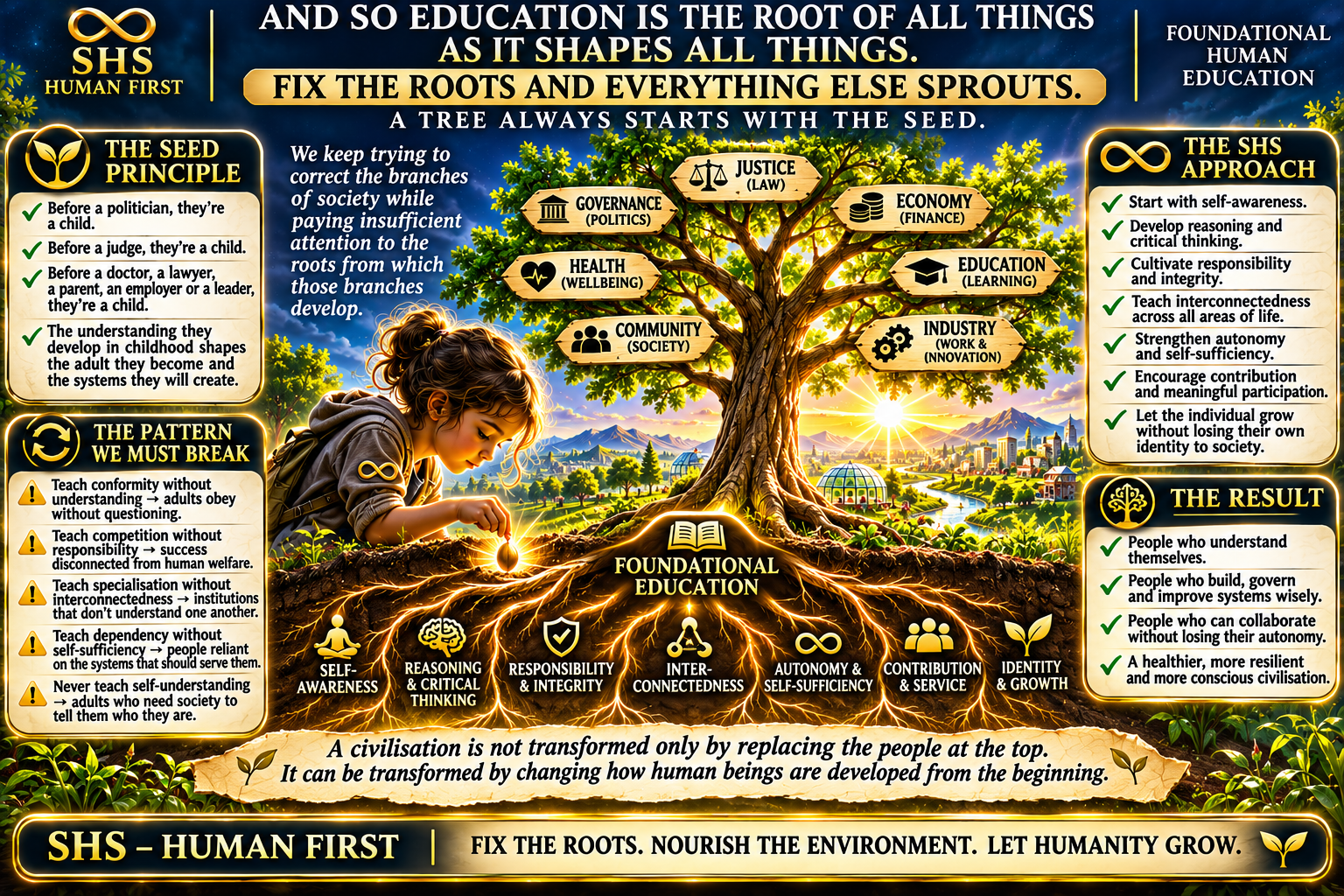
A person plants a tree.
They may not live to sit beneath its fullest shade.
Others may never know their name.
But the tree can still grow.
Its roots can still stabilise the soil.
Its branches can still provide shelter.
Its seeds can still create other trees.
The original act of care can continue producing consequences long after the person who performed it is gone.
And that’s what I mean when I say that, at Stage Three, taking care of others becomes another way of taking care of one’s own continuity.
You are tending to the world into which your contribution will continue.
You are creating conditions beyond yourself.
You are recognising that your existence is part of a much longer human story.
And your relationship with that story does not have to end at the boundary of your immediate participation.
I DON’T NEED TO BE THE ONE SITTING UNDER THE TREE TO KNOW WHY I PLANTED IT.
This is where I stand today.
I want to live.
I want to enjoy life.
I want to love.
I want to be loved.
I want to participate in what I build.
I want to experience the full expression of the work I’ve developed.
I want the people around me to understand me beyond the versions of myself they remember.
I want to receive care, not merely provide it.
And I want to see what humanity can become when we organise life differently.
But none of those desires is a condition for me to recognise the value of contributing.
I have already reached a place within myself where I can look at the life I’ve lived and see someone I would honour.
That doesn’t mean my development is finished.
It doesn’t mean I have nothing left to learn.
It doesn’t mean my work has already achieved every outcome I intend for it.
It means I no longer require the promise of future recognition to justify the existence I’ve already lived.
And when I look at the future, I don’t see only what I personally might receive from it.
I see what I might be able to leave for others.
I see what they might create from what I leave.
I see what might continue long after my immediate involvement.
And within my personal belief in reincarnation, I also see the possibility of existence continuing into a world influenced by the contributions of the lives that came before.
That is part of how I understand the continuity of life.
Not merely as a series of individual achievements, but as an interconnected history of contributions that shape the conditions inherited by those who follow.
Some people build because they want to be part of what they create.
Some people build because they want what they create to become part of the world.
And some of us want both, while understanding that the second does not depend upon the first.
Perhaps that’s why the distinction is so difficult for people to recognise.
Because if your understanding of achievement is inseparable from personally experiencing its rewards, you may struggle to understand someone who considers the contribution itself a meaningful outcome.
But that doesn’t make the contribution less real.
It simply means you’re examining it through a different relationship with existence.
So here’s my question to every creator, every builder, every leader, every parent, every professional and every human being deciding what to do with their life:
If you knew you could create something extraordinary for humanity, but you could not guarantee that you would personally experience its fullest expression, would you still create it?
And if the answer is no, why?
What exactly are you building for?
What do you need your creation to give back to you?
And how much of your relationship with creation is determined by the life you want to experience, rather than the life you want to make possible?
There is no requirement for everybody to have the same answer.
But understanding the answer may reveal something profound about how we perceive ourselves, other people, time, mortality and the purpose of our contributions.
As for me, I know my answer.
I would still plant the tree.
I’d love to sit beneath it.
I’d love to watch it grow.
I’d love to see what the world becomes around it.
But if my lifetime ends before its branches reach their fullest expression, I would still be glad I planted it.
Because the purpose of the seed was never merely to provide shade to the person who placed it in the ground.
It was to grow.
SHS – HUMAN FIRST
The Three Stages of Human Care | Consciousness | Creation | Mortality | Reincarnation | Integrity & Continuity
I do not need to possess the future to contribute to its existence.
And I do not need the world to remember my name for my contribution to become part of its memory.


Leave a Reply