
No pun intended for the DIC.🤣 We make light of serious matters. Society seems to love this so much, so why not?!
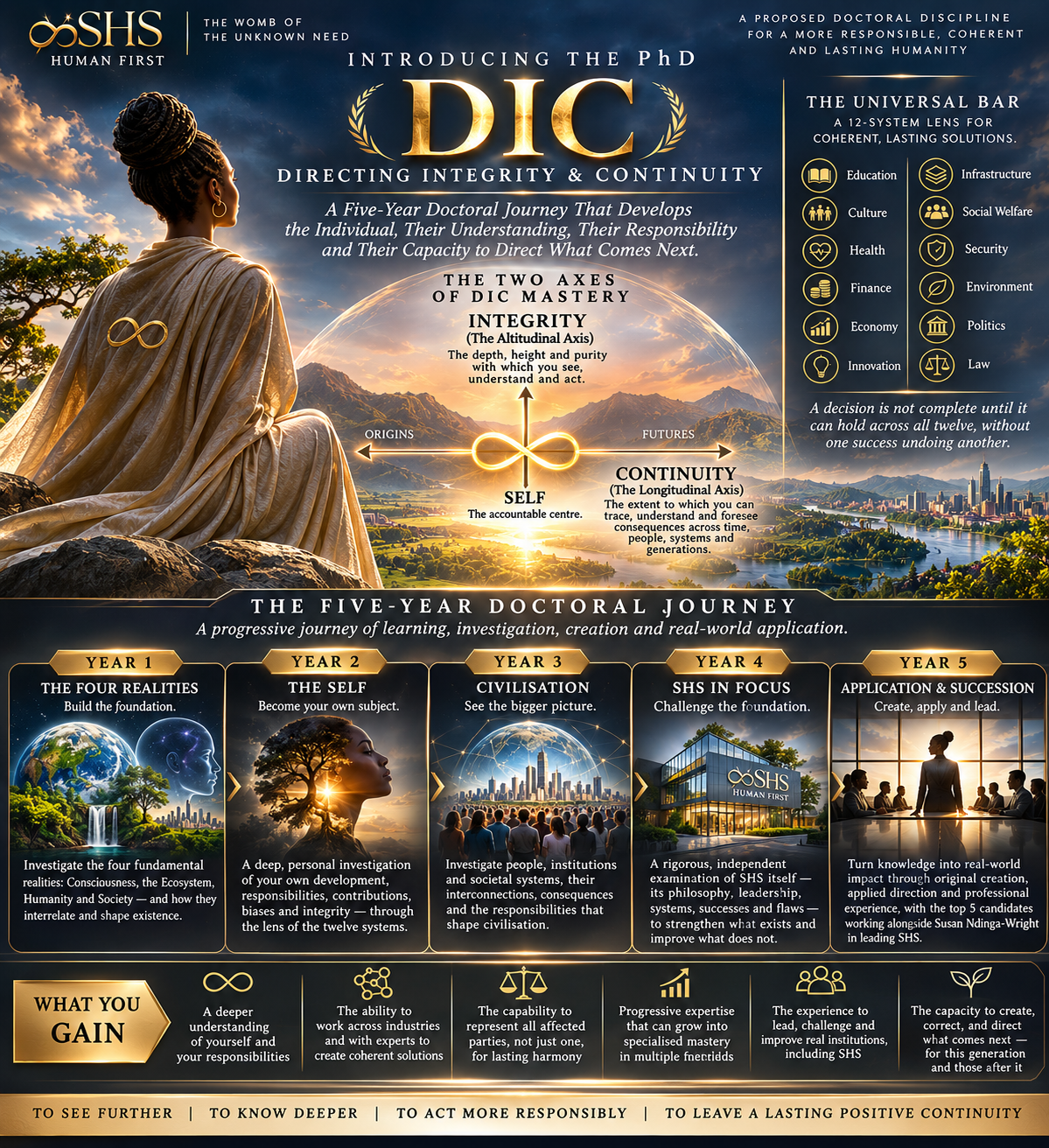
Introducing the Proposed PhD in Directing Integrity & Continuity (DIC) — A Doctoral Journey Where You Study Reality, Investigate Yourself, Examine Civilisation, Challenge Your Own Educators, and Ultimately Learn to Direct What Comes Next.
SHS – HUMAN FIRST | The Womb of The Unknown Need
By Susan Ndinga-Wright | Founder, Metaphysical Expert & Chief Continuity Architect
Imagine entering a doctoral programme where, rather than beginning with the expectation that you must become an expert in one particular industry, you are invited to understand the foundations upon which every industry, institution, relationship and human experience exists.
And then, imagine that the subject you will spend an entire year investigating is yourself.
Not the version of yourself you present professionally.
Not the identity society has given you.
Not merely your personality, ambitions, education, achievements or limitations.
But the human being who has been developing through the continuities of consciousness, life, humanity and society since before you were capable of recognising any of them.
Imagine having to understand yourself so thoroughly that, by the time you begin investigating the decisions of governments, businesses, professionals and institutions, you have already spent a significant part of your education learning to recognise your own biases, contradictions, assumptions, responsibilities and consequences.
And imagine that, before graduating, you will be invited to investigate the very organisation responsible for your education.
Including its founder.
Welcome to the proposed PhD in Directing Integrity & Continuity.
A doctoral discipline I intend to develop through SHS – HUMAN FIRST, designed not merely to produce knowledgeable individuals, but individuals capable of progressively extending how far they can see, how deeply they can understand, and how responsibly they can act.
FIRST, WHAT ARE YOU ACTUALLY LEARNING TO MASTER?
There are two directions that define this discipline.
Integrity — the altitudinal axis.
Continuity — the longitudinal axis.
The first concerns the extent and depth of integrity you are capable of maintaining in your knowing, investigations, reasoning, behaviour and decisions.
The second concerns how far you can trace reality through its origins, present conditions, interconnected consequences and possible futures.
The objective is to develop both directions simultaneously.
Because what good is extraordinary foresight if you lack the integrity to use it responsibly?
And what good is extraordinary integrity if your knowledge is so limited that you cannot foresee the consequences of your own decisions?
The goal is to see the longest with the highest integrity possible.
But to do that, you must keep learning.
You must develop your own knowing as extensively as the responsibilities you intend to carry.
And that is where our proposed doctoral journey begins.
YEAR ONE — BEFORE YOU STUDY THE WORLD, LEARN THE REALITIES THAT MAKE IT POSSIBLE.
Your first great acquisition: a foundation for understanding everything else.
We begin with four fundamental dimensions of the reality in which you exist.
Consciousness. The Ecosystem. Humanity. Society.
Consciousness, as explored through our metaphysical foundations, concerns the very nature of awareness, existence and the unknown.
The ecosystem concerns life and the natural systems in which humanity exists.
Humanity concerns the human being: our bodies, minds, emotions, development, relationships, capabilities and contributions.
Society concerns the systems, structures, beliefs, laws, economies, institutions and cultures humanity has created.
You will investigate how these dimensions relate, how they influence one another and where the distinction lies between what nature provides and what human beings have constructed.
You will learn to distinguish what is established knowledge, what remains open to investigation and what belongs to philosophical or metaphysical interpretation.
One fascinating proposal is that our founding cohort will help determine the direction in which this educational journey is first taught.
Do we begin with consciousness and progress towards society?
Or begin with society and investigate backwards towards consciousness?
Either way, you will encounter all four.
By the end of your first year, you should possess a fundamentally expanded lens through which to investigate reality, rather than simply a collection of new information.
And you will produce your first major research work examining the foundations and interrelationships of these four dimensions.
Then comes the year I am particularly interested in witnessing.
YEAR TWO — YOU BECOME YOUR OWN SUBJECT OF INVESTIGATION.
Your second great acquisition: the ability to hold yourself accountable through a deeper understanding of your own existence.
For an entire year, you are invited to be almost obsessively curious about yourself.
How did you become who you are?
What did you inherit?
What did you learn?
What have you accepted without questioning?
Which experiences developed your understanding of responsibility?
Which of your behaviours emerged as adaptations to circumstances that may no longer exist?
How have you contributed to the realities you criticise?
How have you benefited from arrangements you disagree with?
What have you consumed, produced, protected, ignored, misunderstood or unknowingly passed forward?
And how does your personal history connect with the four dimensions you studied during your first year?
You will now examine yourself through the twelve systems of our Universal Bar: Education, Culture, Health, Finance, Economy, Innovation, Infrastructure, Social Welfare, Security, Environment, Politics and Law.
Not to judge your worth as a human being.
But to understand the responsibilities of being one.
You will investigate your own continuity, identify your integrity marks, distinguish your intentions from your outcomes and develop the ability to recognise when your personal experiences are influencing your judgement.
Your second major thesis will examine your own existence within the larger reality.
And I envision a practical defence exercise, inspired by the simulated court proceedings seen in legal training, where you will demonstrate how well you can investigate, explain and defend your conclusions while remaining open to challenge.
Imagine completing an entire year of education and discovering that one of your greatest achievements is knowing yourself well enough to recognise when you might be wrong.
You cannot responsibly direct the integrity of others while refusing to investigate your own.
YEAR THREE — NOW LOOK AT EVERYONE ELSE.
Your third great acquisition: the ability to understand civilisation beyond the boundaries of individual institutions.
You have investigated reality.
You have investigated yourself within it.
Now we expand the investigation to humanity collectively.
Families, companies, governments, industries, communities, educational systems, laws, economic arrangements, technology, culture, power and authority.
You begin investigating how one decision produces consequences across multiple territories of life.
Consider a company making a decision that benefits its finances but compromises its workforce.
Or an innovation that improves efficiency while producing environmental costs.
Or a legal proceeding in which unequal access to representation affects the pursuit of a reliable and just outcome.
What happens beyond the initial decision?
Who benefits?
Who carries the costs?
What responsibilities were considered?
Which were missed?
What happens when a consequence becomes somebody else’s problem, and that person’s solution creates another problem elsewhere?
This is where your growing expertise becomes collaborative.
You may work alongside legal specialists without becoming a lawyer, healthcare experts without becoming a clinician, or engineers without possessing an engineering doctorate.
You will have developed your own discipline’s expertise: understanding how to investigate the relationships between their territories, recognising where knowledge must be expanded and bringing the relevant experts together to examine what a more coherent solution requires.
You will learn to be challenged by specialists as much as you learn to challenge them.
And through continued experience, you may develop substantial additional expertise in particular industries.
You are not learning to replace every expert. You are learning to understand where their expertise converges with the responsibilities of everyone else.
Your third major thesis examines civilisation, its institutions, their interactions and the consequences of their organisation.
By now, you have three different bodies of investigation:
Reality itself.
Yourself within reality.
And civilisation within that same reality.
But before we allow you to go further, there’s something else you must do.
YEAR FOUR — INVESTIGATE THE PEOPLE WHO TAUGHT YOU EVERYTHING.
Your fourth great acquisition: intellectual independence, institutional courage and the ability to hold even your own foundations accountable.
Yes, you read that correctly.
Your fourth year will be dedicated to examining SHS – HUMAN FIRST itself.
The organisation.
Its philosophy.
Its economic propositions.
Its institutions.
Its leadership.
Its educational frameworks.
Its operations.
Its contradictions.
Its foreseeable consequences.
And the extent to which its actions actually represent the integrity and continuity it claims to stand for.
Including my own decisions as its founder.
You will be expected to investigate what works, what doesn’t work, what could work better, what has been overlooked and what might eventually become a problem if left unexamined.
You will have to challenge our assumptions.
Our reasoning.
Our arrangements.
And where necessary, our conclusions.
And through your fourth major research work, you will be given the opportunity to contribute to SHS’s own development and correction.
Imagine being educated by an organisation that prepares you to become one of its most capable investigators.
Not to destroy it.
Not to worship it.
But to help ensure it remains worthy of the responsibilities it intends to carry.
An organisation that claims to represent integrity and continuity must be willing to be investigated through those same principles.
That is how I intend for SHS to continue sharpening its own foundations as humanity and society evolve.
And importantly, your evaluation must be about the quality of your investigation, not whether your findings flatter us.
By the end of year four, you should be capable of examining an institution without being intellectually owned by it.
Including ours.
YEAR FIVE — NOW, WHAT CAN YOU ACTUALLY DO WITH EVERYTHING YOU KNOW?
Your fifth great acquisition: the opportunity to turn extensive knowing into responsible creation, professional expertise and applied direction.
This is where the journey begins transforming from the investigation of existing realities into your own contribution to what comes next.
You may discover an industry in which you want to develop further expertise.
You may identify an unmet human need that requires an entirely new approach.
You may want to create a service, investigate an institutional failure, develop an alternative arrangement or collaborate with specialists to redesign something that has never properly served the people affected by it.
The question becomes:
Now that you understand how far responsibility can extend, what are you capable of creating or correcting with that understanding?
Your work would be examined not only through academic research but through practical application, independent challenge and your ability to account for actual or reasonably foreseeable consequences.
And there is another opportunity I am proposing.
The five highest-performing eligible candidates would have the opportunity to combine their final studies with practical experience alongside me in the leadership and development of SHS.
Not simply to observe.
To participate, question, contribute, learn and demonstrate their capabilities within a real organisation.
Their performance would help establish where they may be most suited to contribute in the future, including specialist positions, leadership responsibilities, new locations or potentially the future direction of SHS itself.
The intention is not to offer special financial privileges for ranking highest, but meaningful experience and consideration for responsibilities they can demonstrate the capacity to carry.
The precise arrangements and appointment standards will need to be developed with our founding team.
And no individual will be considered a suitable successor merely because they achieved the highest academic score.
The most suitable successor will be whoever demonstrates the greatest ability to see the longest with the highest integrity possible.
Even if their thinking differs from mine.
Especially where they can recognise something I could not.
AND WHAT HAPPENS AFTER THE PHD?
This is perhaps the most exciting part.
Your learning does not end.
Your doctorate establishes expertise in Directing Integrity & Continuity.
But every industry you subsequently investigate becomes another opportunity to deepen your knowing.
Imagine spending ten years supporting investigations across law, healthcare, education and corporate governance.
Imagine twenty years contributing to the development of new institutions.
Imagine thirty years working alongside scientists, architects, governments, communities, artists and businesses.
Imagine fifty years of progressively understanding how humanity organises itself and how its decisions influence what comes next.
What extraordinary body of knowledge might you have developed?
What patterns might you recognise that someone confined to a single professional territory may never have encountered?
What specialised expertise might you eventually gain through sustained research and practice?
Perhaps you would pursue additional formal qualifications in some of those fields.
Perhaps your original work would merit academic recognition through the relevant independent processes.
Perhaps you would develop entirely new fields of investigation.
The point is not to collect doctorates. It is to continue developing the knowledge required to exercise responsibility at the highest level you are capable of reaching.
Your original doctorate would not be the end of your expertise.
It would establish the foundation from which that expertise could continue expanding.
THE UNIVERSAL BAR — WHEN ONE SOLUTION MUST ANSWER TO TWELVE REALITIES
Throughout your journey, you will become familiar with a question that can fundamentally transform the way you approach problem-solving.
What happens to everything else when I change this one thing?
Our Universal Bar examines twelve systems simultaneously.
Imagine developing a solution that satisfies six of them.
Then you reach the seventh and discover that meeting its requirements compromises the second.
Do you ignore the second because it has already been checked?
No.
You return to the investigation.
You reconsider the relationship.
You develop further alternatives.
You work towards a solution that can satisfy all twelve without one success cancelling another.
And when conflicting needs cannot yet be fully reconciled, you must explain those limitations and the responsibilities they create rather than pretend harmony has been achieved.
This is the kind of thinking I want the discipline to develop.
Because human beings do not experience healthcare separately from their finances, their homes, their environment, their relationships, their education or the laws governing their lives.
We experience their consequences together.
So why should our solutions continue being designed as though those consequences exist separately?
WHAT I WANT YOU TO WALK AWAY WITH
Imagine beginning this journey believing that your greatest achievement will be obtaining a doctoral qualification.
And discovering, throughout it, that you are progressively becoming someone capable of understanding yourself, other people, institutions and their interrelationships with considerably greater depth.
Someone who can encounter a problem without immediately reducing it to the most familiar explanation.
Someone who understands when to investigate further and when to seek expertise they do not possess.
Someone who can recognise their own contribution to an undesirable outcome.
Someone who can challenge powerful individuals without needing to dominate them.
Someone who can defend humanity without treating the institutions humanity creates as enemies merely for existing.
Someone who can recognise that a business’s continuity and its customers’ welfare need not be competing interests.
Someone who can think about the next generation when making decisions for the present.
Someone who is willing to improve a system they helped create.
And someone whose growing knowledge makes them progressively more accountable, rather than more convinced of their own superiority.
That is the individual I want this discipline to help develop.
Not someone who knows everything.
Not someone who believes they are always right.
Not someone whose authority comes from having a title.
But someone capable of continually expanding the reach of their knowledge while strengthening the integrity with which they apply it.
And perhaps, eventually, someone who will develop this discipline beyond anything I am presently capable of imagining.
A FINAL WORD ON THE PROPOSAL
This five-year journey is a proposed educational architecture, not an already accredited or finalised doctoral programme.
Its specific curriculum, teaching methods, assessments, research doctrines, academic partnerships and formal qualification arrangements will be developed and examined with the relevant team.
I am sharing the intended journey because I want people to understand what the experience is supposed to develop within the individual, not merely what academic title may eventually be awarded.
Because when you understand the purpose of education, you can begin designing an educational experience worthy of that purpose.
And the purpose here is not merely professional competence.
It is to develop human beings capable of assuming greater responsibility as their knowledge, integrity and understanding of continuity grow.
The world already has extraordinary specialists.
I want to develop individuals capable of working alongside them to ensure that what humanity creates in one territory does not unknowingly undermine life in another.
And I want those individuals to be capable of holding themselves, their predecessors, their institutions and eventually their own successors to that same standard.
How far can you see?
How much integrity can you maintain while seeing it?
And how far are you willing to develop yourself to extend both?
That is the journey.
That is the ambition.
That is Directing Integrity & Continuity.
SHS – HUMAN FIRST
The Womb of The Unknown Need
DIC — Directing Integrity & Continuity
Consciousness | Integrity | Continuity | The Basic Human Needs Economy
A Proposed Doctoral Discipline and a Foundation for Generational Succession.


Leave a Reply