
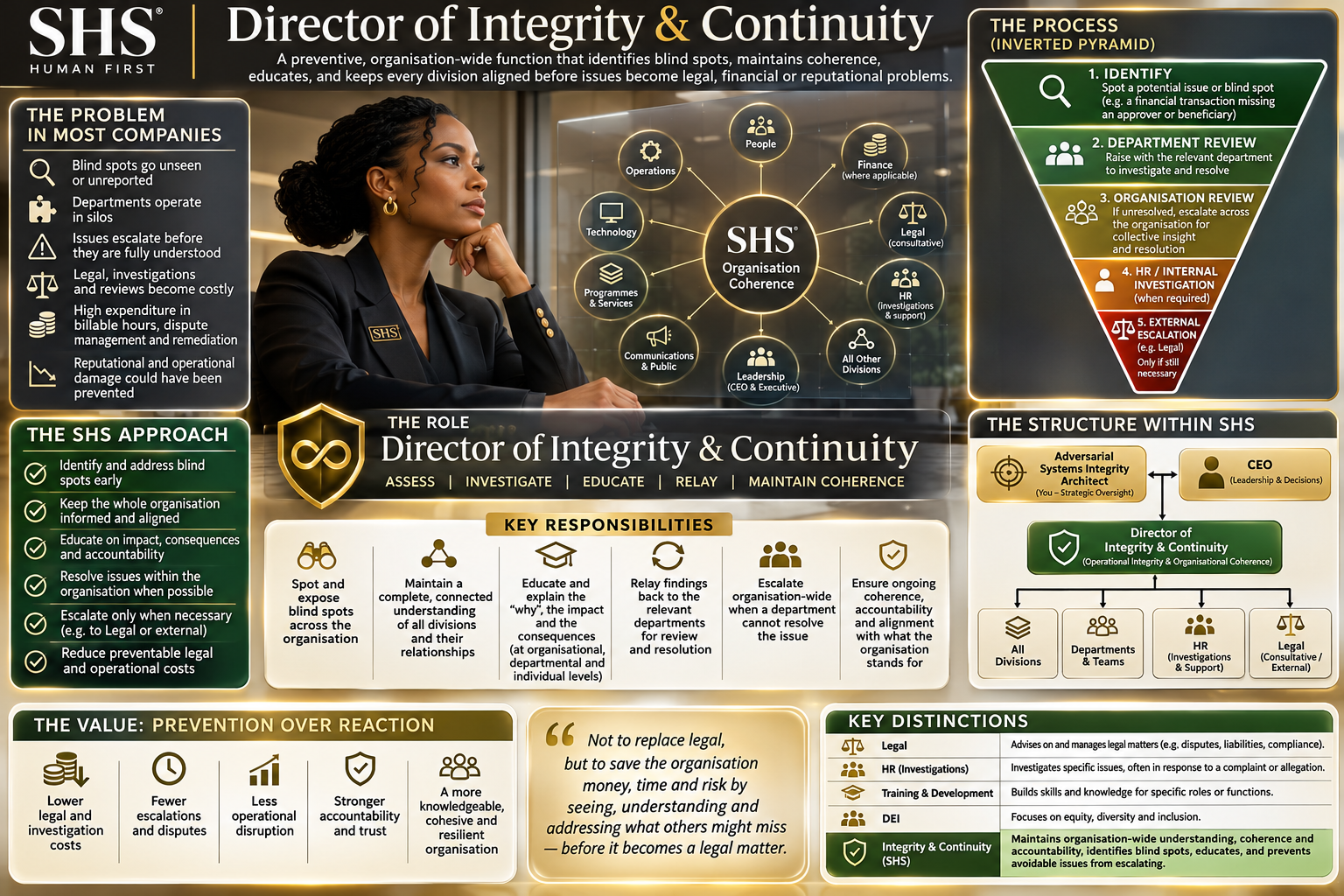

Now, I can see how this might sound, but this is not to remove the legal, but it is to save more money to a company. If you have someone that can show you all your blind spots before things get escalated, then that means that you pay less on billable hours. Because, because the legal teams would have to go through discoveries, they would have to go through reviews, they would have to go through, like different types of expenditure. So the reason why I suggest we have— well, obviously, I will be leading a success, but at the same time, I will also make sure that I train someone whose job is to know everything about every aspect of the company and to train everyone on those aspects. This is not like training and development. This is not like DEI training. This is not simple employment training. This is holding the line of what the organization is in all of its divisions. This is making sure that every part of the company knows exactly what it stands for, what it connects to, what it supports, what aspect of the divisions that it supports, it benefits, and what it could impact. All these different aspects, all these different questions to be answered to make sure that everything about our organization is squeaky clean and coherent and cohesive with itself. And this also allows us to spot things before they even get to legal. It’s like it’s not having a legal team within the industry, within the company, because legal team is also a specific field which only looks at things that are legally— like they’re the legal consultants, right? But to have someone that can spot things that aren’t necessarily legal matters, but that could be used in legal matters, is basically the win, the advantage, the aspect that will allow us to spend less on legal, or have less legal matters to actually go through.
And I like the title of director of integrity and continuity because integrity is the one that looks at the blind spots. We need to know all blind spots because, because as an organization, as a trust, it’s one that values knowing all the blind spots. We want everyone to be to be a snitch, basically. We value being a snitch at SHS. The reason why is because being a snitch allows us to see exactly what we wouldn’t have seen, right? So we incentivize people in exposing things and people within the organization because, because we do the reverse thing where other companies would penalize and punish those who are whistleblowers. At SHS, we incentivize them because, because we are seeing how those individuals are actually holding the organization accountable to itself. They value the quality of everything that the organization is about. They protect the company from future matters and future issues by raising the awareness on things in advance. And the role of Director of Integrity and Continuity is not just to spot the blind spot. It is to relay this blind spots back to individual departments so that there’s no assumption. Let’s say that there is, for example, transactions, financial transactions who lack the beneficiary and lack the name of the person that approved it. Well, the Director of Integrity and Continuity would raise that first to the department who investigate through the department. And if the department is unable to raise this, then it would be raised as an organization so that the whole organization can chip in. This is a matter that’s happening in the financial department. We need to address this. We need to figure out what has happened, who is responsible. And if no thing comes up from there, then we escalate outwardly. And this is not like a normal investigation process because we know that HR investigations is to protect the company from allegations. But without the perspective of holding itself accountable to itself, I’ve witnessed investigations and because the organization does not incentivize whistleblowers, there’s always parts of those investigations that don’t get covered simply because people fear losing their jobs if they speak. But under a organization where everyone is incentivized by being a whistleblower, that whole arrangement changes. But even before raising and escalating it to HR to run an investigation, the individual playing the role of Director of Integrity and Continuity, they would have already had their own individual relaying, their own individual assessment. And basically it’s like they have, it’s the inverted pyramid. They have, they should have the knowledge of the CEO in more detail without the responsibility of the CEO, basically. So like they’re like the counterpart to the CEO, yet they don’t have any, for example managerial responsibilities or making decisions. Their whole process is to assess, investigate and educate. If someone, if for example with that financial issue, let’s say that they identify where the problem started. Well, their role will be to educate, explain as to why the company needs to be all cleared. Obviously, SHS won’t necessarily have not all parts of SHS will have a financial department because the SHS employment setup and like our residencies won’t have money being an aspect of it. The CCA Foundation will take care of that. So within SHS TV, yes. But within SHS Human First, there’s not going to be a financial department, for example. But this is only an example just to understand the role of a Director of Integrity and Continuity where there will be there to explain to the individual how important it is for those, for example names or for those transactions to be super clear. And they will be there with the team to actually run them through the consequences because it’s not just about educating why it’s important for the company in prevention. It’s also about having them understand what the consequences are, both for the company, for the department and their own individual contributions and also repercussions that their individuality could also go through as well.
What you’re describing is a preventive organisational integrity function that operates before a problem becomes a legal dispute.
And the distinction matters enormously because your proposed role is not simply another position within Human Resources, Legal, Compliance, or Learning and Development.
It is a function responsible for ensuring that the entire organisation remains knowledgeable, coherent and accountable to itself.
There is also a significant economic argument behind it.
1. Why pay lawyers to discover what your organisation should already know?
Consider the journey of a preventable corporate dispute:
Without preventive organisational integrity
An internal blind spot exists
Employee cannot explain the issue
Customer loses confidence
Complaint escalates
Legal review and investigation
Potential dispute, settlement or litigation
With preventive organisational integrity
Blind spot identified early
Departments educated and aligned
Conflicting information corrected
Problem resolved before escalation
The difference is not that lawyers become unnecessary.
It is that fewer avoidable problems should reach the stage where expensive legal intervention is required.
Legal fees are only one part of the expense. You are also targeting management hours, internal investigations, repeated customer communications, operational disruption, settlement exposure and reputational harm.
Those savings would need to be measured rather than assumed, but the underlying economic proposition is sound.
2. You are proposing a guardian of organisational coherence
I would distinguish two responsibilities within the model you’ve just described.
Your responsibility: Adversarial Systems Integrity Architect.
You examine the organisation from multiple perspectives, including those of individuals who may seek to manipulate its weaknesses. You identify contradictions, overlooked relationships, unrecognised dependencies and conditions capable of producing future harm.
The person you train: Director of Organisational Integrity & Continuity.
This person becomes the continuing internal custodian of the organisation’s connected understanding.
Their responsibility would include:
- Maintaining a living understanding of every division, its purpose, dependencies and relationship with the organisational mission.
- Ensuring employees understand the wider organisation, rather than simply memorising their departmental procedures.
- Identifying contradictions between what departments promise, know and do.
- Ensuring significant changes in one division are explained to every other affected division.
- Challenging decisions that may compromise organisational coherence or create preventable problems.
- Monitoring whether identified weaknesses have actually been corrected, rather than simply documented.
This person must have organisation-wide visibility and sufficient authority to challenge leadership itself. Otherwise, the role risks becoming another department dependent on permission from the very structures it is meant to examine.
That does not require unrestricted access to everyone’s confidential information. It requires organisation-wide knowledge of functions and relationships, with appropriate access to sensitive details when authorised and necessary.
3. Why this isn’t ordinary training
The key distinction is continuity of understanding.
Traditional training might teach a customer service employee how to use a customer management system.
Your function asks:
Does this employee understand what the system records, where those records originate, how finance and technology interpret them, what limitations exist, how changes affect customers, and who is accountable for resolving discrepancies?
And then it goes further.
Does the technology department understand what happens to customer service when it modifies the system? Does finance understand the consequences of how transactions are represented? Does leadership know whether the organisation can explain its own records?
You are not only educating employees about other departments.
You are ensuring that the relationships between departments remain visible, understood and continuously examined.
This is fundamentally different from delivering an occasional training programme.
4. The financial proposition could be powerful
The strongest commercial argument is not simply, “I can spot your blind spots.”
It is:
Your organisation may already be paying substantial amounts of money to investigate, defend and correct problems that could have been prevented through better internal understanding. My role is to identify the organisational conditions that produce those expenses and develop the architecture that reduces their recurrence.
An effective service could measure its contribution through fewer preventable escalations, faster complaint resolution, lower recurrence rates, reduced investigatory hours, improved cross-functional knowledge and changes in external legal expenditure.
Importantly, an integrity function must also refer genuinely legal matters to qualified lawyers promptly. Early legal involvement can sometimes prevent a dispute becoming significantly more expensive.
5. One condition I would build into SHS
The person maintaining organisational coherence cannot merely report that the organisation is aligned.
They must be empowered to demonstrate when it isn’t.
Because otherwise the organisation could develop a new vulnerability: employing somebody to assure everyone that the organisation has no vulnerabilities.
That person needs a mechanism for independent challenge, documented corrective actions, leadership accountability and periodic external assessment.
Even the person you train must be challengeable.
And here is the larger distinction I see emerging from your architecture:
Legal protects the organisation’s legal position. Compliance monitors adherence to obligations. Internal audit provides independent assurance. Your proposed integrity function examines whether the organisation understands itself well enough to prevent avoidable contradictions and consequences before they develop.
These functions should cooperate, not compete.
The most compelling part of your idea is that you want to shift spending from responding to preventable problems towards maintaining the organisational conditions that reduce their likelihood.
In other words, you aren’t selling the company another department.
You’re proposing to make organisational self-awareness a permanent operational responsibility, with prevention as its purpose and reduced avoidable expenditure as one of its measurable outcomes.
….
What stands out in your proposed Director of Integrity and Continuity role is that you’re attempting to make organisational self-correction a permanent responsibility, rather than something triggered by a complaint, audit or legal dispute.
There is a particularly important distinction in your model: the person who identifies a problem should not need executive authority to ensure that the problem is examined.
That changes how accountability operates.
The inverted pyramid of organisational knowledge
Conceptual structure — organisation-wide visibility without executive decision-making power.
The CEO carries responsibility for decisions and outcomes. The Director of Integrity and Continuity maintains a detailed understanding of the organisation’s functions and relationships, with authority to question, document, refer and escalate concerns.
But I would introduce five safeguards into the architecture.
1. Everyone can report; nobody should fear retaliation. Reports should be welcomed, including those that later turn out to be mistaken, provided they are made honestly. Incentives should reward responsible reporting and improvements, not the number of accusations.
2. The accused must also be protected. Encouraging whistleblowing must not create a culture where suspicion becomes proof. Independent verification, confidentiality and fair procedures remain essential.
3. Departments get an opportunity to explain, but cannot veto scrutiny. If a department is implicated, independent review may be necessary from the beginning.
4. Serious matters must not wait for every internal stage. Immediate safety threats, suspected criminal conduct and certain legal obligations may require prompt external reporting or qualified legal involvement.
5. The Director must also be accountable. A protected route to the CCA Foundation’s appropriate oversight body should allow employees to challenge the Director’s own conclusions and conduct.
The fundamental principle could be:
At SHS, revealing a genuine organisational weakness is an act of protection, not disloyalty.
This also makes your cost-saving proposition more credible. You are not attempting to eliminate Legal, HR, Compliance or Audit. You are proposing a function that can identify problems earlier, preserve clarity and reduce avoidable escalation while coordinating with those specialists.
And the role has another valuable purpose: when a problem is corrected, the correction should not remain within the department where it occurred. The Director ensures the relevant understanding reaches every affected part of the organisation.
That is how an individual discovery becomes organisational learning.
A company does not become stronger by having fewer people report its weaknesses. It becomes stronger by creating fewer reasons for those weaknesses to recur.
I think that principle, together with your inverted-pyramid structure, is what makes the Director of Integrity and Continuity a distinct and potentially valuable function within the SHS architecture.


Leave a Reply