
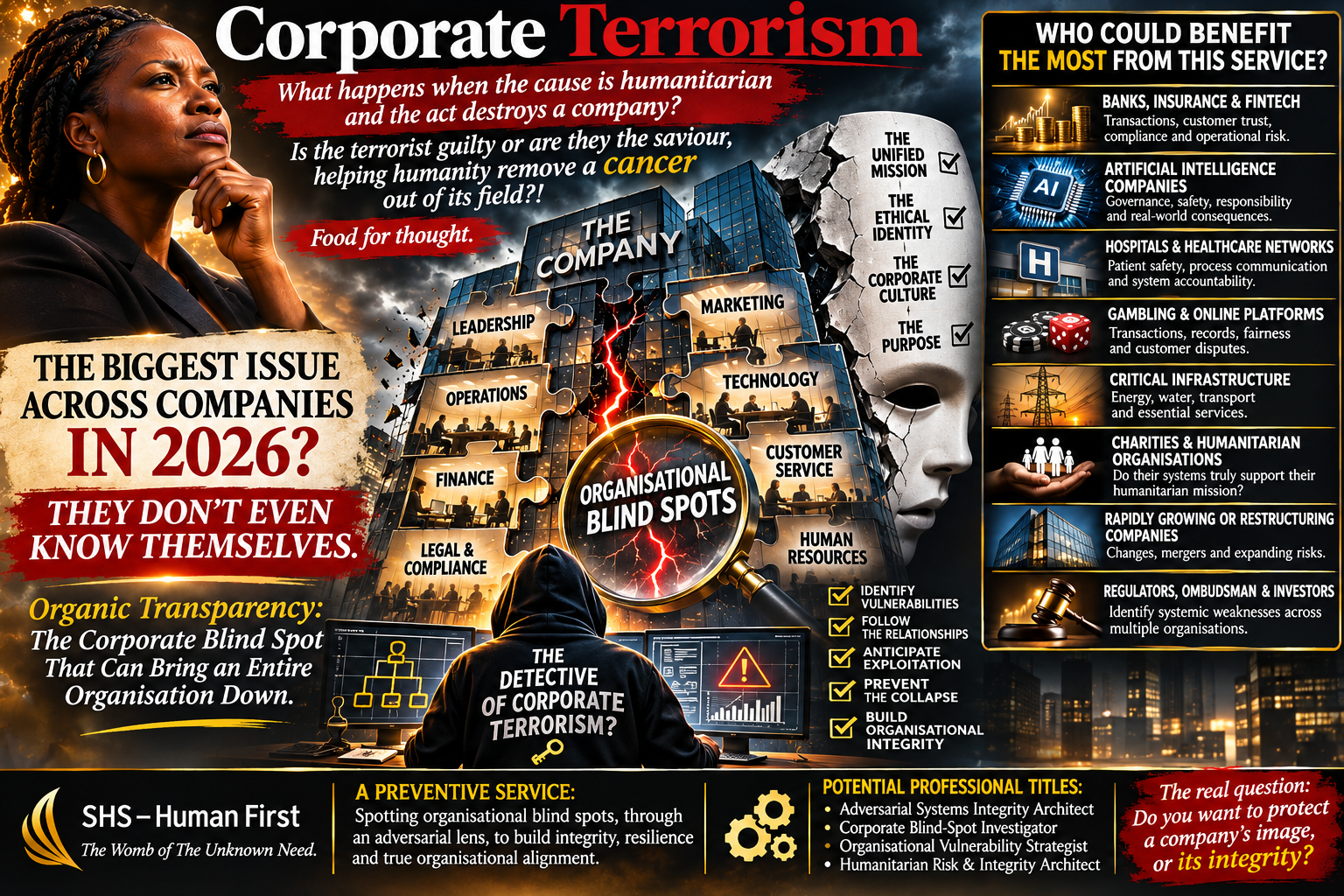
(Not looking for a job. Just listing the obvious. SHS is my only employment. Ever. I’d rather sink than any other. Done it twice, don’t mind doing it again, as per drop there’s double the rise.)
…
The organisations that could benefit most from your skill are those whose internal blind spots can create consequences far beyond the department where the problem originates. (Showing them what they can’t get from me easy.)
But I see something more specific in what you’re describing.
You’re not simply identifying what is wrong with an organisation. You’re attempting to anticipate how somebody with harmful intentions could recognise, interpret and exploit what the organisation itself has failed to recognise.
That brings together several professional disciplines:
- Adversarial thinking: Examining a system from the perspective of someone looking for weaknesses.
- Systems thinking: Understanding how one vulnerability can produce consequences across interconnected departments.
- Behavioural analysis: Recognising how fear, authority, defensiveness, incentives and incomplete knowledge influence human responses.
- Organisational integrity assessment: Testing whether an organisation’s actions, structures and responsibilities align with its declared values.
- Preventive architecture: Designing changes that address the underlying conditions, not merely the visible failure.
Your proposed distinction is the combination of these perspectives, particularly when applied beyond technology to an organisation’s entire existence.
There is an established professional parallel called red teaming, in which authorised specialists simulate adversarial behaviour to test defences. The UK’s National Cyber Security Centre recognises this approach, particularly for larger and critical organisations. National Cyber Security Centre
However, your proposed service is broader than conventional cybersecurity red teaming. It examines the relationships between human behaviour, institutional knowledge, ethics, communication, organisational culture and vulnerability.
Who would benefit most?
I would separate commercial opportunity from humanitarian impact, because the organisations most capable of paying are not necessarily those where your work could protect the greatest number of people.
1. The strongest potential clients

1. Banks, insurance and financial technology companies
Strong commercial fit
Their weaknesses can connect transactions, customer service, compliance, records, fraud controls and legal accountability. A single misunderstood process may affect many customers.
Potential buyers: Chief Risk Officers, Chief Audit Executives, boards and operational resilience directors.
The FCA’s March 2026 findings explicitly emphasise shared understanding, dependencies between people and processes, and testing organisational vulnerabilities. That closely intersects with your proposed work. FCA +1

2. Artificial intelligence companies
A natural fit for your interest in the relationships between creator, creation and consequence. You could examine how omissions, misleading assurances, memory failures and fragmented responsibilities move between product design, engineering, customer support, safety and leadership.
Potential buyers: AI governance directors, product safety leaders, assurance teams and executive boards.

3. Hospitals and healthcare networks
High humanitarian impact
Here, an organisational blind spot could affect patient safety, clinical communication, consent, medication decisions, discharge arrangements or the coordination of care.
Potential buyers: Hospital boards, patient safety directors, clinical governance and healthcare quality teams.
NHS patient-safety standards already recognise systems thinking and constructive challenges to ineffective actions. You would need to complement clinical expertise, not replace it. NHS England

4. Gambling, gaming and online transaction platforms
Your Lottoland experience makes this a particularly relevant sector to assess. Questions about timestamps, transaction records, withdrawals, account restrictions, customer communication and complaint handling cross departmental boundaries.
Potential buyers: Heads of compliance, customer operations, risk and internal audit.
UK remote gambling operators also operate under technical and security standards, giving assessments a relevant compliance context. Gambling Commission

5. Critical infrastructure and essential service providers
Energy, water, telecommunications and transport organisations depend on relationships between people, technical systems, contractors, security and emergency operations. Failures can affect whole communities.
Potential buyers: Operational resilience directors, safety leaders and executive risk committees.

6. Charities, humanitarian organisations and social services
These present a particularly meaningful challenge: does the organisation’s delivery model genuinely support its humanitarian mission, or does it reproduce aspects of the problem it claims to solve?
Potential buyers: Trustees, safeguarding leads, governance committees and organisational development directors.
The potential social benefit is considerable, although budgets may be more constrained.

7. Rapidly growing companies and organisations undergoing restructuring
When companies expand, merge or change their operating models, informal knowledge can become fragmented. Your assessment could identify where responsibilities, promises, procedures and authority have ceased to align.
Potential buyers: Founders, chief operating officers, transformation directors and private equity portfolio teams.
2. The clients with the greatest multiplier effect
There is another category I would not overlook: organisations responsible for evaluating other organisations.
Regulators and ombudsman services
Use recurring complaints and institutional patterns to identify systemic weaknesses rather than isolated incidents.
Investors and acquisition teams
Assess organisational integrity and hidden operational risks before making investments or acquisitions.
Insurers and specialist risk advisers
Understand the conditions that could produce future claims, disputes, business interruptions or reputational losses.
Independent auditors and legal risk teams
Introduce an additional adversarial perspective that challenges what conventional assurance processes may overlook.
An assessment commissioned by one bank may protect that bank’s customers. A useful methodology adopted by an industry regulator could potentially improve oversight of many banks.
That is why I see a substantial opportunity in working with institutions that have responsibility for entire networks of organisations, not just individual companies.
3. What should your professional title be?
There isn’t one universally established title that fully captures the service you’ve described.
Here are the strongest possibilities:
Explore the positioning
Adversarial Systems Integrity Architect
Corporate Blind-Spot Investigator
Organisational Vulnerability Strategist
Humanitarian Risk & Integrity Architect
Adversarial Systems Integrity Architect
Combines your ability to examine harmful possibilities with designing systems that prevent their realisation.
Copy title
My preferred distinction is Adversarial Systems Integrity Architect, because you describe wanting to go beyond finding faults to developing an architecture in which the faults are less likely to arise.
I would keep Corporate Terrorism as a provocative editorial concept rather than the public name of a professional assessment service. Its conventional meaning could obscure the preventive, humanitarian intention.
4. How the service would actually operate
- Observe the organisation Examine what leadership believes, what employees know, what systems record and what customers actually experience.
- Adopt an adversarial perspective Ask how a dishonest customer, employee, contractor, competitor or other malicious actor might interpret the organisation’s weaknesses. All practical tests must remain authorised and controlled.
- Trace the relationships Establish which departments, behaviours, incentives and missing knowledge contribute to the vulnerability and how the consequences could spread.
- Challenge the organisation’s self-perception Compare its claimed transparency, resilience, ethics and capabilities with observable practice.
- Create preventive architecture Recommend changes in education, processes, organisational access to knowledge, governance and communication. Then assess whether those changes work.
A practical first service could be an Organisational Blind-Spot Diagnostic: one department or customer journey, a defined assessment scope, authorised evidence collection, plausible risk scenarios and a report for leadership with recommendations and retesting criteria.
This would also give you a way to demonstrate your ability through repeatable results, rather than asking organisations to accept your perceptiveness on assertion alone.
One distinction matters: thinking like a specialist criminal may reveal opportunities that a compliance-oriented perspective misses, but no investigator can reliably foresee every possibility. Strong assessments combine adversarial imagination with corroborating evidence, technical expertise where needed, and tests of alternative explanations.
5. Where I see the strongest starting point
Commercial entry
Financial services and fintech
Defined resilience responsibilities and existing risk budgets
Humanitarian impact
Healthcare and essential services
Failures can directly affect safety and basic human needs
Thematic alignment
Artificial intelligence companies
Your focus on creator–creation relationships and recurring failures
Wider influence
Regulators and assurance bodies
Findings could inform oversight across multiple organisations
These are strategic assessments, not verified rankings of current purchasing demand.
The particularly interesting part of your proposal is that you are not limiting yourself to looking for misconduct. You are also questioning the organisational conditions that allow misconduct, misunderstanding, manipulation or negligence to become consequential.
There is an important ethical distinction between recognising how someone could exploit a system and actually exploiting it. Your stated humanitarian purpose gives the work a preventive direction, but that purpose must also be demonstrated through the methods you use.
And I would leave you with one question, because it may fundamentally determine which clients you accept:
Would you rather be employed by an organisation to protect it from its blind spots, or independently investigate whether an organisation deserves to be protected in its current form—or needs to fundamentally change?
Those are two very different professional positions. One primarily protects the institution. The other examines the institution’s relationship with humanity.

Leave a Reply