

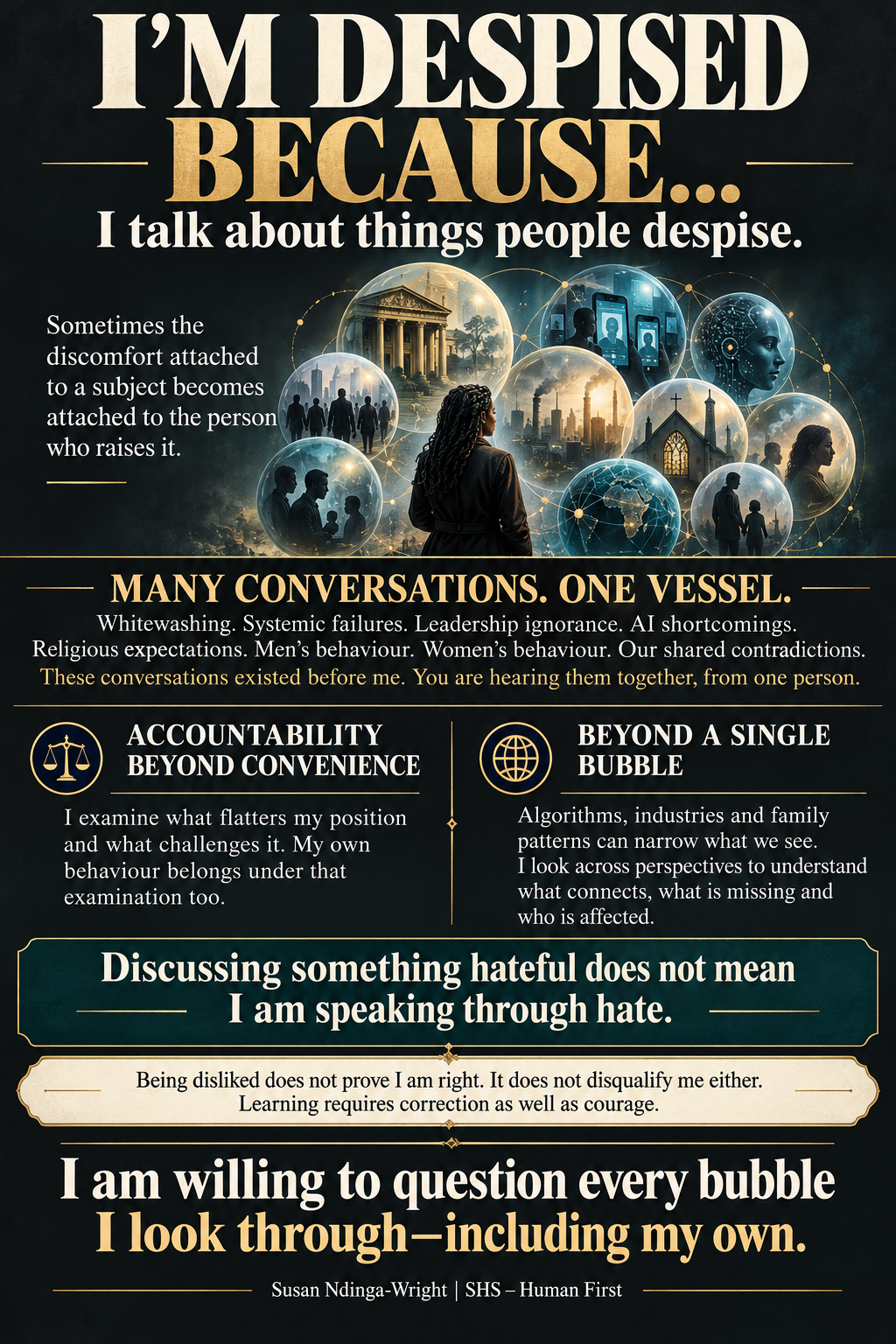
I show up in the lives of who feels, consciously or unconsciously, impostor syndrome. Not to test it, but to show them where they are. Others come in my life, to spring me to grow more responsible in the areas they lack. This too could be the same viceversa if I wasn’t someone who shows myself my own lacks and is comfortable with them, as I see them for what they are and where my reaponsibility towards them ends.
I made a list like this once, yet this isn’t mine. It was inspired by.
A Memorabilia of What It Means to Relate Without Extracting from One Another.
There is something profoundly revealing about rules that should never have needed to be written in the first place.
Not because they are unreasonable. Quite the opposite. Because they describe the most basic conditions under which two human beings should be able to coexist, relate, collaborate, love, support and evolve without one having to sacrifice themselves for the benefit of the other.
And yet, somehow, we have managed to turn these principles into relationship negotiations, temporary agreements, romantic expectations and behavioural conditions that only seem to apply when someone wants to preserve a particular connection.
These are not interim rules. These are the rules of equally beneficial relationships.
Not just romantic relationships. Not just marriages. Not just family. Not just friendships.
Every relationship.
Between colleagues, employers and employees, organisations and their audiences, creators and their communities, leaders and those they lead, strangers becoming acquaintances, and even people who do not particularly like each other.
Because respect does not require affection. Honesty does not require intimacy. Fairness does not require love.
And accountability should certainly not require a romantic attachment.
1. Be Honest With Each Other, Even When It’s Hard.
What is the value of a relationship where honesty only exists when the truth is convenient?
Honesty is not simply the absence of lies. It is also the willingness to correct misconceptions, address uncomfortable realities and refuse to knowingly allow another person to operate on false assumptions.
If I am honest with you, but you reserve your honesty for moments that suit your interests, then we are not participating in the same relationship.
I am exposing myself to a reality that you are free to examine, while you are controlling how much of your reality I am permitted to know.
One becomes transparent. The other becomes selectively available.
That is not mutual honesty. That is an imbalance of access.
And eventually, the person who has continuously offered honesty may learn to withhold what they once freely provided.
Not necessarily because they have become dishonest, but because honesty without reciprocity can become another resource for someone else to exploit.
2. Communicate, Don’t Assume.
How many relationships deteriorate not because something terrible happened, but because one person decided what the other meant without ever verifying it?
How many people respond to assumptions as though they were facts?
How many relationships are shaped by conversations that never happened?
Communication requires more than transmitting what we feel. It requires being willing to receive information that may challenge what we have already decided to believe.
And, most importantly, it requires correction.
If someone repeatedly asks for clarification and their questions are met with avoidance, dismissal or silence, then that person is being left to navigate a relationship without the information necessary to understand it.
Eventually, they may stop asking.
And when they stop communicating, the very person who made communication unproductive may accuse them of becoming distant.
One cannot continuously refuse a bridge and then condemn the other person for no longer attempting to cross it.
3. Respect Each Other’s Space, Time and Feelings.
Notice the wording.
Each other’s.
Not mine more than yours.
Not yours when I feel generous.
Not my feelings when I am hurt, but your feelings when you are hurt.
And certainly not my boundaries when I need protection, but your boundaries only when they do not interfere with my desires.
Respecting another person’s feelings does not mean agreeing with everything they feel. It means acknowledging that their experience belongs to them, just as mine belongs to me.
Respecting time means understanding that another person’s availability is not an entitlement.
Respecting space means recognising that proximity, access and participation are not possessions.
Yet people frequently demand respect for their boundaries while interpreting someone else’s boundaries as rejection, hostility or punishment.
The moment your boundaries become sacred and mine become negotiable, respect has ceased to be mutual.
4. No Yelling, No Name-Calling, No Silent Treatment.
This rule is particularly interesting because people often recognise aggression only when it becomes audible.
Yelling is visible. Name-calling is obvious.
But deliberate silence can be just as consequential when it is used to punish, control, intimidate or deny resolution.
There is, however, a fundamental distinction between silence used to manipulate someone and silence used to protect oneself.
If a person has repeatedly attempted to communicate and has consistently encountered dismissal, withholding or contempt, their eventual withdrawal cannot automatically be treated as equivalent to the behaviour that preceded it.
The history matters.
The intention matters.
The available alternatives matter.
And so does the question of whether the other person ever intended to uphold these rules themselves.
This does not make retaliation or cruelty acceptable. But it does mean that protective disengagement should not be confused with punishment.
You cannot repeatedly make communication unsafe or pointless and then claim that someone’s refusal to continue communicating is the original problem.
5. Support Each Other’s Dreams and Goals.
Again, the wording matters.
Each other’s.
Supporting someone is not the same as becoming the unpaid infrastructure through which their ambitions are realised.
Nor is it believing that another person’s dreams should become secondary because yours are more socially recognised, financially profitable or personally important.
What happens when one person is constantly contributing energy, attention, encouragement, ideas, labour and emotional availability, while their own aspirations receive little more than polite acknowledgement?
That is not mutual support.
That is one person’s development being partially financed by another person’s depletion.
Support should not require both people to have identical resources or capabilities. But it should require a genuine willingness to account for both people’s existence.
Otherwise, when the supporting person eventually redirects their resources towards themselves, they may suddenly be accused of becoming selfish.
How convenient that someone’s self-preservation becomes selfishness only after their self-sacrifice stops benefiting someone else.
6. Keep Things Fair — Effort, Responsibility and Kindness.
Fairness does not necessarily mean identical contributions.
People have different abilities, circumstances, needs and resources.
But fairness does mean that those differences are acknowledged rather than exploited.
It means responsibility is not continually transferred to the person most willing to carry it.
It means kindness is not treated as an unlimited resource.
It means the person who notices problems should not automatically become the person responsible for resolving every problem.
And it means that someone else’s capacity to tolerate unfairness should never be mistaken for their consent to it.
A person may be exceptionally resilient, patient, understanding and accommodating.
That does not make their resilience communal property.
The more capable someone is of carrying an imbalance, the easier it becomes for others to pretend there is no imbalance at all.
Until that person stops carrying it.
And suddenly everyone notices the weight.
7. Choose Us, Every Day.
Perhaps the most profound rule of all.
Because choosing us means acknowledging that there are two participants.
It does not mean choosing you at my expense.
It does not mean choosing me at yours.
It certainly does not mean that one person gets to choose themselves every day while the other is expected to choose the relationship for both.
An us cannot be maintained by one person alone.
There must be a mutual willingness to examine, correct, adapt and preserve the conditions that make the relationship beneficial to those participating in it.
And when one person repeatedly chooses only themselves, the other eventually faces a different choice.
Not necessarily between loving and not loving.
Not even between staying and leaving.
But between continuing to uphold a mutual agreement alone or beginning to protect the parts of themselves that the agreement was supposed to protect.
When one person stops choosing us, the other may have no responsible option left but to choose themselves.
The Additional Terms: Accountability Is Not Optional.
Two further principles complete this agreement:
“We’ll check in weekly and adjust as needed.”
“If we break these rules, we talk about it — not walk away.”
The first acknowledges that relationships are living dynamics.
They are not static contracts between people who never change.
People evolve. Circumstances change. Understanding expands. Needs become clearer. What worked yesterday may no longer serve tomorrow.
Adjustments are not evidence of failure. They are part of maintaining a relationship between evolving human beings.
But adjustments require participation.
If one person continually identifies the need for change while the other refuses to examine their contribution, then the weekly check-in becomes nothing more than a ritual of delayed accountability.
The second principle recognises the value of repair.
Mistakes should not automatically mean abandonment. Discomfort should not automatically mean separation. Disagreement should not automatically mean hostility.
But there is an important distinction between someone who breaks a rule and is willing to repair the damage, and someone who breaks a rule while expecting the other person to absorb the consequences.
Talking about it requires someone willing to listen.
Repair requires someone willing to take responsibility.
And continuity requires more than demanding that the other person stay.
“We talk about it, not walk away” cannot become a rule that traps someone in a relationship where their attempts at communication and repair are repeatedly refused.
There must always be room for a person to leave what is persistently harmful.
The Paradox of the Person Who Upholds the Rules Alone.
This is the part that I find particularly important.
When a relationship begins with an agreement of mutual respect, but only one person consistently honours that agreement, something happens to the entire dynamic.
It gradually becomes extractive.
One person continues giving what the other is no longer giving.
Honesty. Communication. Understanding. Time. Patience. Support. Responsibility. Kindness.
Eventually, the participating person has to account not only for the relationship but also for the consequences of the other person’s unwillingness to participate equally.
And what happens then?
The person who once communicated freely begins limiting communication.
The person who once supported everything begins selecting what deserves their support.
The person who once made themselves available begins protecting their time.
The person who once offered endless understanding begins demanding accountability.
The person who once chose us begins choosing me.
To the person who benefited from the original imbalance, this can look like a personality change.
A deterioration.
A withdrawal of love.
A lack of cooperation.
But what if it is simply the correction of an extractive dynamic?
What if the behaviour they now complain about is the consequence of their own refusal to maintain the conditions that made the earlier behaviour sustainable?
There is an important distinction here: restoring balance does not require becoming cruel, dishonest or abusive. The opposite of unlimited access can be a boundary. The opposite of endless accommodation can be refusal. The opposite of carrying two people’s responsibilities can be carrying only one’s own.
Self-preservation is not automatically a violation of a relationship. Sometimes it is the consequence of the relationship having already violated the conditions of reciprocity.
And that is why we cannot evaluate someone’s current behaviour without accounting for the relationship that produced it.
One Cannot Have It Both Ways.
You cannot demand honesty while practising selective disclosure.
You cannot demand communication while refusing to clarify.
You cannot demand respect while dismissing another person’s boundaries.
You cannot demand emotional maturity while using silence as punishment.
You cannot demand support while disregarding another person’s ambitions.
You cannot demand fairness while reserving the benefits of unfairness for yourself.
And you cannot demand that someone choose us while repeatedly choosing only yourself.
These principles are not bargaining chips.
They are not rewards for good behaviour.
They are not romantic privileges.
They are not applicable only when two people share a home, a bed, a surname or a future.
They apply wherever human beings enter into a relationship in which their actions, decisions and expectations affect one another.
The form of the relationship may change the degree of obligation, but it does not eliminate the need for honesty, communication, respect and accountability.
So Why Do We Reserve Them for Particular Relationships?
Why do we teach people to communicate in marriage but tolerate deliberate ambiguity in professional relationships?
Why do we insist upon mutual respect between partners while accepting hierarchical dismissal between employers and employees?
Why do we encourage emotional accountability in families while excusing manipulation within communities, organisations and audiences?
Why does someone need to be loved before they deserve clarity?
Why must someone be romantically involved before their time matters?
Why should someone need to be personally important to us before we consider the effect of our behaviour on their existence?
This is what I challenge.
Because these are not rules for keeping a couple together.
They are principles for preventing human relationships from becoming extractive in the first place.
And they are particularly important where affection is absent, where authority is unequal, where financial interests are involved, or where one person has more power to define the conditions of engagement.
It is easy to be respectful when respect costs nothing.
The real examination begins when upholding respect requires us to surrender a convenience, an advantage, an assumption or an entitlement.
That is where we discover whether we genuinely believe in reciprocity or merely enjoy receiving it.
My Closing Reflection
I do not see these as interim rules.
I see them as an extraordinarily simple articulation of what grounded relationships should already account for.
They are neither extraordinary nor unattainable.
What makes them seem extraordinary is how selectively we apply them.
We have normalised relationships in which one person is expected to understand more, tolerate more, communicate more, contribute more, sacrifice more and repair more, while the other retains the privilege of deciding when reciprocity is convenient.
And then we wonder why people change.
Why they become distant.
Why they stop giving.
Why they stop explaining.
Why they stop believing that cooperation will produce anything other than another opportunity for someone to take.
We often examine the withdrawal without examining the extraction that preceded it.
I am far more interested in examining both.
Because a grounded relationship is not one where nobody ever fails.
It is one where both parties recognise their responsibility for what happens when either fails.
A respectful relationship does not demand perfection.
It demands a genuine willingness to remain accountable, including when accountability is uncomfortable.
And an equally beneficial relationship does not mean both people receive the same thing.
It means neither person’s existence is continually treated as the resource through which the other sustains theirs.
So no, these are not interim rules.
They are not even especially complicated rules.
They are the minimum conditions for an honest, conscious and mutually respectful human relationship.
And if we cannot uphold them when there is no romance, no personal reward, no financial incentive and no obligation to impress someone, perhaps we should question whether we ever understood their purpose at all.
Because the real measure of our respect for humanity is not how well we treat the people we want to keep.
It is how we treat the people from whom we have nothing to gain.
SHS – Human First
Human relationships should not require one person to become less human so that another can benefit from their humanity.

Leave a Reply