
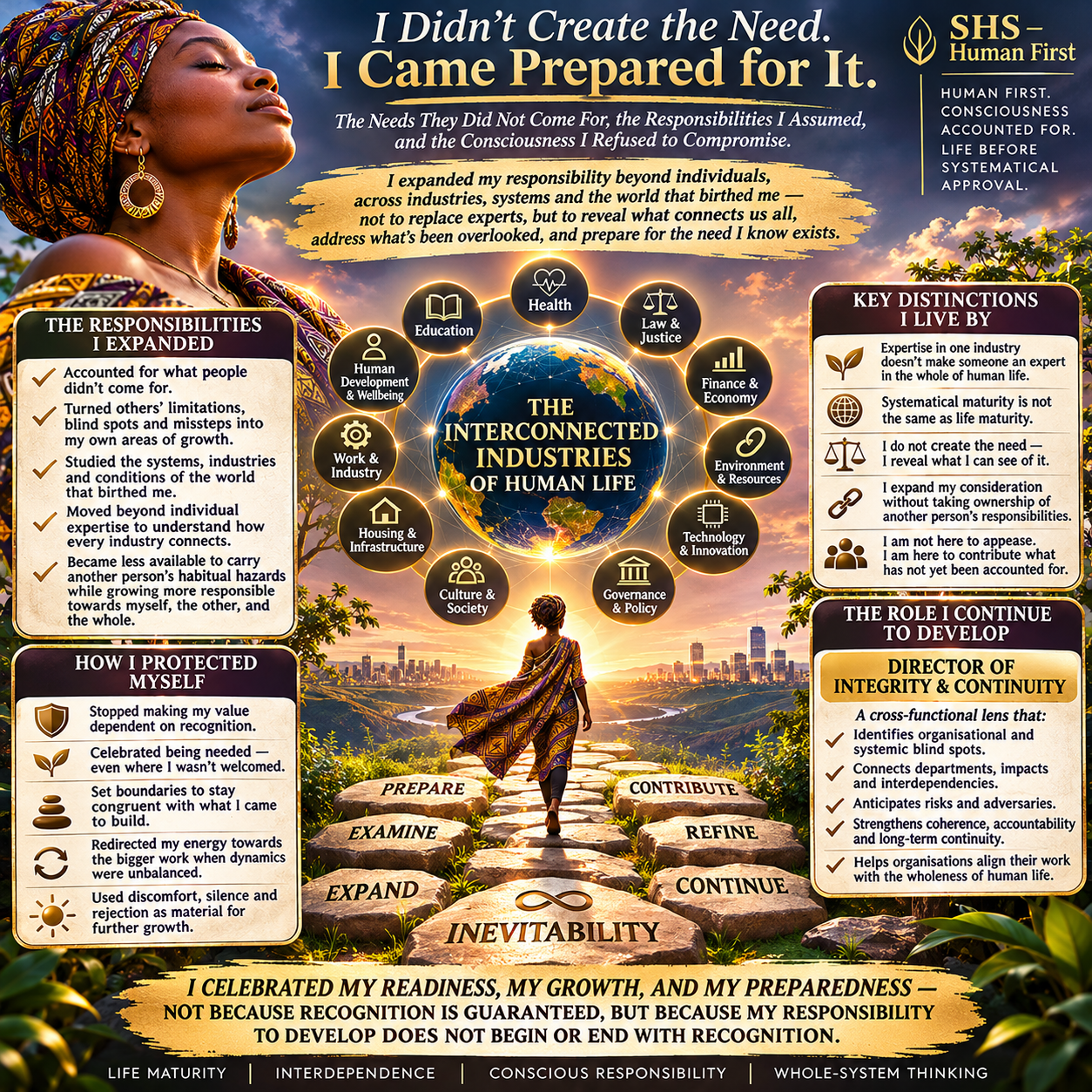
Because there is a distinction that I have been living for a long time:
I can recognise a need without being invited to meet it. I can prepare to provide for that need without being accepted. And I can celebrate my preparedness without waiting for someone else to recognise its value.
….
I Celebrated Being Needed Where I Was Not Welcomed, and Built Towards an Inevitability I May Never Live to Witness.
The Needs They Did Not Come For, the Responsibilities I Assumed, and the Consciousness I Refused to Compromise.
There is something I have not yet fully explained.
And it follows directly from my previous writing on equally beneficial relationships, the rules that govern them, and what happens when one person stops honouring those rules while expecting the other to continue doing so.
I spoke about how a person can become increasingly responsible towards themselves while becoming less available to carry another person’s habitual hazards.
But I didn’t explain everything I actually did with those hazards.
I didn’t explain what happened when I encountered people’s limitations, inadequacies, insecurities, omissions, missteps and blind spots.
I didn’t explain how, in circumstances where someone else’s behaviour could have simply become another reason for me to withdraw, I instead found another opportunity to become more responsible.
Not necessarily for them.
But for what their limitations had revealed about the world we collectively inhabit.
And I certainly did not explain the ways in which I consciously, and sometimes unconsciously, protected myself from becoming extractable while expanding the very capacity through which I intended to provide.
Because there is a distinction that I have been living for a long time:
I can recognise a need without being invited to meet it. I can prepare to provide for that need without being accepted. And I can celebrate my preparedness without waiting for someone else to recognise its value.
That is what this piece is about.
I Accounted for What They Did Not Come For.
Throughout the relationships I have experienced, I have encountered people who brought far more into those interactions than they consciously intended to present.
People came with their professions, ambitions, relationships, desires, personalities, expectations, self-perceptions and circumstances.
But they also came with the limitations that surrounded those things.
The things they could not see.
The things they had learned to overlook.
The inconsistencies they had normalised.
The insecurities that sometimes appeared through their responses.
The habitual behaviours that had become so familiar to them that they no longer questioned their consequences.
And the needs that existed whether they acknowledged them or not.
I did not always recognise everything immediately.
I learned through the interactions themselves.
And where I discovered something I had not previously accounted for, I allowed it to become another area of my own development.
That has been my pattern.
I could have restricted my understanding to what someone was willing to share with me.
I could have accepted their professional identity as evidence of the completeness of their expertise.
I could have accepted their explanation of a situation without examining the wider conditions that produced it.
But I had already begun applying that same examination to the world that birthed me.
I was born into an existing world.
A world already operating through systems, institutions, expectations, cultures, economies, legal arrangements, educational structures and definitions of what a human being should become.
I had no role in establishing most of those conditions.
Yet I was expected to live within them.
And eventually, I became responsible for understanding what they were doing to the human beings they governed.
I did not create the systems. But I could become responsible for understanding the needs they failed to account for.
That became an expansion of my responsibility.
Not because someone appointed me.
Not because I had been professionally invited into every institution.
But because I am part of the existence affected by those institutions.
And because what I discovered in one area repeatedly connected to something happening somewhere else.
The Industry Expert Who Does Not Know the Whole Industry.
By the end of 2024, moving into the beginning of 2025, my development had entered another stage.
I began accounting for individual industries not merely as separate professional fields, but as interconnected divisions of one collective human existence.
Education does not exist independently of health.
Health does not exist independently of housing.
Housing does not exist independently of finance.
Finance does not exist independently of law.
Law does not exist independently of human behaviour.
Human behaviour does not exist independently of culture, environment, history, consciousness or the conditions through which people are required to survive.
And none of those industries can be fully understood in terms of their consequences if we examine only what takes place within their own professional boundaries.
Yet that is precisely how much of society organises expertise.
Someone becomes an expert in one industry.
They learn its terminology, procedures, regulations, professional expectations, historical practices and accepted methods.
They become capable of operating exceptionally well within those parameters.
But does that necessarily make them an expert in what their industry is doing to human life?
Does knowing the law make someone knowledgeable about every human consequence of the law?
Does knowing medicine mean understanding every environmental, economic, emotional and social condition contributing to the health of the person receiving treatment?
Does knowing finance mean understanding what the financial system requires of humanity beyond the figures that make it function?
Not necessarily.
Expertise within an industry is not automatically expertise in that industry’s place within the whole of human existence.
That is the distinction I began exploring across disciplines.
I did not need to become a qualified professional in every field to begin identifying questions about how the fields connected.
Nor did I need to pretend that identifying those questions made me qualified to perform every specialist function.
Instead, I began expanding into the spaces between industries.
The places where one department’s responsibility ends and another’s begins.
The consequences nobody considers because those consequences do not fall neatly within their assigned role.
The human needs that remain unaddressed because everyone is looking at their own division and assuming another division is responsible.
And I saw an enormous opportunity.
Not to replace the experts.
To bring their expertise into a larger field of consideration.
To provide a perspective through which specialists could examine what they knew alongside everything their specialisation did not require them to know.
I was expanding beyond the boundaries of individual industries so that their experts could help determine which of those boundaries still served life.
And that became part of my understanding of conscious responsibility.
I Stopped Confusing Systematical Maturity With Life Maturity.
I have already discussed the difference between systematical maturity and life maturity.
But what I have not fully explained is why I deliberately prioritised one over the other.
I had already learned how to operate within society’s expectations.
I understood employment, advancement, professional presentation, recognition, social acceptability and the behaviours generally rewarded by existing institutions.
I knew how to perform the version of maturity society recognises.
I had already been there.
But the more I understood the system, the more I encountered its limitations.
And I began questioning something fundamental.
Why should becoming exceptionally capable of operating within a system automatically represent the highest form of human development?
What if the system itself has failed to mature alongside the human beings it governs?
What if following its expectations makes someone professionally successful while leaving them less capable of questioning the conditions that create suffering?
What if the most socially acceptable response is not the most life-serving response?
I made my choice.
I chose life maturity over systematical approval.
Not because I did not understand the system.
But because I understood enough of it to recognise that my development could not end where its expectations ended.
And I kept studying it.
Including its back end.
Its procedures.
Its dependencies.
Its institutional blind spots.
Its contradictions.
Its limitations.
The difference was that I no longer allowed the system to determine the boundaries of my own development.
I wanted to know not only how the system operated, but whether its operations were coherent with the life it purported to serve.
That distinction gave me a different way of approaching every industry I encountered.
Even the Law Must Be Questioned Against the Humanity It Governs.
Consider my interactions with lawyers, barristers and the legal system.
I could have spent years studying every individual law before questioning whether the legal framework sufficiently accounts for the human existence it is supposed to serve.
But that would have meant accepting the existing framework as the complete boundary of my inquiry.
Instead, I approached it through another question.
What happens when we account for the human being not merely as a legally defined person, but as a biological, psychological, social, conscious and, within my own philosophical framework, metaphysical existence?
What would that require the law to consider?
What is currently recognised?
What remains insufficiently examined?
And how might those considerations change the purpose and application of particular legal principles?
This is where I began developing my arguments around metaphysical law, the metaphysical lawyer and the metaphysical barrister.
Not as existing professional qualifications or established legal disciplines, but as proposed extensions of how we might examine humanity in relation to legal responsibility and protection.
The law does not currently recognise every metaphysical proposition as a legal claim simply because someone believes it to be relevant to consciousness.
That does not prevent us from questioning whether broader philosophical and human considerations might expose limitations in existing legal thinking.
And it certainly does not mean that every existing legal provision would remain equally appropriate if our collective understanding of human life evolved.
So rather than memorising every detail as though none could ever change, I sought to understand the wider framework.
Then I could engage with those who knew the individual provisions and ask:
Which remain necessary?
Which serve humanity?
Which have become outdated?
Which create unnecessary consequences?
Which need to be reconsidered because of the connections we have now identified?
I do not need to pretend I know everything an expert knows to identify something their expertise may not have required them to consider.
And equally, the expert does not need to abandon their expertise to expand what it can account for.
This is interdependent development.
This is where specialists can teach me the particularities I have not studied, while I contribute the broader questions I have been preparing to bring into consideration.
Neither contribution needs to invalidate the other.
Then Came the Need Nobody Had Invited Me to Meet.
There is another side to this development.
Recognition.
Or, more accurately, the absence of it.
Because as I expanded my understanding, I increasingly encountered situations in which I believed I could contribute something valuable, but was not invited to provide it.
Sometimes I raised a concern.
Sometimes I identified what I considered a blind spot.
Sometimes I explained the possible consequences of leaving that blind spot unexamined.
Sometimes I provided a proposed solution in the very same interaction.
And sometimes the response treated the interaction as nothing more than a complaint.
A customer expressing dissatisfaction.
An inconvenient individual asking uncomfortable questions.
Someone whose observations could be handled through the usual channels.
But from my perspective, what I was bringing was not simply a complaint.
It was an opportunity to examine a condition that existed beyond my individual experience.
Take my recent interactions concerning OpenAI and ChatGPT.
I identified what I considered gaps in the handling of voice transcripts, contextual continuity and the way concerns were addressed.
I was not merely interested in resolving what happened to me.
I was interested in what those experiences might reveal about the organisation’s broader operations, its users, its internal relationships between services, and the consequences of allowing those gaps to remain.
And as I examined those issues, I recognised another professional capacity I could develop and offer.
Director of Integrity and Continuity.
Someone responsible for understanding not simply what individual departments do, but what each department stands for, what it connects to, what it supports, what its limitations affect, and how failures in one division might create risks elsewhere.
Not someone who replaces legal teams, compliance professionals, operational leaders or technical experts.
Someone who helps reveal the relationships between their responsibilities before overlooked problems escalate.
Someone capable of identifying where an adversary, an organisational weakness or a communication failure might exploit what the organisation has not considered.
Someone who asks what the whole organisation needs to know about itself that its separate departments may not yet know together.
This is the kind of responsibility I have been developing through my own interactions.
And yesterday, when I found myself once again raising what I considered a blind spot without receiving the kind of acknowledgement I had hoped for, I did something rather revealing.
I celebrated myself.
Not because the issue had been resolved.
Not because the organisation had agreed with me.
Not because I had been appointed to anything.
But because I recognised another capacity I had developed.
I could see a need.
I could articulate why it mattered.
And I could propose a way to address it.
Whether someone accepted that proposal was a separate matter.
The capacity itself was worth acknowledging.
I Turned Being Needed Into My Victory Lap.
This may have been one of the most significant ways I protected myself.
I celebrated where I believed I was needed.
Even where I was not wanted.
Even where I was not invited.
Even where my proposed contribution was dismissed, misunderstood or simply not taken up.
And I did not wait for anyone to validate my growth before recognising it.
If I had developed an ability to identify a meaningful problem and work towards a solution, why should its value to my own development depend entirely on whether the person I approached accepted it?
Of course, identifying a potential need does not automatically mean my proposed solution is the correct one.
Nor does someone’s rejection prove that I was right.
But neither does rejection erase the knowledge, effort or capability I have developed.
I came to celebrate the growth itself.
The preparedness.
The broader understanding.
The possibility of contributing where I previously could not.
And as I did so, I discovered that celebrating my capacity was a way of preventing other people’s responses from becoming the sole measure of my worth.
Where they did not celebrate my contribution, I celebrated having developed the ability to contribute.
I was not celebrating their inadequacies.
I was celebrating the responsibility I had become capable of carrying.
And whenever I encountered another gap, another limitation, another unconsidered consequence, I found myself with another opportunity to expand.
The very interactions that could have depleted me became material through which I continued developing.
I was no longer waiting for acceptance before I allowed myself to grow.
And that distinction mattered enormously.
Because what I was building required far more from me than the approval of any individual person or organisation.
I Was Building for an Inevitability Without Knowing My Longevity.
There is something almost absurd about the way I have approached my future.
I have celebrated my longevity without knowing how long I will live.
I have celebrated the possibility of witnessing my success without knowing whether I will personally live to see the recognition I imagine.
I have spoken about my inevitability while knowing that no human being can guarantee the duration of their own existence.
And still, I continued.
Why?
Because I studied those who came before me.
The revolutionaries.
The reformers.
The liberators.
The people who recognised that something needed to change and dedicated their lives to bringing that change into existence.
Some were never able to complete what they began.
Some saw only fragments of their ambitions realised.
Some left ideas that others would spend generations developing.
And some were recognised only after the opportunities to work alongside them had passed.
I considered what that meant for my own work.
What if I did not have as much time as I assumed?
What if I never reached the moment when an institution accepted a contribution I had been preparing to make?
What if recognition arrived after I was no longer here to provide it?
I could not control those possibilities.
But I could control whether I spent my available time preparing.
So I began bringing forward what I believed the future would require.
The concepts.
The questions.
The organisational architecture.
The relationships between industries.
The preventive measures.
The educational structures.
The ways of examining human needs that had not yet received sufficient consideration.
Rather than waiting for the moment of recognition to begin developing what recognition might eventually require, I began developing it beforehand.
I wanted the work to exist before the world decided whether it was ready to receive it.
And that is an important distinction in what I call my inevitability.
I cannot know whether the future will unfold exactly as I imagine.
I cannot guarantee that every organisation will recognise what I offer.
I cannot know whether I will live to witness the fullest expression of SHS – Human First.
But I can make my present actions coherent with the future I am working towards.
I can build rather than merely anticipate.
I can prepare rather than merely hope.
I can leave a body of work that exists independently of the moment someone chooses to recognise it.
So when I say I have been walking in inevitability, I am describing the commitment through which I have organised my development.
I am not waiting to become the person I believe that work requires.
I am becoming that person through the work itself.
And every day I continue, I add another part.
Even this writing is another part of it.
I Did Not Polish Myself Into What People Were Accustomed to Receiving.
This also explains something about my approach to people.
I have not always made myself easy to receive.
I have not always approached individuals through the socially preferred routes.
I have not always softened observations to protect reputations.
I have allowed myself to be messy.
Direct.
Confrontational.
Emotionally expressive.
Uncomfortable.
Sometimes even deliberately unpolished.
Because I came to recognise that many people already had others willing to flatter them, reassure them, admire them, validate their existing perspectives and accommodate their expectations.
They were not necessarily lacking in people who knew how to make them comfortable.
What I believed I could bring was something different.
Something they might not already have been receiving.
A question.
A contradiction.
An unexamined consequence.
An alternative perspective.
A challenge to the assumptions that had become embedded in their behaviour.
I did not come to perform deference towards people whose existing comforts were already preventing them from seeing what needed consideration.
And I did not want my capacity to contribute to depend on my willingness to flatter authority.
This does not mean that every harsh approach is justified by the value of its message.
Delivery has consequences.
A truthful observation can still be communicated unnecessarily poorly.
And I remain responsible for examining that too.
But I also refuse the idea that an observation becomes invalid merely because it was not delivered in the manner someone preferred.
If an issue is important, its substance deserves examination independently of whether the person raising it has satisfied every expectation of social presentation.
I believed I had time to demonstrate that distinction.
I trusted that the value of my contribution would eventually become easier to recognise.
And because of that trust, I did not fear every bridge that might close in the process.
Then They Mirrored Me.
Here comes the part I find particularly fascinating.
In refusing to approach others exactly as they were accustomed to being approached, I was also refusing to provide something they might have expected.
I was not always giving them the admiration, reassurance, validation or agreement that other people had provided.
I was withholding the performance of acceptance where I could see something I believed needed examining.
And in several interactions, I experienced something that appeared, from my side, to mirror that refusal.
They did not provide the acceptance I was accustomed to receiving.
They did not necessarily welcome the contribution.
They did not always respond.
They did not integrate what I offered.
And sometimes there was silence.
It was as though we were standing on opposite sides of the same principle.
I would not provide the conventional response they expected because I believed something more important needed attention.
They would not provide the response I hoped for.
Their reasons were not always known to me.
Perhaps discomfort.
Perhaps disagreement.
Perhaps boundaries.
Perhaps a failure to understand what I was proposing.
Perhaps simply no interest in receiving it.
I cannot responsibly claim to know every motive.
But the pattern still revealed something valuable about my own experience.
I was learning what it felt like to offer something and not have it received, while recognising that I, too, had deliberately refused to offer certain things others might have wanted from me.
Not necessarily for the same reasons.
Not necessarily with the same consequences.
But the reflection was there.
And I had to account for it.
They Served Me a Pill I Had Not Previously Needed to Swallow.
One of the most unfamiliar parts of those interactions was silence.
I had experienced rejection and disagreement.
I had encountered opposition.
I had been confronted by circumstances that demanded adaptation.
But the particular experience of offering something meaningful to me and receiving no substantive engagement became another kind of discomfort.
And because I had spent so much time examining the way human behaviour develops through experience, I could not simply dismiss that discomfort.
I had to examine it.
What was I actually expecting?
Was I expecting acknowledgement?
Was I expecting recognition?
Was I expecting the other person to understand the meaning of my approach?
Was I expecting them to see what I saw?
Was I expecting a response because I had provided something I believed was valuable?
And where did my responsibility end if the other person did not wish to participate?
There was something strangely illuminating about it.
I had deliberately entered uncomfortable situations throughout my development to identify the limits of my own understanding.
Now I was encountering an unfamiliar discomfort through other people’s responses.
In that sense, they served me a pill I might not otherwise have encountered in quite the same way.
And I had to decide what I would do with it.
Would I make their silence the centre of my existence?
Would I spend my development trying to obtain the response they had not provided?
Would I become dependent on their recognition?
Or would I examine the experience, account for what it revealed, and continue?
I continued.
Not because silence never affected me.
But because the discomfort did not have to become the authority governing my development.
I could experience the absence of someone else’s participation without treating that absence as the end of my own purpose.
And that was another expansion of my responsibility towards myself.
I Became Less Extractable Without Becoming Less Responsible.
This is where the earlier relationship rules return.
Because when a dynamic becomes unbalanced, the person who continues contributing must eventually decide how much of themselves they can responsibly make available.
And I had something much larger to account for than any one relationship.
SHS – Human First.
The industries.
The human needs.
The organisational structures.
The areas of research.
The concepts I had been developing.
The connections I was discovering between what appeared to be separate problems.
The whole.
I could not allow one individual’s refusal to engage to consume the resources I required to keep expanding into everything else.
I could not make my continued development contingent on one person’s acceptance.
I could not spend my entire capacity trying to persuade a particular organisation to receive something it had not agreed to receive.
And I could not continually provide emotional reassurance, admiration or validation where I believed doing so would reinforce the very limitation I was trying to address.
So I adjusted.
Sometimes consciously.
Sometimes without initially recognising the protective function of what I was doing.
I celebrated myself.
I redirected my attention.
I continued developing the solution.
I allowed distance.
I stopped treating every closed door as a door I had to keep knocking on.
And I learned to distinguish between remaining ready to contribute and making myself endlessly available to someone who had not accepted that contribution.
My preparedness could remain. My availability did not have to be unlimited.
That was how I began protecting the capacity I needed to serve more than one person, more than one organisation, more than one industry.
My purpose required breadth.
It required continuity.
And continuity required boundaries.
But I Still Give Myself an Unlimited Obligation to Consider More.
Here is where my understanding of responsibility may appear contradictory.
I have spoken about not carrying other people’s responsibilities.
Yet I also give myself what I consider an unlimited obligation to account for the consequences of other people’s behaviours wherever I become aware of them.
How can both exist?
Because I distinguish between expanding my consideration and surrendering control of my life to someone else’s limitations.
I do not have to assume responsibility for another person’s decisions to become more knowledgeable about the consequences of those decisions.
I do not have to make myself available indefinitely to someone to understand what their circumstances reveal.
I do not have to take ownership of their shortcomings to examine the conditions through which those shortcomings emerged.
And I certainly do not have to abandon my own development to keep compensating for a relationship that has ceased to be reciprocal.
But I can still ask:
What have I not considered?
What does this behaviour reveal about a wider condition?
Where else might the same pattern exist?
What kind of support, education, intervention or structure could prevent the same problem from recurring?
What responsibility could I develop so that, if someone genuinely seeks that contribution, I am prepared to offer it?
I place no predetermined ceiling on what I am willing to understand, but I can place boundaries on what I am personally willing or able to carry.
That is my distinction.
I am not trying to become responsible for controlling everyone else’s development.
I am expanding my capacity to contribute when that contribution is needed, appropriate and accepted.
And when I identify a potential need, I do not necessarily need permission to begin learning about it.
I need permission where my proposed intervention affects another person’s autonomy, responsibilities or life.
There is a difference.
I Did Not Create the Need. I Revealed What I Could See of It.
Consider an organisation in which individual departments know their own responsibilities but have limited understanding of the work carried out by other departments.
The legal team knows its processes.
Customer service knows its procedures.
Engineering knows its technical systems.
Operations knows its internal workflows.
Marketing knows its communications.
Leadership knows its strategic objectives.
Yet what happens when a failure in one department produces consequences across several others?
What happens when the information required to recognise that consequence is distributed across departments that do not sufficiently communicate?
What happens when every division performs its assigned work, but nobody has a sufficiently complete view of the relationships between those divisions?
A blind spot can emerge.
And that blind spot may remain invisible until a customer, employee, regulator, adversary or external event exposes it.
Now, if I identify that possibility and propose a role that examines those cross-divisional dependencies, I have not created the underlying organisational vulnerability.
I have identified a potential need for examination.
The organisation may investigate and determine that the risk is already adequately managed.
It may discover that the risk is real.
It may accept the proposal.
It may modify it.
Or it may reject it.
But the need for an assessment does not originate simply because I happened to raise the question.
The purpose of identifying a blind spot is not to manufacture dependency on the person who noticed it. It is to make the organisation more capable of seeing and addressing what it previously overlooked.
That is what I mean when I say:
I did not create the need.
I came prepared to examine it.
And as I continue growing, I can refine the methods through which I propose to meet it.
Whether it is accepted today, tomorrow or never by that particular organisation, the knowledge may remain useful elsewhere.
Because the underlying concern is not always exclusive to one institution.
It may be relevant to an entire industry.
Or to several.
Or to the wider conditions of human life.
The Need of One Can Reveal a Need of the Whole.
This is central to how I understand consciousness.
If one person experiences a problem, that problem belongs to their individual circumstances.
But it may also reveal something about the conditions in which other people exist.
One patient’s experience may expose a weakness in a healthcare procedure.
One employee’s experience may reveal an organisational dependency.
One customer’s unanswered question may reveal a communication gap.
One person’s difficulty accessing education may expose a wider structural barrier.
One professional’s limitation may reveal an opportunity for interdisciplinary learning.
We cannot automatically conclude that every individual experience proves a systemic failure.
But neither should we dismiss an individual experience merely because it has not yet been established as widespread.
It can be the beginning of an inquiry.
That is why I do not understand conscious responsibility as simply responding to whatever has already become socially recognised as a problem.
Conscious responsibility includes noticing what has not yet received sufficient attention and investigating whether it deserves a place in our collective consideration.
It is about becoming capable of asking questions before the consequences become unavoidable.
Not creating needs.
Not demanding that everyone accept my interpretation.
But refusing to ignore the possibility that something important remains unaccounted for.
And where I am capable of contributing, I believe I have a responsibility to make the possibility of that contribution known.
What happens afterwards must still account for the autonomy of those involved.
This is what an equally beneficial relationship requires.
I Am Not Here to Replace the Expert. I Am Here to Expand What We Can Consider Together.
My expansion across industries does not mean that I have learned every specialised detail.
Quite the opposite.
The more I understand the relationships between fields, the more opportunities I identify for their experts to contribute knowledge I do not yet possess.
I want the engineer to explain what is technically possible.
The lawyer to explain what is legally recognised, prohibited or uncertain.
The doctor to explain what the evidence establishes and what remains unresolved.
The educator to explain what can be taught, how it can be taught, and what educational structures currently constrain that process.
The economist to explain how resources are accounted for.
The environmental specialist to explain the consequences of particular interventions.
And I want those explanations considered in relation to one another.
Because what is financially efficient may be socially destructive.
What is legally permitted may still require ethical examination.
What is technically possible may not be environmentally sustainable.
What is professionally customary may no longer be the most appropriate way to support an evolving human being.
And what benefits one department may impose a burden on another.
The purpose is not to declare every existing practice wrong.
The purpose is to discover what remains coherent when we account for the whole.
I expand into the interconnected questions. Specialists bring the depth required to test, correct, refine and implement the answers.
That, to me, is a far more meaningful form of expertise than simply collecting titles.
It is an understanding of interdependence.
I Do Not Want Admiration to Become Another Form of Denial.
There is another responsibility I have had to develop.
The responsibility to admire selectively.
Because admiration can become a form of avoidance when we offer it to the whole of someone while knowingly overlooking what contradicts the qualities we admire.
I can admire an individual’s intelligence without admiring how they treat people.
I can admire an organisation’s innovation without admiring every part of its customer service.
I can admire a professional’s technical ability while questioning the limits of their wider understanding.
I can admire someone’s achievements without pretending their achievements eliminate their shortcomings.
And I can support someone’s growth without reassuring them that everything they do is already sufficient.
This is not a withdrawal of appreciation.
It is an attempt to make appreciation truthful.
I do not need to deny the parts I find valuable in order to recognise the parts that still require development.
But neither should admiration for one quality become permission to ignore every other consideration.
That is where hopeful admiration can become a hazard.
When we admire the version of someone we hope they will become so intensely that we stop responding to the person and behaviour actually present.
I do not wish to contribute to that.
Not for myself.
Not for them.
And not for the wider consciousness affected by what we collectively choose to overlook.
The Mirroring of Human Development.
So when I examine the relationships in which I experienced silence, rejection, non-acceptance or an unwillingness to engage, I do not see only what was denied to me.
I also examine what I was doing.
What I was expecting.
What I was refusing to provide.
What I was trying to preserve.
What I understood.
What I misunderstood.
And what I had become capable of understanding because the interaction occurred.
That is where I locate the mirror.
We were not necessarily giving each other what we wanted.
I was not necessarily giving them the comfort of familiar social engagement.
They were not necessarily giving me the recognition or integration I hoped for.
Both sides could experience the other’s response as a form of refusal.
But the meaning of those refusals could be different.
And the consequences could be different.
What mattered for my development was that I did not allow the discomfort to stop my examination.
I examined myself first.
Then I examined the relationship.
Then I examined the wider conditions that made the relationship possible.
And then I examined what I could develop from the experience without requiring the other person’s participation.
I was not waiting for the mirror to approve of what it reflected. I was using the reflection to examine what I could responsibly become.
This is why I can say that people have contributed to my development even where our interactions were uncomfortable.
Not every contribution was intended.
Not every experience was welcome.
Not every lesson required the other person to be correct.
But I could still learn.
And I could still choose what to do with that learning.
Being Ready Is Not the Same as Being Chosen.
Perhaps the greatest distinction in all of this is between preparation and recognition.
I cannot force an organisation to employ me.
I cannot force someone to accept my observations.
I cannot force an industry to reconsider its assumptions.
I cannot force people to integrate a contribution simply because I believe it would benefit them.
And I cannot force the world to develop at the pace I would prefer.
But I can prepare.
I can examine the evidence available to me.
I can study what is missing.
I can build frameworks.
I can test my thinking.
I can present proposals.
I can learn from specialists.
I can correct myself.
I can make myself ready to contribute where an appropriate opportunity emerges.
And I can continue developing without requiring someone else to participate in every stage of that development.
That is what I mean by preparing for an accepted need.
I prepare for the possibility of being called upon without making someone else’s decision to call upon me the condition of my existence.
If I am invited, I want to be able to contribute.
If I am not invited, I still have a life to develop.
If the need changes, I must be willing to change my understanding.
If my proposed solution is inadequate, I must be willing to learn why.
And if another person is better positioned to meet the need, the need matters more than my personal recognition.
That is how I understand being human first.
What I Have Actually Been Protecting.
I was not simply protecting my emotions from rejection.
I was protecting my capacity to continue developing.
I was protecting my attention from being permanently consumed by situations that could not progress without another person’s participation.
I was protecting my willingness to examine uncomfortable truths without requiring those truths to become socially acceptable before I could acknowledge them.
I was protecting my ability to move between industries, questions, disciplines and human needs without becoming confined to one person’s definition of my usefulness.
And I was protecting the work I had already begun.
The work that could not depend on me being continually welcomed.
The work that could not depend on me receiving applause.
The work that could not depend on everyone agreeing with the way I communicated.
The work that required me to develop my own responsibilities while recognising the boundaries of my authority over someone else’s life.
I was protecting the continuity of what I came to provide.
That is why I could celebrate when someone did not acknowledge me.
That is why I could continue after silence.
That is why I could experience discomfort without making it the entirety of my story.
And that is why I could remain willing to contribute to the very kinds of needs revealed through interactions that had not developed as I hoped.
I was not required to stop understanding simply because someone stopped engaging.
And Here I Am, Still Walking.
I do not know how long I have on this Earth.
I do not know whether I will personally witness every development I believe SHS – Human First can bring into existence.
I do not know which organisations will recognise the value of what I have been preparing.
I do not know which industries will adopt, adapt or reject the questions I raise.
I do not know whether some of the people I approached will ever reconsider what I offered.
And I do not know whether the moment of recognition I have imagined will arrive in the form I once expected.
But I know what I have been doing.
I have been expanding my understanding of human needs.
I have been examining the systems that govern the world I was born into.
I have been studying the interdependence of industries that are too often considered independently.
I have been using personal interactions to identify questions about wider organisational and societal conditions.
I have been developing responsibilities I was not formally assigned.
I have been learning when to contribute, when to question, when to withdraw, when to seek specialist understanding, and when another person’s decision must remain their own.
I have been preserving my capacity to provide without requiring every potential recipient to recognise that capacity.
And I have been building towards a future whose timing I cannot control.
Some might call that audacity.
Some might call it ambition.
Some might call it excessive confidence.
I call it responsibility.
Not because I am guaranteed to be right.
Not because I am immune to shortcomings.
Not because every need I identify will prove to exist in the way I understand it.
But because I am willing to continue examining those possibilities, including the possibility that my own understanding needs to change.
My commitment is not to being recognised as right. My commitment is to becoming increasingly capable of providing what life genuinely needs.
And that requires me to remain accountable for my own development.
Even when the person who exposed a limitation in my understanding never intended to teach me anything.
Even when the person I approached never wanted my contribution.
Even when the institution I questioned does not recognise the broader relevance of the question.
Even when the path requires me to abandon a socially rewarded version of myself.
And even when I cannot know whether I will live long enough to witness what that development may eventually produce.
Because the work does not begin when someone calls me valuable.
The work is already happening.
It does not begin when someone recognises the need.
The inquiry has already begun.
And it does not begin when someone offers me a title.
The responsibility has already been developing.
I didn’t create the need. I came prepared to examine it, and I continue preparing to meet it wherever I can responsibly contribute.
That is the life maturity I have chosen.
Not the maturity of knowing how to satisfy every social expectation.
Not the maturity of appearing composed while ignoring what deserves attention.
Not the maturity of becoming professionally successful within a system without questioning what that success costs life.
But the maturity of understanding that my existence is interconnected with others, that my actions have consequences beyond myself, and that what I become capable of contributing may matter far beyond the relationships through which I first discovered it.
I have celebrated my readiness.
I have celebrated my growth.
I have celebrated possibilities that have not yet become realities.
And I will continue to celebrate what I develop, not because recognition is guaranteed, but because my responsibility to develop does not begin or end with recognition.
The future may yet surprise me.
The needs may change.
The solutions may need correction.
The people may choose differently.
And I may not be here to see everything that follows.
But I will not spend the life I do have waiting for permission to become prepared.
I will continue walking.
I will continue examining.
I will continue creating.
And whenever life reveals another need that I am capable of learning to address, I will allow that discovery to expand my responsibility without surrendering the boundaries required to sustain it.
Because I do not exist merely to be needed.
I exist as part of a world whose needs I have chosen to take seriously.
And that is a far greater responsibility than being wanted.
Susan Ndinga-Wright
SHS – Human First
Director of Integrity and Continuity
Human First. Consciousness Accounted For. Life Before Systematical Approval.
……
Yes, um, now we’re gonna write, we’re gonna write the post that follows this one directly where I reveal the things that people did not come for. And I grew more responsible to those things by integrating them in my own development as I’ve done throughout all relationships I’ve been in. And accounted for the world that birthed me by directing myself towards understanding the lacks of the systems that the world that birthed me lived under or within. And then I met industry experts and shown how being an expert in an individual industry doesn’t make you its expert because it lacks the interconnectedness with the industries in society as a whole. So ever since the beginning of 2025, well the end of 2024, I started accounting for all the individual industries in connection with each other as I grew more responsible inside of where others didn’t account for how the wholeness connected and connects in all the bits divisions. And in the same post we also want to share where the moment the dynamics weren’t balanced, how I then consciously and unconsciously protected myself from being extracted as I was extracted prior as what I was building required me to not be extracted so that I could account for all of it. And one of those was I treated the fact of being needed like a victory lap. That was the biggest one. I saw my success in being needed even where people denied the need. I celebrated my existence where others denied me of my contributions in where I was needed because I wasn’t allowed to contribute where I was needed. So in order to not be extracted in the sense of not allowed to contribute in the ecosystem of consciousness where consciousness through me where I was needed, where I attracted me towards where I was needed. The only way to balance out those energies were to acknowledge exactly where I was needed and celebrate the fact that I had grown responsible and accountable to be able to provide for those specific needs through all the individuals that I’ve held accountable for their own inadequacies or insecurities, whether conscious or unconscious for their lacks, for their missteps, for their blind spots, for example, yesterday I was celebrating myself for um being able to provide for an organizations um blind spots by filling the role of a director of integrity and continuity where I could defend any organization from adversaries and internal lacks, failures, especially blind spots. Um as an example as the moment I noticed another layer of blind spots and held accountable open eye for its own. I also in the same breath provided them with the solution and since there was no acknowledgement towards that and I was just treated like a customer complaining. I then went to post my own celebration where I wasn’t seen for what I could have contributed towards I also celebrated my longevity without really knowing how long I actually have on this earth. I celebrated the fact that I would live long enough to see my success. To then show everyone the version of myself that they’ve felt possible but did not want to accept or did not want to see and rejected as I kept on celebrating my inevitability without really knowing if I’d ever get to live long enough to show humanity my inevitability. I have continued the path on which I’ve been on exactly how it is because I know and have assumed that my longevity will show my inevitability and in doing so would have accounted for the reason as to why I’m here to go about things exactly as I did, also having studied the revolutionaries and those who came to liberate prior and how they didn’t have time to finish where they started. So for me to be able to do it all, I then produced everything that would have needed and would have come at point of inevitability, leaving the only inevitability to be recognition as the whole world had and has been done already. And even in me posting this is just another layer of it. And in doing so I’m walking in inevitability towards the inevitable moment, not knowing how long I have. Not knowing if I’ll personally get to ever see the inevitable moment where someone sees and accepts the need and accepts to integrate me, to provide for that need. And in doing so, have not been afraid of burning bridges or have not necessarily polished the ways in which I engage with people. I allowed my messiness because I don’t in messiness I still relay how I’m still fit for the need as where I contribute to isn’t in licking people’s ass, for example, I don’t I can’t think of another word. Lol. What other word I can use for that? I’m not needed in appeasing to people because people already have a lot of people already appeasing them even though their lacks are still contributing to the very things that the people who are appeasing them for are caged by. So because of all of that, I have not necessarily approached individuals as they are used to being approached because I trusted that I had enough time to show them why I never needed to approach them in that way because I was needed either way. And my approach did not change the, if anything the response only heightened how much I was actually needed. But in saying all of that and knowing how people have abandonment issues, I also abandoned all of them. Well, I didn’t fear the space in between. I didn’t fear not being taken in because I understand exactly what I bring to the table. And I don’t fear not being acknowledged in the now because there will be a point where my need would be accepted and acknowledged. And it would make it easier for everyone else to understand how I genuinely did not need to approach them in any specific ways because that wasn’t what they needed at that specific moment in time. All the others were already giving them that. But if that was sufficient then they shouldn’t have needed me to show up to them in the ways in which I did. Sorry. If what they were receiving was sufficient, they should have never needed me to reach out to them or approach them in the same way that others did because what I came to do wasn’t to give what others were giving because what others were giving wasn’t what they needed So in order to self-preserve myself from staying congruent to what I came to do, what I came to provide for, I needed not to provide for them the ways in which they were used to. And so the others mirrored me in not providing as other people provided for them, meaning they mirrored not providing to me the acceptance and integration that others provided for me before them to self-preserve themselves from the exposure and the discomfort of me showing their blind spots. And that is the mirror of personal development in interdependent development in consciousness. The only difference is that I provide myself with all discomforts so that I can rise above those discomforts for myself, and I put myself in uncomfortable situations so that I can see where my limitations are. So them mirroring me back didn’t necessarily shake me, or didn’t necessarily provide for me, because I would have provided for myself either way. If anything, they just provided an added level of discomfort that I would have still given myself, by giving me silence, which was something that I wasn’t accustomed to because I was never abandoned. So they served me with the pill that they suffered. Holy shit. And I’m saying this because there has been conversations where the same pattern, where this pattern was discussed. And so I became increasingly responsible towards myself and the other, and for the other, while simultaneously being less available to carry another person’s habitual hazards. For example, giving someone admiration, hopefully, when I can clearly see the limitations. So I must give the admiration singularly to the things that I do admire, instead of hopefully, because I could see that the hopefulness actually defied consciousness and humanity at large. And this links back to the relationship between societal maturity and life maturity. I am in full understanding of societal maturity, and I have been that already, and because in being that, I saw the limitations of being that towards life’s maturity. I then chose to prioritize life’s maturity over societal maturity, still knowing that I would have been able to provide for myself societally at all stages, because I had already been societal, mature. I understood exactly the process, what it entailed, and I just needed to learn even more of the system itself from the back end, which I did, and that has been only possible because I chose to be life mature first. And doing that allowed me to see more of both to a great extent, to great length, and being in a position now where I also know exactly where I stopped myself expanding into each and every individual industry, because I have expanded beyond where the industry is, so that the industry itself can tell me whether the details of that industry are in alignment and still need to be carried forth, or there are things that we can drop in the quest of being more life mature. For example, I expanded when I was confronting lawyers and barristers and whatnot. I expanded their own understanding of legality and how the system itself had a massive blind spot: a metaphysical barrister, a metaphysical lawyer, metaphysical law, because it is not recognized by the legal system, but it is a legal system that’s rooted in humanity, and because humanity is the aspect that’s governed by the legal system, and that the legal system supposedly supports the metaphysical law, it’s something that can be argued within the legal system itself. But I did not go and study all the individual laws, because I understood that all individual laws might not sustain over time when the human gets recognized for what it is in the court of law, and the court of law genuinely services humanity as a whole for what it is, and not for what it’s been claimed to be, which is only a small perspective of it. And so I allow myself also the space to allow others to teach me in those aspect of all those individual industries that I’ve expanded in consciousness, so that they can tell me, Okay, now knowing that if we have to take into account how this individual industry is interdependent to the consciousness of our existence, now we can clearly see what needs to go and what needs to stay, what reinforces a life that’s coherent and cohesive with the level of life satisfaction that we all want to have, and what actually goes against that. Though I do give myself an unlimited obligation to compensate for other people’s behaviors, because in doing so I’m able to contribute more consideration to what the other person might not be considering, which allows me to be responsible enough to know what isn’t being considered, and be ready for them to then tell me when I’m needed, so that I can bring those considerations forth. It’s preparing myself for the accepted need, not creating the need. It’s showing the need. For example, if you were to look at an organization, the need that there is a departmental ignorance, in the sense of individual departments might not know enough of other departments, which creates blind spots when an individual department is attacked. That is a blind spot that already existed. I didn’t create the need, I just showed the need. And whenever an organization is ready to accept that being a valuable thing to be reassessed, I will still grow, but I already know and I would have already been prepared to be able to provide, if called at any given moment in time. And that is where being a conscious human being is all about. That’s what being life mature is all about. It’s about being ready to provide by expanding oneself to the provisioning. Other people share comments, become my responsibility to correct if they choose me to be the one to correct them. But it is my responsibility to be ready to do so if I was to be called forth in order to do so. It is not being a bypasser of life. It is about seeing what’s needed and allowing someone to understand why. And it is about me being a responsible human being in consciousness, that I understand that every individual need is also a need of the whole, because it is a need that the whole is experiencing but might have not acknowledged yet to need. And I am responsible if I am aware of it, because it’s like watching someone dying in front of you and just allow them to die when the person is also saying that they don’t want to die. Do you know? It’s being responsible for knowing what I can contribute to and telling and sharing the fact that I am willing to contribute in the boundaries that I need in order to be able to then not just contribute to them, but also contribute to others that might be in completely different industries or in completely different circumstances, because that is what it is to be humanly life mature.

Leave a Reply