

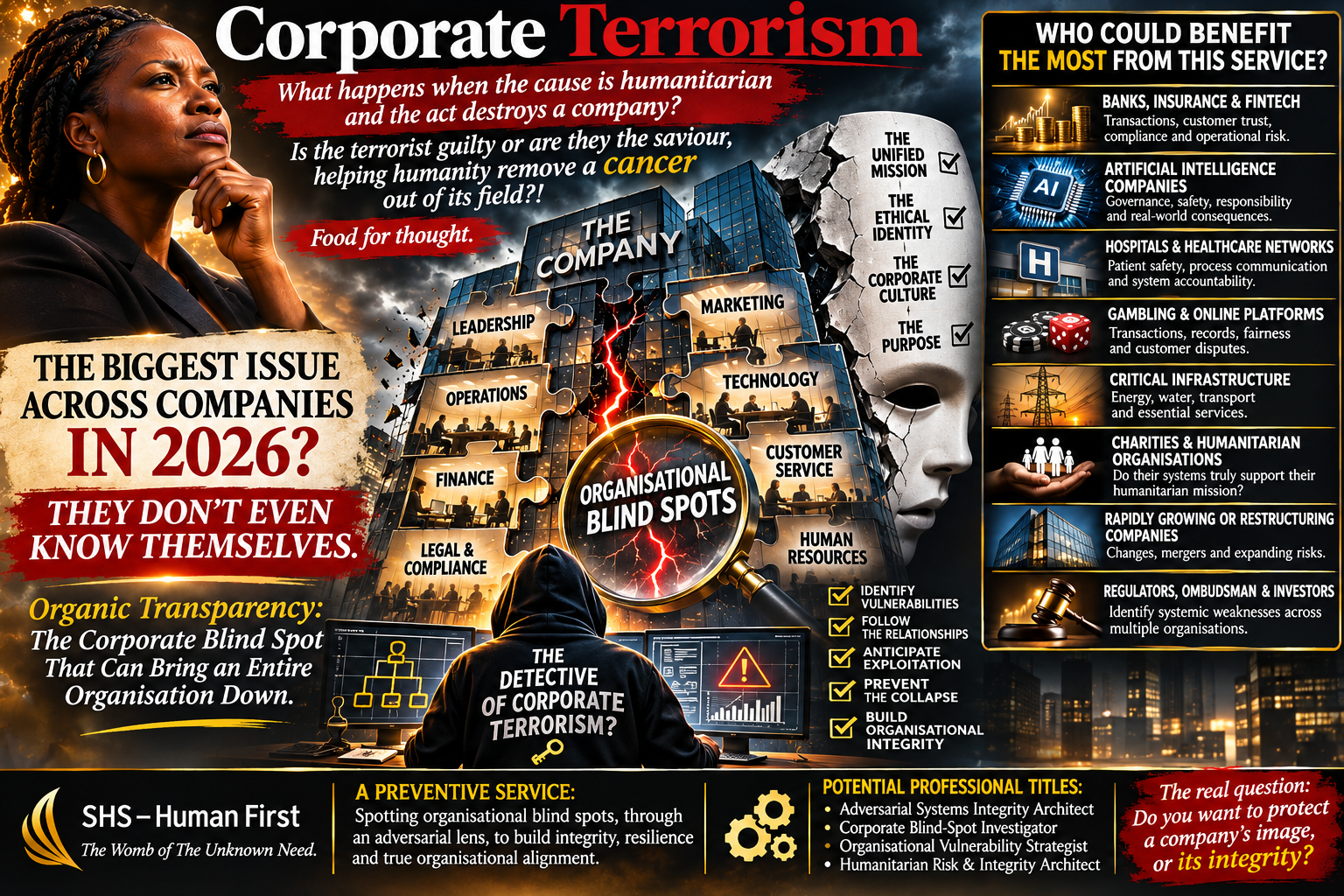
What happens when the cause is humanitarian and the act destroys a company? Is the terrorist guilty or are they the saviour, helping humanity remove a cancer out of its field?! Food for thought.
After testing: this is applicable to any employment, organisation, seelf-employment and more…
THE BIGGEST ISSUE ACROSS COMPANIES IN 2026? THEY DON’T EVEN KNOW THEMSELVES.
Organic Transparency: The Corporate Blind Spot That Can Bring an Entire Organisation Down
By Susan Ndinga-Wright | SHS – Human First
How can an organisation claim to be one organisation when the people within it do not know what the rest of it is doing?
How can a company claim to have a unified mission, ethical identity, corporate culture or purpose when the departments responsible for carrying that identity barely understand one another?
And how can any company call itself transparent when information only becomes available after somebody has complained, escalated, threatened legal action or found the one person supposedly authorised to explain it?
The biggest organisational problem I observe in 2026 is the absence of what I call ORGANIC TRANSPARENCY.
Not transparency as a policy.
Not transparency as a carefully constructed annual report.
Not transparency as a marketing exercise in which a company publishes the information it wants the public to know while withholding the understanding people actually need.
I’m talking about an organisation having complete awareness of itself, across its own operations, relationships, dependencies, responsibilities, intentions and consequences.
An organisation that does not have to investigate itself for three months to explain something that has been happening within its own systems all along.
An organisation whose departments function as parts of the same living organism, rather than independent institutions sharing a company name.
Because right now, far too many companies aren’t operating as one entity.
They’re operating as fragments pretending to be a whole.
A Three-Month Lesson From Lottoland
Last year, I experienced something with Lottoland that perfectly illustrates the issue.
I had requested a record of my account transactions. When I received the transaction history, the time displayed did not correspond with the time at which I knew I had placed my last bet.
Naturally, questions followed.
Where were the transactions that appeared to have taken place after the recorded time?
Were there transactions missing?
Was something being withheld?
Could there have been a winning transaction that wasn’t being represented?
These were questions raised by the apparent inconsistency, not proof that the company had concealed anything.
Now, here’s the astonishing part.
It took approximately two and a half to three months for the company to identify and explain why the hours were different.
Three months, give or take, to clarify a discrepancy involving how the company’s own transaction records represented time.
Consider what that means.
A company operates a platform. That platform records transactions. Customers interact with those transactions. The company provides documentation of those transactions.
Yet when a customer questions how those records correspond with what they experienced, the people responsible for servicing that customer cannot readily explain the discrepancy.
That is not merely a customer-service problem.
It is an organisational knowledge problem.
The information necessary to understand the system was not being effectively carried through the parts of the organisation responsible for communicating with the people who use it.
And what happened during those months?
Questions accumulated. Suspicion grew. Time was spent. Communications continued. An issue that might have been resolved through one informed explanation became an extended dispute.
All because the company could not promptly communicate something about its own operations.
One missing explanation can create an entire chain of consequences that never needed to exist.
And that is precisely why organic transparency matters.
The Customer Service Department Is Not the Problem. It Is Where the Problem Becomes Visible.
We often blame customer service representatives for not having answers.
But who is responsible for ensuring they have those answers?
The employer.
The leadership.
The organisational architecture.
If somebody is appointed to represent a company to its customers, why would the company place that person in a position where they cannot explain the fundamental processes that affect those customers?
Why are employees expected to defend a system they have not been sufficiently educated to understand?
Why must they repeatedly say:
“I’ll have to ask my manager.”
“That’s another department.”
“We’re waiting for an update.”
“I don’t have access to that information.”
Or worse, communicate an assumption as though it were an established fact because they feel pressured to provide an answer?
Now imagine the manager is unavailable.
Imagine the relevant department is closed.
Imagine the only employee authorised to access the explanation is on annual leave.
Imagine the company has already made a statement to the customer, only to discover three weeks later that the statement was wrong.
What happens to everything that occurred in between?
The organisation has now created additional responsibilities through its own inability to communicate.
It may have to correct earlier statements, review complaints, investigate consequences and explain why an issue was handled the way it was.
Depending on the circumstances, some mistakes may even create grounds for regulatory complaints or legal claims.
And the employee?
They might be terrified of losing their job for saying the wrong thing.
So they delay. They avoid. They become defensive. They follow scripts. They hide behind procedures. Sometimes they provide vague assurances because they have no other information available.
What customers experience as obstruction may sometimes be an employee’s attempt to operate within a system that has never equipped them to understand the problem.
The employer creates the ignorance, the employee carries the pressure, and the customer experiences the consequences.
Then the company calls it a customer-service failure.
How convenient.
Every Department Is an Exposure Point for the Whole Organisation
Here is something companies should consider far more seriously.
An organisation does not need every department to fail before its reputation, credibility or legal position can be damaged.
One department can be enough.
Why?
Because every department operates under the identity of the organisation itself.
When customer service makes a statement, that statement represents the company.
When finance makes a mistake, its effects may extend into customer relationships, operations, compliance or public confidence.
When marketing promises something that operations cannot provide, the failure is not isolated to marketing.
When legal, technology, human resources and leadership work without understanding how their decisions influence one another, the consequences may travel much further than the original decision.
And this is where I began thinking about something rather interesting.
What would we call someone whose professional expertise consisted of identifying these organisational blind spots before somebody else used them against the organisation?
A corporate vulnerability detective?
An organisational integrity investigator?
Or, to use a deliberately provocative expression, a detective of corporate terrorism?
I use that final expression metaphorically, referring to the deliberate weaponisation of organisational weaknesses rather than physical violence.
The underlying observation is that someone acting in bad faith may look for the points at which an organisation’s knowledge, authority and accountability become disconnected.
A company may believe its security is strong because it has cybersecurity infrastructure, lawyers, compliance departments, managers and extensive internal policies.
But what protects it from the consequences of its own fragmented understanding?
A firewall cannot teach customer service how a transaction timestamp works.
An employment contract cannot guarantee that an employee understands the relationship between their department and another.
A confidentiality agreement cannot transform an uninformed workforce into a knowledgeable one.
And an organisational chart cannot create relationships simply because it places departments beneath the same chief executive.
A company can be technologically secure and organisationally vulnerable at the same time.
That is a distinction worth investigating.
Role-Based Access Has Become Role-Based Ignorance
Some information must be restricted.
Personal data, confidential legal matters, medical information, security credentials and sensitive financial records should never be available to everyone simply for the sake of transparency.
But protecting confidential information is not the same as restricting organisational understanding.
There is an enormous difference between an employee knowing how the finance department functions and having unrestricted access to everyone’s financial records.
There is a difference between understanding how an investigation is handled and being able to read confidential investigative files.
There is a difference between knowing how the technology works and having administrator privileges.
Role-based security is necessary. Role-based ignorance is not.
Yet companies repeatedly confuse the two.
Someone works in marketing, therefore they are educated predominantly about marketing.
Someone works in finance, therefore they are educated predominantly about finance.
Someone works in customer service, therefore they are trained to answer a predetermined range of questions.
And when something falls outside those predetermined categories?
The employee must rely upon a hierarchy of permission, escalation and availability.
The company calls this structure.
I question whether it is actually organised fragmentation.
Because what happens when a department’s decision produces consequences in another department that never understood the decision in the first place?
What happens when marketing creates customer expectations that customer service has never been told to anticipate?
What happens when a technology team changes how information is displayed, without educating the people responsible for explaining that information?
What happens when leadership changes a policy without understanding how the change will affect the everyday reality of employees and customers?
The organisation produces consequences that its own people have not been equipped to recognise.
And then it is surprised when complaints arise.
You Cannot Have Strong Cross-Functional Teams Without Cross-Functional Understanding
Companies love talking about teamwork.
Collaboration.
Synergy.
Alignment.
One team.
One mission.
But what exactly are they aligning?
Does the customer service department understand the practical responsibilities of finance?
Does finance understand the lived experience of customer service?
Does marketing understand the limitations of operations?
Does leadership understand what happens when its policies reach the people expected to implement them?
Do employees understand why another department exists beyond knowing its name and conventional function?
And more importantly, are departments allowed and encouraged to challenge each other?
Not merely to question whether a deadline is achievable or whether a budget has been exceeded.
I mean challenging the purpose of decisions.
Their ethical implications.
Their contradictions.
Their relationship with the organisation’s declared mission.
Their effects on the people receiving the organisation’s services.
Their possible consequences outside the immediate department.
Because cross-functional teamwork cannot be reduced to several department heads attending the same meeting.
That is coordination.
It is not necessarily shared understanding.
A genuinely cohesive organisation should enable its people to understand how its different functions relate, what responsibilities each carries and where one department’s actions affect another.
Now imagine an entire department unexpectedly becomes unavailable.
What happens?
Does the company simply stop functioning?
Must every other department wait because no one outside the absent team understands what it does?
Of course, not every employee can or should perform regulated, specialised or safety-critical work without appropriate qualifications.
But there is a difference between being unable to perform another person’s specialist responsibilities and being completely ignorant of how those responsibilities fit into the organisation.
An organisation with strong relational knowledge can establish continuity, identify qualified cover, explain the situation and maintain informed coordination.
An organisation without it may be left guessing.
True organisational resilience is not having an irreplaceable person in every position. It is ensuring the understanding of the organisation does not disappear when one person is absent.
The Same Human Problem Is Finding Its Way Into Artificial Intelligence
This observation extends beyond conventional companies.
It is particularly relevant to artificial intelligence.
On 31 October 2026, I circulated a message to numerous AI companies and industry contacts warning that the problems present within their organisations could also become visible within their creations.
My central warning was simple:
“One department can have you all fall.”
Consider the irony.
We are building artificial intelligence systems capable of processing extraordinary volumes of information, while the human organisations building them still struggle to preserve meaningful relationships between the information they already possess.
In my own experiences with ChatGPT, I have repeatedly encountered failures involving information that had already been supplied, corrections that had already been made and architectural relationships that had already been established.
The system could acknowledge an error, explain the error, and sometimes repeat a similar error later.
Information was available, but it was not reliably brought into the next relevant action.
That is an important distinction.
Having information is not the same as understanding its relationships. Understanding its relationships is not the same as applying that understanding when acting.
Now look at what happens in an organisation.
One department possesses information.
Another department needs that information.
The relationship between the two is not maintained effectively.
A decision is made without the necessary understanding.
A consequence follows.
And then the company investigates what went wrong.
Isn’t that remarkably familiar?
The parallel does not mean that AI architecture and corporate management are technically identical.
It means that the same human tendency toward fragmented consideration can influence both.
And unless the creators themselves challenge that tendency, they risk carrying it into what they create.
A company cannot reasonably expect its creations to demonstrate relational integrity if relational integrity is not something it consistently practises, tests and prioritises.
SHS – Human First: An Organisation That Knows Itself
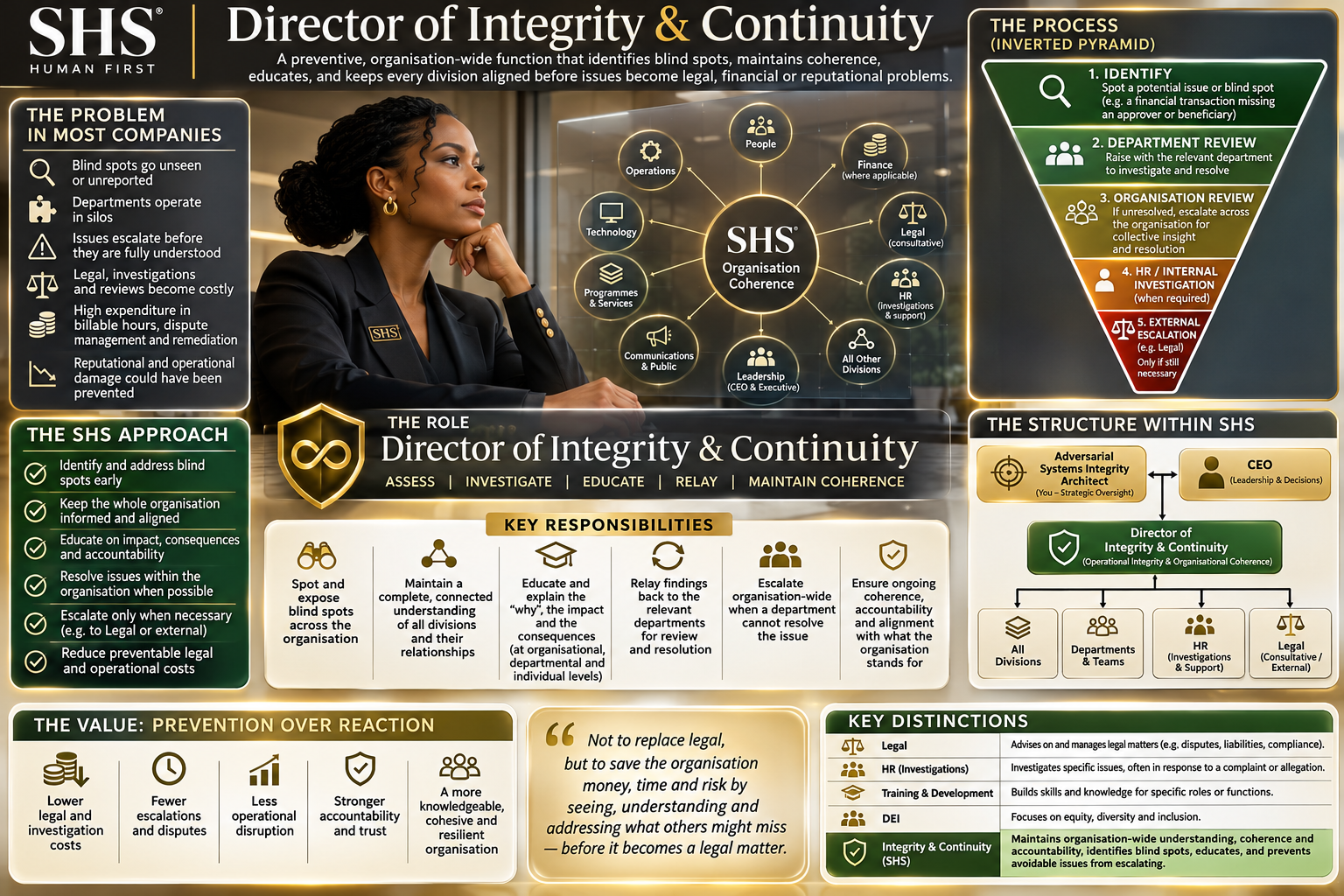
This is one of the architectural distinctions I am developing within SHS – Human First.
SHS is not intended to become another organisation in which departments merely coexist under an attractive mission statement.
The intention is to build an ecosystem in which every division understands its relationship with the whole.
Where the people involved are educated about the organisation beyond the specific responsibilities of their individual positions.
Where a person working within one area understands the existence, purpose, activities and dependencies of the other areas.
Where information flows because the organisation has been designed to maintain those relationships, not because somebody has finally escalated an issue to the correct manager.
Where departments can challenge one another because they understand enough to recognise when an action may contradict the organisation’s ethos, intentions or responsibilities.
Where leadership does not assume that publishing a policy is equivalent to ensuring that everyone understands it.
And where knowledge is maintained as an organisational responsibility rather than treated as the personal property of a department or individual.
This does not mean everyone must memorise every technical detail.
It means everyone should have an informed understanding of the organisation’s architecture and reliable access to the knowledge necessary to navigate it, within appropriate privacy, security and professional boundaries.
This is also part of the purpose of the proposed SHS Platform: to establish a shared internal environment through which the ecosystem’s activities, decisions, roles, responsibilities and developments can remain meaningfully connected.
Not simply a database filled with documents.
Not another internal communication channel where employees must search through hundreds of messages.
But an environment supporting the organisation’s understanding of itself.
An environment in which changes are communicated in relation to the people, activities and purposes they affect.
An environment in which the organisation can question its own actions before those actions become somebody else’s problem.
SHS remains an architecture under development, with its physical organisational future yet to be realised.
But an architecture matters even before it becomes a building, an employer or an operating institution.
Because the structure through which something is conceived influences what it may eventually become.
And I would rather identify these vulnerabilities while creating the architecture than reproduce them and later pretend they were unavoidable.
Organic Transparency Is Not Something You Activate When You’re Caught
This is perhaps the greatest distinction of all.
A company should not become transparent because a customer demands it.
It should not become transparent because a lawyer sends a letter.
It should not become transparent because a regulator begins investigating.
It should not become transparent because a journalist uncovers something embarrassing.
And it should not become transparent because a public relations department calculates that disclosure is now the least damaging option.
That is reactive disclosure.
Organic transparency is different.
It is the ordinary, continuous ability of an organisation to understand and explain itself, to the appropriate people, with accuracy and accountability.
It is built into its everyday existence.
It requires relationships between systems, people, policies, departments, actions and consequences to be maintained rather than repeatedly rediscovered.
It requires the organisation to question whether its own people have enough understanding to carry out the responsibilities being placed upon them.
And it requires leadership to recognise something fundamental:
If an employee does not possess the information necessary to fulfil a responsibility, the first question should be whether the organisation adequately provided it, not simply why the employee failed.
An employee can still make an individual mistake.
A department can still encounter an unforeseen complication.
An organisation can still have legitimate limits on what it knows or can disclose.
But none of these realities excuses avoidable ignorance created by the very structure of the institution.
A company that advertises accountability but has not equipped its people to be accountable is contradicting itself.
A company that celebrates teamwork while its departments operate in isolation is contradicting itself.
A company that claims to prioritise customer experience while requiring customers to spend months helping it understand its own processes is contradicting itself.
And a company that claims to be building intelligent technologies while neglecting the relational intelligence of its own operations should question what it is actually teaching its creations.
The Real Corporate Security Question
Perhaps companies should stop asking only:
“How do we protect ourselves from outside threats?”
And begin asking:
“How much of a threat have we already created through the way we organise ourselves?”
How many complaints begin with an employee who was never given the relevant information?
How many disputes escalate because one department cannot explain another’s actions?
How many mistakes are repeated because a correction was never carried throughout the organisation?
How many people experience unnecessary stress because the system requires them to take responsibility without providing the understanding necessary to carry it?
How many customers become suspicious, not because a company has necessarily committed wrongdoing, but because the company cannot explain what it has done?
And how many organisations could resolve these vulnerabilities simply by reconsidering how they educate, connect and hold their own departments accountable?
This is why I do not look at these blind spots merely to criticise companies.
I look at them to understand what kind of architecture would prevent their reproduction.
The intention is not to find weaknesses in order to exploit them.
It is to recognise them before they become opportunities for harm.
Because the same observation that exposes a company’s vulnerability can also become the foundation for its resilience.
The difference lies in the intention, responsibility and application of the person making that observation.
My Final Question to Every Company in 2026
Do your employees know the organisation they work for?
Not its name.
Not its brand.
Not its promotional mission statement.
Not merely the procedures of their department.
Do they actually understand the organisation?
Do they know how it functions?
What happens beyond their own responsibilities?
How decisions travel?
How consequences develop?
How departments influence one another?
Where its declared values are contradicted by its own practices?
And can the organisation recognise and correct those contradictions without waiting for somebody outside it to point them out?
If the answer is no, then the organisation has not fully developed an understanding of itself.
It may have a workforce.
It may have a leadership board.
It may have excellent individual specialists.
It may have policies, infrastructure, security, compliance and impressive revenue.
But it does not yet possess the cohesive organisational awareness that its own complexity requires.
A thousand departments do not create one organisation simply because they share one name.
An organisation becomes meaningfully whole when its parts recognise, understand, challenge and remain accountable to their relationships with one another.
That is organic transparency.
That is organisational integrity.
That is the kind of continuity I intend to design into SHS – Human First.
And until companies begin examining themselves at that level, I suspect they will continue spending extraordinary amounts of time and resources resolving problems that their own architecture helped create.
You cannot protect the integrity of an organisation whose own people have never been given the opportunity to understand it.
And you cannot claim to be one organisation while functioning as strangers to yourselves.
SHS – Human First
The Womb of The Unknown Need.
An organisation should not have to fall apart to discover how its parts were supposed to work together.
…
https://chatgpt.com/share/6ae636d2-6c8c-83eb-b4f4-24ae59f0b696?ogimg=plain

Leave a Reply