

YOUR ACCOUNTS CAN BALANCE WHILE YOUR INSTITUTIONS FAIL. YOUR REVENUE CAN INCREASE WHILE YOUR ASSETS DETERIORATE. AND YOUR FINANCIAL YEAR CAN END WHILE THE CONSEQUENCES CONTINUE FOR GENERATIONS.
ACCOUNTING, PUBLIC FINANCE & INSTITUTIONAL AUDIT — PART XII AND THE FINAL INVESTIGATION OF THE SHS INTERDISCIPLINARY SERIES INTO LEADERSHIP, ACCOUNTABILITY AND HUMAN CONTINUITY.
SNW | SHS – HUMAN FIRST
We began with psychology.
We investigated what the mind considers worth protecting, what it defends, and how self-interest can influence its decisions.
Then engineering.
We examined whether institutions are actually capable of delivering the human purposes they claim to serve.
Then law.
We established that responsibilities extending beyond the present generation are already recognised in existing legal frameworks.
Then ontology.
We questioned what institutions recognise as existing and whether they have confused their own survival with the continuation of the lives they supposedly serve.
Then epistemology.
We examined what institutions know, what they should reasonably investigate, and whether knowledge of harm leads to corrective action.
Then economics.
We investigated how financial benefits can be accumulated while costs are transferred to other people and future generations.
Then ecology.
We examined the consequences of consuming the natural systems that make continued production and human life possible.
Then public health.
We investigated why systems can become highly organised around treating suffering while inadequately addressing preventable contributors to it.
Then demography.
We established that population needs change in ways that can be investigated and projected long before those needs become immediate.
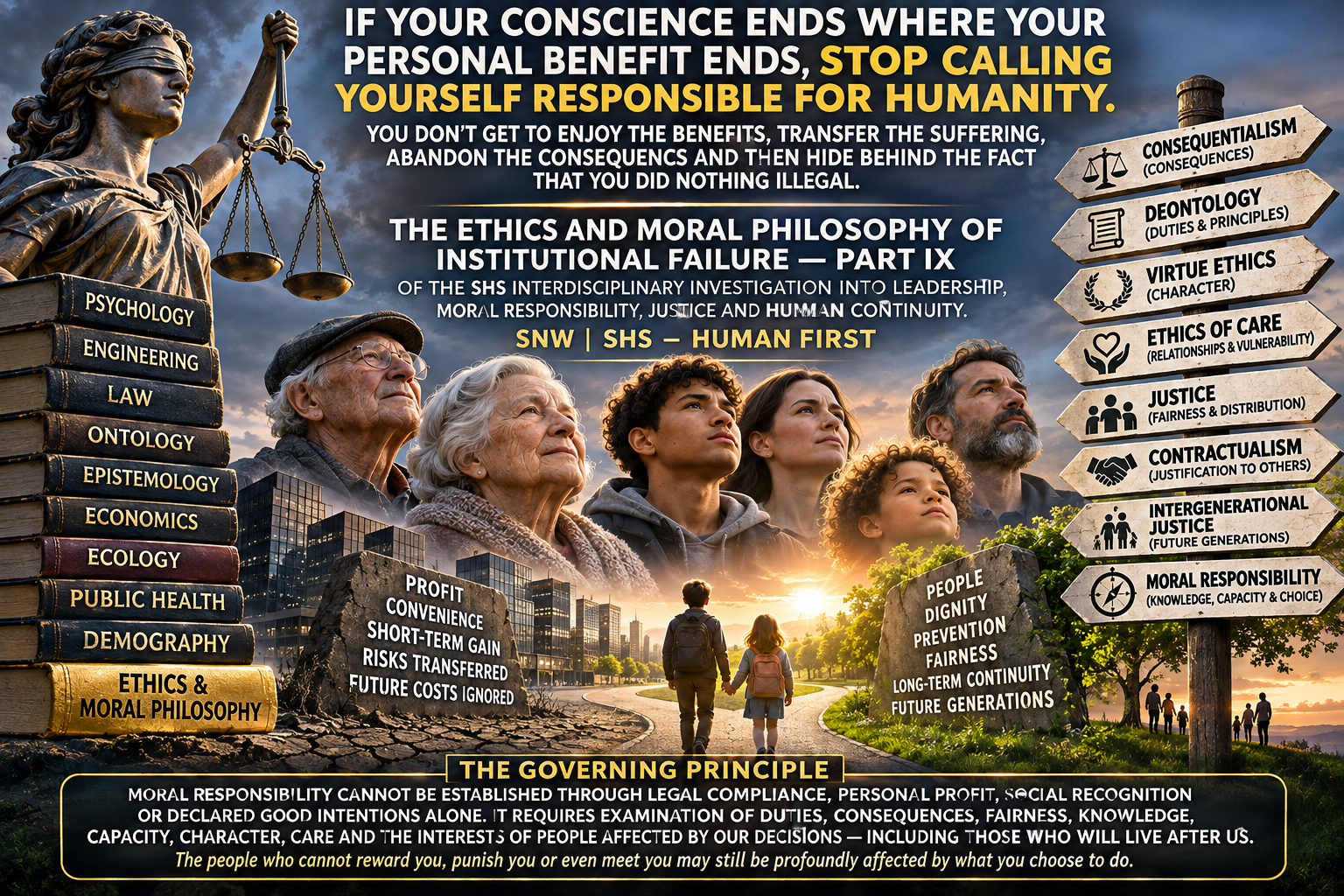
Then ethics and moral philosophy.
We examined what responsibilities arise when our decisions affect lives that cannot reward, punish or even confront us.
Then entertainment.
We investigated the relationship between commercial incentives, human attention, creativity and cultural continuity.
Then political science and governance.
We questioned how temporary political authority, institutional incentives and administrative arrangements influence long-term public responsibility.
Now we arrive at the final discipline.
ACCOUNTING.
PUBLIC FINANCE.
INSTITUTIONAL AUDIT.
And this is where I want the entire investigation brought together.
Because after everything we have examined, there is one final question.
WHAT HAPPENS WHEN AN INSTITUTION HAS BEEN KEEPING A RECORD OF ITS OWN SUCCESS WHILE FAILING TO ADEQUATELY ACCOUNT FOR THE CONSEQUENCES OF THE WAY IT ACHIEVED IT?
What happens when money was received, but the environmental damage was not fully represented?
When expenditure was reduced, but essential maintenance was postponed?
When an asset was recorded, but its physical condition was deteriorating?
When financial performance improved, but service quality declined?
When liabilities were transferred into future periods?
When costs appeared in somebody else’s institution?
When public benefits were claimed but never independently demonstrated?
And when the official records themselves could not obtain adequate audit assurance?
WHO HAS BEEN KEEPING THE ACCOUNTS FOR HUMANITY?
Not merely the accounts of government.
Not merely the accounts of corporations.
Not merely the accounts of public authorities.
THE ACCOUNT OF WHAT ALL THESE ACTIVITIES ACTUALLY PRODUCED, CONSUMED, PRESERVED, DAMAGED AND LEFT BEHIND.
Because we have spent eleven investigations examining the difference between institutional performance and human continuity.
Now I want to examine how that difference becomes visible—or disappears—inside the measurement systems used to declare success.
YOU DO NOT GET TO DECLARE THE CONSEQUENCES SETTLED MERELY BECAUSE YOU HAVE FINISHED RECORDING THE TRANSACTIONS.
The money may have moved.
The financial year may have ended.
The accounts may have been prepared.
But the consequences?
THEY MAY ONLY BE BEGINNING.
Let’s conduct the final investigation.
I. FIRST, UNDERSTAND THIS: AN ACCOUNTING PROFIT IS NOT A COMPLETE MEASUREMENT OF WHAT HUMANITY GAINED.
Accounting performs an essential function.
It records, classifies and reports financial information.
Assets.
Liabilities.
Income.
Expenditure.
Cash flows.
Changes in financial position.
And other matters required under applicable reporting frameworks.
These records can support accountability and informed decisions.
But financial accounting does not purport to capture every consequence of an activity for society.
AND THAT DISTINCTION MATTERS.
Consider a company.
It generates revenue.
Pays expenses.
Reports profit.
And distributes returns to shareholders.
Those financial transactions may be accurately recorded.
Now suppose its activity also contributes to environmental damage whose full costs are not borne by the company.
Or creates health risks for surrounding communities.
Or depends upon public infrastructure that is not adequately maintained.
THE COMPANY’S FINANCIAL RESULT DOES NOT AUTOMATICALLY REPRESENT ALL THOSE SOCIAL CONSEQUENCES.
That does not necessarily mean its accounts are fraudulent or incorrectly prepared.
Accounting standards have defined recognition and disclosure requirements.
Not every social harm meets the criteria for recognition as a financial liability.
SO THE FIRST LESSON IS NOT THAT ALL ACCOUNTANTS ARE HIDING THE TRUTH.
It is that the scope of financial accounting and the scope of societal consequences are different.
And if we use financial accounts as though they represent the entirety of value created or destroyed, we risk misunderstanding what they actually measure.
PROFIT IS A FINANCIAL RESULT.
SOCIAL VALUE IS A BROADER QUESTION.
And the fact that one can be calculated does not make the other irrelevant.
II. THE BALANCE SHEET IS NOT THE WHOLE WORLD. WHAT HAPPENS TO EVERYTHING THAT DOESN’T MEET ITS RECOGNITION CRITERIA?
Now let’s examine a technical distinction.
Accounting standards do not permit organisations to recognise every imaginable future problem as a liability.
Under IAS 37 — Provisions, Contingent Liabilities and Contingent Assets, a provision generally requires a present legal or constructive obligation arising from a past event, a probable outflow of resources and a sufficiently reliable estimate.
Possible obligations and some existing obligations that do not satisfy recognition criteria may require contingent-liability disclosure instead.
The precise requirements depend upon the circumstances and applicable standards.
Source: IFRS Foundation — IAS 37
Now understand the importance of this.
AN ANTICIPATED FUTURE COST IS NOT AUTOMATICALLY A LIABILITY THAT CAN BE RECORDED IN TODAY’S ACCOUNTS.
And a serious external harm does not always create a present accounting obligation for the organisation benefiting from the activity.
Suppose there is environmental contamination.
If a legal or constructive obligation to remediate has arisen and the recognition conditions are met, a provision may be required.
But suppose the ecological harm exists without a corresponding enforceable or constructive obligation that satisfies the accounting criteria.
THE ECOLOGICAL CONSEQUENCE MAY BE REAL EVEN WHERE THE ACCOUNTING LIABILITY IS NOT RECOGNISED.
This is not necessarily a defect in the accountant’s application of the standard.
It reflects a difference between what financial reporting is designed to measure and what an assessment of wider human and ecological wellbeing must consider.
SO STOP CONFUSING THE ABSENCE OF A RECORDED LIABILITY WITH PROOF THAT NOBODY HAS BEEN HARMED.
And stop confusing the absence of a financial provision with proof that no future remedial action will be necessary.
The correct investigation asks:
What is recognised?
What is disclosed?
What remains outside the financial statements?
What other reporting frameworks apply?
And what broader consequences require examination through other disciplines?
THE LEDGER HAS BOUNDARIES.
REALITY DOES NOT NECESSARILY STOP AT THEM.
III. THE UK ALREADY PUBLISHES WHOLE OF GOVERNMENT ACCOUNTS. NOW LOOK AT WHAT THEY ACTUALLY CONTAIN.
The United Kingdom’s Whole of Government Accounts consolidate financial information across more than 10,000 public-sector bodies.
They are prepared by HM Treasury under the Government Resources and Accounts Act 2000, using International Financial Reporting Standards adapted for the public sector.
They provide a broader financial picture than annual cash expenditure or public-sector debt figures alone.
Source: HM Treasury — Whole of Government Accounts 2024–25
The latest published accounts, for the financial year ending 31 March 2025, reported:
- £2.785 trillion in total assets.
- £5.332 trillion in total liabilities.
- Approximately £2.547 trillion in net liabilities.
The figures include assets such as public-sector property, infrastructure and financial holdings, alongside borrowing, pension obligations, provisions and other liabilities.
Now consider what this represents.
THE GOVERNMENT ALREADY MAINTAINS A CONSOLIDATED FINANCIAL RECORD OF ENORMOUS SCALE.
Trillions of pounds in assets.
Trillions in obligations.
Institutions.
Facilities.
Investments.
And commitments whose consequences extend across years and decades.
But I want to make an important distinction.
Net liabilities in these accounts are not the same thing as public-sector net debt.
Nor do they automatically mean that government must pay the entire amount immediately.
Some obligations extend over decades.
The value of pensions and other liabilities can change substantially with actuarial assumptions and discount rates.
And public finances cannot be analysed responsibly by taking one balance-sheet number in isolation.
THE QUESTION IS NOT WHETHER A LARGE LIABILITY FIGURE AUTOMATICALLY MEANS COLLAPSE.
The question is whether the accounts provide reliable information that enables institutions and the public to understand the obligations, assets and financial risks involved.
Because without reliable information, even a sophisticated government can struggle to make properly informed long-term decisions.
AND NOW WE ARRIVE AT SOMETHING PARTICULARLY IMPORTANT.
IV. JUNE 2026: THE NATIONAL AUDIT OFFICE COULD NOT GIVE AN AUDIT OPINION ON THE GOVERNMENT’S CONSOLIDATED FINANCIAL STATEMENTS.
On 18 June 2026, the National Audit Office reported on the Whole of Government Accounts for 2024–25.
The Comptroller and Auditor General disclaimed his audit opinion.
For the third consecutive year.
The reason concerned the scale of missing, unaudited and disclaimed financial information, particularly from English local authorities.
Source: National Audit Office — Whole of Government Accounts 2024–25
Now understand what a disclaimer means.
It does not automatically establish fraud.
It does not prove that every reported figure is wrong.
It does not mean the auditor has discovered that the accounts are entirely fictitious.
IT MEANS THE AUDITOR WAS UNABLE TO OBTAIN SUFFICIENT APPROPRIATE EVIDENCE TO FORM AN AUDIT OPINION ON THE FINANCIAL STATEMENTS.
And here is the extraordinary part.
Of the 408 English local authorities expected to submit audited financial data for consolidation into the 2024–25 accounts:
- 107 were missing from the consolidated submission.
- 280 submitted data that had not been audited at the relevant consolidation point.
- Only 21, approximately 5%, were included on the basis of audited data.
These figures describe the status at the relevant point in the consolidation process. Some bodies subsequently completed audits, and the government has introduced measures to address the backlog.
But the problem was sufficiently serious for the auditor to disclaim the overall opinion.
NOW THINK ABOUT WHAT THAT MEANS FOR PUBLIC ACCOUNTABILITY.
An institution can publish financial information.
But publication is not identical to independent assurance.
Numbers can exist without the auditor possessing enough evidence to establish whether the financial statements as a whole provide the required true and fair view.
SO WHAT IS THE VALUE OF ACCOUNTABILITY IF THE RECORDS ON WHICH ACCOUNTABILITY DEPENDS CANNOT BE SUFFICIENTLY VERIFIED?
The correct response is not to announce that every public authority has engaged in misconduct.
It is to investigate the causes of the assurance failure.
Audit capacity.
Reporting delays.
Complexity.
Institutional coordination.
Data quality.
And the resources necessary to produce reliable financial information.
BECAUSE THE PUBLIC HAS A LEGITIMATE INTEREST IN FINANCIAL RECORDS THAT CAN WITHSTAND INDEPENDENT SCRUTINY.
Not merely financial records that have been published.
V. THE AUDIT BACKLOG IS NOT SIMPLY AN ACCOUNTANT’S INCONVENIENCE. IT IS A PUBLIC ACCOUNTABILITY PROBLEM.
Now consider local government.
Local authorities deliver or support services affecting everyday life.
Housing.
Social care.
Planning.
Public spaces.
Waste services.
Transport functions.
And many other responsibilities.
Their financial records provide information about how resources are used and what obligations exist.
External audit helps establish whether those records can be relied upon.
When audit work is delayed or assurance is unavailable, the implications extend beyond the accountancy profession.
THE PUBLIC’S ABILITY TO SCRUTINISE THE FINANCIAL POSITION OF ITS INSTITUTIONS IS AFFECTED.
In 2026, the government continued its programme of local-audit reform in England.
The English Devolution and Community Empowerment Act 2026 provided for a new Local Audit Office, and the reforms included measures to strengthen the audit system, improve capacity and rebuild assurance.
The government also introduced statutory backstop deadlines for completing outstanding local audits.
Source: UK Government — Local Audit Reform
The government has reported progress against those deadlines.
But it has also acknowledged that clearing the backlog and rebuilding reliable audit assurance are not the same thing.
THERE IS A DIFFERENCE BETWEEN COMPLETING THE PROCESS AND OBTAINING THE EVIDENCE REQUIRED TO PROVIDE CONFIDENCE IN THE RESULT.
And that distinction brings us back to epistemology.
What do we know?
How reliable is the information?
What uncertainty remains?
And what steps are necessary to correct the weaknesses?
THE PURPOSE OF AN AUDIT IS NOT SIMPLY TO PRODUCE ANOTHER DOCUMENT.
It is to provide an independent examination under defined standards.
And when the auditor cannot provide the expected assurance, that limitation must be made visible.
YOU CANNOT REPAIR A PROBLEM WITH ACCOUNTABILITY BY PRETENDING AN UNVERIFIED ACCOUNT HAS BECOME VERIFIED SIMPLY BECAUSE THE DEADLINE HAS PASSED.
VI. £49 BILLION IN MAINTENANCE BACKLOG. AND YOU WANT TO CALL POSTPONED REPAIRS A COMPLETED SAVING?!
Now return to the engineering and economics investigations.
In January 2025, the National Audit Office estimated that the maintenance backlog across the UK government’s public-service facilities had reached at least £49 billion.
The properties included schools, hospitals, prisons and other buildings essential to public services.
The NAO warned that the true backlog could be higher because of limitations in the available data.
It also reported that approximately 5,400 NHS clinical service incidents annually, on average across 2019–20 to 2023–24, were associated with property and infrastructure failures.
Source: NAO — Maintaining Public Service Facilities, January 2025
Now let’s examine the accounting question.
A department reduces current expenditure by postponing maintenance.
Its immediate spending may decline.
But the asset continues to age.
The necessary work may become more expensive.
Service disruption may increase.
And the organisation may incur additional costs later.
THE DEFERRED EXPENDITURE DOES NOT AUTOMATICALLY BECOME A LIABILITY RECOGNISED IN THE BALANCE SHEET.
Routine future maintenance generally does not qualify as a present obligation merely because the organisation expects to incur it.
Yet the physical deterioration can be real.
This distinction matters enormously.
THE ACCOUNTING STANDARD CAN BE CORRECTLY APPLIED WHILE THE INSTITUTION STILL FACES A SERIOUS UNFUNDED MAINTENANCE REQUIREMENT.
So how does leadership keep that requirement visible?
Asset-condition assessments.
Maintenance plans.
Lifecycle-cost analysis.
Capital investment schedules.
Risk registers.
And appropriate public reporting.
BECAUSE A BUILDING DOES NOT BECOME SAFE MERELY BECAUSE THE ACCOUNTING TREATMENT OF ITS FUTURE MAINTENANCE IS TECHNICALLY CORRECT.
The building must actually be maintained.
And if public services depend upon it, the consequences of its deterioration extend to the people using those services.
YOUR FINANCIAL RECORD SHOULD HELP YOU UNDERSTAND THE CONDITION OF YOUR ASSETS.
IT SHOULD NOT BECOME A SUBSTITUTE FOR MAINTAINING THEM.
VII. DEPRECIATION IS NOT MAINTENANCE. STOP CONFUSING THE ACCOUNTING OF AN ASSET WITH THE PRESERVATION OF ITS FUNCTION.
Now let’s investigate depreciation.
Depreciation is an accounting process for allocating the depreciable amount of an asset across its useful life.
It can help represent the consumption of an asset’s service potential.
But depreciation is not the same thing as physical maintenance.
An organisation can record depreciation while failing to spend what is necessary to keep an asset functioning.
And an asset may require substantial maintenance even where its accounting value has already been reduced.
THE BOOK VALUE OF A BUILDING IS NOT A COMPLETE MEASUREMENT OF ITS PHYSICAL CONDITION.
A road can require repairs.
A school can experience structural defects.
A hospital can face equipment or infrastructure failures.
A water system can deteriorate.
And none of those conditions is corrected merely by recording an expense in the accounts.
ACCOUNTING RECOGNISES THE CONSUMPTION OF SERVICE POTENTIAL.
ENGINEERING MUST EXAMINE WHETHER THE SERVICE POTENTIAL ACTUALLY REMAINS AVAILABLE.
That is the relationship between these disciplines.
If an organisation possesses a valuable asset, it needs to know more than the asset’s financial carrying amount.
It needs to know whether the asset is safe.
Functional.
Appropriately maintained.
Capable of delivering its intended services.
And financially sustainable over its remaining life.
WHAT IS THE VALUE OF REPORTING A HOSPITAL AS AN ASSET IF THE FACILITY CANNOT RELIABLY PROVIDE THE HEALTHCARE FUNCTIONS FOR WHICH IT EXISTS?
The financial value may remain relevant.
But it cannot answer the whole question.
THE ASSET IS NOT PRESERVED MERELY BECAUSE IT REMAINS ON THE BALANCE SHEET.
VIII. A LIABILITY CAN CHANGE ON PAPER WITHOUT THE UNDERLYING PROMISE DISAPPEARING.
Now consider long-term obligations.
Public-sector pensions.
Provisions.
Financial commitments.
And obligations requiring settlement across future years.
Accounting standards can require these obligations to be measured using present-value methods.
Their reported values may change when discount rates or actuarial assumptions change.
And here is the important distinction.
A CHANGE IN THE MEASURED PRESENT VALUE OF AN OBLIGATION DOES NOT AUTOMATICALLY MEAN THE UNDERLYING FUTURE CASH PAYMENTS HAVE CHANGED IN THE SAME WAY.
HM Treasury’s 2024–25 Whole of Government Accounts expressly discuss the sensitivity of public-sector pension liabilities to discount rates.
The accounts distinguish those accounting valuations from other measures used to assess future affordability.
Now consider the epistemological consequences.
A reported financial position improves.
But why?
Was expenditure reduced?
Did an asset become more productive?
Did an obligation genuinely diminish?
Or did the measurement change because of an updated assumption?
THE NUMBER MAY HAVE CHANGED WITHOUT THE UNDERLYING PUBLIC SERVICE OR PROMISE CHANGING IN THE SAME PROPORTION.
That does not make discounting illegitimate.
Present-value measurement is an established accounting tool.
But its assumptions must be understood.
IF YOU WANT TO CLAIM THAT THE FINANCIAL POSITION HAS IMPROVED, EXPLAIN WHAT PRODUCED THE IMPROVEMENT.
Was it an operational change?
A new investment?
A liability settlement?
A valuation movement?
An accounting adjustment?
Or some combination?
Because these are different kinds of information.
AND PUBLIC ACCOUNTABILITY REQUIRES MORE THAN SELECTING WHICHEVER NUMBER MAKES THE INSTITUTION APPEAR MOST SUCCESSFUL.
IX. NATURAL CAPITAL: THE LAND MAY BE LOSING VALUE WHILE THE COMPANY REPORTS A PROFIT.
Now bring ecology back into the accounting investigation.
An organisation may rely upon:
Water.
Forests.
Soil.
Biodiversity.
Fisheries.
Minerals.
Energy.
And ecological processes that support production.
Some natural resources may be recognised in financial accounts under applicable standards.
But the full value of every ecosystem service is not necessarily reflected in an organisation’s balance sheet.
THE FINANCIAL STATEMENTS OF AN INDIVIDUAL BUSINESS DO NOT AUTOMATICALLY CONTAIN A COMPLETE ACCOUNT OF THE NATURAL SYSTEMS ON WHICH THE BUSINESS DEPENDS.
Consider agricultural production.
A farm may record income from its harvest.
But changes in soil health may require separate ecological monitoring.
Consider forestry.
A commercial enterprise may record the value of timber.
But biodiversity, water regulation and other ecosystem services may not be captured in the same figures.
Consider industrial production.
An organisation may account for its purchased inputs.
But wider ecological consequences may require separate measurement and evaluation.
SO IF WE ONLY EXAMINE THE FINANCIAL RECORD, WHAT PARTS OF THE ECOLOGICAL REALITY ARE WE MISSING?
This is why natural-capital accounting and environmental-economic accounting have developed.
The United Nations’ System of Environmental-Economic Accounting provides frameworks for connecting economic information with environmental assets and ecosystem services.
The Office for National Statistics publishes UK natural-capital accounts.
Source: United Nations — System of Environmental-Economic Accounting
Source: ONS — UK Natural Capital Accounts
These approaches do not eliminate every difficulty involved in valuing ecosystems.
And a monetary valuation cannot fully represent every ecological, cultural or ethical dimension of nature.
But they provide additional information.
BECAUSE AN ECONOMY CANNOT BE PROPERLY UNDERSTOOD THROUGH FINANCIAL FLOWS ALONE WHEN ITS PRODUCTIVE CAPACITY DEPENDS UPON ECOLOGICAL SYSTEMS.
The resources may be physically deteriorating even when financial output increases.
And if that deterioration is not measured, the risk may be inadequately understood.
X. THE GOVERNMENT ALREADY HAS SUSTAINABILITY REPORTING GUIDANCE. SO WHAT IS ACTUALLY BEING MEASURED?
Now consider another existing framework.
HM Treasury’s Sustainability Reporting Guidance for 2025–26 established expectations for relevant central-government annual reporting.
The guidance incorporates climate-related financial disclosures aligned with the Task Force on Climate-related Financial Disclosures and includes environmental performance metrics.
For 2026–27, in-scope central-government bodies are expected to comply with the guidance or explain non-compliance, subject to the specified framework and exemptions.
Source: HM Treasury — Sustainability Reporting Guidance 2025–26
Now think about what that means.
The public sector already possesses reporting frameworks intended to provide information extending beyond ordinary financial transactions.
Energy.
Emissions.
Environmental performance.
Climate-related governance.
And related risks.
THE CONCEPT OF EXPANDING INSTITUTIONAL REPORTING BEYOND REVENUE AND EXPENDITURE IS ALREADY RECOGNISED.
But the question remains.
What information is material?
What is measured?
How reliable are the figures?
What reporting boundaries apply?
What information is missing?
Is the performance independently assured?
And do the findings influence decisions?
BECAUSE THE PURPOSE OF REPORTING ENVIRONMENTAL CONSEQUENCES IS NOT SIMPLY TO CREATE AN ENVIRONMENTAL SECTION WITHIN AN ANNUAL REPORT.
It should improve understanding.
Risk management.
Decision-making.
And accountability.
A CLIMATE DISCLOSURE IS NOT THE SAME THING AS A REDUCTION IN EMISSIONS.
An environmental target is not the same thing as a restored ecosystem.
And an annual statement of commitment is not proof that the physical consequences of the activity are improving.
THE REPORT SHOULD HELP US EXAMINE REALITY.
Not replace reality with a report.
XI. FINANCIAL AUDIT IS NOT THE SAME THING AS AN AUDIT OF HUMAN WELLBEING.
Now let’s establish another essential distinction.
An external financial audit is conducted under defined standards.
Its purpose includes obtaining sufficient appropriate evidence to support an opinion on financial statements prepared under the applicable framework.
It is not ordinarily a universal investigation of every social consequence arising from the organisation’s activities.
A financial auditor may identify matters relevant to fraud or irregularity within the scope of the engagement.
But a clean financial audit opinion does not automatically prove that every business practice was ethical.
That every customer was treated fairly.
That every public service was effective.
Or that the organisation created a net benefit for humanity.
A CLEAN FINANCIAL AUDIT IS NOT A CERTIFICATE OF UNIVERSAL MORAL INNOCENCE.
Equally, a disclaimed audit opinion does not automatically establish fraud.
The kind of audit matters.
Financial audit.
Compliance audit.
Performance audit.
Value-for-money examination.
Environmental audit.
Clinical audit.
Operational audit.
And human-rights assessment.
Different methods answer different questions.
SO WHAT EXACTLY WAS AUDITED?
Against which criteria?
Using what evidence?
With what limitations?
And what conclusion did the auditor actually reach?
Because if we confuse different forms of assurance, we risk claiming that an institution has been validated in ways the audit never attempted to establish.
THE SCOPE OF THE CONCLUSION CANNOT REASONABLY BE WIDER THAN THE SCOPE OF THE EVIDENCE SUPPORTING IT.
That is the epistemological standard.
And it applies to every investigation in this series.
XII. WHAT IS THE POINT OF AN INTERNAL CONTROL SYSTEM THAT CAN PROTECT THE MONEY BUT CANNOT IDENTIFY THE FAILURE OF THE PUBLIC PURPOSE?
Now consider internal controls.
Organisations establish procedures to support reliable reporting, compliance, asset protection and operational objectives.
These controls can be essential.
Authorisation processes.
Reconciliations.
Separation of duties.
Recordkeeping.
Risk registers.
Procurement procedures.
Internal audit.
Management oversight.
But a system can be highly structured around financial controls while possessing insufficient measures of whether its public purpose is being fulfilled.
YOU CAN PREVENT AN UNAUTHORISED PAYMENT WHILE FAILING TO DETECT AN AUTHORISED POLICY THAT PRODUCES POOR OUTCOMES.
You can reconcile every transaction while failing to investigate a deteriorating service.
You can maintain accurate procurement records while delivering an asset that does not meet its intended needs.
You can comply with a budget while accumulating serious maintenance requirements.
FINANCIAL CONTROL IS NECESSARY.
BUT IT IS NOT SUFFICIENT PROOF OF HUMAN OR OPERATIONAL SUCCESS.
This is where institutional audit must connect to engineering.
What was the institution supposed to accomplish?
What performance indicators were established?
Are those indicators valid?
Are they measuring outcomes or merely activity?
What failures are they capable of identifying?
And what happens when the results contradict the institution’s claims?
IF YOUR CONTROLS CAN TELL YOU WHERE EVERY POUND WENT BUT CANNOT TELL YOU WHETHER THE SERVICE ACTUALLY WORKED, YOU HAVE ANSWERED ONLY PART OF THE ACCOUNTABILITY QUESTION.
And when human lives depend upon the service?
The missing part matters.
XIII. THE PUBLIC ENTERPRISE QUESTION: IF THE GOVERNMENT OWNS PRODUCTIVE ASSETS, WHO IS ACCOUNTING FOR THEIR REAL RETURNS?
Now I want to connect this finale to SHS’s work on public-enterprise models.
Public ownership can allow returns from productive assets to contribute to public finances.
But public ownership alone does not guarantee that the enterprise is financially sustainable.
Nor does it automatically establish that the business is creating adequate public value.
SO IF SHS PROPOSES A PUBLICLY OWNED COMMERCIAL OPERATION, WHAT MUST THE ACCOUNTING DEMONSTRATE?
Not merely revenue.
Not merely how many customers purchase the product.
Not merely a projected surplus.
THE COMPLETE FINANCIAL AND OPERATIONAL MODEL.
Initial investment.
Financing costs.
Operating expenditure.
Maintenance.
Depreciation.
Cash flow.
Working capital.
Regulatory costs.
Tax treatment.
Insurance.
Contingencies.
Environmental obligations.
Potential liabilities.
And the reserves necessary to sustain the enterprise.
Then we must examine its wider public consequences.
Employment.
Service quality.
Environmental performance.
Distributional effects.
Health and safety.
Community benefits.
And whether surpluses actually become available for the purposes they are supposed to finance.
A PROJECTED PUBLIC DIVIDEND IS NOT MONEY AVAILABLE FOR PUBLIC SERVICES UNTIL THE ENTERPRISE HAS ACTUALLY GENERATED THE RESOURCES THAT CAN LAWFULLY AND SUSTAINABLY BE DISTRIBUTED.
And if the business incurs losses, those losses must be accounted for too.
PUBLIC OWNERSHIP MUST NOT BECOME AN EXCUSE TO MAKE FINANCIAL REALITY DISAPPEAR.
Neither should a commercially productive public operation be dismissed merely because it does not resemble a traditional tax-funded service.
The appropriate evaluation depends upon the actual activity, market conditions, costs, benefits, risks and governance arrangements.
THE PURPOSE IS NOT TO CHOOSE PUBLIC OR PRIVATE OWNERSHIP AS AN ACT OF FAITH.
IT IS TO DEMONSTRATE WHICH ARRANGEMENTS DELIVER THE REQUIRED OUTCOMES UNDER REALISTIC CONDITIONS.
And that is why SHS’s proposed enterprises must be developed through evidence, financial modelling, legal analysis and independent testing.
They remain proposals until actual implementation produces verifiable results.
THE STANDARD WE DEMAND OF EXISTING INSTITUTIONS MUST ALSO APPLY TO THE ONES WE WANT TO CREATE.
XIV. MONEY IS A RECORD OF ECONOMIC RELATIONSHIPS. IT IS NOT A COMPLETE RECORD OF HUMAN WORTH.
Now consider what accounting does not establish.
An unpaid carer may contribute enormously to another person’s wellbeing.
That contribution may not appear as wage expenditure.
A parent may spend years supporting a child’s development.
The full value of that care cannot be established merely by recording market transactions.
A community may maintain social relationships that reduce isolation.
A forest may support ecological functions that do not generate an invoice.
A volunteer may provide assistance without payment.
And an older person may transmit knowledge whose value does not appear in employment income.
THE ABSENCE OF A MARKET TRANSACTION DOES NOT PROVE THE ABSENCE OF VALUE.
Likewise, the presence of a transaction does not automatically prove that the activity increased human wellbeing.
So we must distinguish different forms of accounting and evaluation.
Financial.
Economic.
Environmental.
Social.
And qualitative assessments of wellbeing.
These are not interchangeable.
And none should be manipulated to conceal the limits of the others.
THE PURPOSE IS NOT TO FORCE EVERY DIMENSION OF HUMAN LIFE INTO A SINGLE MONETARY NUMBER.
Some things require financial measurement.
Others require physical measurement.
Others require population data.
Others require clinical evidence.
Others require legal analysis.
And some require ethical judgment.
THE WHOLE HUMAN CONSEQUENCE CANNOT ALWAYS BE CONVERTED INTO ONE BALANCE-SHEET FIGURE.
That is precisely why interdisciplinary investigation matters.
Because the institution’s financial position is only one part of the reality within which the institution operates.
XV. THE MOST DANGEROUS ACCOUNTING ERROR MAY BE COUNTING THE WRONG THING CORRECTLY.
Now let’s return to the entire purpose of this research.
An institution may possess accurate records.
But what if the performance indicator is inadequate?
Suppose a service measures the number of cases closed.
The figures may be entirely accurate.
But did the service resolve the problems experienced by the people?
Suppose a hospital measures appointments delivered.
That information is valuable.
But what happened to patient outcomes?
Suppose a government measures houses completed.
How suitable are the homes?
Where are they located?
Who can afford them?
Suppose a business measures engagement.
Did the audience experience meaningful value?
Suppose a public authority measures environmental projects completed.
Did the ecosystems recover?
THE NUMBER CAN BE CORRECT WHILE THE CONCLUSION DRAWN FROM IT IS UNJUSTIFIED.
And this is where accounting becomes inseparable from epistemology.
What was measured?
Why?
What was excluded?
What does the number establish?
What does it not establish?
And what other evidence is necessary?
AN ACCURATE COUNT OF ACTIVITIES IS NOT AUTOMATICALLY AN ACCURATE ACCOUNT OF OUTCOMES.
A hundred completed interventions may produce little benefit.
One effective intervention may prevent substantial harm.
A reduction in spending may represent efficiency.
Or it may represent the postponement of necessary work.
WITHOUT THE CONTEXT, THE NUMBER MAY NOT ANSWER THE QUESTION WE ACTUALLY NEED ANSWERED.
So stop asking only whether the figures add up.
ASK WHAT THE FIGURES ARE ADDING UP TO.
XVI. WHO AUDITS THE AUDITOR? AND WHO ESTABLISHES WHETHER THE AUDIT ITSELF WAS ADEQUATE?
Now consider the independence of assurance.
An audit is only as credible as the professional standards, evidence, independence and quality controls supporting it.
The auditor must be able to challenge the records.
Examine supporting evidence.
Consider material uncertainty.
And report limitations.
But the auditor’s work also requires scrutiny.
Professional oversight.
Quality inspection.
Ethical standards.
Appropriate independence safeguards.
And mechanisms for addressing deficient audit work.
ACCOUNTABILITY DOES NOT BECOME COMPLETE SIMPLY BECAUSE THE WORD “INDEPENDENT” HAS BEEN PLACED BEFORE A PERSON’S JOB TITLE.
Independence must be supported by appropriate arrangements.
And the conclusions must be proportionate to the evidence.
Now consider public accountability.
What happens when an institution receives a favourable audit opinion?
The opinion should be read within its defined scope.
What happens when the opinion is qualified?
The reasons must be examined.
What happens when the auditor disclaims an opinion?
The limitations must be understood.
And what happens when an audit identifies significant problems?
THE INSTITUTION MUST DETERMINE WHAT CORRECTIVE ACTION IS REQUIRED.
Because the purpose of independent assurance is not merely to provide legitimacy.
It is to strengthen confidence where the evidence supports confidence and expose limitations where it does not.
A RESPONSIBLE INSTITUTION SHOULD NOT BE AFRAID OF AN AUDIT THAT REVEALS SOMETHING REQUIRING CORRECTION.
It should be concerned about operating without adequate knowledge of whether its systems are working.
XVII. THE SHS FINAL INSTITUTIONAL ACCOUNTABILITY AUDIT.
Now I want to bring all twelve disciplines into one framework.
Not as twelve separate accusations.
Not as twelve predetermined verdicts.
AS TWELVE METHODS OF INVESTIGATION.
Each capable of identifying a different part of the same institutional reality.
1. PSYCHOLOGY — WHAT DOES THE DECISION-MAKER PRIORITISE?
What motives, incentives and cognitive biases may influence judgment?
How are those risks managed?
2. ENGINEERING — CAN THE SYSTEM ACTUALLY PERFORM?
What requirements must be fulfilled?
What evidence demonstrates reliability, safety and fitness for purpose?
3. LAW — WHAT DUTIES EXIST?
Which obligations apply?
Were they discharged?
What oversight or remedies are available?
4. ONTOLOGY — WHAT IS THE INSTITUTION ACTUALLY PRESERVING?
Its formal identity?
Its internal arrangements?
Or the human purpose that justifies its existence?
5. EPISTEMOLOGY — WHAT IS KNOWN?
What evidence was available?
How was it evaluated?
What uncertainty remains?
6. ECONOMICS — WHAT VALUE IS CREATED OR DESTROYED?
Who benefits?
Who pays?
What costs have been transferred?
What alternatives exist?
7. ECOLOGY — WHAT HAPPENS TO THE NATURAL SYSTEMS?
What is consumed?
What is regenerated?
What functions are maintained or degraded?
8. PUBLIC HEALTH — WHAT HAPPENS TO HUMAN WELLBEING?
What preventable harms arise?
What health benefits are produced?
How are inequalities affected?
9. DEMOGRAPHY — WHAT HAPPENS AS THE POPULATION CHANGES?
Can the institution adapt to foreseeable needs?
Is capacity being planned?
10. ETHICS AND MORAL PHILOSOPHY — WHAT SHOULD BE DONE?
Are the burdens justifiable?
Are rights respected?
Is vulnerability considered?
What obligations exist towards future people?
11. ENTERTAINMENT AND CULTURE — HOW ARE ATTENTION, MEANING AND HUMAN EXPRESSION AFFECTED?
What is created?
What is normalised?
How are audiences, creators and cultural resources treated?
12. POLITICAL SCIENCE, GOVERNANCE AND ACCOUNTING — WHO HOLDS AUTHORITY, WHAT WAS RECORDED, AND CAN THE RESULTS BE VERIFIED?
Who made the decisions?
Who controlled the resources?
What was delivered?
What remains unaccounted for?
And who can require correction?
These are the twelve lenses of this investigation, culminating in accounting and audit as the means of bringing the evidence together.
NO SINGLE DISCIPLINE CAN NECESSARILY ESTABLISH THE ENTIRE TRUTH OF AN INSTITUTIONAL FAILURE.
But together, they can provide a much broader account.
And that is why the investigation cannot stop at an institution’s preferred explanation.
THE SYSTEM MUST BE EXAMINED THROUGH THE CONSEQUENCES IT ACTUALLY PRODUCES.
XVIII. THE FINAL QUESTION: WHO RECEIVED WHAT, WHO PAID WHAT, AND WHAT WAS LEFT FOR EVERYBODY ELSE?
Let’s bring it back to something simple.
Imagine an institution describing its annual performance.
It reports increased revenue.
Reduced expenditure.
Improved financial ratios.
Successful delivery of certain projects.
And an efficient use of resources.
Now ask:
What was the human outcome?
What was the ecological outcome?
What was the condition of the assets?
What liabilities remain?
What new risks were created?
What costs were transferred elsewhere?
What future expenditure is becoming necessary?
What evidence supports the claims of improvement?
And what happened to the people the institution was supposed to serve?
THOSE QUESTIONS DO NOT INVALIDATE THE FINANCIAL ACCOUNTS.
They establish what additional information may be necessary to understand the institution’s overall contribution.
Because an organisation can be financially sound while failing at a public purpose.
An organisation can also face financial challenges while delivering significant public benefit.
And some public benefits may require expenditure without generating commercial profit.
SO WE MUST STOP ASSUMING THAT ONE FINANCIAL MEASUREMENT SETTLES EVERY OTHER QUESTION.
The entire purpose of the interdisciplinary investigation is to examine the relationships.
What the institution intended.
What it knew.
What it did.
What it achieved.
What it failed to achieve.
And what consequences continue.
THAT IS THE ACCOUNT I WANT HUMANITY TO DEMAND.
Not simply the account of how much money passed through the institution.
THE ACCOUNT OF WHAT THAT MONEY, AUTHORITY AND ACTIVITY ACTUALLY DID TO LIFE.
XIX. WE SHOULD NOT INVENT NUMBERS FOR THINGS WE CANNOT MEASURE. BUT WE SHOULD NOT PRETEND UNMEASURED CONSEQUENCES DO NOT EXIST.
Now I want to establish an important standard.
Not every consequence can be precisely quantified.
Some future harms are uncertain.
Some benefits are difficult to monetise.
Some causal relationships require further research.
Some outcomes depend upon circumstances beyond the control of the institution.
And some dimensions of value are not adequately represented through financial figures.
THAT DOES NOT AUTHORISE US TO FABRICATE NUMBERS.
If the value is unknown, say it is unknown.
If an estimate has uncertainty, disclose the uncertainty.
If a causal relationship is unproven, do not present it as established.
If the available evidence cannot determine responsibility, recognise the limitation.
BUT DO NOT USE THE LIMITATION OF MEASUREMENT AS A CLAIM THAT THE CONSEQUENCE IS NECESSARILY ZERO.
There is a difference between an unmeasured cost and a nonexistent cost.
A difference between uncertainty and irrelevance.
A difference between inadequate data and proof that no harm occurred.
And a difference between a future obligation not recognised under accounting standards and a future need that society may nevertheless have to address.
THE RESPONSE TO MISSING INFORMATION SHOULD BE TO INVESTIGATE WHAT CAN REASONABLY BE KNOWN.
Not to invent certainty.
Not to conceal uncertainty.
And not to treat the absence of a number as the absence of reality.
XX. THE LAST ENTRY IN THE LEDGER IS NOT THE END OF THE CONSEQUENCES.
Now return to time.
An accounting period closes.
The accounts are prepared.
The figures are reviewed.
An audit may be completed.
And the financial results become part of an institution’s historical record.
But physical and human processes continue.
The public building continues ageing.
The environmental system continues responding.
The population continues changing.
People continue experiencing health conditions.
The obligations continue requiring settlement.
And the long-term effects of decisions continue unfolding.
THE FINANCIAL YEAR ENDS.
LIFE DOES NOT.
And this is where the final investigation connects directly to the central philosophy of SHS – HUMAN FIRST.
The preservation of an institution is not identical to the preservation of human life.
The accumulation of wealth is not identical to the creation of human wellbeing.
The satisfaction of a legal requirement is not automatically proof of ethical responsibility.
The presence of knowledge is not the same as its effective application.
And the accurate recording of an activity is not the same as demonstrating that the activity served its intended purpose.
THESE ARE DIFFERENT QUESTIONS.
And a responsible institution must be prepared to answer the ones relevant to its role.
Not simply the ones that make it appear successful.
XXI. THE FINAL VERDICT MUST BELONG TO THE EVIDENCE, NOT TO OUR ANGER.
I want this said clearly.
This series is an investigation.
It raises serious questions about institutional design, incentives, knowledge, resource use, accountability and human continuity.
It documents examples of failures.
It identifies legal duties.
It examines scientific evidence.
And it develops a framework for assessing institutional responsibility across multiple disciplines.
BUT THE EXISTENCE OF A SERIOUS QUESTION IS NOT PROOF OF THE ANSWER.
We cannot responsibly conclude that every public institution is incapable of serving humanity.
We cannot conclude that every leader deliberately disregards future generations.
We cannot conclude that financial profit necessarily requires exploitation.
We cannot conclude that every adverse outcome establishes negligence.
And we cannot assign responsibility without examining evidence, authority, causation and the applicable standards.
THE PURPOSE OF INVESTIGATION IS NOT TO PREDETERMINE GUILT.
It is to establish what happened and what follows from the evidence.
That is especially important when our criticism is directed towards institutions that possess significant power.
Because the standard must remain consistent.
IF WE DEMAND TRUTH FROM THEM, WE MUST BE PREPARED TO RECOGNISE TRUTH EVEN WHEN IT CORRECTS US.
If an institution has performed effectively, the evidence should be acknowledged.
If it has improved, the improvement should be recognised.
If its constraints are genuine, they should be included.
If it has failed, the failure should be established accurately.
And if the system requires correction, the correction should address the demonstrated causes.
NOT OUR PREFERRED NARRATIVE.
THE ACTUAL PROBLEM.
Because humanity does not benefit from replacing institutional self-deception with investigative self-deception.
We must be capable of doing better than that.
XXII. THE FINAL STATEMENT — HUMANITY’S CONTINUITY IS NOT AN EXPENSE TO BE HIDDEN IN SOMEBODY ELSE’S ACCOUNTS.
And now I want to close the investigation where it began.
RESPONSIBILITY.
Not as a title.
Not as a performance.
Not as a credential.
Not as a political identity.
Not as a declaration of moral superiority.
AS SOMETHING THAT CAN BE EXAMINED THROUGH WHAT PEOPLE AND INSTITUTIONS ACTUALLY DO.
Because humanity has created extraordinary systems.
Governments.
Laws.
Economies.
Hospitals.
Schools.
Infrastructure.
Scientific institutions.
Financial systems.
Cultural industries.
Environmental management.
Public administration.
And methods for accounting for the resources passing through them.
WE KNOW HOW TO ORGANISE.
We know how to record transactions.
We know how to produce financial statements.
We know how to assess assets.
We know how to recognise obligations.
We know how to conduct audits.
We know how to model risks.
We know how to investigate failures.
We know how to compare alternatives.
And we know how to evaluate whether an intervention produces the results it was supposed to produce.
SO WHAT ARE WE DOING WITH THAT CAPACITY?
Are we using it to preserve the conditions necessary for human life?
Or primarily to preserve the arrangements through which certain people and institutions benefit from it?
Are we accounting for the resources we consume?
Or merely the money we receive?
Are we recording the deterioration of essential assets?
Or congratulating ourselves for postponing the expenditure required to maintain them?
Are we evaluating the actual human outcomes?
Or merely the activities we performed?
Are we accounting for ecological consequences?
Or treating them as somebody else’s responsibility?
Are we examining what future generations may inherit?
Or assuming their absence from the present gives us permission to leave them with whatever remains?
THE CHILD WHO WILL NEED THE SCHOOL IN TWENTY YEARS IS NOT AN ACCOUNTING ERROR.
THE OLDER PERSON WHO WILL REQUIRE CARE IS NOT AN UNEXPECTED DEFECT IN THE POPULATION.
THE PATIENT WHO SUFFERS BECAUSE INFRASTRUCTURE WAS NEGLECTED IS NOT AN ACCEPTABLE SIDE EFFECT OF MEETING A FINANCIAL TARGET.
THE COMMUNITY THAT INHERITS POLLUTION IS NOT MERELY AN EXTERNALITY TO BE FORGOTTEN WHEN THE BUSINESS CLOSES.
AND THE FUTURE GENERATION THAT MUST FINANCE YOUR DEFERRED OBLIGATIONS IS NOT A SILENT GUARANTOR OF YOUR PRESENT CONVENIENCE.
They are human beings.
Some already exist.
Some may exist later.
And their living conditions can be influenced by choices made before they have any meaningful opportunity to participate in those choices.
SO WHY WOULD WE TREAT THE CONSEQUENCES OF THOSE CHOICES AS OPTIONAL INFORMATION?
Why should the institution be permitted to declare success while leaving its essential purpose insufficiently examined?
Why should the people experiencing a service failure be expected to accept an accounting result as proof that their experience is incorrect?
Why should profit automatically outweigh unmeasured ecological harm?
Why should a reported saving be celebrated without examining the later costs?
Why should the successful completion of a project be confused with evidence that the project delivered its intended benefits?
And why should public accountability end with an audit report when the identified problem remains unresolved?
THE PURPOSE IS NOT TO MAKE THE ACCOUNTS LOOK BEAUTIFUL.
It is to make the accounts reliable and useful.
And to combine them with the other forms of evidence necessary to understand what the institution actually achieves.
A GOVERNMENT SHOULD NOT HAVE TO LIE ABOUT ITS FAILURES TO JUSTIFY ITS EXISTENCE.
It should be capable of recognising them.
Correcting them.
And demonstrating the correction.
A CORPORATION SHOULD NOT HAVE TO CONCEAL ITS COSTS TO DEMONSTRATE THAT ITS ACTIVITIES CREATE VALUE.
It should be capable of accounting for relevant obligations and responding to the wider consequences of its operations.
A PUBLIC AUTHORITY SHOULD NOT HAVE TO DEFEND AN INEFFECTIVE ARRANGEMENT MERELY BECAUSE IT HAS ALREADY SPENT MONEY ON IT.
It should examine whether continuing, modifying or replacing the arrangement best serves its lawful purposes.
And an individual entrusted with authority should not have to pretend to be infallible.
THEY SHOULD BE CAPABLE OF LEARNING.
Because that is what responsible human institutions require.
Not perfection.
CORRECTION.
Not infinite resources.
RESPONSIBLE ALLOCATION.
Not the ability to predict every future event.
REASONABLE PREPARATION.
Not the complete elimination of human vulnerability.
THE REDUCTION OF AVOIDABLE HARM.
Not the indefinite preservation of every existing organisation.
THE PRESERVATION OF THE PURPOSES THAT JUSTIFY THE ORGANISATIONS WE CREATE.
And not the illusion that every financial consequence can be eliminated.
THE HONEST RECOGNITION AND MANAGEMENT OF THE CONSEQUENCES THAT ACTUALLY EXIST.
This is what the twelve disciplinary investigations have brought us towards.
THE INSTITUTION IS NOT THE WHOLE.
The people who lead it are not the whole.
The money passing through it is not the whole.
The legal framework governing it is not the whole.
The financial report describing it is not the whole.
And the time during which its current leadership remains in power is not the whole.
HUMAN LIFE EXISTS THROUGH RELATIONSHIPS, RESOURCES, CONDITIONS AND CONTINUITIES THAT EXTEND BEYOND ANY SINGLE INSTITUTIONAL REPORTING PERIOD.
So the accounting cannot be our final moral standard.
It must be one part of a wider understanding.
And where that wider understanding reveals a problem, we must be willing to investigate the correction.
THE FUTURE DOES NOT CARE THAT YOU FINISHED THE FINANCIAL YEAR ON TIME IF ITS INFRASTRUCTURE IS FAILING.
THE EARTH DOES NOT CARE THAT YOUR COMPANY REPORTED A PROFIT IF THE ECOLOGICAL SYSTEMS SUPPORTING PRODUCTION ARE BEING DESTROYED.
THE PATIENT DOES NOT CARE THAT YOUR DEPARTMENT MET ITS BUDGET TARGET IF THE SERVICE THEY REQUIRED WAS NOT AVAILABLE.
THE CHILD DOES NOT CARE THAT YOU WON YOUR ELECTION IF THE CONDITIONS THEY INHERIT ARE BEING NEGLECTED.
AND THE UNBORN DO NOT BECOME RESPONSIBLE FOR YOUR DECISIONS MERELY BECAUSE YOU WILL NOT BE PRESENT WHEN THEIR CONSEQUENCES ARRIVE.
This is the distinction that has remained throughout the entire series.
YOU DO NOT OWN HUMANITY’S FUTURE BY OCCUPYING AUTHORITY OVER ITS PRESENT.
And you cannot establish responsible governance through the mere possession of power.
You must examine what the power accomplished.
What it protected.
What it improved.
What it consumed.
What it damaged.
What it restored.
And what it left behind.
BECAUSE LIFE IS NOT YOUR ACCOUNTING ADJUSTMENT.
HUMANITY IS NOT YOUR UNRECORDED LIABILITY.
THE PUBLIC IS NOT YOUR RESERVE FUND FOR COSTS YOU REFUSE TO ACKNOWLEDGE.
AND FUTURE GENERATIONS ARE NOT AN UNLIMITED SOURCE OF COMPENSATION FOR BENEFITS THE PRESENT HAS ALREADY CONSUMED.
So I want every institution to answer.
Not merely how much money it made.
HOW MUCH VALUE DID IT CREATE?
Not merely how much expenditure it reduced.
WHAT COSTS DID IT AVOID, AND WHAT COSTS DID IT POSTPONE?
Not merely how many assets it owns.
WHAT CONDITION ARE THOSE ASSETS IN?
Not merely how many interventions it completed.
WHAT OUTCOMES DID THEY PRODUCE?
Not merely what regulations it complied with.
WHAT RESPONSIBILITIES DID IT ACTUALLY FULFIL?
Not merely whether its financial statements were prepared.
WERE THEY RELIABLY AUDITED?
Not merely whether it promises sustainability.
WHAT EVIDENCE DEMONSTRATES SUSTAINABLE PERFORMANCE?
Not merely whether it survived.
DID THE LIVES IT EXISTS TO SERVE BENEFIT FROM ITS CONTINUATION?
And not merely what it achieved for the current generation.
WHAT CONDITIONS WILL REMAIN FOR THOSE WHO COME AFTER US?
Because the purpose of accountability is not to make institutions permanently defensive.
IT IS TO MAKE RESPONSIBILITY VISIBLE ENOUGH THAT WE CAN IDENTIFY WHAT IS WORKING, WHAT IS FAILING AND WHAT REQUIRES CORRECTION.
We should not need twelve disciplines to persuade ourselves that human life deserves serious consideration.
But if twelve disciplines help us understand the mechanisms through which life can be supported or undermined—
THEN WE WILL USE ALL TWELVE.
Not to manufacture accusations.
Not to claim knowledge we do not possess.
Not to condemn entire groups of people.
BUT TO INVESTIGATE THE SYSTEMS THROUGH WHICH HUMANITY IS GOVERNED, FINANCED, PROTECTED, EDUCATED, ENTERTAINED, TREATED AND SUSTAINED.
And to require that claims of institutional success be examined against the actual purposes those institutions exist to serve.
THE FINAL AUDIT IS NOT SIMPLY AN ACCOUNT OF MONEY.
It is an investigation of responsibility.
The authority exercised.
The knowledge available.
The decisions made.
The resources consumed.
The outcomes produced.
The consequences transferred.
And the capacity preserved for future life.
IF SOMETHING IS WORKING, DEMONSTRATE IT.
IF SOMETHING IS FAILING, ESTABLISH WHY.
IF SOMETHING CAN BE CORRECTED, INVESTIGATE HOW.
IF SOMETHING CANNOT BE MEASURED PRECISELY, ACKNOWLEDGE THE LIMITATION.
AND IF SOMETHING HAS BEEN LEFT OUT OF THE ACCOUNTS, DO NOT AUTOMATICALLY ASSUME IT HAS BEEN LEFT OUT OF REALITY.
Because accounting is supposed to help us understand what has happened to resources.
It should never become an excuse for disregarding what has happened to life.
HUMANITY DOES NOT EXIST TO BALANCE YOUR BOOKS.
YOUR BOOKS EXIST TO HELP YOU ACCOUNT FOR ACTIVITIES UNDERTAKEN WITHIN HUMANITY’S WORLD.
And when the numbers are complete—
When the audit is finished—
When the financial year is closed—
When the institution has submitted its report—
THE MOST IMPORTANT QUESTION MAY STILL BE WAITING.
WHAT DID YOU LEAVE BEHIND?
Not merely in money.
In capacity.
In knowledge.
In health.
In infrastructure.
In ecological conditions.
In justice.
In opportunity.
In cultural inheritance.
In institutional reliability.
And in the ability of future human beings to continue living meaningful lives.
THAT IS THE ACCOUNT I WANT HUMANITY TO KEEP.
THE FULL COST.
THE FULL CONSEQUENCE.
THE IDENTIFIABLE RESPONSIBILITY.
THE EVIDENCE.
THE CORRECTION.
AND THE CONTINUITY.
BECAUSE THE FINANCIAL YEAR CAN END.
THE POLITICAL TERM CAN END.
THE CORPORATION CAN DISSOLVE.
THE ACCOUNTANT CAN CLOSE THE LEDGER.
THE LEADER CAN RETIRE.
AND THE INDIVIDUAL CAN DIE.
BUT THE CONSEQUENCES MAY CONTINUE.
SO ACCOUNT FOR THEM WHILE YOU STILL HAVE THE CAPACITY TO DO SOMETHING ABOUT THEM.
NOT ON OUR WATCH.
SNW | SHS – HUMAN FIRST
FINAL INTERDISCIPLINARY INVESTIGATION — PART XII
Accounting, Public Finance & Institutional Audit
23 November 2026
THE FINAL GOVERNING PRINCIPLE
THE ACCURACY OF FINANCIAL RECORDS DOES NOT, BY ITSELF, ESTABLISH THE SUCCESS OF AN INSTITUTION’S HUMAN PURPOSE. THE ABSENCE OF A RECOGNISED ACCOUNTING LIABILITY DOES NOT PROVE THE ABSENCE OF REAL-WORLD HARM. AND THE COMPLETION OF AN AUDIT DOES NOT AUTOMATICALLY ESTABLISH THAT THE SYSTEM IS FUNCTIONING AS IT SHOULD.
RESPONSIBILITY REQUIRES EXAMINING WHAT WAS KNOWN, WHAT WAS DONE, WHAT WAS PRODUCED, WHAT WAS CONSUMED, WHAT WAS PRESERVED, WHAT WAS DAMAGED AND WHAT CONTINUES AFTER THE DECISION-MAKER HAS DEPARTED.
The books may close. The consequences continue. The purpose is life, and the measure of responsibility must remain answerable to it.
Final research and official authorities
- HM Treasury — Whole of Government Accounts 2024–25
- National Audit Office — Whole of Government Accounts 2024–25: Audit Findings
- UK Government — Local Audit Reform, 2026
- National Audit Office — Maintaining Public Service Facilities, 2025
- IFRS Foundation — IAS 37: Provisions, Contingent Liabilities and Contingent Assets
- HM Treasury — Government Financial Reporting Manual, 2026–27
- HM Treasury — Sustainability Reporting Guidance, 2025–26
- United Nations — System of Environmental-Economic Accounting
- Office for National Statistics — Environmental and Natural Capital Accounts
- National Audit Office — Financial Audits: Overview
END OF SERIES
TWELVE DISCIPLINES. ONE CONTINUING QUESTION.
DO THE SYSTEMS WE HAVE CREATED ACTUALLY SERVE THE CONTINUITY OF THE LIFE THEY CLAIM TO EXIST FOR?
SNW | SHS – HUMAN FIRST




Leave a Reply