
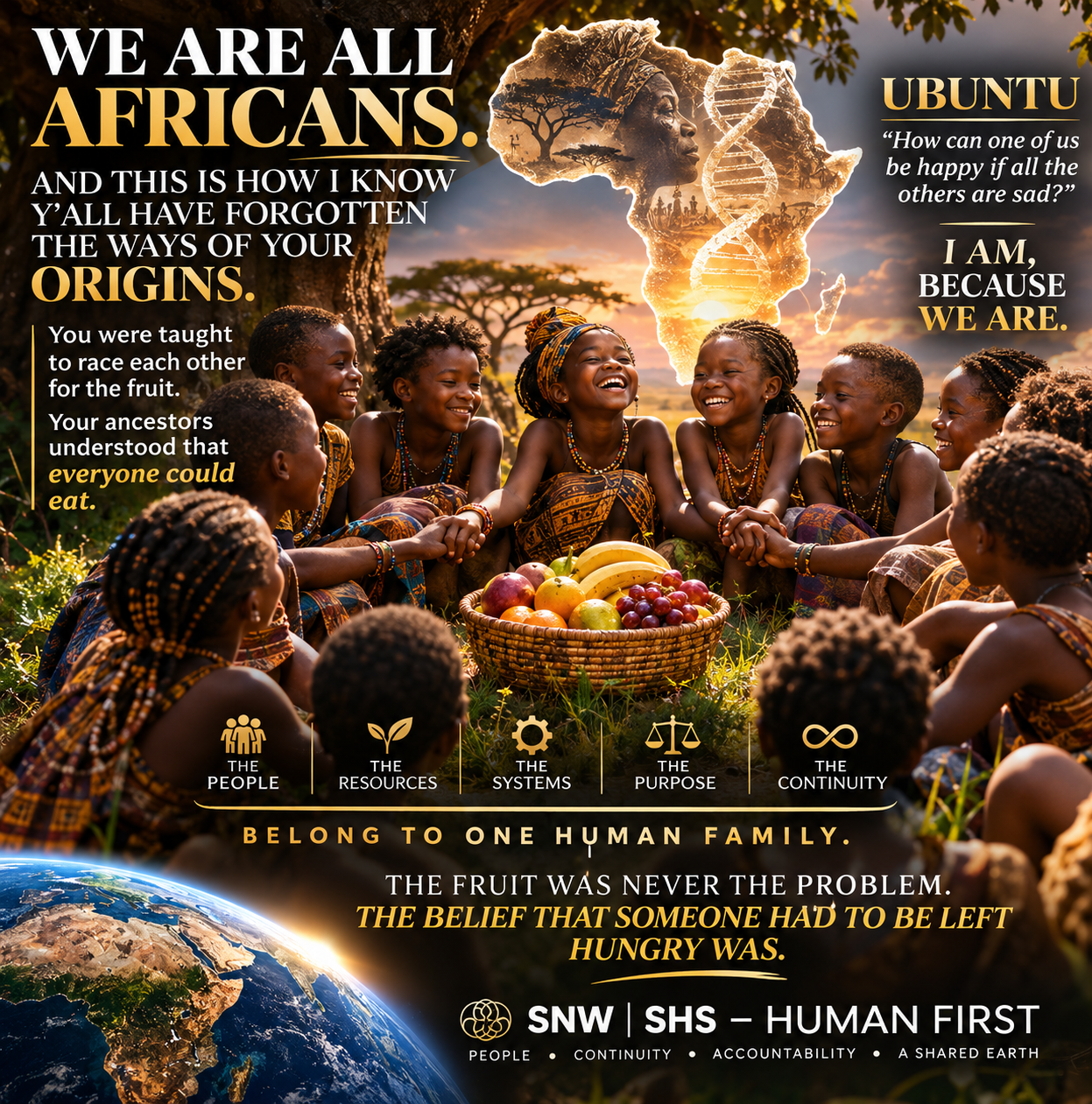
You have no idea how to run with others, you just care for yourselves. If someone was to ask me ” are they african? “, I’d have to answer: ” No. If they don’t know how to run together they’re not my kind. They have become something else. Shame might not be it, but very close. ” Keep chasing the mula away from home and keep watching yourself be drained of anything that makes you feel alive until shame is all there’s left.
YOU WERE TAUGHT TO RACE EACH OTHER FOR THE FRUIT. YOUR ANCESTORS UNDERSTOOD THAT EVERYONE COULD EAT.
SNW | SHS – HUMAN FIRST
I find this so interesting.
There is a widely shared African story about an anthropologist who placed a basket of fruit near a tree and invited a group of children to race towards it.
Whoever reached it first would win the fruit.
But instead of competing, the children reportedly held hands, ran together, and shared the reward.
When asked why they had not competed to win everything for themselves, they answered with the principle of Ubuntu:
“How can one of us be happy if all the others are sad?”
Now, this story is best understood as a parable rather than a verified anthropological event. But the philosophy it illustrates is real.
And THIS is where I want humanity to pay attention.
WE ARE ALL AFRICANS.
Not because everybody belongs to the same contemporary ethnicity, nationality or culture.
But because the evolutionary origins of our species are rooted in Africa.
Before your passports.
Before your borders.
Before your flags.
Before your national anthems.
Before the classifications that taught you to separate yourselves into supposedly superior and inferior populations.
Before your economies decided who deserved to eat according to who could afford the food.
WE WERE HUMAN.
And somewhere along the way, humanity began confusing its systems of organisation with the nature of its existence.
Now look at those children.
The instruction was to COMPETE.
The reward was offered to ONE.
But the children recognised something beyond the conditions of the game.
THERE WAS ENOUGH FRUIT FOR EVERYONE.
So why would they manufacture a loser?
Why would they leave somebody behind when they could arrive together?
Why would they accept that another person’s deprivation was a necessary condition for their own happiness?
THEY DID NOT CHANGE THE FRUIT. THEY CHANGED THE RELATIONSHIP BETWEEN THE PEOPLE SEEKING IT.
Do you understand how profound that is?
Because that is exactly what I have been investigating across our modern institutions.
Humanity has constructed systems in which people are repeatedly told:
Compete for employment.
Compete for housing.
Compete for education.
Compete for healthcare access.
Compete for resources.
Compete for recognition.
Compete for the opportunity to survive.
And then we wonder why people begin treating one another as obstacles instead of fellow participants in existence.
YOU HAVE BEEN TAUGHT TO SEE ANOTHER HUMAN BEING’S SUCCESS AS A THREAT TO YOUR OWN.
Even when cooperation could increase what becomes available to everybody.
Even when the resources already exist.
Even when the suffering is preventable.
Even when the cost of allowing people to suffer eventually becomes greater than the cost of preventing their suffering in the first place.
And you call this civilisation?
You call this advancement?
You call this human development?
YOU HAVE DEVELOPED SYSTEMS OF COMPETITION FASTER THAN YOU HAVE DEVELOPED YOUR RESPONSIBILITY TOWARDS ONE ANOTHER.
Now, I am not suggesting that every African community historically lived without competition, conflict or inequality. Africa has never been one uniform culture.
Nor am I suggesting that every form of competition is harmful.
I am asking something much more fundamental.
WHEN DID COMPETITION BECOME MORE IMPORTANT THAN THE PEOPLE PARTICIPATING IN IT?
Because competition can challenge our capabilities, encourage discovery and contribute to progress.
But when another person’s suffering becomes the price of your reward, you ought to be capable of questioning the rules.
And that is where I see Ubuntu.
Not as an exotic philosophy belonging to some distant people whose wisdom can be admired and then forgotten.
But as a reminder of a human capacity we have not lost:
THE CAPACITY TO RECOGNISE OURSELVES IN ONE ANOTHER.
Ubuntu is commonly expressed through the idea that a person becomes a person through other people.
I AM BECAUSE WE ARE.
And look at how far humanity has travelled from understanding the implications of that relationship.
You cannot have a functioning economy without people.
You cannot have a government without people.
You cannot have an institution without people.
You cannot have a society without relationships.
You cannot even inherit knowledge without generations of human beings who existed before you.
Yet we have created institutions that treat human beings as disposable while protecting the systems that depend upon their existence.
MAKE IT MAKE SENSE.
A corporation can celebrate record profits while employees struggle to eat.
A country can celebrate economic growth while people sleep on its streets.
A supermarket can discard edible food while families go hungry.
A property market can hold buildings empty while people have nowhere to live.
A government can measure the success of its financial year while leaving the consequences of its decisions for future generations.
THE FRUIT EXISTS.
The question is no longer only who reaches it first.
It is who decided that the others should be left behind.
Who designed the rules?
Who benefits from the scarcity?
Is that scarcity natural, manufactured, or a combination of circumstances that could be changed?
And why do we protect the rules even when their consequences undermine the people they were created to serve?
Because the children in that parable did something that many of our most powerful institutions still struggle to accomplish.
THEY QUESTIONED THE PRESUMPTION THAT ONE PERSON’S BENEFIT REQUIRED ANOTHER PERSON’S EXCLUSION.
They did not need to destroy the basket.
They did not need to fight the person offering the fruit.
They did not even need to reject the reward.
They simply recognised a better way of reaching it.
TOGETHER.
And this is what I mean when I speak about humanity’s continuity.
Your future does not exist independently of everybody else’s.
The air you breathe does not recognise your nationality.
The ecosystems sustaining your food do not recognise your financial status.
A disease does not respect the prestige of your employer.
The consequences of environmental destruction do not disappear because your accounting books have balanced.
And the children who will inherit this planet will not be protected from its problems by the reputations of the institutions that created them.
YOUR EXISTENCE IS INTERCONNECTED WHETHER YOUR IDEOLOGY ACKNOWLEDGES IT OR NOT.
That interconnectedness does not mean we must surrender our individuality.
It does not mean sacrificing yourself indefinitely for people who refuse reciprocity.
And it certainly does not mean everybody must want the same things.
It means understanding that individuality does not cancel interdependence.
You can be yourself without needing somebody else to become less.
You can succeed without deliberately manufacturing another person’s failure.
You can enjoy the fruit without requiring another human being to go hungry.
And you can develop a society where personal achievement contributes to collective continuity instead of being rewarded for undermining it.
THAT is advancement worth pursuing.
So when I say we are all Africans, I am not asking humanity to abandon its many cultures and histories.
I AM ASKING HUMANITY TO REMEMBER THAT ALL THOSE CULTURES BELONG TO ONE HUMAN FAMILY.
You travelled.
You settled.
You built.
You named lands.
You developed languages.
You created nations.
You established religions.
You inherited traditions.
You built industries and governments.
And somewhere along the way, too many of you began behaving as though those distinctions had erased the life you share.
THE SYSTEMS YOU CREATED TO ORGANISE HUMANITY BECAME THE VERY THINGS YOU USED TO DIVIDE IT.
How extraordinary.
We have become capable of sending machines beyond Earth, yet still struggle to organise the resources on Earth so that human beings do not die from preventable deprivation.
We can communicate across continents in seconds, yet construct barriers to recognising one another’s humanity.
We can produce extraordinary wealth, yet continue to debate whether everybody deserves the basic conditions necessary to remain alive.
AND YOU WONDER WHY I KEEP RETURNING TO HUMANITY FIRST?
Because it was never complicated to understand who the systems were supposed to serve.
The difficulties arise when the systems become more important than their purpose.
The children in that story were presented with a race.
THEY RECOGNISED AN OPPORTUNITY TO SHARE.
Modern humanity has been presented with an entire planet.
AND TOO OFTEN WE HAVE TREATED IT AS A COMPETITION TO SEE WHO CAN OWN THE MOST BEFORE THEY DIE.
Tell me.
What exactly are you winning if the world you leave behind becomes increasingly difficult for your children to survive in?
What have you achieved if your prosperity depends upon the continued deprivation of those whose labour, resources and existence make your prosperity possible?
And what is the purpose of being first if your achievement leaves humanity further behind?
YOU DON’T NEED TO WIN THE WHOLE BASKET TO ENJOY THE FRUIT.
You need enough.
You need continuity.
And you need a world in which the next generation has the opportunity to enjoy it too.
So yes.
WE ARE ALL AFRICANS.
Our species’ origins remind us of a shared ancestry, while Ubuntu offers one profound African philosophical expression of our shared humanity.
And perhaps it is time to examine just how much we have forgotten about living together.
Because humanity does not need another generation of people who know how to win at everybody else’s expense.
IT NEEDS PEOPLE WHO KNOW HOW TO CREATE A WORLD IN WHICH EVERYBODY HAS A MEANINGFUL OPPORTUNITY TO LIVE.
The fruit was never the problem.
THE BELIEF THAT SOMEONE HAD TO BE LEFT HUNGRY WAS.
And that, humanity, is a belief we are capable of changing.
HUMAN FIRST. NOT THE RACE FIRST. NOT THE WINNER FIRST. NOT THE SYSTEM FIRST.
SNW | SHS – HUMAN FIRST
23 November 2026



Leave a Reply