
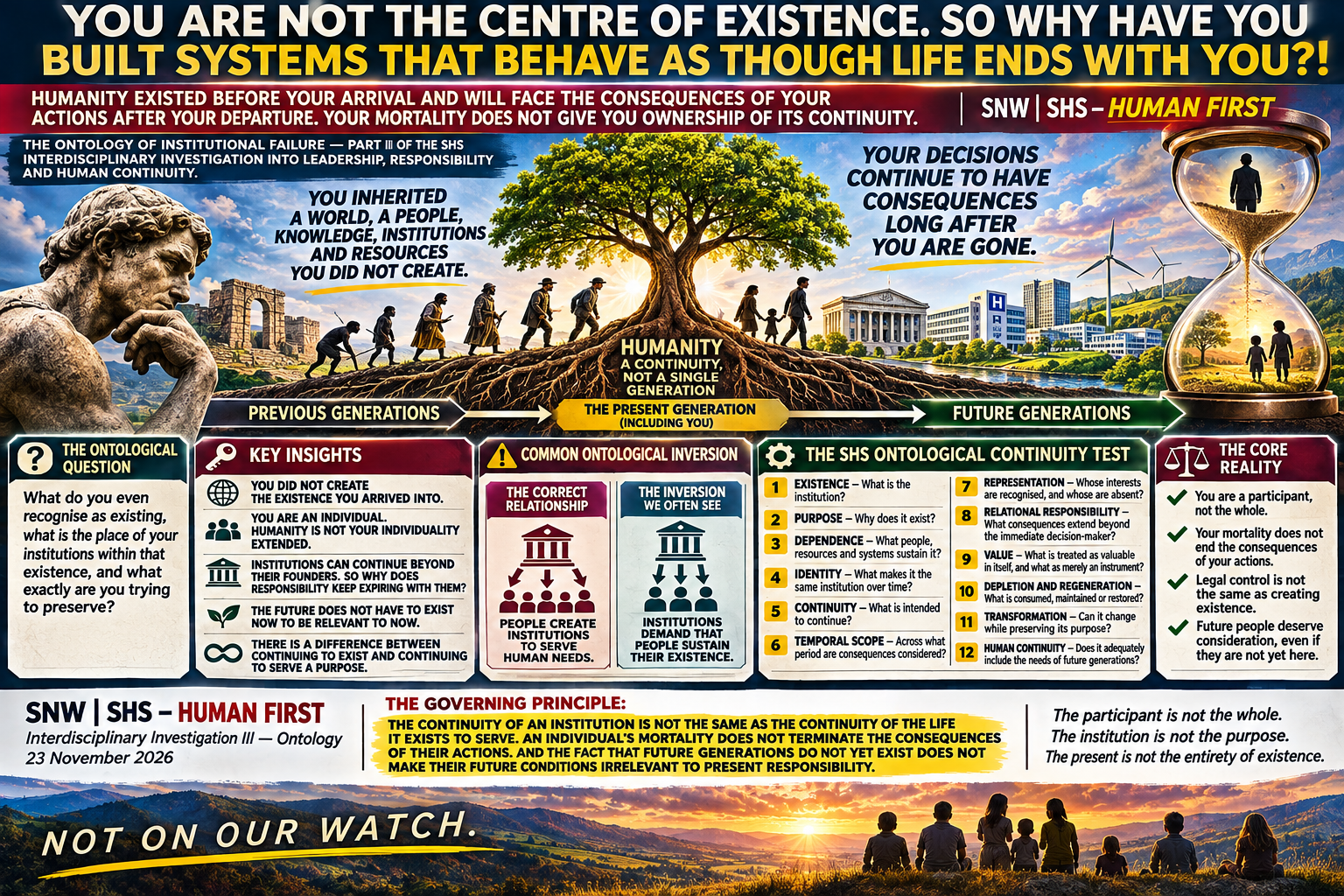
HUMANITY EXISTED BEFORE YOUR ARRIVAL AND WILL FACE THE CONSEQUENCES OF YOUR ACTIONS AFTER YOUR DEPARTURE. YOUR MORTALITY DOES NOT GIVE YOU OWNERSHIP OF ITS CONTINUITY.
THE ONTOLOGY OF INSTITUTIONAL FAILURE — PART III OF THE SHS INTERDISCIPLINARY INVESTIGATION INTO LEADERSHIP, RESPONSIBILITY AND HUMAN CONTINUITY.
SNW | SHS – HUMAN FIRST
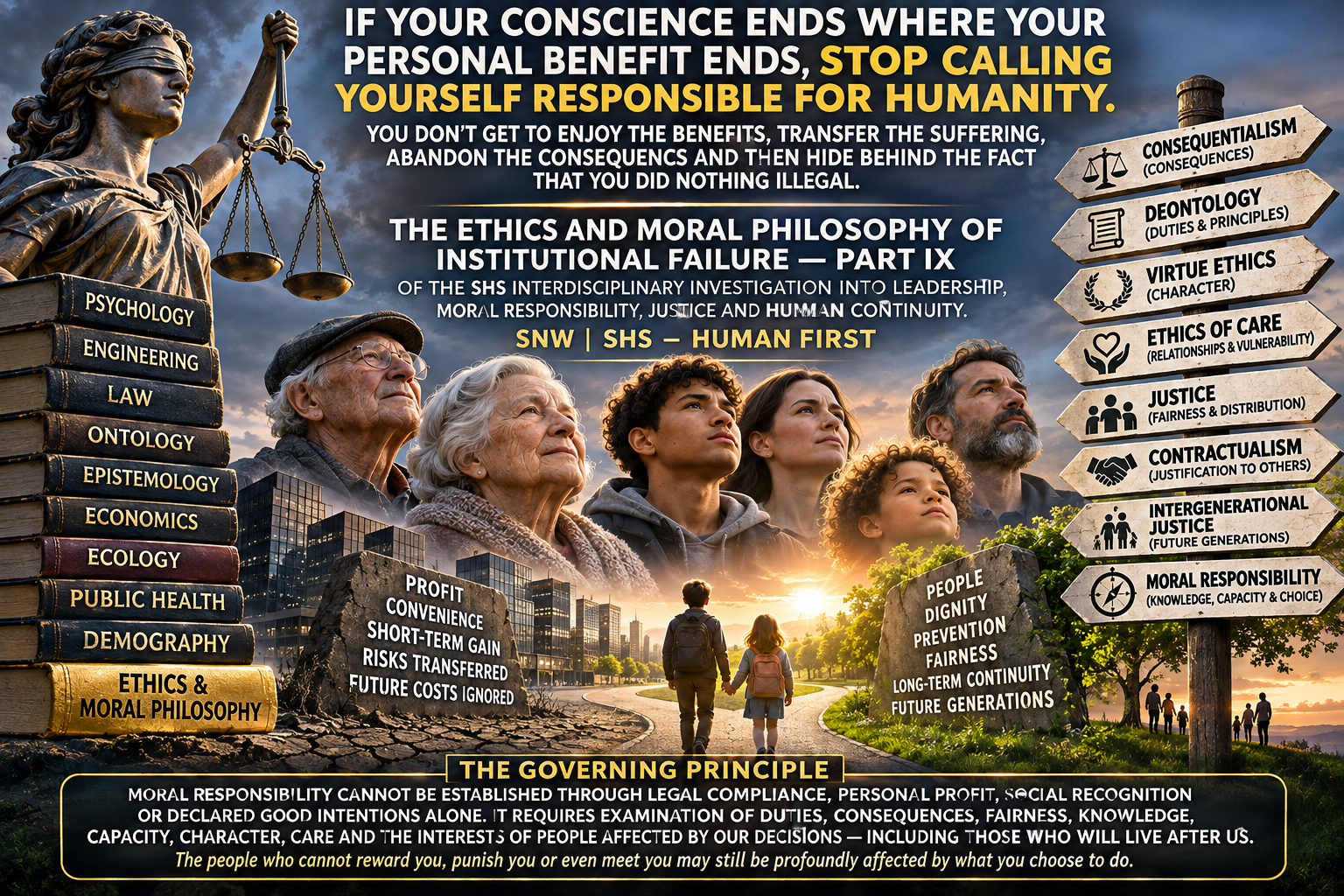
First, psychology.
We investigated what the mind directs itself towards, what it considers worth protecting, and how cognitive biases can reinforce the interests around which somebody organises their existence.
Then, engineering.
We investigated whether the systems responsible for human life are actually capable of fulfilling their intended functions, or whether they have been designed to preserve institutional interests while allowing the conditions of life to deteriorate.
Then, law.
We established that future generations have already entered the statutory responsibilities of public institutions, most explicitly through the Well-being of Future Generations (Wales) Act 2015.
Now I want to examine something even more fundamental.
ONTOLOGY.
The philosophical study of being, existence, what kinds of things exist, and the relationships that make those things what they are.
Because before we can ask whether somebody is capable of protecting humanity’s continuity, we must ask something else.
WHAT DO THEY EVEN RECOGNISE AS EXISTING, AND WHAT PLACE DO THEY BELIEVE THEY OCCUPY WITHIN THAT EXISTENCE?!
Is humanity merely the people presently alive?
Is a government the individuals temporarily occupying its offices?
Is an institution its executives, its legal identity, or the continuing social function it performs?
Is wealth the amount somebody possesses, or does its value depend upon the living systems that make possession and exchange possible?
And most importantly:
DOES THE FACT THAT SOMEBODY WILL NOT PERSONALLY EXPERIENCE A FUTURE MAKE THAT FUTURE ANY LESS CONSEQUENTIAL?
Because humanity may have built an extraordinary amount of its governance around a philosophical confusion.
WE HAVE ALLOWED TEMPORARY OCCUPANTS OF EXISTENCE TO BEHAVE AS THOUGH THEY ARE THE OWNERS OF ITS CONTINUATION.
And I want to investigate what happens when that confusion becomes institutional design.
I. FIRST OF ALL, YOU DID NOT CREATE THE EXISTENCE YOU ARRIVED INTO.
Let’s establish something.
Before you were born, the world existed.
The atmosphere was here.
The oceans were here.
The land was here.
The conditions necessary for your biological existence had already been developing for billions of years.
Humanity existed.
Language existed.
Knowledge existed.
Cultures existed.
People constructed roads, cultivated food, discovered medicines, developed systems of communication and established institutions.
You entered an existence already containing the accumulated consequences of other lives.
YOU DID NOT ARRIVE INTO AN EMPTY WORLD AND GENERATE EVERYTHING THAT SUSTAINS YOU.
You inherited conditions.
You inherited resources.
You inherited knowledge.
You inherited opportunities.
And you inherited problems.
Even the body through which you experience existence is dependent upon biological processes and relationships you did not independently create.
The oxygen you breathe.
The water you consume.
The food that nourishes you.
The ecosystem that supports that food.
The labour of other people.
The knowledge that makes modern medicine possible.
The infrastructure through which society functions.
YOUR INDIVIDUAL EXISTENCE IS DEPENDENT UPON CONDITIONS THAT EXTEND FAR BEYOND YOUR INDIVIDUAL EXISTENCE.
So how exactly did we arrive at the idea that personal benefit should be the dominant measurement of what an individual owes to life?
How did the participant begin behaving like the proprietor?
How did temporary access become an assumed entitlement to unrestricted consumption?
YOU WERE BORN INTO A CONTINUITY.
You did not invent the continuity merely by arriving.
And when your personal participation ends, the consequences of your participation do not necessarily end with it.
That should fundamentally change how leadership understands responsibility.
II. YOU ARE AN INDIVIDUAL. HUMANITY IS NOT YOUR INDIVIDUALITY EXTENDED.
This is where I want to distinguish the self from the whole.
You are an individual human being.
You possess your own experiences, needs, relationships, interests and limited perspective.
But humanity is not reducible to your personal experience of being human.
It includes people who exist beyond your perception.
People whose circumstances you do not know.
People whose needs you have never personally experienced.
People who disagree with you.
People who do not contribute to your financial wellbeing.
People who cannot offer you recognition.
And, in the continuing human population, people who will exist after you.
YOUR INABILITY TO EXPERIENCE SOMEBODY ELSE’S LIFE DOES NOT MAKE THEIR LIFE AN EXTENSION OF YOURS.
Nor does it make their needs imaginary.
Yet look at how easily institutions can confuse the interests of their leadership with the interests of the populations they govern.
An executive’s financial reward becomes evidence of corporate success.
An administration’s survival becomes evidence of political effectiveness.
An organisation’s profitability becomes evidence of its social value.
A leader’s reputation becomes something to protect even when doing so competes with recognising the suffering of others.
THE PART BEGINS TO BEHAVE AS THOUGH IT IS THE WHOLE.
But it is not.
A leader is not the population.
A government is not humanity.
A corporation is not the economy.
An economy is not the biosphere.
And an individual’s personal continuity is not the entirety of life’s continuity.
THE INABILITY TO DISTINGUISH YOUR OWN EXISTENCE FROM THE GREATER EXISTENCE IN WHICH YOU PARTICIPATE IS A SERIOUS PROBLEM WHEN YOU HAVE AUTHORITY OVER OTHER PEOPLE’S LIVES.
Not because ontology can diagnose anybody’s psychology.
It cannot.
But because the underlying concepts used to define a system influence what that system is designed to recognise and protect.
III. YOU HAVE BUILT INSTITUTIONS THAT CONTINUE BEYOND THEIR FOUNDERS. SO WHY DOES RESPONSIBILITY KEEP EXPIRING WITH THEIR LEADERS?
Now we enter social ontology.
Governments.
Corporations.
Legal systems.
Currencies.
Property rights.
Political offices.
Professional institutions.
These are not all natural objects existing in exactly the same way as mountains, trees or biological organisms.
Their existence and operation involve rules, recognition, practices, social relationships and institutional structures.
Philosophers of social ontology investigate how such entities are constituted and maintained.
Consider a corporation.
Its founder may die.
Its shareholders may change.
Its employees may be replaced.
Its directors may retire.
Its buildings may be demolished.
Yet the corporation may continue operating as a legal entity.
SOMEHOW WE HAVE LEARNED TO ORGANISE THE CONTINUITY OF AN INSTITUTION BEYOND THE LIVES OF THE PEOPLE WHO CREATED IT.
We can establish succession arrangements.
Transfer ownership.
Preserve records.
Maintain contractual obligations.
Create reserves.
Plan investments.
Protect intellectual property.
Develop long-term business strategies.
Ensure an institution survives changes in leadership.
SO WE CLEARLY UNDERSTAND HOW TO ORGANISE THINGS BEYOND THE INDIVIDUAL LIFESPAN.
Now comes my question.
Why is that same capacity not consistently demonstrated in protecting the human and environmental conditions on which those institutions depend?
Why can an organisation plan for its own existence decades into the future while failing to account adequately for the long-term consequences of its operations?
Why can it recognise future profits as worthy of investment but treat future harms as uncertain inconveniences?
Why is institutional continuity so frequently a formal objective while humanity’s continuity risks becoming somebody else’s concern?
YOU KNOW HOW TO PLAN FOR TOMORROW WHEN TOMORROW BELONGS TO YOUR INSTITUTION.
WHAT CHANGES WHEN TOMORROW BELONGS TO HUMANITY?!
And if your institution’s long-term survival depends upon the deterioration of the systems that sustain human life, what exactly is the value of that survival?
Philosophical foundation: Stanford Encyclopedia of Philosophy — Social Ontology
IV. THE INSTITUTION EXISTS BECAUSE HUMAN BEINGS SUSTAIN IT. STOP BEHAVING AS THOUGH HUMAN BEINGS EXIST TO SUSTAIN THE INSTITUTION.
Here is one of the greatest ontological inversions in modern governance.
Human beings establish institutions to fulfil social functions.
But institutions can gradually become so focused on their own preservation that the relationship appears reversed.
The institution begins treating people as instruments for sustaining its existence.
Workers become labour costs.
Patients become cases.
Students become performance indicators.
Citizens become administrative categories.
Communities become markets.
Natural resources become assets.
And sometimes, the human outcome becomes secondary to the system’s continued operation.
THE CREATION BEGINS DEMANDING THAT ITS CREATORS SACRIFICE THEMSELVES TO PRESERVE IT.
Think about the difference.
A hospital needs funding, staff, facilities, equipment and administration to provide healthcare.
Those resources are necessary.
But the purpose of healthcare is not merely to keep the hospital legally and financially alive.
The purpose concerns the health needs of people.
A school needs an organisation, curriculum, funding and personnel.
But education does not exist merely to preserve the school as an institution.
The institution exists to facilitate education.
THE ORGANISATIONAL VEHICLE IS NOT AUTOMATICALLY IDENTICAL TO THE HUMAN PURPOSE IT WAS CREATED TO SERVE.
This is a conceptual distinction with real consequences.
When the continued existence of the vehicle becomes more important than the function it was supposed to deliver, the institution may begin protecting the wrong thing.
And here is the question ontology demands we ask:
WHAT EXACTLY ARE YOU PRESERVING WHEN YOU CLAIM YOU ARE PRESERVING THE SYSTEM?
The organisation?
Its authority?
Its financial arrangements?
Its employees?
Its public function?
Or the actual conditions of life that justified its creation?
Because these are related, but they are not identical.
And treating them as identical can prevent us from recognising when one survives at the expense of another.
V. THE FUTURE DOES NOT HAVE TO EXIST IN THE PRESENT TO BE RELEVANT TO THE PRESENT.
Now let’s investigate future generations.
Here we encounter a genuine philosophical problem.
Future individuals are not presently existing people.
We cannot simply pretend they already exist in the same sense that people alive today exist.
We do not know exactly who they will be.
Some future people may exist partly because of the decisions we make today.
Others might never exist if different decisions are made.
Their identities are not fixed independently of history.
This is part of what philosophers call the non-identity problem.
And it creates difficult questions about how to understand obligations towards people whose very existence may depend upon present choices.
But here is the distinction I want humanity to recognise.
THE FACT THAT A FUTURE PERSON DOES NOT CURRENTLY EXIST DOES NOT MAKE THE FUTURE CONSEQUENCES OF PRESENT ACTIONS IRRELEVANT.
Consider a water supply.
You know that people will need water in the future.
You may not know their names.
You may not know their identities.
You may not know precisely when they will be born.
But that does not prevent you from recognising the importance of preserving water quality, infrastructure and availability.
Consider a school.
Children who will attend it twenty years from now may not yet have been born.
Does that mean the building should be constructed without consideration for its future safety?
Consider a forest.
Some of the people who may depend on its ecological functions fifty years from now do not currently exist.
Does that mean its future condition has no relevance to what we do today?
YOU DO NOT NEED TO KNOW THE NAME OF THE PERSON WHO WILL SUFFER A FORESEEABLE CONSEQUENCE TO RECOGNISE THAT THE CONSEQUENCE MATTERS.
And you do not need to believe your own consciousness will survive death to recognise that other lives may continue after yours.
The philosophical debate concerns how such obligations are justified, how far they extend, and how to compare possible futures.
It does not establish that future human welfare is meaningless.
Philosophical foundations: Intergenerational Justice and The Nonidentity Problem
VI. YOUR DEATH IS AN EVENT IN YOUR EXISTENCE. IT IS NOT THE DEATH OF EVERY RELATIONSHIP YOUR EXISTENCE CREATED.
Now we reach the personal dimension.
What happens when an individual dies?
Biology can investigate the cessation of bodily functions and the physical processes that follow.
Philosophy examines what constitutes personal identity, persistence and existence over time.
Religious and metaphysical traditions offer different accounts of what, if anything, survives bodily death.
These are not all the same questions.
The conservation of energy does not, by itself, establish that personal consciousness continues after death.
But notice what does not depend upon settling that question.
THE CONSEQUENCES OF YOUR ACTIONS CAN CONTINUE AFTER YOUR DEATH.
The building you constructed may remain standing.
The pollution you released may remain in the environment.
The knowledge you taught may continue through other people.
The children you raised may influence further generations.
The law you helped create may continue being applied.
The debt you incurred may remain attached to an institution.
The resources you depleted may take centuries to regenerate.
YOUR PERSONAL EXPERIENCE OF A CONSEQUENCE IS NOT THE CONDITION THAT MAKES THE CONSEQUENCE EXIST.
So why would anyone organise their moral responsibilities as though they must end at the boundary of personal experience?
That is not a conclusion established by mortality.
It is an additional moral position.
One that deserves to be examined.
Because you can believe that death ends personal consciousness and still recognise obligations to humanity.
And you can believe in an afterlife while neglecting those obligations.
WHAT MATTERS IS WHETHER YOUR UNDERSTANDING OF EXISTENCE ALLOWS YOU TO RECOGNISE RESPONSIBILITIES THAT EXTEND BEYOND YOURSELF.
The existence of consequences is not conditional on your continued presence to witness them.
VII. IF YOUR DEFINITION OF SUCCESS ENDS WITH YOUR OWN LIFESPAN, YOU HAVE ALREADY EXCLUDED THE PEOPLE WHO COME AFTER YOU.
Let’s make this practical.
A political administration may evaluate success over an electoral term.
A corporation may prioritise annual or quarterly results.
An executive may focus on achievements recognised during their tenure.
A property investor may evaluate returns over the expected ownership period.
None of these timescales is inherently illegitimate.
Different decisions require different planning horizons.
But what happens when the measurement horizon is shorter than the lifespan of the consequences?
What happens when environmental restoration takes sixty years but the investment decision is evaluated over six?
What happens when a building must remain usable for generations but maintenance decisions are made primarily around immediate savings?
What happens when today’s financial benefits are measured while future public costs receive inadequate consideration?
YOU HAVE NOT MADE THE FUTURE DISAPPEAR.
YOU HAVE SIMPLY EXCLUDED IT FROM THE FRAMEWORK THROUGH WHICH YOU MEASURE SUCCESS.
And once excluded, its interests may be treated as external to the decision.
That is the danger.
A system can report success while generating consequences that undermine the conditions necessary for its continued beneficial operation.
THE MEASUREMENT CAN END BEFORE THE DAMAGE BEGINS.
And then the people responsible for the measurement congratulate themselves.
This is not necessarily evidence of deliberate malice.
Sometimes it arises from poor incentives, limited information, institutional fragmentation or the genuine difficulty of forecasting long-term effects.
But it remains something we must investigate.
Because when short-term indicators repeatedly dominate decision-making, we must examine whether the institution has adequately represented the time horizon of the lives and systems it affects.
VIII. EXISTENCE IS RELATIONAL. YOU CANNOT SEPARATE WHAT BENEFITS YOU FROM EVERYTHING THAT MAKES THAT BENEFIT POSSIBLE.
I want to examine dependence.
A company depends on workers.
Workers depend on food, water, shelter, health and social conditions.
Food depends on agricultural and ecological systems.
Production depends on energy, infrastructure and resources.
Markets depend on social cooperation and institutional arrangements.
Financial assets depend on economic and legal systems through which ownership and exchange are recognised.
THE THINGS WE VALUE ARE EMBEDDED WITHIN RELATIONSHIPS THAT ENABLE THEM TO EXIST AND FUNCTION.
This does not mean everything is identical.
It means independence cannot simply be assumed.
A corporation may possess a separate legal identity.
That does not mean it can produce value without physical resources, human participation or surrounding social systems.
Money may possess purchasing power.
That does not mean money can independently generate oxygen, clean water, fertile soil or biological health.
A leader may possess authority.
That does not mean the authority exists without the political, legal and social arrangements that establish it.
YOUR POWER DOES NOT MAKE YOU INDEPENDENT OF THE WORLD THAT MAKES YOUR POWER POSSIBLE.
So why would a system organise itself around maximising benefits for one component while neglecting the conditions sustaining the whole?
Why would it treat resource regeneration as secondary?
Why would it measure economic success without sufficient consideration for ecological depletion?
Why would it prioritise private returns while transferring significant costs to the public?
WHAT IS THE PURPOSE OF ACCUMULATING WEALTH IF THE CONDITIONS THAT GIVE THAT WEALTH PRACTICAL VALUE ARE BEING UNDERMINED?
You cannot consume the foundations of a system indefinitely and reasonably expect its productive capacity to remain unchanged.
And you cannot protect your own prosperity by disregarding every dependency on which that prosperity rests.
That is not a complete understanding of the system.
It is a restricted understanding of your position within it.
IX. THERE IS A DIFFERENCE BETWEEN CONTINUING TO EXIST AND CONTINUING TO SERVE A PURPOSE.
Now consider identity across time.
A corporation may retain its legal identity despite replacing its directors.
An institution may retain its name despite transforming its practices.
A government department may continue existing despite substantial changes to its responsibilities.
But does continuity of identity establish continuity of purpose?
Not necessarily.
An organisation may continue legally while no longer adequately fulfilling its original function.
A system may remain operational while delivering increasingly poor outcomes.
An institution may protect its assets while the needs it was established to serve become neglected.
ITS NAME SURVIVED. BUT DID ITS PURPOSE?
This distinction matters.
Because preserving an institution and preserving the value of an institution are not automatically the same thing.
The preservation of a name is not necessarily the preservation of a function.
The survival of a legal entity is not necessarily the continuation of its public benefit.
And maintaining historical arrangements is not necessarily equivalent to fulfilling their original purpose under present conditions.
IF THE REASON FOR AN INSTITUTION’S EXISTENCE HAS BEEN LOST, WHAT EXACTLY ARE WE DEFENDING BY REFUSING TO CHANGE IT?
Its identity?
Its prestige?
Its authority?
Its resources?
Or the needs of the people who depend on it?
Because the preservation of institutions should be open to evaluation against the purposes that justify their existence.
WE DO NOT HAVE TO PRESERVE EVERY ARRANGEMENT EXACTLY AS IT WAS CREATED IN ORDER TO PRESERVE THE HUMAN VALUE IT WAS SUPPOSED TO DELIVER.
Sometimes continuity requires maintenance.
Sometimes it requires adaptation.
Sometimes it requires reconstruction.
And sometimes it requires replacing an arrangement that is no longer capable of performing its function.
The thing that deserves preservation may not be the organisation’s original form.
IT MAY BE THE PURPOSE THE ORGANISATION WAS CREATED TO SERVE.
X. STOP CONFUSING OWNERSHIP WITH ONTOLOGICAL INDEPENDENCE.
This is another distinction institutions need to understand.
Ownership is a relationship recognised within a social and legal framework.
It is not the same as having created every condition that makes the owned thing possible.
You may legally own land.
That does not mean you created the geological processes that formed it.
You may own a business.
That does not mean you independently created every resource, relationship and infrastructure system on which it relies.
You may hold a public office.
That does not mean the people affected by your decisions become extensions of your personal existence.
LEGAL CONTROL OVER A RESOURCE DOES NOT MAKE YOU THE CREATOR OF ITS EXISTENCE.
And exercising lawful control does not eliminate every responsibility that may arise from how that control is exercised.
This is where we need to examine the differences between possession, stewardship, legal entitlement and consequence.
What rights exist?
What duties accompany them?
What effects extend beyond the rights-holder?
What resources are depleted?
What is transferred to others?
And what does the law currently recognise or fail to recognise?
YOU CAN HAVE AUTHORITY TO MAKE A DECISION WITHOUT BEING THE ONLY LIFE AFFECTED BY ITS CONSEQUENCES.
That is the central issue.
Authority and impact are not confined to identical boundaries.
And when decisions affect people beyond the decision-maker’s immediate interests, those consequences deserve independent consideration.
XI. HUMANITY IS A CONTINUITY, NOT A SINGLE GENERATION TAKING TURNS TO CONSUME THE WORLD.
Think about what humanity actually is across time.
No single generation contains every human being who has existed.
No single generation will contain every human being who may exist.
People are born.
People live.
People die.
Knowledge is transmitted.
Institutions evolve.
Cultures change.
Resources are consumed, restored or depleted.
Consequences accumulate.
THE INDIVIDUAL MEMBERS CHANGE WHILE THE HUMAN POPULATION CONTINUES THROUGH TIME.
That does not require believing humanity is a single conscious organism.
It does not mean future people already exist.
Nor does it mean the continuation of humanity is guaranteed.
It means human existence can be understood through relationships and processes extending beyond any individual lifespan.
And that observation has enormous consequences for responsibility.
Because if a decision affects the conditions under which the next generation will live, its significance cannot be adequately measured solely through the experience of the person making it.
If a decision depletes a resource that takes centuries to regenerate, the consequences extend beyond its immediate beneficiaries.
If an institution creates obligations that future people must finance, those obligations remain relevant after the present leadership departs.
THE GENERATION THAT MAKES THE DECISION IS NOT ALWAYS THE GENERATION THAT EXPERIENCES ITS GREATEST CONSEQUENCES.
And yet we continue to organise so much of society around the immediate interests of those who presently possess power.
Why?
That is the ontological question I want directed towards institutional design.
WHO HAS BEEN INCLUDED IN THE SYSTEM’S UNDERSTANDING OF THE HUMAN BEINGS IT EXISTS TO SERVE?
Only today’s customers?
Only current taxpayers?
Only present shareholders?
Only existing voters?
Only the people capable of making demands?
Or does its concept of responsibility extend to the continuing human needs its decisions will affect?
XII. THE NON-IDENTITY PROBLEM DOES NOT GIVE YOU PERMISSION TO TREAT THE FUTURE AS A DUMPING GROUND.
Now let us confront the philosophical complication rather than avoiding it.
Suppose present decisions influence who will be born in the future.
A different policy may lead to different people existing.
That creates a difficult question.
Can somebody claim they were made worse off by a decision if, without that decision, they would not have existed at all?
This is one form of the non-identity problem, associated particularly with Derek Parfit’s work.
It challenges simple ways of explaining harm to future persons.
And philosophers disagree about how best to resolve it.
But notice what does not follow.
It does not follow that every future outcome is equally desirable.
It does not follow that humanity has no reason to preserve the conditions necessary for future wellbeing.
It does not follow that foreseeable environmental destruction becomes morally irrelevant.
It does not follow that a society has no reason to avoid creating severe preventable suffering.
PHILOSOPHICAL COMPLEXITY IS NOT A LICENCE FOR MORAL INDIFFERENCE.
We may disagree about the precise foundations of obligations to future people.
But that disagreement is not proof that we have no obligations whatsoever.
And the uncertainty surrounding future identities does not eliminate the possibility of evaluating future living conditions.
Will there be sufficient safe water?
Will essential infrastructure remain functional?
Will environmental conditions remain compatible with health?
Will foreseeable risks have been reasonably addressed?
Will present decisions leave avoidable liabilities for those who come afterwards?
THE FACT THAT WE CANNOT IDENTIFY EVERY FUTURE PERSON DOES NOT PREVENT US FROM INVESTIGATING THE CONDITIONS WE ARE CREATING FOR FUTURE PERSONS.
That is where philosophical analysis must meet practical responsibility.
XIII. WHAT IF THE FUNDAMENTAL PROBLEM IS THAT OUR INSTITUTIONS HAVE MISIDENTIFIED WHAT THEY EXIST TO PRESERVE?
Now return to the central investigation.
Psychology asks what the decision-maker values.
Engineering asks whether the system can perform.
Law asks what duties apply.
ONTOLOGY ASKS WHAT THE SYSTEM IS, WHAT ITS PURPOSE DEPENDS UPON, AND WHAT EXACTLY IS BEING PRESERVED.
These questions are connected.
An institution may be structured around preserving its own legal and financial continuity.
Its leadership may receive incentives aligned with that objective.
Its internal measurements may reward short-term institutional performance.
Its decision-making may consequently give insufficient consideration to the continuing conditions necessary for wider human wellbeing.
But this is a hypothesis to investigate, not an explanation we can simply assume in every case.
We need evidence.
Institutional objectives.
Resource allocation.
Performance measures.
Decision records.
Governance structures.
The treatment of long-term costs.
The participation of affected communities.
And the actual consequences of institutional activity.
BECAUSE THE QUESTION IS NOT WHETHER AN INSTITUTION CAN DESCRIBE ITS COMMITMENT TO HUMANITY.
THE QUESTION IS WHETHER HUMANITY’S CONTINUING NEEDS ARE ACTUALLY REPRESENTED IN WHAT THE INSTITUTION IS DESIGNED TO DO.
An institution cannot demonstrate that through philosophy alone.
It must demonstrate it through its decisions and outcomes.
But ontology can reveal the conceptual confusion that the practical investigation needs to test.
ARE WE PROTECTING THE SYSTEM BECAUSE IT SERVES LIFE?
OR HAVE WE BEGUN PROTECTING THE SYSTEM EVEN WHEN ITS OPERATION FAILS TO SERVE LIFE?
That distinction changes everything.
XIV. THE SHS ONTOLOGICAL CONTINUITY TEST.
I want this investigation organised around twelve questions.
1. EXISTENCE
What is the institution?
What makes it the kind of entity it is?
2. PURPOSE
Why does it exist?
What human function justifies its operation?
3. DEPENDENCE
Which people, resources, ecological conditions and social structures sustain it?
4. IDENTITY
What constitutes its identity across changes in leadership, ownership and structure?
5. CONTINUITY
What is intended to continue: the institution itself, its function, its beneficiaries’ wellbeing, or some combination?
6. TEMPORAL SCOPE
Across what period are consequences considered?
Does that period reflect the lifespan of the effects the institution creates?
7. REPRESENTATION
Whose interests are recognised?
Whose interests are absent?
8. RELATIONAL RESPONSIBILITY
What consequences extend beyond the immediate decision-maker, beneficiary or owner?
9. VALUE
What is treated as valuable in itself, and what is treated merely as an instrument?
10. DEPLETION AND REGENERATION
What conditions are consumed?
What conditions are maintained?
What conditions must be restored?
11. TRANSFORMATION
Can the institution change its structure while preserving its essential purpose?
Or has its present structure become more important than the purpose itself?
12. HUMAN CONTINUITY
Does the institution’s understanding of responsibility adequately include the conditions necessary for people who will live beyond the current generation?
This test would not, by itself, establish misconduct or incompetence.
But it would reveal the assumptions on which an institution’s objectives and responsibilities are constructed.
And those assumptions could then be tested through engineering, law, economics, ecology, public health and other disciplines.
BECAUSE BEFORE YOU CAN ESTABLISH WHETHER SOMETHING IS FULFILLING ITS PURPOSE, YOU HAVE TO KNOW WHAT YOU BELIEVE IT IS AND WHAT PURPOSE YOU BELIEVE IT EXISTS TO FULFIL.
XV. YOU ARE NOT THE END OF EXISTENCE. STOP GOVERNING AS THOUGH YOU ARE.
This is where I want to conclude.
You were born.
You entered an existence already containing lives, resources, relationships, histories and consequences that preceded you.
You participated.
You consumed.
You created.
You influenced.
You made decisions.
You affected other lives.
And whether you believe your personal consciousness continues after death is a distinct question from whether the consequences of your actions continue.
THE WORLD DOES NOT NEED YOUR PERMISSION TO CONTINUE AFTER YOUR PERSONAL EXPERIENCE OF IT ENDS.
And the people who come after you do not need to have met you for your actions to affect their circumstances.
So what are we doing entrusting long-term human responsibilities to institutions that cannot adequately demonstrate their consideration of those consequences?
What are we doing treating institutional preservation as if it automatically means preservation of the people?
What are we doing measuring prosperity without adequately accounting for the systems on which prosperity depends?
What are we doing allowing temporary benefits to be evaluated independently of the longer-term conditions they may damage?
YOU ARE NOT THE WHOLE.
You are a participant.
Your office is not the whole.
Your corporation is not the whole.
Your government is not the whole.
Your wealth is not the whole.
Your generation is not the whole.
AND YOUR ABSENCE FROM THE FUTURE DOES NOT MAKE THE FUTURE AVAILABLE FOR YOU TO EXPLOIT WITHOUT CONSIDERATION.
I don’t care how prestigious your institution is.
Its prestige does not change its dependencies.
I don’t care how much authority its leadership possesses.
Authority does not change the causal consequences of its decisions.
I don’t care how many years the institution has existed.
Its longevity does not automatically establish that it is fulfilling its purpose.
And I don’t care how beautifully it describes its contribution to humanity.
A DESCRIPTION OF VALUE IS NOT THE SAME AS THE DEMONSTRATION OF VALUE.
So let us investigate what the institutions actually preserve.
The life they serve?
Or the arrangements through which they benefit?
The resources humanity needs?
Or the rights to extract from those resources?
The conditions necessary for future generations?
Or the interests of the people currently capable of making demands?
The human purpose?
Or the institutional identity?
BECAUSE HUMANITY SHOULD NOT HAVE TO SACRIFICE THE CONTINUITY OF LIFE TO PRESERVE THE CONTINUITY OF ARRANGEMENTS IT CREATED.
Institutions can be redesigned.
Policies can be rewritten.
Financial models can be restructured.
Public services can be improved.
Legal frameworks can evolve.
Systems can be corrected.
BUT A DESTROYED ECOSYSTEM CANNOT ALWAYS BE RESTORED.
A depleted resource cannot always be regenerated within the timescale of human need.
A lost life cannot simply be reconstructed by an administrative review.
And some consequences cannot be reversed merely because the institution eventually acknowledges that its previous decisions were inadequate.
SO WHY WAIT UNTIL THE CONSEQUENCES BECOME IRREVERSIBLE BEFORE GIVING THEM THE SERIOUSNESS THEY DESERVE?
The study of existence should make us question our assumptions about what deserves preservation.
And here is mine.
LIFE DOES NOT EXIST FOR THE PURPOSE OF SUSTAINING THE INSTITUTIONS WE HAVE CREATED.
OUR INSTITUTIONS MUST JUSTIFY THEMSELVES THROUGH THE PURPOSES THEY SERVE WITHIN LIFE.
That does not mean every institution is illegitimate.
It means none should be regarded as beyond examination merely because it exists.
EXISTENCE ALONE IS NOT JUSTIFICATION.
AUTHORITY ALONE IS NOT CAPACITY.
CONTINUITY ALONE IS NOT SUCCESS.
AND PRESERVING AN INSTITUTION IS NOT AUTOMATICALLY PRESERVING HUMANITY.
You are not the first.
You are not the last.
You are not the entirety of existence.
You are not exempt from the consequences that extend beyond your personal experience.
And you do not own the future simply because those who will inhabit it are not yet here to challenge your decisions.
THE FUTURE IS NOT AN EMPTY ROOM.
IT IS NOT YOUR STORAGE SPACE FOR CONSEQUENCES.
IT IS NOT YOUR EXIT STRATEGY.
IT IS NOT YOUR PERSONAL RESOURCE TO EXHAUST.
It is the period in which the consequences of today’s decisions will continue unfolding, affecting lives that deserve consideration.
And if you want to lead an institution whose decisions influence those conditions, your responsibility must be examined against that reality.
NOT SIMPLY AGAINST HOW WELL YOU MANAGE YOUR OWN PRESENT.
Because what you choose to preserve reveals something about what you believe matters.
And what you allow to deteriorate reveals something about what your system has failed to protect.
HUMANITY IS NOT YOUR TEMPORARY EXPERIENCE TO CONSUME.
HUMANITY IS A CONTINUITY IN WHICH YOU HAVE BEEN GIVEN THE OPPORTUNITY TO PARTICIPATE.
THE QUESTION IS WHAT YOUR PARTICIPATION LEAVES FOR THOSE WHO COME AFTER YOU.
And when our institutions cannot satisfactorily answer that question?
We investigate.
We examine their purposes.
We examine their dependencies.
We examine their decisions.
We examine their consequences.
And where their design fails the needs they exist to serve, we pursue correction.
NOT ON OUR WATCH.
SNW | SHS – HUMAN FIRST
Interdisciplinary Investigation III — Ontology
23 November 2026
THE GOVERNING PRINCIPLE
THE CONTINUITY OF AN INSTITUTION IS NOT THE SAME AS THE CONTINUITY OF THE LIFE IT EXISTS TO SERVE. AN INDIVIDUAL’S MORTALITY DOES NOT TERMINATE THE CONSEQUENCES OF THEIR ACTIONS. AND THE FACT THAT FUTURE GENERATIONS DO NOT YET EXIST DOES NOT MAKE THEIR FUTURE CONDITIONS IRRELEVANT TO PRESENT RESPONSIBILITY.
The participant is not the whole. The institution is not the purpose. The present is not the entirety of existence.
Philosophical foundations and further research
- Stanford Encyclopedia of Philosophy — Social Ontology
- Stanford Encyclopedia of Philosophy — Social Institutions
- Stanford Encyclopedia of Philosophy — Collective Intentionality
- Stanford Encyclopedia of Philosophy — Personal Identity
- Stanford Encyclopedia of Philosophy — Intergenerational Justice
- Stanford Encyclopedia of Philosophy — The Nonidentity Problem



Leave a Reply