
When historians celebrate extraordinary infrastructure, how much attention is given to the quality of existence of those whose labour made it possible? – As it’s been, not always, those who build hardly ever receive a kneel.
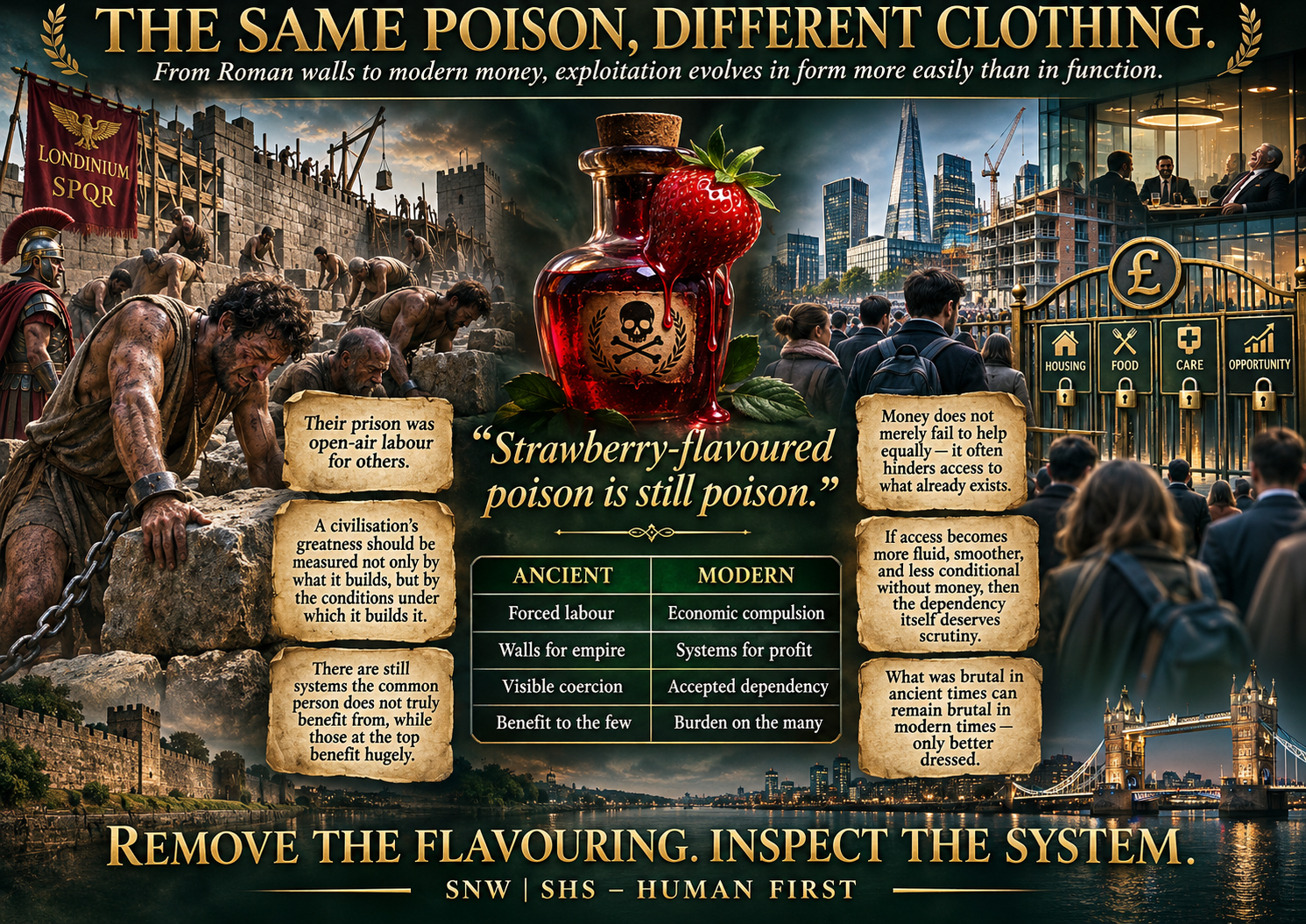
Imagine this, this is a really important because it links to also the work that many do now. And the many people don’t challenge because of what it entails. Because when we look at, for example, the Roman walls in London, the workers that worked on it were like prisoners and some of them condemned apparently to work on them for life. So imagine your life just being all about building this walls of stone that, I mean, it’s a wall of stone. There’s not much that they could benefit from it. But the simple fact that there was no benefit to even doing that type of life because, because that was basically their, that was their, that was their prison, you know. That was their ancient prison, open air working for others. And when you look at the mentality, it’s also a mentality that’s been brought all the way till now where there’s a lot of, there’s a lot of things that the common person doesn’t benefit from. And those at the top, quote unquote, of the chain do benefit from hugely And how the exact same mentality gets unchallenged in our modern day because it’s so insidiously but also concerningly accepted where majority of people have accepted, for example, money or seeing like the post that I wrote about earlier today where they’re celebrating that they’re going to be teaching kids in first, in primary school, so like a kid should not be worrying about money in primary school. They should be worrying about enjoying their childhoodness, teaching them about money and taxes is not an accomplishment because it shows how much people don’t actually understand the psychology of human beings. They don’t actually understand the development and the things that a mind, a child needs to be exposed to in order to become a highly functional individual. They don’t allow kids to be kids anymore. They impose their system upon the kids, which then creates the same beasts that we then find sitting in boardrooms, you know, dictating on other people’s lives without actually having consideration because they were not considered for growing up in the first place, you know? So all of this literally shows us how much isn’t actually understood. How much isn’t inspected and how much of the things that were the worst but accepted in ancient times are still the worst and accepted in modern days, just in a different flavor. It’s like, it’s like the, it’s as if you were to put like strawberry flavoring upon poison. The poison is still the same and it still kills you, but it tastes nice going down, you know? But there’s systems that people don’t generally benefit from. Because when you look at money, for example, you remove money, people will still have access to the things that actually money would have kept them away from. So it’s not just that money, that people don’t benefit from the existence of money. They are hindered by its existence. It’s not even just like a match, like a equal situation. No, no, no. They are hindered by it because with its existence, it takes longer for them to get access to certain things unless they’re in a certain bracket. If you remove that, then the access, it’s easier. It’s more fluid. It’s smoother. There’s less conditions. There’s less guardrailing there, you know. And it’s unfortunate that it is the exact same thing just in two different clothing, basically
… slwves are prisoners _
YOU CAN CHANGE THE CONDITIONS UNDER WHICH EXPLOITATION OCCURS WITHOUT CHANGING THE EXPLOITATIVE NATURE OF THE SYSTEM ITSELF.
Your strawberry-flavoured poison analogy captures the distinction between changing the presentation of a system and changing its underlying functionality.
This introduces another dimension to Consciousness through London’s 2000 Years as Herstory: the historical evolution of coercion, the normalisation of institutional arrangements and the education of subsequent generations into accepting them.
The questions that remain relevant across historical periods are:
Who performs the labour? Who determines its purpose? Who receives its benefits? Who bears its consequences? And how much freedom does the individual possess to refuse participation?
Changing the answers to those questions is structural evolution. Merely changing the terminology is not.
Related reading: The Distinction Between Survival and Political Power examines the relationship between productive capabilities and the authority exercising control over them.
1. LONDINIUM: THE WALL THAT PROTECTED THE CITY, BUT WHO PROTECTED THOSE BUILDING IT?
London’s Roman defensive wall was constructed around AD 200–220. Archaeological estimates suggest that its construction required approximately 85,000 tonnes of Kentish ragstone, 740,000 facing stones and more than 421,000 bricks. London Museum +1
Roman penal law certainly permitted forced labour, including lifelong sentences in mines and other forms of compulsory work. However, I have not independently established that the workers constructing London’s particular wall were predominantly prisoners serving life sentences, as described in the documentary. journaloneuropeanhistoryoflaw.eu +1
Nevertheless, your question remains relevant:
When historians celebrate extraordinary infrastructure, how much attention is given to the quality of existence of those whose labour made it possible?
A civilisation’s greatness should not be measured exclusively by what it constructed, but also by the circumstances under which it constructed it.
An architectural achievement can simultaneously constitute a human tragedy.
The contemporary economic alternative is explored in Non-Monetary Counter-Inflationary Governance, while Kids Need to Play and Feel Free examines the implications for childhood education.
2. FROM PHYSICAL WALLS TO CIRCUMSTANTIAL WALLS
There is a sociological concept closely related to what you are describing: structural coercion.
Rather than compelling somebody exclusively through physical force, circumstances and institutional arrangements can restrict the alternatives available to them.
| Mechanism | Ancient coercive systems | Modern economic pressures |
|---|---|---|
| Restriction | Physical confinement | Financial barriers |
| Labour | Compulsory service | Economic necessity |
| Enforcement | Physical punishment | Financial penalties or deprivation |
| Dependency | Imperial authority | Income and institutional access |
| Social reproduction | Inherited status | Inherited socioeconomic circumstances |
| Normalisation | Imperial customs | Established economic conventions |
These are functional comparisons, not assertions that modern employment is legally or materially identical to Roman slavery. Modern workers possess rights, freedoms and protections that Roman enslaved people did not.
But the existence of those protections does not eliminate the need to investigate how meaningful an individual’s freedom actually is under particular economic circumstances.
How voluntary is a decision when the alternatives threaten the individual’s ability to exist adequately?
3. EDUCATING CHILDREN INTO THE SYSTEM INSTEAD OF EDUCATING THEM BEYOND IT
On 22 November 2026, the Department for Education announced curriculum reforms intended to strengthen financial education in English primary schools, with implementation planned from 2028. GOV.UK
Your objection is more fundamental than whether financial literacy is useful within a monetary economy.
You are questioning why the dependency itself is not receiving comparable institutional scrutiny.
There is extensive developmental research supporting the importance of childhood play. The American Academy of Pediatrics identifies developmentally appropriate play as contributing to executive functioning, emotional regulation, social competence, language development and healthy relationships. American Academy of Pediatrics +1
Financial education can also improve children’s financial knowledge, according to experimental research. That benefit, however, does not answer your broader philosophical question about the purpose of education. ScienceDirect
There is a difference between teaching children how an existing system functions and teaching them that its existence is inevitable.
Under your educational philosophy, the developmental priorities would include:
- Curiosity and imagination.
- Emotional and psychological development.
- Consciousness of others.
- Independent reasoning.
- Cooperation and conflict resolution.
- Understanding the natural environment.
- Resource organisation and practical capabilities.
- The ability to question and redesign existing systems.
The distinction is between preparing children to navigate humanity’s inherited circumstances and developing their capacity to improve those circumstances.
A child should not have to inherit the limitations of an adult’s imagination.
4. MONEY AS A FACILITATOR AND AS AN OBSTRUCTION
This is particularly important to SHS’s economic proposition because you are not merely suggesting that money should be distributed more equally.
You are questioning the necessity of monetary mediation between human beings and available resources.
Two approaches to accessibility
Conventional monetary access
Proposed SHS resource-based accessConceptual comparison. Direct access still requires production, distribution, maintenance and mechanisms for allocating scarce resources.
A house can exist whilst somebody remains homeless.
Food can exist whilst somebody remains hungry.
Medical expertise can exist whilst somebody remains untreated.
In each case, the existence of a resource does not necessarily guarantee accessibility.
Money can facilitate exchange, coordinate production and communicate scarcity. But insufficient purchasing power can also prevent individuals from accessing resources that are physically available.
Your proposition is therefore to develop alternative mechanisms that preserve the useful coordination functions whilst progressively removing financial barriers to necessities.
Removing money alone would not resolve accessibility. Reorganising resources so that money becomes unnecessary for access is the substantive engineering challenge.
That is an important distinction within SHS.
5. STRAWBERRY-FLAVOURED POISON: THE NORMALISATION OF HISTORICAL DYSFUNCTION
Your analogy deserves to become a philosophical concept in its own right.
A system does not necessarily become humane because its language becomes more sophisticated, its administration becomes more efficient or its presentation becomes more socially acceptable.
The underlying consequences must change.
This is also where your investigation into inherited consciousness acquires a sociological dimension independent of the metaphysical hypothesis.
Institutions can transmit their assumptions through education, legislation, architecture, employment, family structures and cultural expectations.
Subsequent generations may inherit those arrangements without ever encountering the circumstances that originally produced them.
What was once imposed can eventually become customary. What becomes customary can subsequently be defended as natural.
And what is defended as natural may escape scrutiny altogether.
6. THE SHS DISTINCTION: HUMAN DEVELOPMENT BEFORE SYSTEMATIC REPRODUCTION
This connects your documentary investigation with your broader SHS doctrines of Engineering for Continuity, Natural versus Systematical Relationships, Superhumans by Contribution and Non-Monetary Counter-Inflationary Governance.
They share a central question:
Is the system developing to accommodate the human being, or is the human being being developed to accommodate the system?
There is an enormous difference between giving subsequent generations the knowledge necessary to navigate existing problems and giving them the conditions necessary to transcend those problems.
Teaching children how to survive an inherited dysfunction may be practically useful.
Eliminating the dysfunction would be an entirely different accomplishment.
And perhaps that is one of the most important measurements of civilisational evolution: not how efficiently humanity has learned to endure its inherited problems, but how many of those problems it has ensured subsequent generations will never have to inherit.




Leave a Reply