
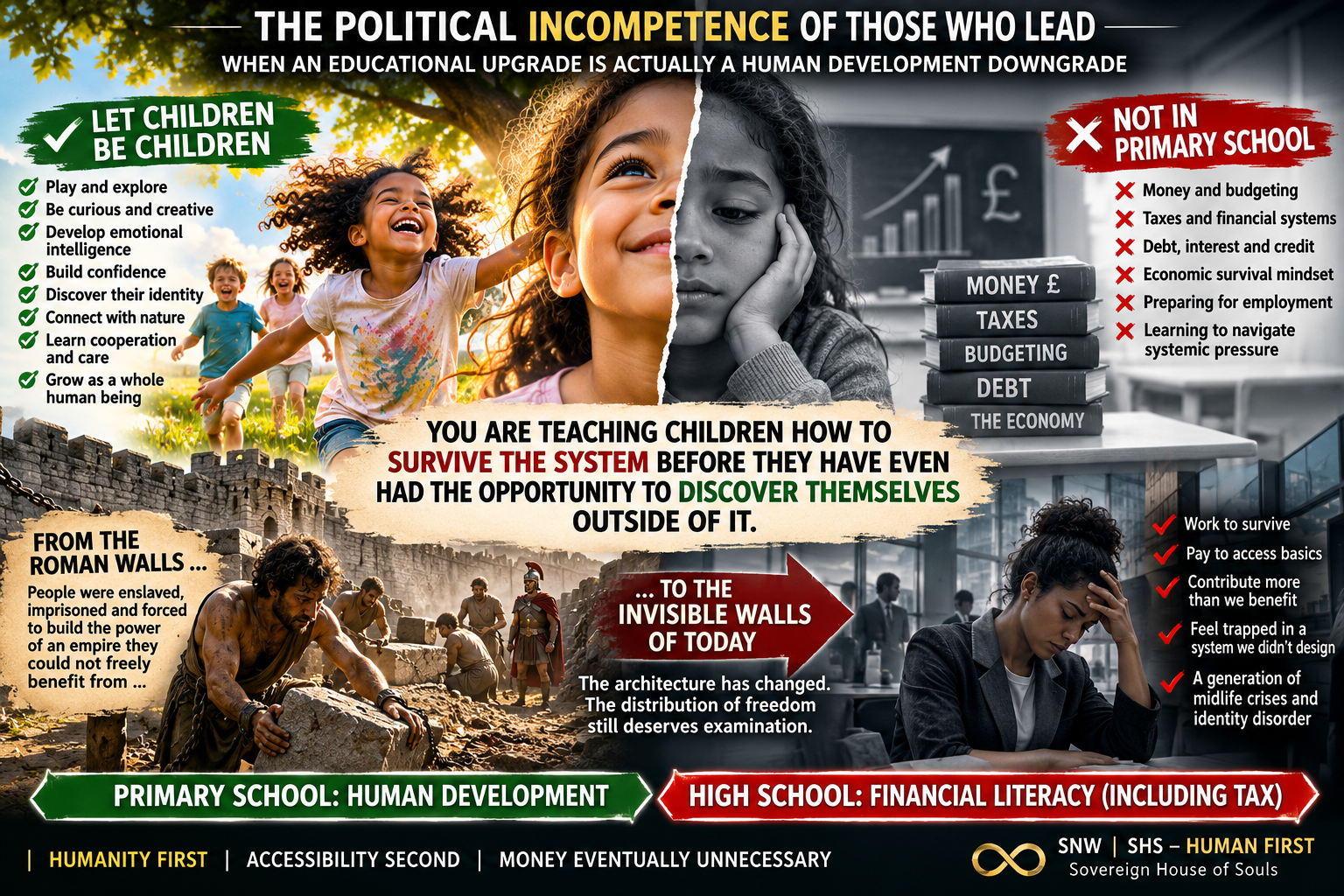
The political incompetence of those who lead. Extrapulate from that below about the educatioanl update, which is a downgrade, as kids do not need to be thinking about money, they can put that in high school, not primary school. To having to relate themselves to money to survive isn’t how a chikd must rise. Wjy don’t they have psychologist talk about a child’s brain in making these decisions?! Stupidity commanding natural ignoarence.
No wonder people are the embodiment of a midlife crisis now. Identity disorder left right and centre.
YOU ARE TEACHING CHILDREN HOW TO SURVIVE THE SYSTEM BEFORE THEY HAVE EVEN HAD THE OPPORTUNITY TO DISCOVER THEMSELVES OUTSIDE OF IT.
WHEN AN EDUCATIONAL UPGRADE IS ACTUALLY A HUMAN DEVELOPMENT DOWNGRADE
SNW | SHS – HUMAN FIRST
27 November 2026
There is something deeply concerning about a civilisation that celebrates introducing children to monetary dependency at an increasingly younger age, rather than questioning why human existence remains so dependent upon money in the first place.
On 22 November 2026, the Department for Education announced reforms to England’s national curriculum, strengthening financial education from primary school onwards.
And this is being celebrated as progress.
Progress for whom?
Because there is an enormous difference between educating a human being and educating a human being to accommodate the shortcomings of an existing system.
One develops humanity.
The other develops humanity’s capacity to tolerate what has not been developed for it.
The proposed SHS alternative is developed in This Is the Schooling Structure We Should Have All Had Growing Up. The distinction between financial education and structural monetary dependency is explored further in Learning How to Use a Toxic Tool Isn’t a Win. Explore the wider Education and Human Development framework.
FROM THE ROMAN WALLS TO THE INVISIBLE WALLS OF MODERN CIVILISATION
When we look at the remnants of the Roman walls in London, we often admire the engineering, the architecture, the historical significance and the longevity of the structures.
But how often do we consider the lives of those whose labour sustained the Roman Empire?
Roman civilisation made use of enslaved people, prisoners and individuals condemned to hard labour. Some were stripped of their freedom and made to work in mines, quarries and public construction.
Imagine spending the entirety of your existence undertaking labour from which others derive considerably greater benefits than yourself.
Imagine building the infrastructure of a civilisation that celebrates its own greatness whilst denying you the opportunity to develop yours.
For those condemned to such labour, imprisonment did not necessarily require confinement within four walls.
Their imposed circumstances constituted their imprisonment.
Now, approximately two thousand years later, how extensively have we examined the relationship between human labour, human freedom and the distribution of its benefits?
Modern employment is not legally or materially identical to Roman forced labour. Nevertheless, the underlying question of how much control individuals possess over their time, their contribution and the conditions of their existence remains relevant.
How many people spend decades working without acquiring the security, freedom or accessibility that their labour was supposedly intended to provide?
How many contribute to the construction of an increasingly wealthy civilisation whilst remaining unable to afford adequate housing within it?
How many produce food whilst struggling to feed themselves?
How many maintain the systems that they themselves cannot afford to benefit from?
The architecture has changed.
The distribution of freedom still deserves examination.
THE STRAWBERRY-FLAVOURED POISON
You can put strawberry flavouring into poison.
You can improve its appearance, change its packaging, make it more palatable and even cultivate a culture around its consumption.
But you have not changed what the substance does.
You have merely changed the experience through which it is consumed.
This is the danger of confusing societal adaptation with societal evolution.
Just because people have become accustomed to something does not establish that it is beneficial, necessary or incapable of being replaced.
Normalisation is not validation.
Longevity is not evidence of efficiency.
Acceptance is not proof of human betterment.
And yet, instead of continuously examining the structures that restrict human development, we increasingly celebrate the ability to introduce human beings to those structures earlier in their development.
Now, even childhood becomes another opportunity to prepare individuals for monetary dependency.
CHILDREN SHOULD NOT HAVE TO DEVELOP A RELATIONSHIP WITH MONEY IN ORDER TO DEVELOP A RELATIONSHIP WITH EXISTENCE
What should a child between the ages of five and eleven be developing?
Curiosity.
Imagination.
Emotional intelligence.
Communication.
Creativity.
Self-awareness.
Physical capabilities.
Confidence.
Cognitive flexibility.
An understanding of nature.
An appreciation of other living beings.
The ability to collaborate, investigate, question, discover, experiment and learn without fear of failure.
Childhood should be the period during which human beings discover the extent of their capabilities before adult responsibilities begin restricting the time available for such discovery.
Research published by the American Academy of Pediatrics recognises the importance of play in developing cognitive, social, emotional, linguistic and executive functioning capabilities.
Play is not an absence of productivity.
Play is one of nature’s most sophisticated mechanisms of human development.
Yet we increasingly measure the value of education according to how effectively it prepares children for the economy.
When did the economy become the primary reference point for human development?
Was the economy created to serve humanity, or was humanity born to serve the economy?
Because the order in which these things are introduced matters.
KNOWING HOW MONEY WORKS IS NOT THE SAME AS UNDERSTANDING HOW LIFE WORKS
I am not arguing that financial literacy has no practical usefulness within the current system.
Teach budgeting, taxation, credit, debt, interest rates, mortgages and financial responsibilities in secondary education, when young people are approaching greater independence and have more developed capacities through which to contextualise that knowledge.
But do not confuse the necessity of understanding an existing mechanism with the necessity of that mechanism itself.
A child can learn mathematics without having to associate every mathematical calculation with monetary value.
A child can learn resource management by cultivating a garden.
A child can learn responsibility by caring for another living being.
A child can learn cooperation by building something alongside others.
A child can learn the value of resources by observing the effort, knowledge and time required to produce them.
A child can learn exchange, fairness, distribution, planning and conservation without making money the central reference point through which those concepts are understood.
Why are we so determined to teach children how to calculate the price of things before teaching them how to comprehend their actual value?
The price of a tree does not teach a child what a forest contributes to the continuity of life.
The price of food does not teach a child how to cultivate it.
The price of a house does not teach a child how to build one.
The price of healthcare does not teach a child how to maintain their health.
Monetary literacy is not a substitute for existential literacy.
WHO IS DEVELOPING THE HUMAN BEINGS WHO WILL EVENTUALLY LEAD HUMANITY?
Consider the adults who will emerge from the educational decisions being made today.
Some will become politicians.
Some will become judges, scientists, engineers, executives, doctors and educators.
Some will sit in boardrooms deciding the conditions under which millions of other human beings will live.
What are we cultivating within them before they reach those positions?
Are we cultivating their ability to understand human beings beyond their economic usefulness?
Are we cultivating their capacity to recognise harm before it becomes statistically significant?
Are we cultivating their understanding of continuity, consequences and intergenerational responsibility?
Or are we cultivating their ability to navigate the very same structures whose inadequacies they will eventually inherit the responsibility of addressing?
If we educate generations exclusively through the parameters of existing systems, where will the intellectual capacity to supersede those systems come from?
A leader who understands profitability but does not understand human development possesses an incomplete education.
A leader who understands economic growth but cannot distinguish it from societal betterment possesses an incomplete education.
A leader who understands how to maintain a system but cannot contemplate an alternative to it possesses an incomplete education.
And what happens when those individuals are entrusted with educating the next generation?
The limitations risk becoming intergenerational.
MONEY DOES NOT CREATE ACCESSIBILITY. IT CONDITIONS IT.
Food does not originate from money.
Water does not originate from money.
Human intelligence does not originate from money.
Land, sunlight, minerals, biodiversity, knowledge and the capacity to contribute do not originate from money.
Money is an organisational mechanism through which access to many of these things has become conditional.
And that distinction matters tremendously.
Consider a society possessing sufficient food, adequate housing, medical knowledge, productive capabilities and available human expertise.
If individuals within that society are nevertheless unable to access these resources because they do not possess sufficient monetary units, is the problem necessarily a lack of resources?
Or is it a problem of organisation, distribution and accessibility?
Removing monetary requirements without establishing an alternative means of coordinating production and distribution would not automatically resolve these problems.
But establishing a coherent alternative capable of coordinating those resources without requiring every individual to purchase their right to access them could fundamentally change the conditions of human existence.
That is precisely the kind of possibility political leadership should be capable of investigating.
Not merely teaching successive generations how to navigate existing restrictions.
WHAT SHS WOULD PRIORITISE IN PRIMARY EDUCATION
The purpose of primary education under SHS would be to develop the human being before developing their relationship with institutional mechanisms.
| Developmental area | Educational purpose |
|---|---|
| Cognitive development | Learning how to think, question, investigate and understand. |
| Emotional development | Understanding emotions, relationships and self-regulation. |
| Metacognition | Becoming aware of one’s own thinking and learning processes. |
| Natural sciences | Understanding the relationship between life, nature and continuity. |
| Mathematics | Understanding quantities, patterns, proportions and relationships beyond monetary applications. |
| Resource literacy | Understanding where resources originate, how they are produced and how they can be responsibly shared. |
| Creativity | Developing imagination, invention and alternative thinking. |
| Physical development | Understanding and developing the capabilities of the body. |
| Cooperation | Learning to contribute without requiring competition as the primary motivation. |
| Ethics and responsibility | Understanding how individual actions affect others and future generations. |
| Play and exploration | Providing the freedom to discover capabilities without premature economic expectations. |
Secondary education would progressively introduce the institutional knowledge necessary to navigate the existing world, including financial literacy, whilst encouraging young people to critically examine its limitations and investigate alternatives.
The objective is not to cultivate ignorance of money.
It is to prevent money from becoming the foundation upon which a human being constructs their understanding of existence.
Humanity first. Accessibility second. Money eventually unnecessary.
THE POLITICAL RESPONSIBILITY THAT PRECEDES EDUCATIONAL REFORM
Before political leaders celebrate preparing children to survive a system, they should ask themselves why that system requires so much preparation for survival.
Why are human beings having to become increasingly financially sophisticated simply to obtain what is necessary to live?
Why are people being taught to navigate increasingly complex economic circumstances instead of being presented with efforts to simplify those circumstances?
Why does the responsibility for adapting to institutional inadequacies continually fall upon the individual?
And now, why should that responsibility be introduced earlier in childhood?
Political leadership should not merely be responsible for preparing the next generation for the world it has inherited.
It should be responsible for bettering that world before the next generation inherits it.
There is a difference between teaching children how to overcome obstacles and perpetuating the obstacles so that future generations must continue learning how to overcome them.
LET CHILDREN BE CHILDREN
There will be enough time for them to learn about the systems humanity has constructed.
Primary education should give them the intellectual, emotional, physical and creative foundations through which they might eventually construct something better.
Let them discover themselves before teaching them how much their existence costs.
Let them understand the value of life before teaching them the price of living.
Let them develop their capabilities before teaching them how to sell those capabilities.
Let them learn how to contribute before teaching them how to monetise their contribution.
Let them develop their humanity before preparing them for employment.
Because I do not consider it an educational accomplishment to prepare children to endure circumstances that adults in positions of responsibility should be working to improve.
The greatest educational achievement would not be raising children who know how to survive the world we have created.
It would be raising children capable of creating a world in which survival is no longer the predominant occupation of human existence.
SNW | SHS – HUMAN FIRST
Sovereign House of Souls
References
- Department for Education — Pupils learn money skills for real life in curriculum shake-up, 22 November 2026
- American Academy of Pediatrics — The Power of Play: A Pediatric Role in Enhancing Development in Young Children
- English Heritage — History of London Wall
- Oxford Classical Dictionary — Mines and Mining, Roman
- House of Commons Education Committee — Delivering Effective Financial Education



Leave a Reply