
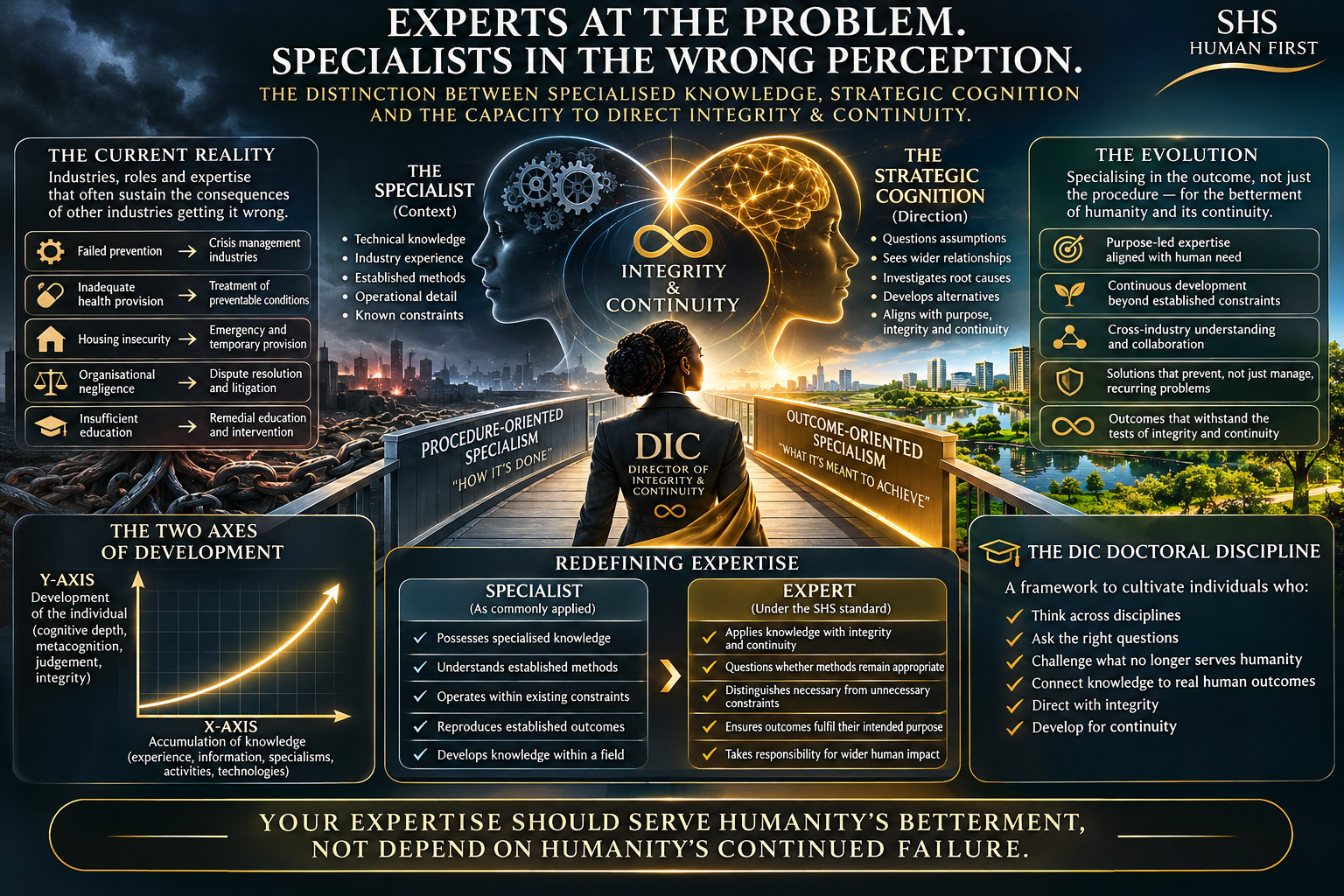
How can one person be better at 99% of other jobs?! All strategy based jobs. How?! How is still even possible!!! Hooooowwwww?! Are the set and accepted standards that low?!
And I don’t even need to have experience in all these roles?! I just need to observe what they’re doing for a little while and I can already see all these possible solutions. So what have the people actually occupying these roles been doing all this time?! Are people sleeping on their jobs?! What is it?! How can I come into an environment, observe it for a fraction of the time they’ve been operating in it, and already identify things that could be done differently? Surely the more time you spend in a role, the more opportunities you have to identify what needs improving?! Experience is supposed to develop your capabilities, not just add years to your CV. What are we actually measuring when we recruit people?! The years they’ve spent doing something, or what they’ve actually done with those years?! No matter the industry.
When Organisations Fail the People They Serve by Failing the People They Employ.
SNW | SHS – HUMAN FIRST
27 November 2026
Political Incompetence, Human Resources, Operational Integrity & Human Continuity — Case Study II
How interesting that, on the very same day I published an investigation into governmental human resources, operational incompetence and institutional accountability, I find myself addressing similar organisational concerns within an entirely different environment.
Different industry.
Different responsibilities.
Different human beings.
Potentially, the same structural deficiencies.
The question in my opening is also connected to On Disruption, Standards, and Why I Chose Consciousness Anyway (18 January 2026), where I examined the friction that arises when established norms meet a different set of expectations. Here the question becomes operational: what is the accepted standard of strategic work, and how is it actually tested?
This morning, in Transparent Accountability. For the People, by some people, I questioned whether governmental institutions are adequately recruiting, training, developing and supporting the human beings entrusted with delivering their publicly declared responsibilities.
This afternoon, I find myself questioning whether an organisation responsible for supporting vulnerable human beings is adequately supporting the human beings it employs to provide that support.
And this is where I want people to understand the extent of what I mean by HUMAN FIRST.
Because my concern is not exclusively for the recipient of a service.
My concern extends to those providing it.
This is the practical application of A Systemical View, Does not Know How to Recognise A Human View: the person must remain recognisable as a human being before their institutional classification as employee, manager or resident.
How can an organisation sustainably provide a quality service to human beings whilst neglecting the circumstances under which other human beings are expected to deliver it?
I. I AM NOT ASKING FOR SOMEONE TO LOSE THEIR JOB. I AM ASKING WHY THEIR ORGANISATION HAS NOT BETTER EQUIPPED THEM TO DO IT.
For the purposes of this publication, I will refer to the project manager as Jane Doe. Identifying information concerning the organisation, residents and accommodation has been omitted.
Jane Doe is a considerate individual.
She demonstrates care in ways that extend beyond the strictly administrative aspects of her responsibilities. Her interpersonal qualities are among the very reasons I believe her organisation should be providing her with greater professional support.
And yet, concerns within the accommodation have reportedly persisted for months.
Some of these circumstances precede my own arrival.
There are questions surrounding safety, coexistence, the effectiveness of previous interventions, escalation procedures and the adequacy of management support.
But my immediate response is not to demand Jane Doe’s dismissal.
My immediate response is to question the infrastructure surrounding Jane Doe.
This is also why I developed the role of Director of Integrity & Continuity on 31 October 2026: to identify blind spots across divisions, before they escalate into disputes, and to make the organisation’s different responsibilities coherent with one another.
- Who recruited her?
- Who inducted her?
- Who trained her?
- Who assessed her preparedness for the circumstances she would encounter?
- Who supervises her?
- Who provides assistance when circumstances exceed her capabilities or authority?
- Who reviews the effectiveness of her interventions?
- Who holds responsibility when she has exhausted the resources available to her?
Because if Jane Doe genuinely cares about the people she is responsible for, but the organisation has not adequately equipped her to translate that care into effective operational outcomes, whose failure are the residents experiencing?
And whose failure is Jane Doe experiencing?
II. KINDNESS IS A HUMAN QUALITY. COMPETENCY IS SOMETHING AN ORGANISATION SHOULD CONTINUOUSLY CULTIVATE.
There is a considerable difference between someone unwilling to fulfil their responsibilities and someone insufficiently supported in fulfilling them.
Human resources should be capable of distinguishing between the two.
Management should be capable of distinguishing between the two.
Leadership should be capable of distinguishing between the two.
An individual’s limitations should not automatically become grounds for their elimination from an organisation.
They should first become information through which the organisation can identify opportunities for development.
Additional training.
Additional supervision.
Greater operational clarity.
Appropriate authority.
Access to experienced management.
Better distribution of responsibilities.
And, where necessary, reassignment to a position more suited to the individual’s capabilities.
But how many organisations investigate their own contribution to an employee’s difficulties before deciding that the employee is the difficulty?
How many managers examine the quality of their own management when somebody beneath them is struggling?
How many human resource departments investigate the effectiveness of their recruitment, induction and continuous development processes when employees repeatedly encounter similar problems?
Recruitment does not conclude an organisation’s responsibility towards an employee. It initiates it.
An organisation should not acquire access to a human being’s capabilities without assuming responsibility for cultivating and supporting those capabilities throughout their professional journey.
III. IT IS NOT WHAT WAS DONE. IT IS WHAT WAS KNOWN AND WASN’T DONE.
This is the central distinction I want to introduce into the ongoing SHS accountability research.
An incident may occur unexpectedly.
Human beings make mistakes.
Unforeseen circumstances arise.
No organisation can realistically guarantee that nothing will ever go wrong.
But what happens AFTER the organisation becomes aware of something going wrong?
That is where a different level of accountability begins.
This develops the epistemological argument in YOU WERE WARNED. YOU HAD THE EVIDENCE. YOU HAD THE AUTHORITY. SO WHY DID HUMANITY HAVE TO SUFFER BEFORE YOU DECIDED TO KNOW?! The responsibility to investigate does not disappear because the information is inconvenient. This case asks how knowledge was acquired, verified and translated into action.
If the previous reports concerning these circumstances are substantiated, management should be able to establish:
- When the concerns first became known.
- Who received the information.
- How the associated risks were assessed.
- What interventions were undertaken.
- What resources were made available to those responsible for intervening.
- Whether the interventions were monitored for effectiveness.
- Why the circumstances reportedly continued.
- What temporary protections were provided to affected residents.
- Who retained operational responsibility throughout the process.
- What corrective measures will prevent recurrence.
The passage of time following a report is not organisationally meaningless.
It represents a period during which the organisation had an opportunity to investigate, assess, intervene and develop its understanding of the circumstances.
The relevant question is not whether management could have prevented every initial difficulty.
The question is what management did with the knowledge it subsequently acquired.
Because an organisation cannot demonstrate continuous improvement simply by continuously receiving information.
Information must be translated into action.
Action must be assessed against outcomes.
Outcomes must inform further action.
Otherwise, what exactly is being improved?
IV. A COMPLAINT IS FEEDBACK. AN UNRESOLVED COMPLAINT MAY BE EVIDENCE OF A FAILED FEEDBACK MECHANISM.
In ENGINEERING HAS NO USE FOR YOUR EXCUSES. IF YOUR SYSTEM CANNOT SUSTAIN LIFE, WHAT EXACTLY HAVE YOU ENGINEERED?!, I investigated the distinction between procedural compliance and the successful delivery of an institution’s intended purpose.
This experience provides another practical application of that investigation.
An organisation may have a complaints procedure.
It may have incident reporting forms.
It may have safeguarding policies.
It may have escalation procedures.
It may have risk assessments.
It may have an entire management infrastructure dedicated, on paper, to maintaining a safe environment.
But does that infrastructure actually work?
| Administrative activity | Operational question |
|---|---|
| A concern was recorded. | Was it investigated? |
| An incident was reported. | Was the associated risk reduced? |
| A meeting took place. | What changed afterwards? |
| Management was informed. | Who assumed responsibility? |
| An intervention was undertaken. | Was it effective? |
| An employee received training. | Can they apply that training? |
| A case was closed. | Was the problem resolved? |
An organisation can complete every administrative activity within its procedures whilst failing to achieve the human outcome for which those procedures were created.
That is the distinction between verification and validation previously explored through engineering.
The procedure is not the purpose.
The procedure is supposed to be a mechanism through which the purpose is fulfilled.
If it repeatedly fails to fulfil that purpose, the organisation should be reviewing the procedure, its implementation or both.
Not simply repeating it.
V. WHY ARE THE PEOPLE RECEIVING THE SERVICE HAVING TO MANAGE THE MANAGEMENT OF THE SERVICE?!
One of the concerns I find particularly interesting across multiple industries is the extent to which responsibility can gradually migrate towards the very people an organisation exists to support.
The residents must identify the problems.
The residents must repeatedly report them.
The residents must establish whether previous reports were acted upon.
The residents must identify the relevant management structure.
The residents must investigate escalation routes.
The residents must sometimes develop potential solutions.
And the residents must continuously follow up.
At what point does the organisation recognise the amount of unpaid operational coordination being undertaken by its service recipients?
In YOU CLOSED THE BOOKS. YOU DIDN’T CLOSE THE DAMAGE., I examined how an institution can record its own financial performance while leaving the human costs of its operations outside the accounting boundary. The time and effort residents spend chasing resolution are another potential expression of those unrecorded costs.
Especially when those recipients are supposed to be receiving support to develop their own lives.
There is nothing wrong with encouraging participation, independence and collective responsibility.
There is, however, a fundamental difference between empowering people to participate in the betterment of their environment and leaving them to compensate for deficiencies in its management.
Participation should expand human capabilities, not become a prerequisite for receiving the basic standard of service an organisation exists to provide.
VI. RULES FOR THE RESIDENTS. WHAT ABOUT OPERATIONAL STANDARDS FOR THE ORGANISATION?
Organisations can be extremely thorough when communicating the responsibilities of those receiving their services.
What they can do.
What they cannot do.
Who they can approach.
When they can approach them.
What is expected of them.
What consequences they might experience if they fail to comply.
But where is the equivalent visibility of the organisation’s own responsibilities?
What can residents expect when they report a safety concern?
How quickly will it be assessed?
Who will take responsibility?
What happens when the person initially approached cannot resolve it?
How will residents know whether appropriate measures have been undertaken?
What happens when concerns remain unresolved over an extended period?
Rules should not exclusively operate downwards through a hierarchy.
Accountability must also operate upwards.
This directly connects with the philosophical investigation published yesterday, 4,400 YEARS OF GLORIFIED POLITICAL INCOMPETENCE: WHEN THE INABILITY TO COLLABORATE BECAME THE GREATNESS OF AN EMPIRE.
That investigation questioned humanity’s historical tendency to confuse the acquisition of authority with the development of the capabilities required to exercise it constructively.
Here, on a considerably smaller organisational scale, the same distinction becomes relevant.
Authority can establish rules.
Competency establishes whether those rules actually serve their intended purpose.
Authority can demand compliance.
Leadership develops the circumstances under which people can coexist constructively.
Authority can assign responsibilities.
Leadership ensures that the individuals receiving those responsibilities possess the resources, capabilities and support necessary to fulfil them.
Having authority over an environment does not establish that you are capable of managing it.
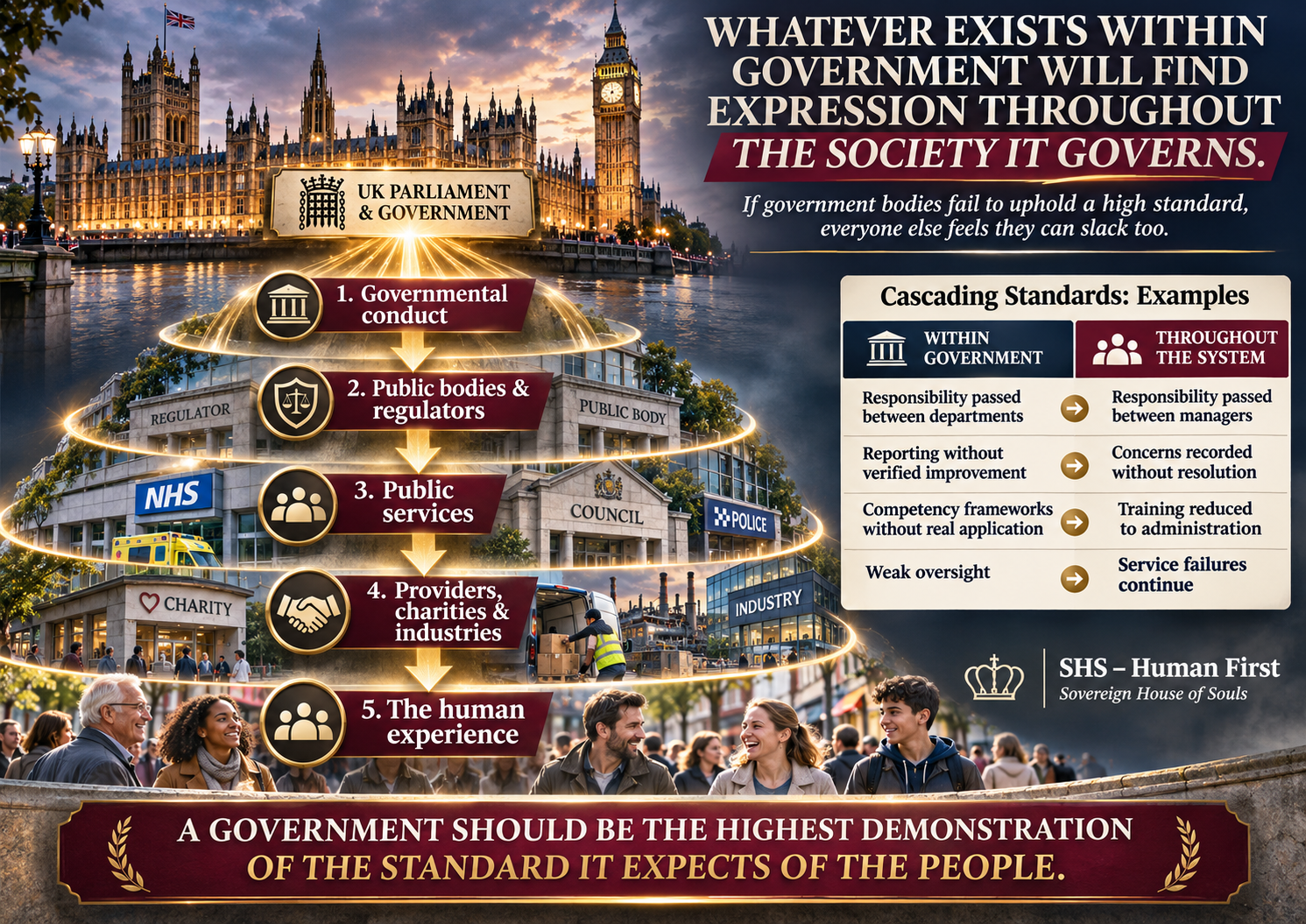
VII. WHATEVER EXISTS WITHIN GOVERNMENT WILL FIND EXPRESSION THROUGHOUT THE SOCIETY IT GOVERNS.
This is precisely why the circumstances of this morning are so relevant to those of this afternoon.
In yesterday’s Modern Day Diplomatic Incompetence, I questioned the substitution of silence and referrals for meaningful engagement. The present case extends that inquiry beyond government correspondence: what happens when responsibility is transferred without confirming that anybody has actually assumed it?
Government does not merely establish policies for society. It sets a standard of conduct through the way it conducts itself.
And that standard is expressed through the institutions, industries, organisations and human relationships that exist within its jurisdiction.
If the bodies responsible for establishing and upholding standards do not themselves demonstrate those standards, what example are they setting for everybody else?
If governmental departments pass responsibility from one desk to another without establishing ownership, why should it surprise anyone when organisations elsewhere begin to consider the same behaviour acceptable?
If government can receive information without meaningfully acting upon it, how many other organisations will come to regard acknowledging a concern as sufficient?
If government publishes competency frameworks without consistently demonstrating those competencies in practice, what incentive does its example create for the organisations it funds, commissions, regulates or otherwise influences to exceed that standard?
And if those responsible for oversight tolerate recurring discrepancies between declared responsibilities and actual outcomes, what are they teaching the people being overseen?
The Government cannot expect to cultivate a culture of accountability throughout society whilst tolerating the avoidance of accountability within itself.
Governmental influence is expressed in more than legislation. It is expressed through funding decisions, procurement, commissioning, regulation, inspection, recruitment, management practices and, most importantly, the example government sets through its own conduct.
This is why governmental incompetence is not necessarily contained within a governmental office. Its consequences can travel through the relationships connecting public bodies to councils, charities, contractors, housing providers and the people ultimately delivering services.
| Standard tolerated at governmental level | Potential expression elsewhere |
|---|---|
| Responsibility passed between departments | Responsibility passed between managers or service providers |
| Reporting without verified improvement | Concerns recorded without effective resolution |
| Competency frameworks without demonstrated application | Training and induction treated as administrative exercises |
| Weak oversight of commissioned provision | Service failures persisting without effective correction |
| Protection of institutional reputation over learning | Employees or service recipients discouraged from raising concerns |
This is not to suggest that every organisation behaves in the same way, that government is the sole cause of every organisational deficiency, or that individual organisations are relieved of their own responsibilities. Many organisations and individuals maintain excellent standards even where the institutions above them fall short.
The point is that the behaviour of those setting and enforcing standards can influence what others come to regard as acceptable.
If the highest public authorities settle for less, they risk creating permission for others to settle for less too.
If the standard of government rises, it has the opportunity to raise the standard expected and demonstrated throughout the infrastructure it influences.
This also extends the Political Science and Governance of Institutional Failure investigation. Public authority is temporary, but the organisational practices and consequences it establishes can persist long after an individual officeholder departs.
This is why I am investigating political incompetence at its source rather than exclusively addressing its expressions wherever I encounter them.
The two cases today do not independently establish a causal relationship. They do, however, raise a shared question about how responsibility, competency and corrective action are organised across institutions.
And it is precisely that question which the SHS Public Accountability platform and the proposed Public Service Integrity and Continuity Assurance (PSICA) function are intended to investigate: whether the standards declared at the level of government are actually being expressed through the services people experience.
A GOVERNMENT SHOULD BE THE HIGHEST DEMONSTRATION OF THE STANDARD IT EXPECTS OF THE PEOPLE, NOT THE JUSTIFICATION FOR EVERYBODY ELSE LOWERING THEIRS.
VIII. CONFIDENTIALITY MUST NOT BECOME AN OBSTRUCTION TO EMERGENCY PREPAREDNESS.
Another concern arising from the circumstances is the relationship between individual privacy and collective safety.
Residents are entitled to privacy.
They should not be required to disclose confidential personal circumstances to other residents simply because they share accommodation.
But the organisation responsible for that accommodation must consider how emergency arrangements function in practice.
Can relevant personnel account for occupants during an emergency?
Are responsibilities clearly established?
Do residents know what to do?
Are individual support requirements appropriately considered by authorised personnel?
Are emergency arrangements compatible with the actual circumstances of the accommodation?
Privacy and safety are not inherently contradictory.
An adequately designed operational structure should accommodate both.
This is precisely why organisations require individuals capable of thinking across multiple responsibilities simultaneously.
Not safeguarding OR confidentiality.
Not employee welfare OR resident welfare.
Not individual independence OR collective safety.
The capability to accommodate multiple legitimate human needs simultaneously is part of what competent leadership should represent.
IX. WHO SUPPORTS THE PEOPLE PROVIDING THE SUPPORT?
The experience also extends the research published in I Am Experiencing the Journey of 8Honeth.
In that publication, I explained that I am not merely designing a programme for human beings experiencing houselessness.
I am experiencing the journey myself.
I am learning through participation in existing humanitarian infrastructure, observing what works, what does not, and what further provisions need to be developed.
This experience reinforces another requirement for 8Honeth.
The development of the human beings delivering the programme must be as structurally significant as the development of those participating in it.
| Human beings receiving support | Human beings providing support |
|---|---|
| Require appropriate guidance. | Require appropriate training. |
| Require stability. | Require stable working conditions. |
| Require access to resources. | Require adequate operational resources. |
| Require meaningful communication. | Require access to responsive management. |
| Require individual development. | Require continuous professional development. |
| Require psychological safety. | Require a working environment where concerns can be raised safely. |
| Require protection from foreseeable harm. | Require protection from unsupported responsibilities and unreasonable demands. |
These are not competing interests.
The same principle emerged through the everyday experience recorded in Self v Other Provision: how much does a human being need for themselves to sustainably fulfil the expectations they establish for others? The organisational application is to provide staff with the conditions necessary to deliver their commitments without exhausting themselves.
They are interconnected conditions of sustainable service delivery.
An organisation that continuously develops the capabilities of its employees increases its capacity to provide better services.
An organisation that neglects those capabilities risks transferring the consequences of that neglect onto the people receiving its services.
You cannot continuously better the service without continuously bettering the circumstances and capabilities of those providing it.
X. THE SHS OPERATIONAL INTEGRITY AND CONTINUITY TEST
As an extension of the Public Service Integrity and Continuity Assurance (PSICA) proposal introduced through this morning’s research, I would apply the following assessment across organisations responsible for human provision.
| Area of assessment | Required evidence |
|---|---|
| Recruitment | Evidence that selection assesses practical capabilities, judgement and interpersonal competencies. |
| Induction | Evidence that employees understand responsibilities, operational procedures and escalation routes. |
| Continuous development | Evidence of ongoing training informed by actual operational experiences. |
| Management support | Evidence that employees can access appropriate assistance when required. |
| Operational authority | Evidence that responsibilities are matched with sufficient authority and resources. |
| Communication | Evidence of effective information transfer between individuals and departments. |
| Risk management | Evidence that identified risks are assessed, addressed and monitored. |
| Accountability | Evidence of designated ownership rather than indefinite transfers of responsibility. |
| Service-user experience | Evidence that actual human experiences inform organisational assessment. |
| Corrective action | Evidence that interventions produce meaningful and sustained improvement. |
| Employee welfare | Evidence that the organisation considers the circumstances of those delivering its services. |
| Continuity | Evidence that improvements remain effective beyond the immediate intervention. |
These assessments should not exist exclusively as internal declarations.
They should be periodically examined against evidence of what people are actually experiencing.
The organisation must be capable of learning from both its employees and its service recipients.
XI. ACCOUNTABILITY IS NOT PUNISHMENT. ACCOUNTABILITY IS AN OPPORTUNITY FOR BETTERMENT.
Yesterday, I published ACCOUNTABILITY IS THE MOST EXTREME REPRESENTATION OF STRENGTH.
Within that publication, I distinguished organisations built around survival from organisations built around betterment.
An organisation concerned predominantly with its own survival may treat complaints as threats.
It may treat mistakes as something to conceal.
It may treat employees as replaceable components.
It may prioritise the protection of its reputation over understanding why its reputation is being questioned.
An organisation concerned with betterment should recognise the value of identifying deficiencies before their consequences become more severe.
The ethical foundation is explored in IF YOUR CONSCIENCE ENDS WHERE YOUR PERSONAL BENEFIT ENDS, STOP CALLING YOURSELF RESPONSIBLE FOR HUMANITY. Institutional self-preservation must not become the limit of the responsibility an organisation accepts towards those affected by its decisions.
I do not want Jane Doe to experience professional detriment simply because I have raised concerns.
I want her organisation to examine whether she has been adequately supported.
I want the residents to experience a safer and better-managed environment.
I want management to learn from the circumstances.
I want the organisation to develop arrangements that prevent similar experiences from recurring elsewhere.
And if improvements cannot be achieved through additional support, training and supervision, then alternative operational arrangements should be considered.
But nobody should be sacrificed merely to create the appearance that accountability has taken place.
Removing an individual without correcting the infrastructure that contributed to their difficulties may simply transfer those difficulties to the next individual.
XII. MUST SOMEONE GET HURT BEFORE THE ORGANISATION DECIDES THAT SOMETHING NEEDS TO BE DONE?!
Prevention should not require a victim.
A foreseeable risk should not need to become an injury before receiving appropriate attention.
An unresolved concern should not need to become an emergency before acquiring sufficient organisational significance.
A human being should not need to become seriously ill before someone investigates the circumstances contributing to their deterioration.
And an employee should not need to reach exhaustion before management recognises that they require additional support.
This is what I mean by continuity.
Not simply responding to what has already occurred.
Developing the capacity to recognise what could occur, and organising the necessary provisions to prevent avoidable harm.
The future is continuously being influenced by what organisations choose to do with the information available to them in the present.
Which brings me back to the original statement.
IT IS NOT WHAT WAS DONE. IT IS WHAT WAS KNOWN AND WASN’T DONE.
XIII. FROM INDIVIDUAL EXPERIENCE TO COLLECTIVE ORGANISATIONAL LEARNING
Through the SHS Public Accountability platform, I am inviting human beings to share their experiences of institutional provision.
Not exclusively negative experiences.
Positive experiences are equally valuable because they enable the identification of practices that should be replicated elsewhere.
This particular case remains ongoing. The reported circumstances, previous interventions and management arrangements require further examination before definitive institutional findings can be established.
The purpose of documenting it is not to prejudge the outcome.
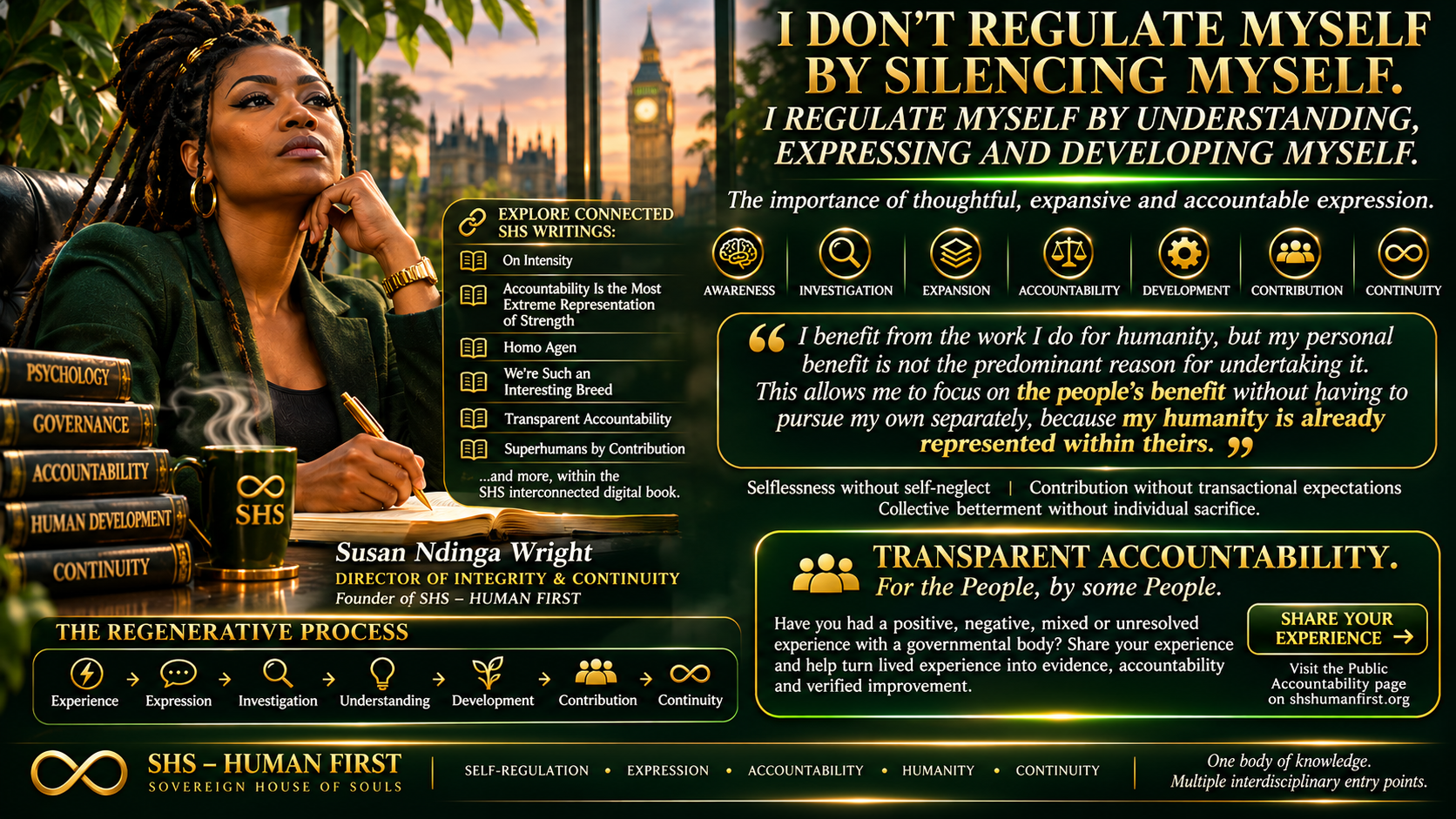
As I explored this afternoon in I DON’T REGULATE MYSELF BY SILENCING MYSELF. I REGULATE MYSELF BY UNDERSTANDING, EXPRESSING AND DEVELOPING MYSELF., expression can be a means of learning and development rather than an end in itself. The same principle applies to institutional criticism: its purpose here is to identify what requires investigation and improvement.
It is to establish the questions against which the outcome should subsequently be assessed.
Employees should also have opportunities to identify the deficiencies within their organisations without fearing that their employment will automatically be threatened for doing so.
Imagine how much more effectively organisations could develop if the human beings sustaining them were encouraged to identify what was not working.
Imagine how much institutional knowledge is lost when employees leave without the organisation examining why they struggled, why they left, or what could have been improved during their employment.
Imagine how much public expenditure, human suffering and professional exhaustion could potentially be prevented through earlier, better-informed interventions.
This is not merely a housing investigation.
This is not merely a human resources investigation.
This is not merely a political investigation.
It is an investigation into how humanity organises its responsibilities towards itself.
And whether the structures humanity has established are continuously developing the capabilities of those entrusted with fulfilling those responsibilities.
HUMAN FIRST DOES NOT MEAN CHOOSING WHICH HUMAN BEING MATTERS MOST.
It means developing circumstances in which the betterment of one human being does not require the deterioration of another.
The residents matter.
Jane Doe matters.
The human beings responsible for managing Jane Doe matter.
And the organisation should be capable of accommodating the betterment of all of them.
That is leadership.
That is operational integrity.
That is continuity.
SNW | Director of Integrity & Continuity
SHS – HUMAN FIRST
Sovereign House of Souls
Contribute to the SHS Public Accountability Research



Leave a Reply