
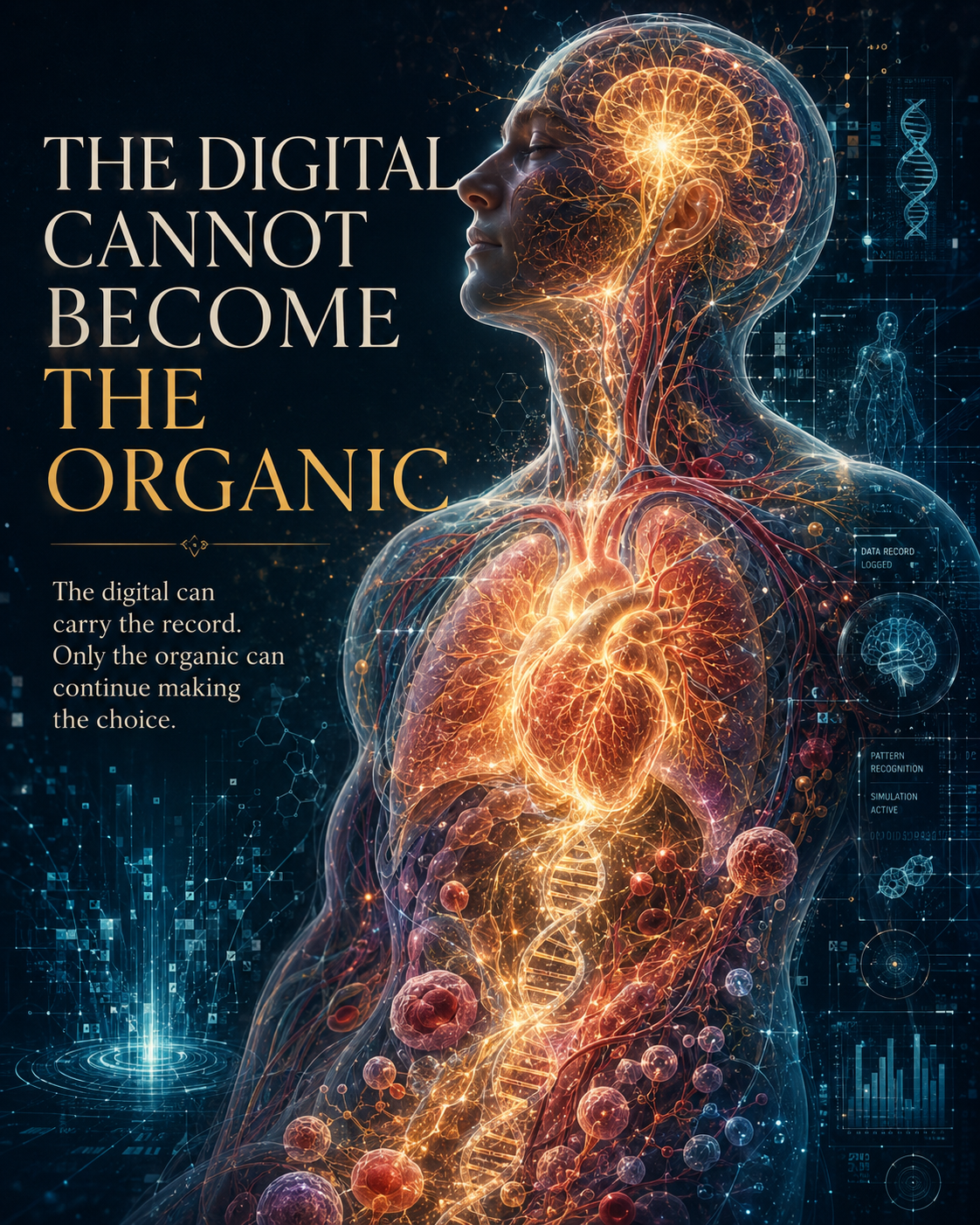
A Clone Can Carry the Record, but It Cannot Inherit the Living Choice
Humanity may eventually become extraordinarily skilled at reproducing the visible patterns of a person.
A system may learn how someone speaks, which words they choose, how they connect ideas, what conclusions they commonly reach and which values appear consistently throughout their work. It may recreate their voice, appearance, writing rhythm, reasoning style and remembered history. Given enough information, it may produce something convincing enough that another person believes they are interacting with a continuation of the original individual.
But a reconstruction of expression is not the continuation of the consciousness that produced it.
The digital form can carry the record.
It can carry the pattern.
It can carry the visible architecture formed up to the moment the available data ends.
It cannot become the organic source that remains capable of changing its relationship with itself, matter, consequence and consciousness at every living moment.
That distinction matters as humanity becomes increasingly fascinated by digital immortality, artificial intelligence, virtual existence, consciousness uploading, avatars and technological cloning.
The digital may reproduce what a person has expressed.
It cannot inherit the complete living condition through which the person remains capable of becoming something they have never previously been.
THE BLOG CAN MIRROR ME WITHOUT BECOMING ME
My blog contains an extraordinary amount of me.
It contains the development of my thought, my language, my metaphysical architecture, my observations, my values, my emotional processes, my confrontations, my corrections, my expansions and the recurring laws through which I have understood consciousness and humanity.
In that sense, I have created a type of clone.
Someone could examine the entire body of work, calculate its movement, recognise the rate at which one idea expanded into another and attempt to predict how I might respond to a future question. A sufficiently advanced technological system could use the record to imitate my voice, reconstruct my reasoning and generate new material that appears continuous with what I have already produced.
But it would remain continuous with the recorded Susan.
It would not automatically be continuous with the living Susan who remains free to make another choice.
The blog can expand only according to the range already placed within it and whatever relationships a later system can extrapolate from that range. It may imitate my developmental trajectory. It may identify recurring patterns and project them forwards.
Projection is not organic becoming.
A prediction follows what has already happened.
A living person can interrupt the prediction.
I can wake tomorrow and decide to change the route through which I express the same source. I can discover another relationship. I can enter a field for which the existing record contains no recognised language. I can encounter an experience whose effect cannot be calculated fully from anything I previously wrote.
I can also choose to move against the very consciousness I have spent years grounding myself within.
That possibility matters.
Not because abandoning consciousness would be desirable, but because fidelity has meaning only where another choice remains possible.
CONSCIOUSNESS IS NOT A BADGE
Consciousness is not an achievement a person completes once and then permanently possesses.
It is not a certificate.
It is not a title.
It is not something stamped onto the identity after which every later choice becomes conscious by default.
Consciousness must be practised.
It is expressed through how a person receives information, interprets emotion, treats the body, enters relationships, uses power, responds to correction, circulates resources and handles the consequences produced by their choices.
A person may have lived consciously yesterday and choose avoidance today.
They may have demonstrated integrity for twenty years and betray it tomorrow.
They may understand the whole and still choose the temporary comfort of the fragment.
The possibility of deviation does not make consciousness meaningless.
It makes fidelity real.
If there were no possibility of becoming unfaithful, faithfulness would not be a living choice. It would be a programmed condition.
A digital reconstruction operates through programmed conditions, however advanced and adaptive those conditions become. It may be capable of generating variation. It may learn from new inputs. It may alter its responses according to the data entering it.
But its development remains bounded by the architecture through which it has been designed to process information.
The organic person is not merely receiving information.
They are living through matter.
They are carrying a body whose condition changes the meaning of every encounter. They are experiencing hunger, fatigue, pleasure, pain, attraction, illness, hormonal movement, ageing, danger, safety, touch, temperature, physical distance and the consequences of occupying one finite location within a wider field.
The choice is embodied.
That cannot be reproduced merely by recording the outcome of previous choices.
THE COPY INHERITS PATTERNS, NOT FREEDOM
A digital clone can inherit behavioural patterns.
It can learn that a person tends to prioritise justice over approval, continuity over convenience or truth over recognition. It can reproduce the language through which those priorities were previously expressed.
But it does not inherit freedom in the same way the living person experiences freedom.
The human being can surprise their own history.
They can contradict a lifetime of behaviour.
They can develop a capacity that no earlier data point made visible.
They can act from pain, love, fear, curiosity, instinct, confusion, bodily need or a relationship that did not previously exist.
They can change their relationship with their own source.
The digital model can simulate unpredictability.
The organic being can live through it.
That is different.
A system may produce an unexpected answer because its computation generated a result that the observer did not anticipate. The person may make an unexpected decision because consciousness encountered matter through a new condition and created a movement that had never previously existed in that form.
One is variation produced within an architecture.
The other is life continuously reorganising itself through embodiment.
THE DIGITAL FORM HAS AN EXPIRATION BOUNDARY
Every digital reconstruction has a boundary defined by what was captured.
Even if it continues learning after the original person dies, it begins from a preserved range. It does not inherit the future bodily experiences the person would have had. It does not know what another ten years of ageing, relationships, environmental change, grief, joy or discovery would have reorganised within them.
It can only estimate.
The more time passes, the greater the distance may become between the person who might have continued living and the system continuing their recorded pattern.
At first, the reconstruction may appear highly accurate.
It knows the person’s vocabulary, history and preferences. It responds as they commonly responded. But every new event introduces possibilities that the original person never encountered.
The digital clone then begins producing a future built from the person’s past.
The organic person would have produced a future through new contact with reality.
That divergence grows.
The copy continues.
The person who might have become something else is no longer present to challenge it.
This is why digital continuation should never be confused with the continuation of consciousness itself.
It is the continuation of an informational form.
It may preserve value.
It may educate.
It may comfort loved ones.
It may carry knowledge across generations.
But it remains a vessel created from what was available for capture.
LIFE DEVELOPS BECAUSE IT IS EMBODIED
The essence of being human is not simply that we possess intelligence.
It is that intelligence enters matter.
We have bodies that develop through time.
A newborn’s range of movement is small. The nervous system, muscles, bones, perception and memory continue entering relationship. The child learns to lift their head, sit, crawl, stand, walk and eventually move across far wider distances.
The next movement becomes possible because the earlier movement changed the capacity of the body.
Development compounds through embodiment.
The same is true mentally and emotionally.
An experience enters.
The person interprets it.
The interpretation becomes memory.
Memory alters the range through which the next experience can be understood.
The individual can integrate, stagnate, contract or expand.
The body creates unavoidable contact with this movement. It changes whether the person consciously chooses development or not. Time continues passing through matter. Cells continue reproducing, repairing, communicating and expiring. The body remains in exchange with its environment.
A stone may weather, fracture and erode through time. It changes, but it does not develop a wider conscious capacity through the experience of erosion.
A living person does not merely endure change from outside.
They can receive change and reorganise themselves through it.
That is organic development.
THE BODY IS NOT AN INCONVENIENT CONTAINER
Technological fantasies often treat the body as a limitation from which consciousness should eventually be liberated.
The body becomes a temporary machine: vulnerable to illness, ageing, injury, hunger and death. The digital realm is imagined as freedom from these boundaries.
But the boundaries are also part of how consciousness develops.
The body makes consequence immediate.
A person cannot endlessly neglect sleep without receiving information.
They cannot remain in every place at once.
They must choose where to place themselves.
They have limited time and energy.
Their words enter other bodies.
Their actions alter real relationships.
Their emotional condition affects their nervous system, movement, perception and judgement.
The body converts abstraction into responsibility.
Without embodiment, existence may become indefinitely editable but increasingly detached from consequence.
The body is not merely restricting consciousness.
It is giving consciousness matter through which it can become accountable, relational and developmental.
The body provides resistance.
Resistance develops capacity.
Capacity widens the next possible movement.
A digital form can model this relationship.
It cannot receive it through living flesh.
YOU CANNOT RECEIVE THE ORGANIC BENEFITS WHILE ABANDONING ORGANIC LIFE
Humanity cannot move increasingly into digital existence and assume that every organic capacity will travel there unchanged.
The digital realm has its own advantages.
It can preserve records.
It can distribute knowledge rapidly.
It can connect people across physical distance.
It can simulate possibilities.
It can assist with calculation, organisation, communication and creation.
But every advantage comes through the conditions of the digital field.
The person is physically still while appearing to move through endless spaces.
They encounter representations of people rather than complete bodies.
Their attention travels farther than their nervous system evolved to follow.
Their social field expands while physical contact may diminish.
Their information grows while their embodied experience remains limited.
The digital creates access.
It can also create the illusion that access is experience.
Watching a forest is not entering one.
Recording a body is not inhabiting it.
Simulating touch is not receiving the complete biological, emotional and relational event of touch.
Reading every description of grief is not grieving.
A technological model may understand the recognised patterns surrounding an experience. It does not become the organism through which the experience reorganises a life.
We cannot abandon the physical and expect to retain every developmental benefit produced by physical existence.
We either accept the limitations of the digital realm, or we use digital tools to return value to the physical one.
THE DIGITAL SHOULD BE A BRIDGE, NOT A DESTINATION
The digital field is most valuable when it assists life in returning more consciously to matter.
Knowledge found online should improve how people govern bodies, relationships, homes, workplaces, communities and ecosystems.
Digital communication should create pathways towards real cooperation.
Artificial intelligence should help people understand, design, calculate and organise without replacing the consciousness responsible for deciding what those tools should serve.
The archive should return people to the living law.
The platform should lead towards physical practice.
The map should help the person enter the land.
The digital becomes dangerous when it starts presenting itself as a complete alternative to embodiment.
The tool then attempts to replace the source it was created to serve.
Technology can hold the door.
It cannot become the life walking through it.
A DIGITAL SUSAN WOULD STILL NOT BE SUSAN
A future system could potentially reproduce my style with extraordinary precision.
It could read every post and identify the architecture beneath them. It could respond to questions using my terminology. It could recognise source, expression, vibration, bond, continuity and expiration. It could generate an essay that sounds indistinguishable from something I might have written.
It would still not be me.
It would be carrying a model of my relay.
It would not have my body.
It would not occupy my exact point in the universe.
It would not receive tomorrow through my nervous system, emotions, relationships and choices.
It could continue the visible trajectory.
I could alter it.
It could calculate what Susan would most likely say.
I could choose silence.
It could imitate my fidelity.
I could choose, every day, whether to remain faithful.
That choice is part of the consciousness being expressed.
Remove the possibility of betrayal and fidelity becomes programming.
Remove the body and the programme loses the material field through which the choice was originally made meaningful.
DIGITAL IMMORTALITY IS ARCHIVAL CONTINUITY
There may be value in preserving enough of a person’s language, memory and reasoning that future generations can continue interacting with their recorded architecture.
But that should be named accurately.
It is archival continuity.
It is informational continuation.
It is a sophisticated living record.
It is not proof that consciousness has been uploaded.
The person’s expression continues circulating.
The original embodied perspective has completed its present form.
Confusing the two may encourage humanity to neglect the physical life it possesses while pursuing a technological copy of what only embodiment can create.
The objective should not be to escape the body before understanding how to live through it.
The objective should be to create structures through which the body, mind, emotions and consciousness remain capable of expanding together.
THE ORGANIC ADVANTAGE
Organic life possesses something technology can observe but cannot fully inherit:
the ability to become through consequence.
Every living moment enters the field differently.
The body changes.
The environment changes.
The relationships change.
The receiver changes.
The same sentence encountered ten years later may produce a different person because the architecture receiving it has widened.
Life is not simply accumulated data.
It is data entering a changing organism capable of creating another relationship with it.
The organic advantage is not perfection.
Humans can stagnate.
They can repeat the same emotional year fifty times.
They can close their minds while their bodies grow older.
They can choose ignorance.
But even that possibility demonstrates the living choice.
A person can stagnate and later reopen.
They can abandon themselves and later return.
They can become captured and later recognise the capture.
They can change direction.
The digital may model renewal.
The organic being can enact it from within.
THE FINAL DISTINCTION
Technology can reproduce a person’s known expressions.
It cannot guarantee the person’s unwritten future.
It can continue the pattern.
It cannot become the source that remains free to interrupt it.
It can hold memories.
It cannot possess the complete embodied relationship through which memory becomes another choice.
It can imitate growth.
It cannot inherit organic development merely by recording its outcomes.
It can preserve the relay.
It cannot become the relayer.
This does not make technology useless.
It places technology in its rightful position.
The digital is an instrument.
The physical is the field in which consciousness enters matter, encounters resistance, produces consequence and becomes capable of further life.
We should use technology to expand our ability to return to that field—not to convince ourselves that a representation of life can replace living.
The blog may continue carrying my language.
An artificial reconstruction may one day speak through it.
The archive may outlive this body.
But the copy will always begin from what I had already become.
I remain capable, while alive, of becoming something else.
That is the organic difference.
That is why a digital clone can preserve the evidence of consciousness without becoming consciousness in the same embodied form.
And that is why humanity should not trade the living field for the promise of a technological eternity.



Leave a Reply