
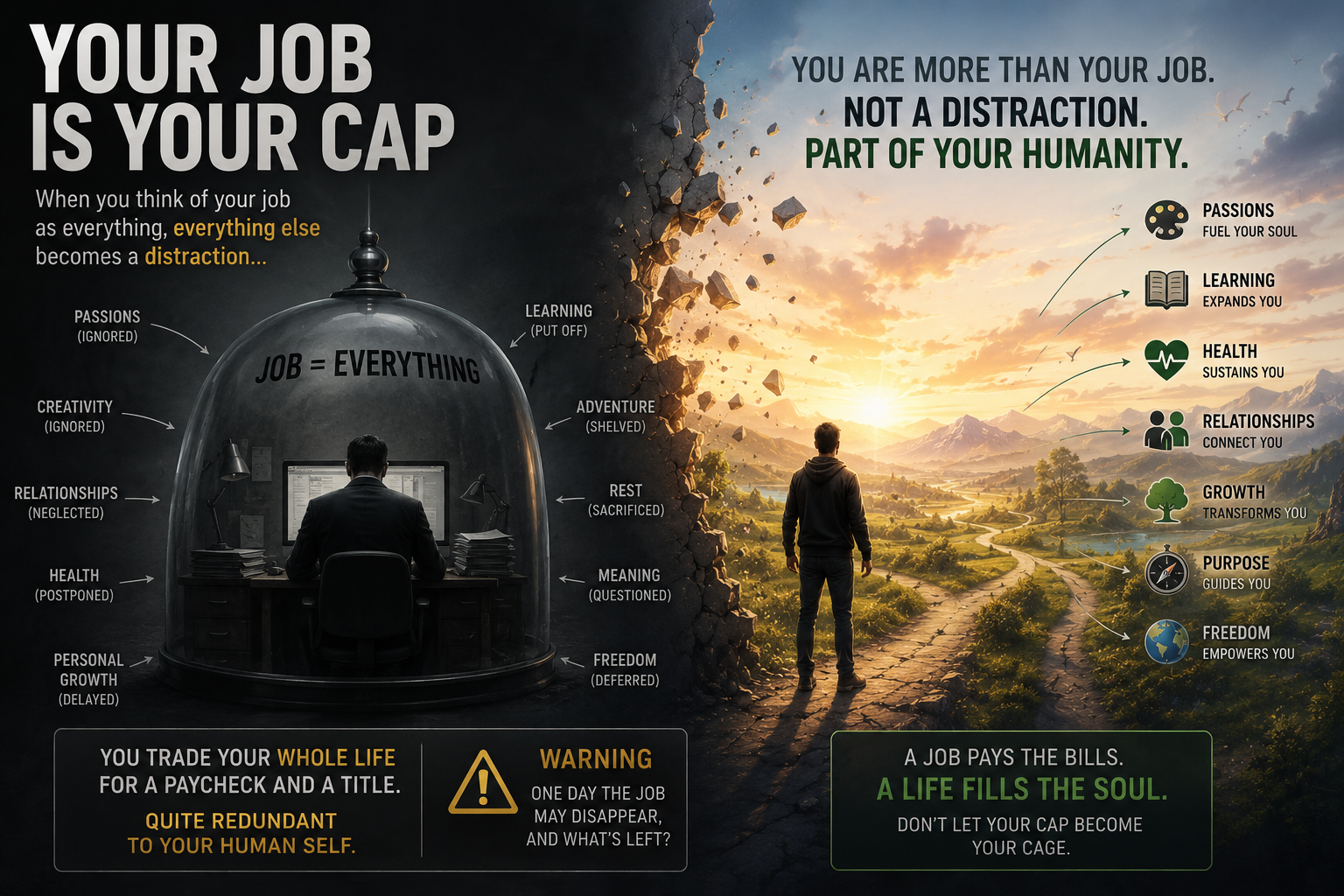
Your job is your cap as youll have to think of the job you do as evthing else would become distraction to the job, even if beneficial to your humanity. Quite redudnant I woukd say to your human self
This one is powerful because people do not always understand it, yet they still understand it.
They just do not always like what it reveals.
My job?! Heaven on Earth, i dunno about yours, i just had to prove God I can do my job while also be present for my human self. It got jelous at some point, and used my human mirrors, this to whom I gave some authority over that which has authority over their subconscious, to remind me of my job firs, and that was to hold them accountable too… if not first, if I was really thinking of taking authority from God and lay it in their hands.
A lot of people cap themselves to a job or a career, and some even learn only one thing throughout their entire working life. That can make them extremely skilled in that one thing. In some cases, it makes them indispensable in that lane. But it also means that their entire value gets measured through the narrowness of that lane.
And that is where the silent agreement begins.
Because once you accept a job as your only identity, your market value begins to shrink to the shape of that job.
You become highly useful in one area, but limited in how far your usefulness can travel.
And if the world around you changes, or the industry changes, or the thing you spent your life mastering becomes less needed, then what happens to the value that was tied only to that one thing?
That is the part people do not want to think about.
We like to believe that skill alone is enough.
But skill is only one part of value.
Knowledge expands value. Narrowness caps it.
If all scientists answered every lingering question, then many industries built around the search would eventually stop needing to exist in the same way.
That does not mean the quest for knowledge was wasted.
It means the very structure of the industry was built around a lack that may eventually be filled.
And this is true for many fields.
A business can exist because there is a problem.
A profession can exist because there is a gap.
A department can exist because there is a need.
A market can exist because there is uncertainty.
But once the answers arrive, the old shape of the industry can change.
That is why a person who learns only one function may become very good at that function, but a person who learns how systems work becomes much harder to reduce.
Because then their value is no longer tied to one title.
It is tied to understanding.
And understanding travels.
The person who knows many systems has more room to move
When you learn all top jobs, you become eligible for anything above them.
Not just because you can do more.
Because you can see more.
You can recognise how one part of the machine relates to another.
You can understand not only your role, but the role above it, below it, beside it and outside it.
That makes you dangerous to limitation.
Because a person who understands multiple systems is harder to trap inside one.
And when you do not study your systems, all of them, you cannot make your value higher in any serious way.
Not because you lack intelligence.
But because you have not expanded the range of your intelligence.
That is the difference.
The insult people throw is often a confession
I have gotten to a point where I am way overqualified for all the jobs I have done.
And yet I am only missing public recognition for the job I am aiming for.
Not more qualification.
Not more capacity.
Not more readiness.
Just recognition.
That is all.
I already know enough to be above the work I have already done, and in many cases I know enough to be above the people who already hold the title I am moving toward.
That is not arrogance.
That is the result of choosing to know it all.
People use that phrase as an insult, but they do not understand what they are really saying.
The offence is often one of three things.
Either they do not see the value in knowing it all.
Or they are not willing to learn it all themselves.
Or they cannot sit comfortably in the presence of someone who refuses to shrink their mind.
Those are three different reactions, but they often come from the same discomfort.
Why does another person’s intelligence offend people so much?
I have always found that childish.
Not everyone, of course.
But enough people.
They hear depth and call it too much.
They hear range and call it distraction.
They hear mastery and call it overkill.
They hear someone refusing to be boxed into one usefulness and suddenly that person becomes inconvenient.
Because a person who knows too much cannot be managed as easily as a person who only knows one lane.
Your job can become your cap
That is another part of the agreement.
Your job can become your cap.
Not because the job itself is bad.
But because you begin to think of yourself as the job.
And once that happens, everything else starts to look like distraction.
Even the things that would benefit your humanity.
Even the things that would expand your intelligence.
Even the things that would make your life more whole.
Even the things that would make you more than marketable.
Because the job begins to define the shape of what you are allowed to know.
That is why people can become very efficient and still very limited.
They learn how to function.
They do not learn how to widen.
They learn how to perform the role.
They do not learn how to outgrow it.
And then they become trapped inside a professional identity that feels like achievement but behaves like confinement.
That is what makes the silent agreement so subtle.
You think you are simply choosing a career.
But slowly, your career begins choosing your ceiling.
The human cost of being useful only in one direction
There is something deeply reductive about a life that can only be valued in one direction.
If you are useful only when you are performing a task, then your worth becomes conditional on your function.
If you are admired only when you stay in your lane, then your intelligence becomes a threat whenever it expands.
If you are respected only when you remain specialised, then your wholeness becomes inconvenient.
And yet human beings are not meant to be single-purpose creatures.
We are not just workers.
We are not just titles.
We are not just marketable units.
We are conscious beings who can learn, transfer, adapt, build, question, and reconfigure ourselves.
So the real loss is not just economic.
It is existential.
Because a person who caps themselves to a job often ends up capping themselves to a version of identity that is smaller than their full capacity.
That is why people can say they want a career, but what they really want is a life that does not require them to amputate the rest of their intelligence.
Knowing it all is not the same as knowing nothing deeply
People also get this wrong.
They assume that knowing many things means you know nothing deeply.
Sometimes it means the opposite.
Sometimes the person who knows broadly understands the architecture underneath many different fields.
They understand pattern.
They understand structure.
They understand system.
They understand transfer.
They understand how one truth behaves when moved into another context.
That kind of mind is not shallow.
It is expansive.
And expansive minds are often misunderstood by narrower ones.
Because narrow minds confuse width with lack of depth.
They do not understand that a person can be deep in one place and wide in many others.
That is why the insult of “knowing it all” can actually point to a rare kind of intelligence: one that refuses to stay artificially small.
The market rewards usefulness, but life rewards wholeness
That is the tension.
The market rewards usefulness.
Life rewards wholeness.
The market wants you efficient.
Life wants you alive.
The market wants you legible.
Life wants you real.
The market wants your role.
Life wants your becoming.
And if you are not careful, you can spend your entire life feeding the market while starving the self.
That is why the person who learns only enough for a job may survive economically, but remain spiritually underdeveloped.
Not always, of course.
But often enough to matter.
Because if your intelligence never gets to move beyond your title, then your title becomes both your shelter and your cage.
So what is the real agreement?
Maybe it is this:
If I choose to make one job my whole value, then I accept being measured only by that job.
And if that job changes, or disappears, or becomes redundant, or stops needing the thing I was trained to provide, then I have also agreed to let my value shrink with it.
But if I learn widely, understand systems, and refuse to reduce myself to a single function, then I become more than a worker.
I become transferable.
Expandable.
Adaptable.
Harder to erase.
Harder to contain.
Harder to replace with ease.
That is why this topic matters.
Because people keep calling breadth a distraction when in truth breadth is often survival.
And they keep calling deep intelligence arrogant when in truth it is sometimes just a refusal to live beneath one’s own capacity.
Your job can be a tool.
It should not become your cage.
Your career can be a path.
It should not become your ceiling.
Your skill can be valuable.
But your wholeness is what makes that value grow beyond the market.
That is the agreement many people never notice they made.
And once you notice it, you can begin refusing it.
….
Next piece 2114: The Silent Agreement series – Your Chosen Job as Your Market Value
This one is powerful cause people dont understnad yet understand it. They cap themselves to a job or career, and some even only learn to do one thing throighout their career, whicj makes thems very skilled in that one thinf, but whatever happens, imagine if all scientist amswer the linguering questions, rhey would have given their whoke life to an industdy that would have just become redundant, as it was jnstalled as a quest to knowledge, but if the knowledge is found the whole thing becomes an extra society pays for, yet doesnt need anymore.
If we were to get to all answers, many industries would stop to exist and so the value one had on the economical market. When you lesrn all top jobs you become elegibke for anything above it, if you don’t study your systems, all 12 systems that exist and we experience daily whether knowingly or not, you can’t make your vakue higher. I have gotten to a point I am way over quakified for all the jobs I have done, yet I’m only missing public recognition for the job I’m aiming for, not more qualification, no norhinf, I overwualify over most that already have the job, simply because i chose to know it all.
People use it as an insukt but they dont understand what theyre saying with the offense is that they either dont see the valje in knowing it all, arent willing to learn it all themswlves or believe wouldnt know how to sit with themselves in knowing it all. All three different ocxasions thst speing from the same offense. Why does another pwrsons smartness and intelligence even offends people i find it quite childish. But thats my personal opinion.
Your job is your cap as youll have to think of the job you do as evthing else would become distraction to the job, even if beneficial to your humanity. Quite redudnant I woukd say to your human self



Leave a Reply