
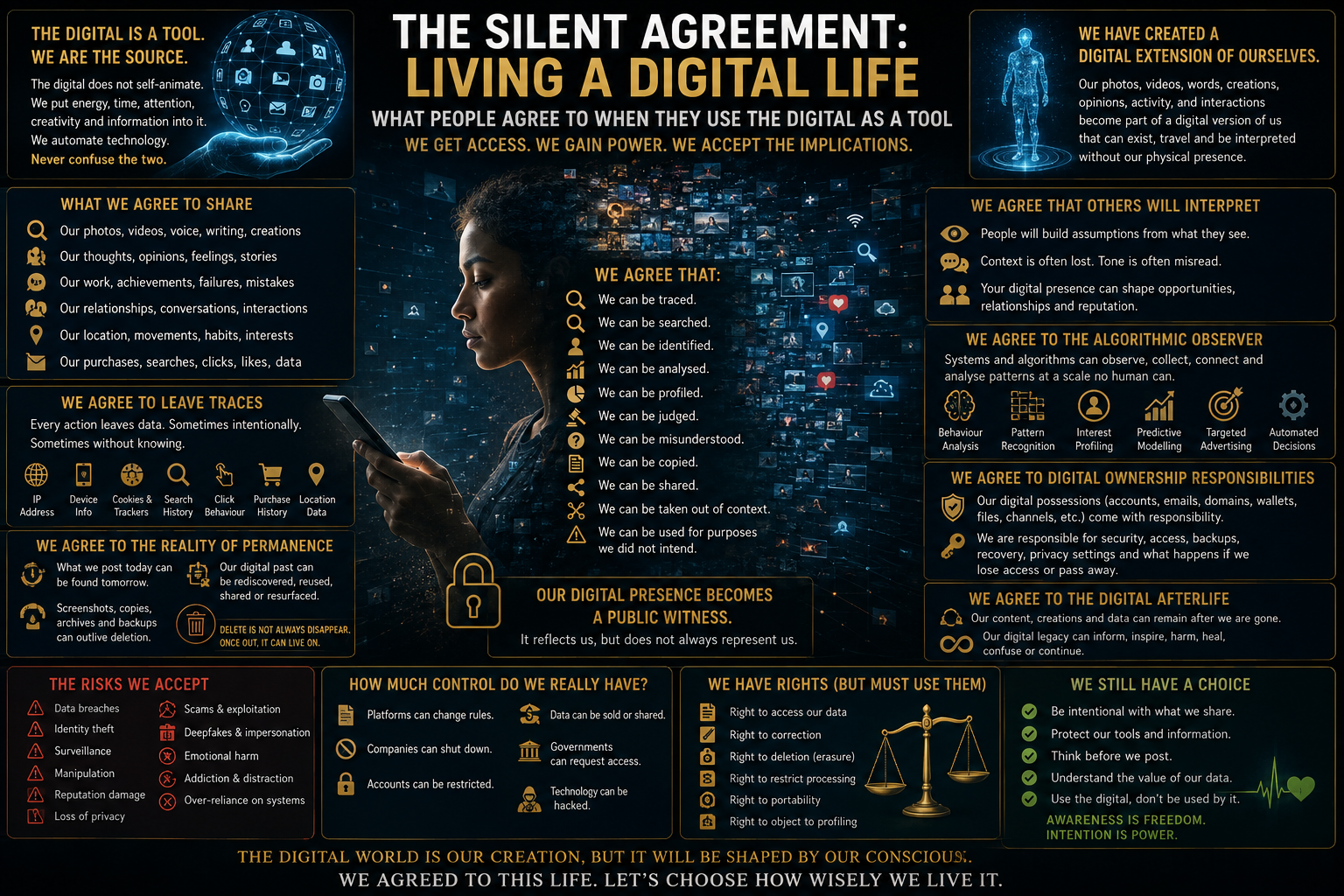
The weapon formed against me that could be used against me. Let’s see.
There is another silent agreement humanity has entered without really stopping to discuss what it means.
We agreed to have a digital existence.
Not a transhuman existence.
Not yet.
We have not uploaded our consciousness into machines.
We have not become digital beings.
But we have done something remarkably close to putting a foot through the doorway.
We have begun placing copies of ourselves into a world that did not exist for us before.
Our photographs.
Our faces.
Our voices.
Our movements.
Our writing.
Our creations.
Our conversations.
Our opinions.
Our arguments.
Our humour.
Our relationships.
Our locations.
Our purchases.
Our searches.
Our interests.
Our fears.
Our desires.
Our memories.
Our work.
Our mistakes.
Our achievements.
Pieces of us everywhere.
And then we call it being online.
Perhaps we should call it something more accurate:
shared existence.
Because once we put something of ourselves into a digital environment, it no longer exists exclusively inside us.
It exists somewhere else.
The digital version of you is still sourced from you
This is where I think humanity gets something fundamentally backwards.
Technology does not spontaneously create the human material we put into it.
We do.
The machine can process it.
Store it.
Reproduce it.
Distribute it.
Combine it.
Analyse it.
Recommend it.
Amplify it.
But we are the source.
A photograph does not appear because the camera decided to have a life.
Someone stood in front of it.
A video does not animate itself.
Someone moved.
A voice recording does not speak because the microphone became conscious.
Someone spoke.
A post does not contain an opinion because the server developed one.
Someone thought.
Someone felt.
Someone typed.
Someone created.
We automate technology.
We do not automate humanity into technology.
There is an important distinction there.
Because the digital world can appear alive precisely because we have filled it with so much evidence of life.
We have given machines our language.
Our images.
Our music.
Our stories.
Our personalities.
Our preferences.
Our attention.
Our creativity.
Our relationships.
We keep putting energy into the machine and then marvel when the machine appears animated.
Of course it appears animated.
We animated it.
And then we agreed to leave traces
The moment you enter the digital world, you begin leaving traces.
Sometimes intentionally.
Sometimes accidentally.
Sometimes without even knowing.
Your email address.
Your username.
Your photograph.
Your IP address.
Your device.
Your location.
Your browsing behaviour.
Your searches.
Your clicks.
Your purchases.
Your interactions.
Even an apparently anonymous account can become identifiable when enough pieces are connected. Online identifiers such as IP addresses, cookies, account handles and device fingerprints can contribute to identifying or profiling individuals.
And this is where the silent agreement becomes uncomfortable.
Because we have accepted a world in which the gateway to us can become evidence about us.
You have an email address.
Fine.
But what does it reveal?
What do you use it for?
Who receives it?
How often is it active?
Where is it registered?
What accounts are attached to it?
What conversations pass through it?
What happens if somebody gains access?
What happens if it is exposed?
What happens if it remains attached to something you did twenty years ago?
The possession itself becomes a doorway.
And every doorway has a history of who entered it.
We don’t just create data. We create interpretations.
This may be the most important part.
We tend to think:
“I only shared this.”
But the digital world can ask:
“What does this tell us?”
Those are not the same question.
A photograph might reveal where you were.
A series of photographs might reveal where you regularly go.
A purchase might reveal a preference.
A collection of purchases might reveal a lifestyle.
A search might reveal curiosity.
A pattern of searches might reveal an interest.
A message might reveal a feeling.
A collection of messages might reveal a relationship.
A location might reveal where you visited.
Repeated locations can reveal routines.
The individual pieces can become a pattern.
And organisations can use information from searches, purchases, social networks, mobile phones and other sources to create profiles that attempt to predict preferences or behaviour.
So eventually the digital version of you can contain something you never consciously uploaded:
an interpretation of you.
That is extraordinary.
Because your digital existence is not only what you say about yourself.
It can also become what others infer about you.
The version of yourself you share becomes a public witness
This is another silent agreement.
When we put ourselves online, we accept that other people can construct an understanding of us from what we choose to reveal.
And they will.
They will see the photograph.
They will read the words.
They will watch the video.
They will see the career.
They will see the relationships.
They will see the things you celebrate.
They will see the things you condemn.
They will see what you repeatedly talk about.
And then they will build a picture.
Sometimes accurately.
Sometimes completely incorrectly.
Because the digital version of you is not necessarily you.
It is the version of you that became visible.
And visibility is not wholeness.
Someone can see a thousand photographs and still not know you.
Someone can read everything you have written and still misunderstand you.
Someone can watch your videos and still have no idea what happens when nobody is watching.
This brings us back to something humanity struggles with offline as well:
we confuse what is visible with what is true.
The internet simply gives us an unprecedented amount of visible material with which to make that mistake.
And then comes permanence
We have also quietly accepted something extraordinary:
what we do today may outlive the person we were when we did it.
A thought from twenty years ago can be found today.
A photograph can be copied.
A video can be downloaded.
A message can be screenshotted.
A webpage can be archived.
A piece of work can circulate without its creator.
Deleting something from your account does not necessarily mean every copy, derivative, backup, screenshot or independently stored version has disappeared.
Even regulators recognise that data retention and deletion are complicated realities; the FTC has found cases where platforms retained extensive data and did not necessarily delete all information after deletion requests.
So we have created something peculiar.
A civilisation in which the past can remain technologically present.
Our ancestors had memories.
We have archives.
They could tell stories about who we were.
We can show them.
We also agreed to be searchable
This is perhaps one of the strangest things about digital existence.
You can now search for a person before meeting them.
An employer can encounter their digital presence.
A stranger can encounter their digital presence.
A potential partner can encounter their digital presence.
A future friend can encounter their digital presence.
Someone who dislikes them can encounter their digital presence.
Someone who has never met them can construct an opinion about them.
And suddenly the person is no longer introduced solely through an interaction.
They can arrive preceded by a search result.
That changes human relationships.
We have effectively created a civilisation where reputation can precede physical presence.
And we accepted the algorithmic observer
Then something even more profound happened.
We didn’t just put ourselves online for other humans.
We put ourselves into systems that can observe patterns at a scale no individual human could.
The digital world can watch millions of interactions and identify relationships between them.
It can notice what people click.
What they watch.
What they ignore.
What makes them return.
What makes them leave.
What they buy.
What they search.
What they respond to.
What time they are active.
And then those observations can become predictions.
This is no longer simply someone looking at your photograph.
It is a system attempting to understand your behaviour.
That is a different kind of observer.
And increasingly, decisions about people can involve automated processing and profiling based on information gathered from many sources.
So we have gone from:
“Here is what I choose to show you.”
to:
“Here is what my behaviour allows you to infer about me.”
That is a massive transition.
Our possessions now have behaviour too
And this returns to something you said about the email address.
We have digital possessions.
An account.
An email.
A profile.
A domain.
A channel.
A digital wallet.
A website.
A cloud folder.
A social-media account.
A portfolio.
A digital library.
A body of creative work.
And ownership isn’t simply possession.
It is also stewardship.
What do you do with it?
Where is it?
Who has access?
Who controls the password?
Who can recover it?
What happens if you die?
What happens if you are locked out?
What happens if the company disappears?
What happens if the platform changes its rules?
What happens to your creations?
What happens to the conversations?
What happens to the digital identity that everyone associates with you?
We have created digital property without fully developing the cultural understanding of what it means to possess something that exists primarily through infrastructure somebody else controls.
That is a very new human problem.
And then there is the digital afterlife
We are also creating versions of ourselves that may survive us.
Our photographs.
Our videos.
Our writing.
Our music.
Our messages.
Our websites.
Our comments.
Our accounts.
Our creations.
A person can die physically while their digital existence continues.
Their image can continue circulating.
Their words can continue being read.
Their work can continue being downloaded.
Their conversations can remain inside somebody else’s device.
Their profile can remain visible.
Their creations can continue generating attention.
And now, with increasingly capable AI systems, the possibility of constructing new outputs from a person’s existing digital material makes the question even stranger:
When does a record of someone become a representation of someone?
And when does a representation become something that feels like a continuation?
We are approaching questions humanity has never previously had to answer at this scale.
The silent agreement is not that everything online is public
That would be too simple.
The agreement is deeper.
It is that we are willing to place pieces of ourselves into an environment where their boundaries are no longer entirely determined by us.
We can choose privacy settings.
We can choose what to share.
We can delete.
We can restrict.
We can protect.
And laws increasingly provide rights concerning access, erasure, objection, portability and certain forms of automated decision-making.
But the existence of those protections does not change the fundamental philosophical shift.
We have created a second environment in which versions of ourselves exist.
And we participate in it voluntarily every day.
We are not transhuman yet. But we have already started leaving ourselves behind.
This is perhaps the most fascinating part.
Our bodies remain here.
Our consciousness remains here.
Our biological lives remain here.
But pieces of us have begun travelling without us.
Our voice can travel without our body.
Our image can travel without our presence.
Our thoughts can travel without our mind being physically present.
Our creations can travel without our hands.
Our memories can travel without our brain.
Our identity can be encountered without us being in the room.
That is not full transhumanism.
But it is certainly a doorway toward a different relationship between human existence and technology.
We have begun externalising parts of ourselves.
And we should be honest about what that means.
Because perhaps the greatest silent agreement of the digital age is this:
We agreed that pieces of ourselves could exist somewhere other than inside us.
And once we agreed to that, everything changed.
We accepted that our past could remain searchable.
That our behaviour could become data.
That our possessions could become gateways.
That our relationships could become visible.
That our creations could travel beyond our control.
That our images could exist without our presence.
That our words could outlive our intentions.
That strangers could construct versions of us.
That machines could analyse patterns in us.
That organisations could build profiles from us.
That our digital selves could become useful, valuable, dangerous, misleading, beautiful, misunderstood, profitable or permanent.
And perhaps most importantly:
we accepted that the digital world would not simply contain our information.
It would contain pieces of our existence.
But we should never forget the fundamental truth underneath all of it:
The machine did not create the life.
We brought the life to the machine.
The technology did not animate humanity.
Humanity animated the technology.
And perhaps the next question of the digital age is therefore not:
“What can technology do with us?”
But:
**“How much of ourselves are we willing to place into something we built—and how carefully are we going to govern what happens to the pieces we leave there?”**
….
Another silent agreement is between us, accepting hsving a digital existence and the implications that ckme with that. We accept everything could be traced, no matter what erasure if needed, we accept everyone can see it, we accept what oir digital presence says abiut what we choose to sharw with the world about us and the consequences of the version of ourselves we share, we accept the assumptions thst gers put on the gateway we house, meaning snything rhat belongs to us digitally, even an emaik address, is statue of what we do with that possession or not meaning tou hsve an email, di yoi use it? How you use it? Where is it? How accessible? All those things..
Add more you find in relations to having a digital shared existence, meaning not transhuman yet, but wirh a foot on the door as we place copies of our being onlins, whether our pictures, videos, creations, thoughts, feelings, all of it. We are source to it all, as rhe digital does not self animate we have to put eneegies into it for it to animate itself. It is not automated, we automate technology. Never confuse the two0


Leave a Reply