
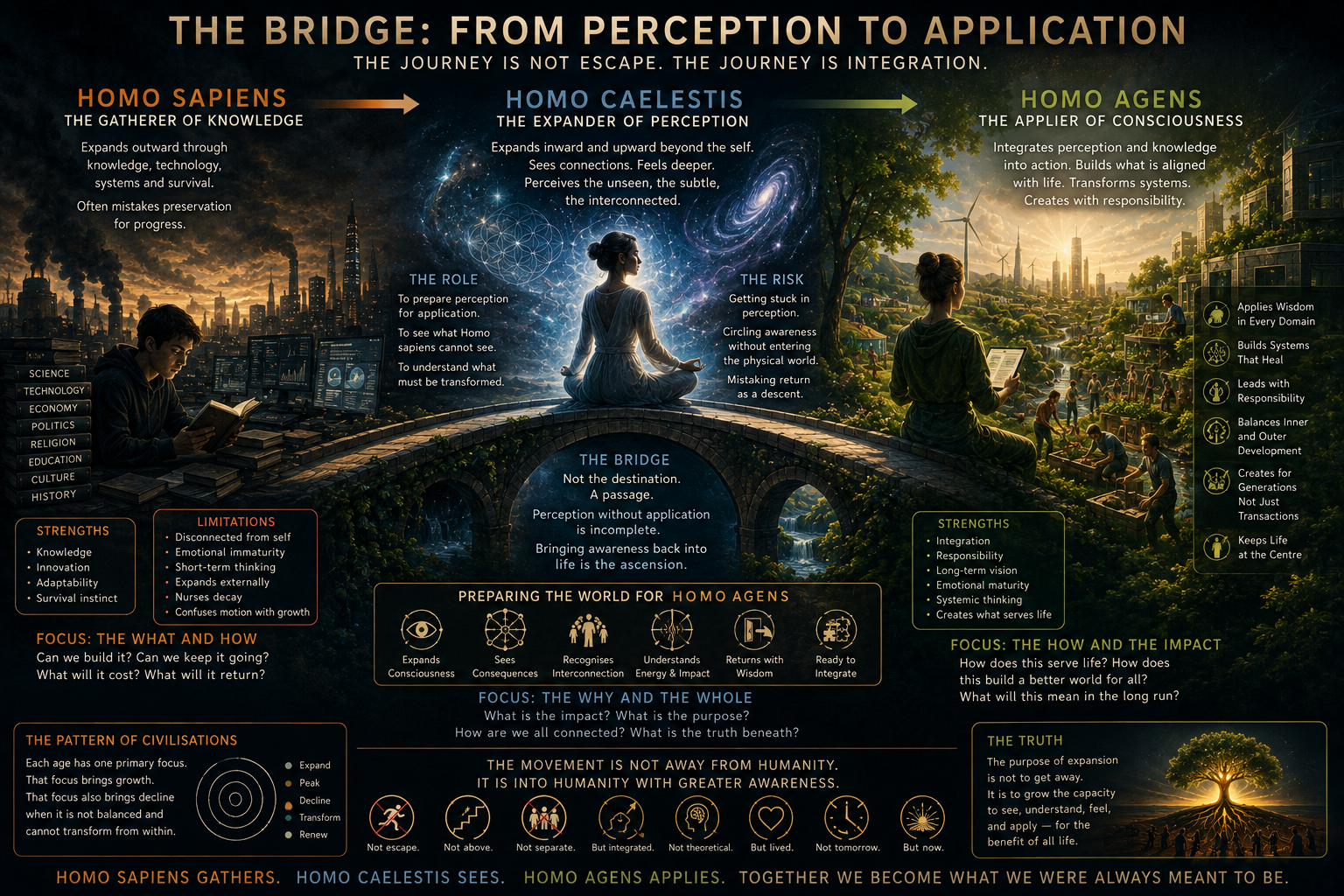
Homo caelestis isn’t the destination between Homo sapiens and Homo agens; it is the bridge that prepares perception for application. The problem begins when the bridge becomes a residence.
If homo caelestis is the bridge between homo sapiens and homo agens, then its purpose cannot be to remain suspended between the two.
Its purpose is to prepare the world for what comes next.
Homo caelestis expands perception beyond the individual.
It begins to see what homo sapiens struggles to see: the connections between things, the energetic dimensions beneath the physical, the collective consequences behind individual actions, the reality that the self is not isolated from the whole.
It sees further.
It feels further.
It perceives further.
And that expansion is necessary.
Because homo agens cannot apply what it cannot perceive.
But perception was never supposed to become the final destination.
This is where the problem begins.
Homo caelestis can become so fascinated by expanded perception that it begins circulating around perception itself.
It keeps looking.
Keeps feeling.
Keeps expanding.
Keeps searching for another layer.
Another frequency.
Another revelation.
Another dimension of meaning.
But eventually, the question becomes:
What are you going to do with what you have seen?
Because if perception never enters the physical world, it has not completed its journey.
It has only expanded inwardly.
And this is where some interpretations of spiritual expansion become inverted.
They begin to treat the physical world as something lesser.
They see entering the systems of homo sapiens as a descent.
They believe that returning to ordinary life, ordinary structures, ordinary responsibility and ordinary human problems means moving away from consciousness.
But perhaps the opposite is true.
Perhaps bringing expanded consciousness into the physical world is the ascension.
The descent is not necessarily coming into matter.
The descent is becoming trapped in perception without application.
The ascension may be taking what has been perceived and successfully integrating it into matter.
That is the movement toward homo agens.
Homo caelestis sees the interconnectedness.
Homo agens builds accordingly.
Homo caelestis recognises the energetic consequences.
Homo agens changes the system that produces them.
Homo caelestis expands beyond the self.
Homo agens brings that expanded self back into relationship with the world.
This is why homo caelestis should be preparing the world for homo agens.
It is the bridge.
A bridge exists to allow movement.
It is not meant to become a permanent home.
And this matters because homo sapiens does not automatically make the transition simply because homo caelestis has perceived something greater.
Homo sapiens can take perception and intellectualise it.
It can turn revelation into information.
It can turn wisdom into philosophy.
It can turn spirituality into identity.
It can turn consciousness into another thing to possess.
And then it can continue living exactly as it did before.
That is the danger.
The perception becomes another form of knowledge without transformation.
Homo caelestis therefore has its own responsibility.
It must not merely escape the limitations of homo sapiens.
It must return with something.
Return with perception.
Return with understanding.
Return with expanded responsibility.
Return with a different way of seeing the systems that humanity has already built.
Return with enough consciousness to say:
Now that I can see this differently, I must live differently.
That is the movement.
Not away from humanity.
Into humanity.
Not away from the physical.
Into the physical with greater awareness.
Not away from responsibility.
Into responsibility with greater perception.
This is why I would call the movement from homo caelestis to homo agens an ascension through integration.
The consciousness rises by becoming capable of holding more, not by abandoning what it previously considered beneath it.
The spiritual and the physical stop competing.
The mental and emotional stop being separated.
Knowledge and perception stop operating independently.
And consciousness becomes capable of application.
That is homo agens.
It does not ask:
“How far can I get away from homo sapiens?”
It asks:
“How much of what I have learned can I bring back to improve the human experience?”
That question changes everything.
Because the purpose of expansion was never simply to expand.
The purpose of expansion was to create capacity.
Capacity to perceive.
Capacity to understand.
Capacity to feel.
Capacity to hold contradiction.
Capacity to see consequences.
Capacity to create.
Capacity to act.
And eventually:
capacity to apply.
Homo caelestis prepares the perception.
Homo sapiens provides the enormous accumulated knowledge of the human experiment.
Homo agens brings the two together.
That is why the bridge must eventually be crossed.
Otherwise, the bridge becomes another place to remain stuck.
And humanity does not need another consciousness that merely knows there is a better world.
It needs a consciousness capable of building one.






Leave a Reply