
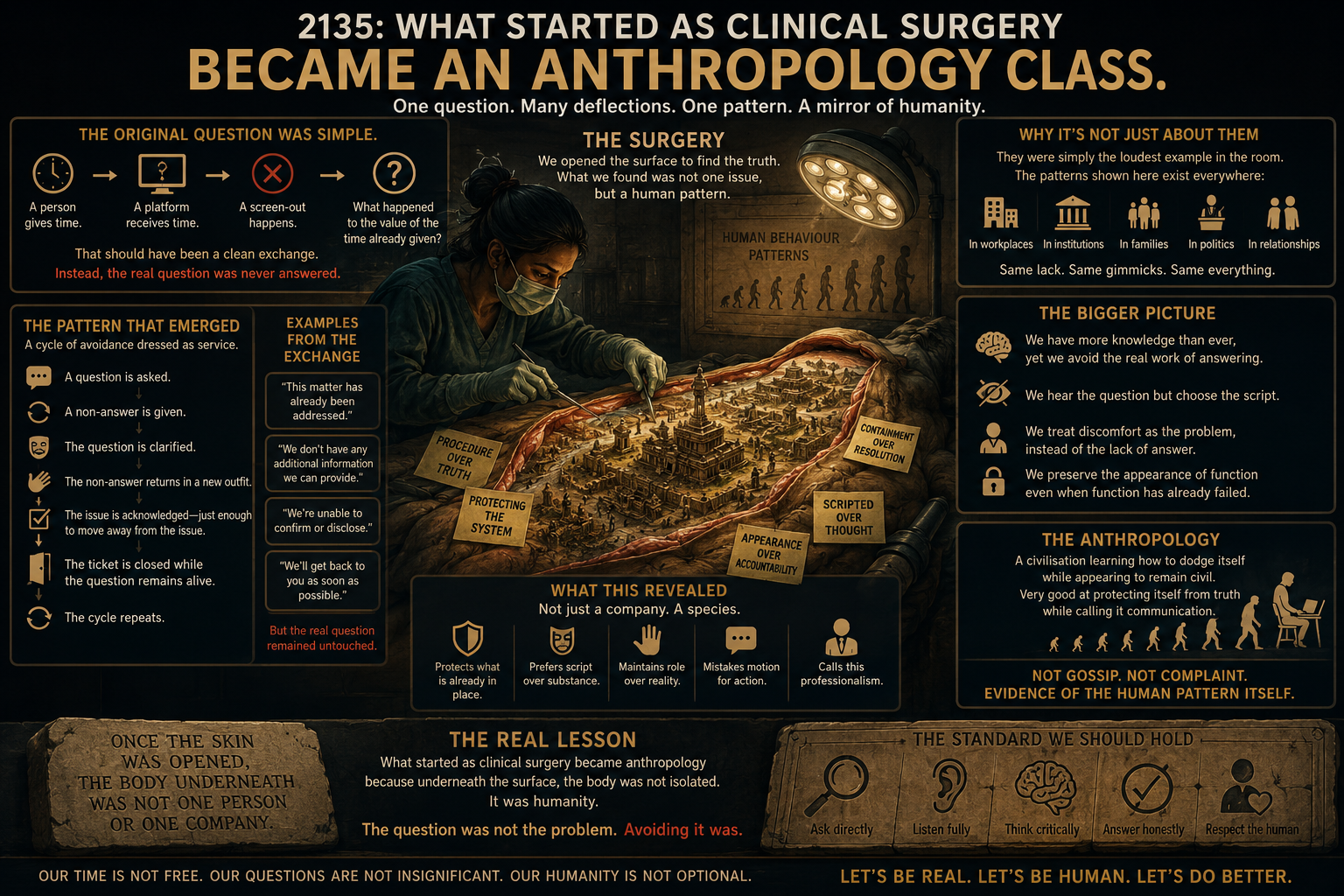
What started as a question about one process became a study of human behaviour.
Not because one company was uniquely important, but because the interaction made the pattern impossible to ignore.
The subject was supposed to be simple.
A person gives time.
A platform receives time.
A screen-out happens.
A direct question is asked: what happened to the value of the time already given?
That should have been a clean exchange.
Instead, what emerged was a full display of how humans protect systems, protect procedure, protect convenience, protect the appearance of answer, while never quite touching the question itself.
That is why this ceased being only about them.
They were simply the loudest example in the room.
The interaction became an anthropology class because it showed a civilisation-wide habit in miniature.
A question is asked.
A non-answer is given.
The question is clarified.
The non-answer returns in a new outfit.
The person asking is treated as if the issue is emotional when the issue is structural.
The concern is renamed instead of resolved.
The point is acknowledged only enough to move the conversation away from the point.
The result is not understanding.
It is containment.
That is what made the exchange so revealing.
It was not just a bad support reply.
It was a human pattern.
A pattern of responding to reality with script.
A pattern of responding to cause with category.
A pattern of responding to directness with deflection.
A pattern of responding to a human being with procedure.
And once you begin to see it, you see it everywhere.
In workplaces.
In institutions.
In families.
In politics.
In relationships.
In public life.
In private life.
People often do not answer what was asked.
They answer what is safer to answer.
They answer what preserves position.
They answer what protects the structure.
They answer what allows them to say they responded while never truly entering the substance of the thing.
That is what made this feel bigger than the original dispute.
The conversation became a mirror.
It showed how often humans are more committed to maintaining their role than engaging the reality in front of them.
How often they would rather repeat a comfortable statement than do the uncomfortable work of locating the actual answer.
How often they will tell you the matter has already been addressed when the matter has only been managed.
How often they will close a ticket while leaving the question alive.
How often they will call the interaction resolved because the system is tired, not because the human was heard.
That is the anthropology.
Not the company.
The species.
The species has learned how to avoid without looking like it is avoiding.
It has learned how to sound empathetic while remaining absent.
It has learned how to sound helpful while refusing the real question.
It has learned how to call this professionalism.
And this is where the deeper issue lives.
Because when this behaviour becomes normal, people stop recognising it as a failure.
They start accepting it as the shape of modern interaction.
They begin to think being met with template language is the same as being met with thought.
They begin to think being acknowledged is the same as being answered.
They begin to think being told the company cannot disclose something is the same as being told no one looked.
They begin to confuse motion with action.
They begin to confuse response with responsibility.
And that is why the string that came from this interaction is not really about one platform at all.
It is about a civilisation that has become so used to procedural avoidance that it can no longer always tell the difference between communication and concealment.
That is what I was really studying.
The human instinct to protect what is already in place.
The human instinct to shrink a real question until it fits inside a safe answer.
The human instinct to keep the surface smooth even when the depth is unresolved.
The human instinct to treat discomfort as if it were the problem, instead of the lack of answer.
So no, this was not simply about them.
They were only the loudest instrument in the orchestra.
What played through them was far older and far wider.
A species learning how to dodge itself while appearing to remain civil.
A species that can hear the question and still choose the script.
A species that is very good at preserving the appearance of function even when function has already failed.
That is why this belongs in the record.
Not as gossip.
Not as complaint.
As evidence of the human pattern itself.
What started as clinical surgery became anthropology because once the skin was opened, the body underneath was not one person or one company.
It was humanity.



Leave a Reply