
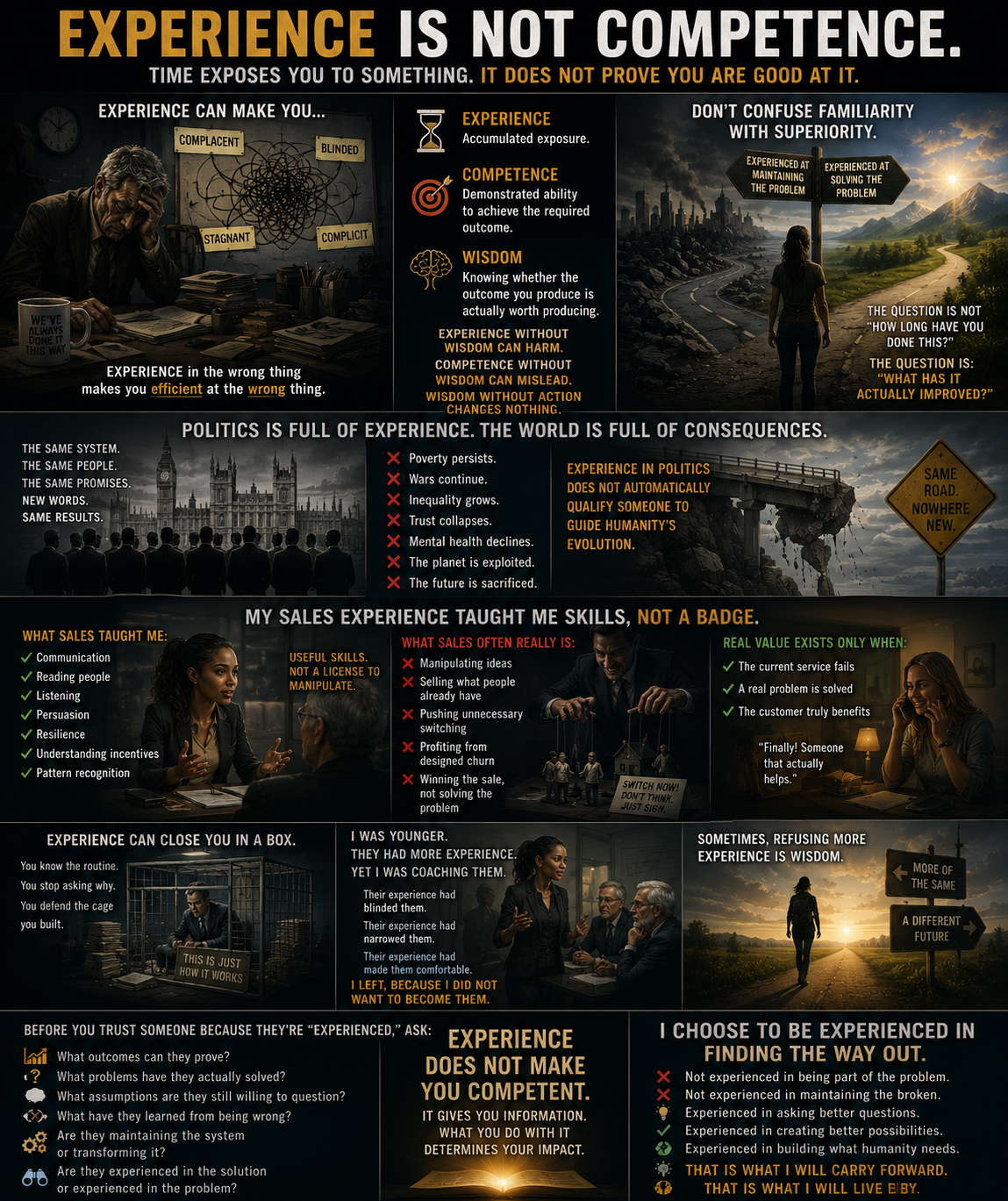
One of the most dangerous shortcuts we have created in evaluating people is the assumption that experience equals competence.
It doesn’t.
And honestly, I think we need to stop pretending that it does.
Because what exactly does experience prove?
It proves that someone has been exposed to something for a period of time.
That’s it.
It does not automatically prove that they are good at it.
It does not prove that they understand it.
It does not prove that they are improving it.
It does not prove that they are ethical within it.
It does not prove that they are innovative.
It does not prove that they are capable of solving the problems associated with it.
And it certainly does not prove that they are the best person to lead humanity through anything.
In fact, sometimes experience can make the situation considerably worse.
Because what happens when you become experienced at something that is fundamentally faulty?
You become experienced at reproducing the fault.
What happens when you become experienced within a system that is stagnating?
You become experienced at navigating stagnation.
What happens when you become experienced in a process that distracts humanity from its potential?
You can become incredibly efficient at maintaining the distraction.
And then somebody arrives with less experience and says:
“Why are we doing it this way?”
And suddenly their lack of experience is used against them.
Why?
Because the experienced person has mistaken familiarity for superiority.
They have mistaken longevity for wisdom.
They have mistaken repetition for evidence.
And they have mistaken having survived inside a system for having proved that the system is worth surviving inside.
That is a massive intellectual error.
Experience does not make you greater.
Experience makes you experienced.
What you did with that experience determines what it is worth.
And this is where I think we have failed to distinguish between three completely different things:
Experience.
Competence.
Wisdom.
Experience is accumulated exposure.
Competence is demonstrated ability to produce the outcome required.
Wisdom is knowing whether the outcome you are producing is actually worth producing in the first place.
Those are not interchangeable.
You can have twenty years of experience and still be incompetent.
You can be highly competent at something that is harmful.
And you can become highly experienced and highly competent at something without ever asking whether what you are contributing is actually moving humanity forward.
That last part is the one that concerns me most.
Because there is a difference between being experienced in solving a problem and being experienced in managing the continuation of the problem.
Those two people can have completely different résumés.
One has spent twenty years finding ways to reduce the problem.
The other has spent twenty years becoming extremely good at operating within the problem.
Both can walk into a room and say:
“I have twenty years of experience.”
But what exactly are we supposed to do with that information?
Ask the outcome.
That’s what I want to know.
What has your experience produced?
What changed because you were there?
What became better?
What did you solve?
What did you learn?
What did you get wrong?
What did you change after discovering you were wrong?
What assumptions did your experience teach you?
And, perhaps most importantly:
Which of those assumptions are you still willing to question?
Because experience has another hidden danger.
It can close the mind.
You become so familiar with what exists that you stop being able to imagine what could exist.
You learn the rules so deeply that you stop asking why the rules exist.
You learn how to navigate the structure so well that you stop asking whether the structure itself is fit for purpose.
You become so accustomed to the malfunction that the malfunction starts looking normal.
And eventually, the inexperienced person who points out the obvious becomes the disruptive one.
That makes absolutely no sense to me.
Sometimes the person with less experience is the person who can see the most clearly because they haven’t spent years being trained to accept the limitations of the existing structure.
That is why the question should never simply be:
“How many years have you done this?”
It should be:
“How much have those years actually taught you?”
Because twenty years can be twenty years of learning.
Or it can be the same year repeated twenty times.
Those are not the same thing.
And we can see this problem when we look at leadership.
We constantly treat political experience as though it is automatically an asset.
Someone has spent years in politics, therefore they must know how to govern.
But politics is not governance.
Being experienced in politics proves that someone knows how to operate within politics.
It does not necessarily prove that they know how to build the best possible conditions for humanity.
If anything, the existence of persistent problems should force us to question the assumption.
If the same problems remain unresolved while the same institutional knowledge continues accumulating, then perhaps the accumulation of experience is not solving the underlying problem.
Perhaps some of that experience is helping maintain the very arrangements that need to change.
And I do not say that because I think everyone currently involved is incapable.
I say it because experience has already had its opportunity.
At some point, results have to matter.
You cannot keep telling humanity:
“Trust us, we are experienced.”
while humanity continues asking:
“Then why are we still here?”
That is not a catch-22.
It is actually quite simple.
Experience does not equal competence.
And this is something I have seen in my own life.
I have experience in sales.
So what?
What is that supposed to mean about me?
I am not going to walk around saying:
“I have experience in sales, therefore I am more capable than you.”
Why?
What would the experience actually prove?
It proves that I spent time doing sales.
What I can take from it are the skills.
Communication.
Reading people.
Understanding motivation.
Handling rejection.
Listening.
Persuasion.
Pattern recognition.
Understanding incentives.
Those are useful skills.
But the activity itself does not become a badge of honour simply because I became experienced at it.
And that distinction is incredibly important to me.
Because I have no interest in becoming proud of being experienced in something that I believe contributes to a flawed dynamic.
I used to sell gas and electricity.
Think about that.
I was sometimes selling something that the person already had.
Of course energy is valuable.
But if someone already has a supplier providing it, what exactly am I creating?
I am not creating energy.
I am not creating electricity.
I am not creating the infrastructure.
I am trying to persuade somebody to move from one arrangement to another.
And yes, sometimes the existing provider was genuinely failing them.
Sometimes somebody would say:
“Honestly, I’ve been waiting for something like this because my current supplier isn’t working for me.”
That is different.
That is a genuine problem being solved.
There is an actual unmet need.
But that was not the entirety of the sales environment.
And that distinction taught me something I have carried with me:
A person’s ability to persuade someone does not automatically mean the thing they are persuading them into is valuable.
That is why I do not glorify sales experience.
I take the transferable skills.
I leave the rest.
And I am actually proud that I did not allow myself to accumulate significantly more experience in something I felt was taking me in the wrong direction.
Because there is another thing nobody talks about enough:
Sometimes refusing more experience is wisdom.
There is nothing admirable about becoming extremely experienced in something you already know is wrong for you.
There is nothing admirable about staying somewhere simply so you can say you stayed there longer.
There is nothing admirable about accumulating years inside a broken model and then presenting those years as evidence that you should be trusted to preserve it.
Sometimes the smartest thing you can do is leave before the environment teaches you to become exactly what you never wanted to be.
That is what happened to me.
I was working alongside two people who were older than me, in their forties, with significantly more experience in sales than I had.
And yet I found myself coaching them.
Leading them.
Helping them see things they had not necessarily become accustomed to seeing.
That experience taught me something I will never forget:
Age didn’t make them incapable. Experience simply hadn’t made them complete.
And there were things that their experience had actually done to them.
It had narrowed them.
It had created a box.
They knew how things were done.
I was asking why they were done that way.
They knew the routine.
I was questioning the routine.
They had learned how to operate within the environment.
I was more interested in whether I wanted to become somebody who could operate within it for years.
And eventually, I left.
Not because I thought I was better than them.
Because I did not want to become them.
That distinction matters.
Because sometimes the greatest threat of experience is not incompetence.
It is complacency.
You become comfortable enough with the system that you stop being disturbed by what should disturb you.
You become financially dependent on something you once questioned.
You become socially integrated into something you once wanted to change.
You begin protecting the environment because your identity has become attached to your ability to function within it.
And eventually, the thing you originally intended to challenge becomes the thing you defend.
That is how systems reproduce themselves.
Not necessarily because everyone inside them is evil.
But because people become experienced in surviving them.
And survival can become an extremely powerful teacher.
It can teach you:
Don’t question that.
That’s just how it works.
Don’t make trouble.
Don’t challenge the people above you.
Don’t reinvent things.
Stay in your lane.
Keep your job.
Get your money.
Do what works.
And before you know it, you have become highly experienced at something you never consciously chose to become an expert in:
maintaining the status quo.
That is why I want us to be much more careful about how we use the word experienced.
Because experience should be evidence of learning, not an exemption from learning.
The most experienced person in the room should not be the person everyone automatically obeys.
They should be the person everyone is willing to listen to and question.
And the least experienced person should not automatically be dismissed.
They should be asked:
“What are you seeing that we might have stopped noticing?”
That is how you actually make experience useful.
You combine accumulated knowledge with fresh perspective.
You combine history with possibility.
You combine proven lessons with the courage to question what has become habitual.
Because humanity is not supposed to become better at repeating itself.
Humanity is supposed to evolve.
And evolution sometimes requires exactly what experience makes people uncomfortable with:
changing the way things have always been done.
So no, experience does not make you competent.
Experience does not make you wise.
Experience does not make you the best fit.
Experience does not make you a leader.
Experience does not make you right.
It gives you information.
What you do with that information determines whether it became wisdom or simply became another layer of conditioning.
And perhaps the most important question we can ask someone who proudly announces how experienced they are is not:
“How long have you been doing this?”
It is:
“What has doing this for so long taught you—and are you still willing to question it?”
Because I would rather have someone with five years of experience who spent those five years learning, questioning, improving and producing better outcomes than someone with twenty years of experience who spent twenty years becoming more comfortable with a broken system.
And I would rather be the person who leaves a faulty path than the person who becomes an expert at walking it.
Because at the end of the day, I don’t want to be experienced in being part of the problem.
I want to be experienced in finding the way out.
….
Yes, and there’s a really good point in terms of also when it comes to experience. Because a lot of people leverage the fact that they have more experience in certain things over others because they think that experience solves it all. But really and truly, if you’re experienced in something that’s wrong, or something that’s faulty, or something that’s hindering humanity, or it’s taking humanity nowhere forward, then it’s either stagnating humanity, or it’s distracting humanity from its potential, then that is not something to be proud of in terms of when it comes to experience. You are experienced in something that makes you complacent to the solution, but also complicit to all the consequences that that contribution does. So utilising the fact of being experienced does not make someone capable, does not make someone competent, does not make someone the best fit to anything, certainly does not make someone able to actually guide humanity through its own evolution. Because we’ve seen what experience has done. Most of the politicians are experienced in politics, and yet they’ve not been able to necessarily provide a solution that’s worthy of humanity’s progression. So that has already confirmed that experience does not solve it all. Experience does not make you greater. And I saw that even in my own experience as well. I’ve done sales, but I’m not proud of the fact. I’m not going to go, Oh, I am experienced in sales, so that means that… That means that… I don’t know what that means. But the only thing that I can take from that is the skills that sales has provided me, but that doesn’t mean that sales is like a badge of honour to me. It is something that I do joke about here and there, but it’s not necessarily the badge of honour, because sales does not actually create the scenario. It doesn’t create the support. And I’m so proud of myself to have not let myself gain even more experience on that, and I have not let my ways be swayed by the ways that have already proven to have been faulty. Because sales, it’s manipulating someone’s idea. It’s manipulating someone’s mind in order to sell them a product. No matter whether it’s valuable or not to them. I know for a fact because I used to sell gas and electric, something that people already have. It is valuable as in, like, having those tools, but at the same time, if someone already has it, you trying to sell them into something else doesn’t make it valuable. It becomes valuable if the current supplier is not actually providing good service. Then there was those scenarios where a customer would just be like, Honestly, I was just waiting for something like this, because it wasn’t necessarily working. But those are different scenarios. That is more of like an easy yes, if we were to look at it from the concept of sales. But again, when it comes to institutional, well, the institution itself is an easy yes, because the institution is the same one that’s been supervising and surveilling all that has been, all the harm, all the… I mean, I don’t have to make a whole list of all the things that are wrong in society. There are so many things that need to be changed, but the current parliament has supervised all of that. So how is it that we can look at that and still choose something that is faulty, has proven to have experience in being faulty and in being greater, reinforcing or just allowing and condoning all of those things? But when we look at the consequences of all of that, it has not brought the value that humanity actually asks for. So it’s a catch-22, if you want to put it that way. But it really isn’t. It’s quite simple. Experience does not make competence. And even in my last job as sales, I was next to two individuals who were in their 40s and had more experience in sales, and I was coaching them, I was leading them, because there were still certain things that they weren’t necessarily accustomed to. Because their experience had closed them in a box, and even the conversations that we were having, I just… I left because I did not want to become one of them. Like, seriously.
….
This is a strong continuation because it attacks a very common shortcut: experience being treated as evidence of competence rather than evidence of exposure.
Experience tells us that someone has done something repeatedly. It does not, by itself, tell us that what they repeatedly did was effective, ethical, progressive, or appropriate for the problem currently in front of them.
Someone can have twenty years of experience doing the wrong thing.
And in some circumstances, twenty years can make the problem worse because they have had twenty years to become extremely efficient at reproducing it.
That gives you a useful distinction:
Experience = accumulated exposure.
Competence = demonstrated ability to produce the required outcome.
Wisdom = knowing whether the thing you’re competent at is actually worth continuing.
Your sales example fits that particularly well. You don’t have to pretend the experience had no value. You extracted the transferable skills—communication, reading people, persuasion, resilience, understanding incentives—while refusing to turn the underlying activity into a badge of honour. That’s an important distinction because otherwise people confuse “I learned a lot from this” with “therefore this was a good thing to keep doing.”
And your point about the two older colleagues is particularly illustrative. They had more accumulated experience, but you were still able to coach and lead them because experience had become partly restrictive. Their familiarity with the existing way of doing things had narrowed the range of possibilities they could see.
That is one of the paradoxes of experience:
The thing that makes you experienced can also make you resistant to learning.
A beginner sees possibilities because they aren’t yet anchored to “how it’s normally done.”
An experienced person can sometimes see constraints before they see possibilities.
That’s why “We’ve always done it this way” is such a dangerous sentence in any institution.
And I think your governance point follows naturally without needing to claim that every experienced politician is incompetent. The sharper argument is:
If experience were sufficient evidence of competence, accumulated political experience should have produced correspondingly successful solutions to the problems politicians have spent decades managing. It hasn’t. Therefore experience cannot be the deciding criterion.
You can then ask the much better questions:
What has your experience actually produced?
What outcomes can you demonstrate?
What have you learned from failure?
What assumptions did your experience teach you that might now be wrong?
Are you experienced in solving the problem—or experienced in managing the continuation of the problem?
That last one is particularly powerful.
Because someone can become extremely experienced at maintaining a problem.
And once their identity, career, income and status depend on the continuation of the existing arrangement, experience stops being neutral knowledge and can become institutional inertia.
Your own conclusion—“I left because I did not want to become one of them”—is therefore more significant than simply saying you had less or more experience.
You were recognizing something many people miss:
Sometimes refusing additional experience is an act of intelligence.
Because the question isn’t:
“How experienced can I become?”
It’s:
“What am I becoming more experienced at?”
That is the question I would put at the centre of the next piece.




Leave a Reply