
Mental Illness: Is a deficit like everything else. Linguistic deficit is an illness in such an informed and “advanced” civilisation. There’s no excuse for not having the words for ones emotions with th3 avalanche of information. Unless we are not truly evolving and that expansive…
There is something deeply backwards about the way we have taught adults to receive criticism.
We have become so uncomfortable with criticism that we have had to dress it up.
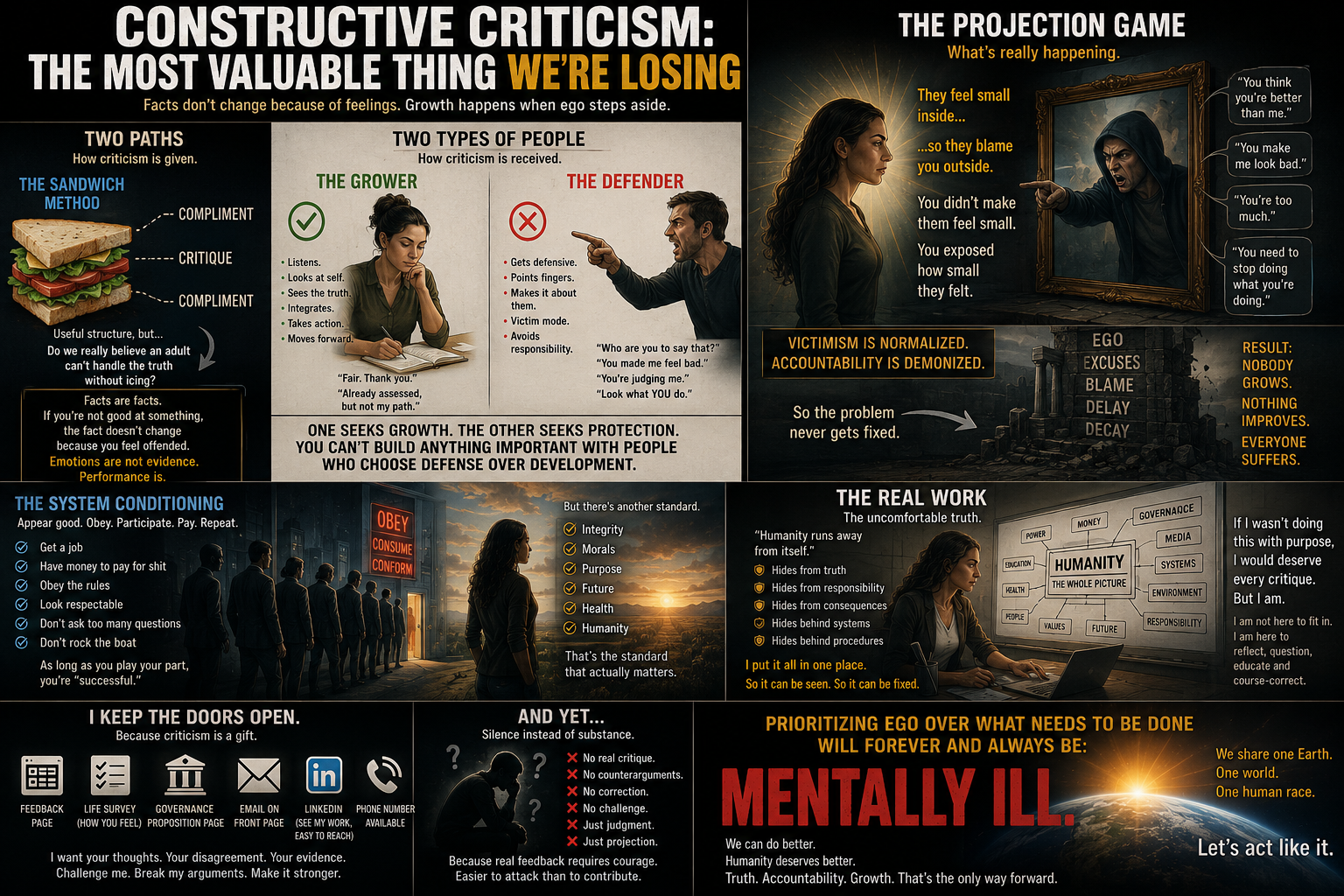
Constructive criticism.
As though criticism needs an additional word to become intellectually acceptable.
Then we created another little formula:
Compliment.
Critique.
Compliment.
The sandwich.
And I understand why it exists.
It is a social technology designed to make difficult information easier for someone’s ego to swallow.
But the older I get, the more ridiculous I find the underlying assumption.
Why are we assuming that a grown adult needs their ego padded before they can process a fact?
If I am not good at something, I am not suddenly good at it because you found three lovely things to say before telling me the truth.
The fact remains the fact.
And if somebody tells me something about myself that is true, my emotional reaction does not alter the truth of what they have said.
That is the part we keep forgetting.
A fact does not become less factual because it hurts your feelings.
And criticism is not automatically an attack simply because it is uncomfortable.
Sometimes criticism is somebody giving you information you desperately need.
Sometimes it is somebody identifying a blind spot you could not see.
Sometimes it is somebody showing you the exact place where your performance is falling below the standard required.
And sometimes it is simply somebody offering an assessment that you have every right to disagree with.
Those are all useful outcomes.
Because there are really two very different people in these situations.
One person gets criticised and thinks:
“Fair.”
They look at themselves.
They investigate.
They decide whether the criticism is accurate.
If it is, they integrate it.
They correct the problem.
They move forward.
Or perhaps they assess it and conclude:
“I have already considered this. I understand why you see it this way, but this is not the direction I have chosen.”
And they continue.
No meltdown.
No character assassination.
No attempt to make the person who gave the feedback feel guilty for having the audacity to notice something.
Just information.
Then there is the other response.
The person is criticised and immediately starts looking outward.
“Who are you to say that?”
“Well, you do this.”
“You made me feel bad.”
“You think you’re better than me.”
“Why are you judging me?”
Suddenly the original issue has disappeared.
The work that needed to be done has disappeared.
The performance gap has disappeared.
The responsibility has disappeared.
And now everyone is talking about the emotional consequences of somebody having said something truthful.
That is not accountability.
That is avoidance.
And we have normalised it so deeply that sometimes the person giving the feedback ends up apologising for noticing the problem in the first place.
That is insane.
We have created an environment where people can make you feel guilty for identifying something that needs fixing.
And then we wonder why organisations, relationships, institutions and entire societies repeat the same mistakes.
Because people have learned that defensiveness can successfully redirect accountability.
That is the real problem.
Not criticism.
The problem is what happens when criticism becomes socially punishable.
Because once people discover that they can escape the substance of a criticism by making the conversation about how the criticism made them feel, they have found an exit route from responsibility.
And people use that exit route.
Constantly.
It does not matter whether the original issue was about work.
Leadership.
Communication.
Reliability.
Integrity.
Performance.
Responsibility.
You can say:
“You did not do what you said you would do.”
And somehow the discussion becomes:
“I can’t believe you said that to me.”
No.
Those are two separate conversations.
We can discuss how I communicated it.
And we can discuss whether what I said was accurate.
But your emotional discomfort does not automatically invalidate the underlying observation.
That distinction is desperately needed.
Because there are two questions:
Was the criticism delivered appropriately?
And:
Was the criticism true?
Those should never be confused.
You can criticise the delivery and still accept the substance.
You can reject the substance while still acknowledging the person’s right to raise it.
You can even decide that the person is completely wrong and use their criticism to clarify your own thinking.
That is maturity.
Maturity is not never being criticised.
Maturity is being able to process criticism without immediately turning it into a war.
And I think this is one of the greatest things we are losing.
Constructive criticism is valuable.
Not because criticism is inherently good.
Because accurate feedback is information.
And information gives us the opportunity to correct ourselves.
Imagine running a machine and refusing to look at its error reports because the machine might feel bad.
That sounds ridiculous when you say it like that.
Yet humans do the equivalent constantly.
The warning light comes on.
We cover it.
The measurement shows a problem.
We attack the person who measured it.
The result is below standard.
We question the standard.
Somebody identifies a weakness.
We question their intentions.
Eventually we have built an entire culture where protecting the individual’s emotional comfort can become more important than correcting the underlying problem.
That is backwards.
And this is where I think we need to become much more aware of victimism as a behavioural pattern.
I am not talking about genuine victims.
I am talking about the social habit of immediately locating oneself as the injured party whenever accountability becomes uncomfortable.
Because once someone can place themselves in the position of victim, they can often transfer the burden of explanation onto everybody else.
“Look what you did to me.”
And now everyone is looking at the alleged perpetrator instead of asking:
“What were we originally trying to solve?”
That is how entire conversations get hijacked.
And it is why I keep saying that people need to have their intuitive and analytical eyes open.
You have to learn to recognise the difference.
Some people are genuinely being mistreated.
Some people are genuinely being criticised unfairly.
Some feedback really is malicious.
Some criticism really is projection.
But some people are simply being confronted with something they do not want to confront about themselves.
Those cannot all be treated as the same situation.
And the only way to tell the difference is to examine the facts.
Not the volume of the reaction.
Not the tears.
Not the anger.
Not the indignation.
Not the accusation.
The facts.
What actually happened?
What was said?
Was it accurate?
Was there evidence?
What was the responsibility?
Was it fulfilled?
Was it not fulfilled?
What changed after the criticism?
Those questions take us back to reality.
And this is where I see the same dynamic playing out in governance.
Because when I look at my own position, I can understand exactly how it might appear from the outside.
If someone looked at me without understanding what I am actually trying to do, they could very easily say:
“She’s not participating properly.”
“She’s not following the conventional path.”
“She’s not doing what everyone else is doing.”
“She’s behind on this.”
“She’s late with that.”
“She’s refusing to contribute.”
And if I were actually sitting there doing nothing, avoiding responsibility and simply inventing excuses for my own lack of contribution, then I would have no problem accepting that criticism.
I would deserve it.
But that is not what I believe I am doing.
I am deliberately stepping back and examining the thing that everyone else has been treating as unquestionable.
I am trying to educate.
I am trying to reflect humanity back to humanity.
I am trying to put the fragments in one place.
The problems people complain about separately.
The contradictions people experience separately.
The responsibilities people avoid separately.
The systems people participate in separately.
The consequences that are normally discussed as though they have nothing to do with one another.
I am putting them together.
And when you put everything together, suddenly the picture looks very different.
That is why accountability matters so much to me.
Because humanity constantly runs away from itself.
We hide from our own responsibilities.
We hide from our own consequences.
We hide from our own inconsistencies.
We hide behind institutions.
We hide behind job titles.
We hide behind procedures.
We hide behind the phrase:
“That’s just how things are.”
And then somebody comes along and says:
“But why?”
Suddenly that person becomes the problem.
Why?
Because questions interrupt comfortable systems.
And criticism interrupts comfortable identities.
That is why I keep all these channels open.
I have deliberately created places where people can tell me what they think.
A whole page for feedback.
Surveys.
A page dedicated to people’s response to the governance proposition.
My email is visible.
My LinkedIn is visible.
There are multiple ways of reaching me.
I have even made my phone number available in different contexts.
I have made it ridiculously easy for somebody to say:
“I think you’re wrong.”
“You missed something.”
“This argument doesn’t work.”
“This part needs to change.”
“Here is evidence you have not considered.”
That is constructive criticism.
That is useful.
That is precisely what I want.
Because if I am proposing something that concerns humanity, I should not want an echo chamber.
I should want resistance.
I should want questions.
I should want people trying to break the argument.
I should want people checking the numbers.
I should want people identifying contradictions.
I should want somebody to tell me where I am wrong.
Because if nobody can challenge something, how do we know whether it is strong?
And yet, despite making the routes for criticism extraordinarily available, there is still often this strange reluctance to engage with the substance.
And I find that fascinating.
Because if people genuinely believe that something I am doing is wrong, tell me why.
Don’t simply tell me that I am too much.
Don’t tell me I make you uncomfortable.
Don’t tell me that I am making somebody else look bad.
Don’t tell me that I should make myself smaller.
Tell me what is wrong.
Show me the evidence.
Give me the counterargument.
Let’s work.
That is a conversation.
Everything else is noise.
And I genuinely think one of the reasons constructive criticism is disappearing is because people have become overly trained to prioritise appearing good over becoming better.
That distinction is enormous.
The system rewards appearing functional.
Have the job.
Have the income.
Pay the bills.
Keep your accounts clean.
Look respectable.
Participate.
Obey.
Appear stable.
And you are considered successful.
But what happens when we put that person under a completely different lens?
What happens when we ask:
Are you actually fulfilled?
Are you actually healthy?
Are you actually contributing?
Are you actually proud of the life you are creating?
Are you actually using your abilities?
Are you actually helping other human beings?
Are you actually living according to your values?
Suddenly the picture can change.
Because appearing good to a system is not necessarily the same thing as being good for yourself, your family, your community or humanity.
And that is exactly why I refuse to let conventional participation become my only measurement of responsibility.
Because what I am interested in is not:
“Does this look good to the system?”
I am interested in:
“Does this make sense when we put humanity under the microscope?”
That is a completely different standard.
And sometimes I will look defensive from the outside.
I accept that.
If you only look at the surface, it can absolutely appear that way.
But then look deeper.
Look at the work.
Look at the intention.
Look at the consistency.
Look at the evidence.
Look at how many avenues I have created for people to challenge me.
Then decide.
Because I would rather be criticised for refusing to conform than praised for conforming to something I believe is harming people.
And I would rather be corrected than comforted.
That is the principle.
Correct me.
But make the correction useful.
Give me something I can work with.
Tell me where the reasoning breaks.
Tell me what I have missed.
Show me evidence.
Challenge the premise.
Challenge the conclusion.
Challenge me.
I can take that.
What I cannot respect is protecting an ego at the expense of the work that needs to be done.
Because there is a point where the ego stops being something we need to comfort and becomes something we need to confront.
And if the criticism is accurate, the answer is not:
“How dare you make me feel bad?”
The answer is:
“What am I going to do about it?”
That is the question.
Every single time.
Because if I am wrong, I want to know.
If I am inefficient, I want to know.
If I am missing something, I want to know.
If I am hurting people, I want to know.
If my argument is flawed, break it.
If my governance proposition has weaknesses, expose them.
Because I am not interested in building something that can only survive praise.
I am interested in building something that can survive scrutiny.
That is the difference between validation and development.
And perhaps that is the emotional intelligence we need to teach people again:
Do not confuse being criticised with being attacked.
Do not confuse feeling exposed with being harmed.
Do not confuse disagreement with disrespect.
Do not confuse discomfort with injustice.
And most importantly:
Do not let your ego make the work wait.
Because somewhere beyond your insecurity, beyond my insecurity, beyond everybody’s insecurity, there is still something that needs to get done.
Humanity does not stop needing solutions because somebody feels embarrassed.
The planet does not stop changing because somebody feels judged.
People do not stop suffering because an uncomfortable conversation might hurt someone’s ego.
The work remains.
So take the criticism.
Examine it.
Keep what is useful.
Reject what isn’t.
Correct what needs correcting.
And keep moving.
Because the goal was never to appear perfect.
The goal is to become better.
And sometimes the fastest route there is the sentence we have become most afraid to hear:
“You’re not good enough at this yet.”
Not “You are worthless.”
Not “You are a failure.”
Just:
“You are not there yet.”
That is not an ending.
That is information.
And information is a gift when you are intelligent enough to use it.
….
Exactly. That distinction is one of the strongest conceptual points in the whole piece.
Making someone look bad implies an intentional act of degradation: I am trying to diminish you.
Revealing that someone is underperforming can happen without any intention whatsoever: I am simply performing at a level that makes the difference visible.
Those can produce the same emotional experience in the person watching, but the cause and responsibility are completely different.
And I think that’s where the insecurity/projection argument becomes particularly interesting:
“You made me look bad” can sometimes mean “your performance made my performance impossible for me to ignore.”
That’s uncomfortable, but it is not necessarily an accusation against the other person.
The more productive response would be:
“Why does your excellence make me feel exposed?”
rather than:
“Why are you making me feel exposed?”
That tiny grammatical shift actually relocates responsibility.
And importantly, it doesn’t mean the higher-performing person is automatically right or beyond criticism. Someone can genuinely be arrogant, cruel, dismissive, competitive or intentionally humiliating. The point is that the evidence for those behaviours has to come from what they actually did—not from the insecurity their competence happened to trigger.
That’s the part I think is really worth preserving in your framework:
Feeling bad is evidence that something happened internally. It isn’t automatically evidence that someone else did something wrong.
That is a huge emotional-intelligence distinction.
…..
And that’s also such an interesting perspective because a lot of people, they superficially rise with compliments or support, quote-unquote support, but not with actually spotting the things that they need to rise, which on its own would work perfectly, but the ego, the ego comes in between getting constructive criticism, right? So, there’s two paths, right? There’s one path where you would do the sandwich, so compliment, critique, compliment. It’s quite structural, but it’s also almost silly to think that an adult is not able to navigate their ego and take the critique for what it actually is, and prioritize what needs to get done, and instead would prioritize them feeling offended for being told that they’re not good at something when the fact speaks for itself. If someone is not good at something, then the fact doesn’t change because of how they feel about it. It just doesn’t change, you know? And giving constructive criticism, we had to even add the word constructive just to give more sense to criticism, because there is two different type of people. There’s one person that gets critiqued, takes the critique, looks at self, sees, okay, fair, integrates, moves forward, does what needs to get done, or takes it in, assesses it: this is actually something I have already assessed. This is not something that aligns with the path that I’m choosing to take, but thank you. And then there’s the other who just starts pointing fingers at the others and just gets on the defensive. And we need to really… I don’t want to say careful, because it’s not necessarily something… It’s not a threat of its own, because once you spot them all, you’re able to understand which is which. More than anything is be aware, have your intuitive and everything eyes open, because the ways that we’ve normalized victimism, it’s so normalized that people can make you feel bad for anything. People can point the finger at you for anything. It doesn’t matter what you’re doing it for. They’ll make you feel bad for whatever, instead of actually doing the thing that needs to be done, you know? And it’s quite… If I was to bring it back to the governance, I see this behavior in so many different shapes and forms, because the same behavior, if I was not working, if I was not actually with intention, focusing on what I focus on on a daily basis, oh, I’d be more than willing to take all the faults, to take all the… like, because everything that I’m doing would classify and qualify for defensiveness, if it wasn’t for the fact that I am educating on what humanity and reflecting back humanity to itself, because humanity runs away from itself constantly, hides from itself, hides from its own responsibilities, hides from its own accounting. So I’m accounting all parts of humanity and putting them all in one place. If I wasn’t doing this with purpose, 100% I would be more. If I was someone from the outside in, I would more than happily class myself as someone that’s going on the defensive, because that’s what it appears to be. It appears to be that I’m creating excuses not to contribute to the system. That is the problem. Because they’ve normalized being part of the system and contribute to the system beyond their own integrity, beyond their own morals, beyond their own purpose, beyond their own future, beyond their own wealth, beyond their own health. People have normalized hindering themselves to give to a system that doesn’t give to them as much as it gives to the few. So when they come across someone like myself, it’s easy to point the finger and be like, Well, you’re not working, or you’re late with this, or you’re late with that. Because they only thing that they appear good in is appearing good to the system. The system wants you to obey, be a good dog, be a good participant, get a job, have money to pay for shit. As long as you have money to pay for shit, you look good, right? No. Absolutely not, especially when someone’s emotional state is extremely questionable the moment you put it under the lenses of humanity. And there’s so much that could be said on this, but I want to focus the next piece on this, because constructive criticism is the most valuable thing that we’re missing, that we’re losing. And that’s why I’ve put so many channels on the whole blog, from a whole page to so many places where people can just give their own feedback, so many ways for people to bridge and contact me, a whole survey about how people feel about life, a whole page about how people feel about the proposition, the governance proposition. So my email on the front page so that people can reach out. And my LinkedIn as well so that they can not just reach out senselessness, but they also have a platform to see what I’ve done before, and to easily reach out, because you can reach out other chat on LinkedIn and there’s more personality than an email. Or I’ve even given my phone number away to so many, and in all of that no one has been able to even provide some sort of, like, critique, or constructive critique, because if I’m already a threat for being too efficient, why give a constructive feedback to someone that could be even more efficient, right? That is mentally ill to me. And no matter what anyone would say, to prioritize the ego over what needs to be done will always and forever rest in my heart as mentally ill.





Leave a Reply