
STOP CALLING IT ECONOMIC GROWTH WHEN THE RESOURCES THAT MAKE LIFE POSSIBLE ARE BEING CONSUMED FASTER THAN THEY CAN BE RESTORED.
THE ECONOMICS OF INSTITUTIONAL FAILURE — PART V OF THE SHS INTERDISCIPLINARY INVESTIGATION INTO LEADERSHIP, RESOURCE ALLOCATION, HUMAN WELLBEING AND THE COST OF CONTINUITY.
SNW | SHS – HUMAN FIRST
First, psychology.
We examined what the mind considers valuable, what it directs its attention towards, and how personal interests can shape the information people defend or disregard.
Then engineering.
We examined whether institutions are actually designed and maintained to fulfil the functions for which they exist.
Then law.
We established that responsibility towards future generations is already recognised in legislation, including the Well-being of Future Generations (Wales) Act 2015.
Then ontology.
We examined the distinction between preserving an institution and preserving the lives, relationships and conditions that justify its existence.
Then epistemology.
We investigated what institutions know, how they establish knowledge, and what happens when reliable evidence is available but fails to produce an adequate response.
Now we arrive at a discipline that connects every one of these investigations.
ECONOMICS.
The study of how people and societies allocate scarce resources, respond to incentives, produce and distribute goods and services, and make choices under constraints.
Because I have a question.
HOW CAN YOU CLAIM TO HAVE CREATED ECONOMIC VALUE WHEN YOUR SUCCESS DEPENDS UPON TRANSFERRING COSTS TO PEOPLE WHO NEVER RECEIVED THE BENEFITS?!
How can a business declare profit while the public pays to repair damage caused by its operations?
How can an institution declare savings while essential infrastructure deteriorates?
How can an economy celebrate increased production while the natural resources sustaining that production are being depleted?
How can a government demonstrate improvement in one financial period while accumulating liabilities for the next?
How can an organisation become wealthier while the communities affected by its decisions become worse off?
AND WHY HAVE WE BECOME SO ACCUSTOMED TO MEASURING WHAT SOMEBODY RECEIVES WITHOUT ADEQUATELY MEASURING WHAT EVERYBODY ELSE HAS TO GIVE UP?!
Because I am not interested in money merely moving between accounts.
I am interested in what the economic activity actually produces.
What it preserves.
What it consumes.
What it regenerates.
Who benefits.
Who pays.
And whether the conditions necessary for future human life are strengthened or undermined.
MONEY IS A MEANS OF ORGANISING EXCHANGE.
IT IS NOT THE PURPOSE FOR WHICH HUMANITY EXISTS.
And if we have designed economic arrangements that reward the accumulation of money while neglecting the systems that make money useful, we have a serious problem with what our economies are measuring and incentivising.
Let’s investigate.
I. BEFORE YOU TELL ME HOW MUCH PROFIT YOU MADE, SHOW ME THE FULL COST OF MAKING IT.
Let’s begin with a fundamental economic concept.
EXTERNALITIES.
An externality occurs when an activity imposes costs or provides benefits to others that are not fully reflected in the decisions of those undertaking the activity.
Consider a business producing a profitable product.
It purchases materials.
Pays workers.
Operates machinery.
Sells its products.
Calculates revenue.
Deducts its costs.
And reports a profit.
Now suppose its production also contaminates a local waterway.
The business may not bear the full costs of that contamination.
Residents may experience damage.
Public authorities may finance treatment or restoration.
Ecosystems may be degraded.
Other businesses may lose productive opportunities.
And future generations may inherit conditions they had no part in creating.
THE COMPANY’S PROFIT DOES NOT AUTOMATICALLY ACCOUNT FOR ALL OF THOSE CONSEQUENCES.
Its private financial success and the overall social consequences of its operations are different measurements.
Now imagine an entire economy containing activities whose prices do not adequately reflect significant environmental, health or social costs.
What happens?
Activities may appear cheaper than they actually are for society.
Resources may be allocated towards activities that generate attractive private returns while imposing substantial public costs.
And the people enjoying the benefits may have insufficient financial incentives to prevent the damage.
THE COST HAS NOT DISAPPEARED.
IT HAS BEEN TRANSFERRED.
Sometimes to taxpayers.
Sometimes to neighbouring communities.
Sometimes to workers.
Sometimes to public services.
Sometimes to ecosystems.
And sometimes to people who have not yet been born.
IF YOUR PROFIT REQUIRES SOMEBODY ELSE TO PAY COSTS YOU HAVE NOT ACCOUNTED FOR, THE PROFIT FIGURE ALONE DOES NOT ESTABLISH THE VALUE YOU CREATED FOR HUMANITY.
That is not an argument that all profit is illegitimate.
It is an argument that profit and social value are not identical.
And economics already understands the distinction.
So why do we continue treating one as sufficient evidence of the other?
II. YOU CAN MAKE A FORTUNE FROM AN ACTIVITY THAT MAKES SOCIETY POORER.
This is where the distinction between private and social costs becomes important.
An activity may be financially beneficial to the person undertaking it while generating net harm when its wider consequences are considered.
Equally, an activity may produce substantial public benefits without generating equally substantial private financial returns.
Consider preventive healthcare.
A service that prevents illness may reduce future demand for more expensive treatment.
But the financial benefits may appear across several organisations, budgets or years.
The institution financing prevention may not receive the entire financial saving.
Consider education.
The benefits of an effective educational intervention may extend into employment, health, civic participation and future productivity.
Those benefits may be distributed across decades.
Consider public transport.
An improved service may benefit commuters, employers, road users and local communities.
But the transport operator does not necessarily receive every economic benefit created.
THE ENTITY THAT PAYS FOR AN IMPROVEMENT IS NOT ALWAYS THE ENTITY THAT RECEIVES THE FULL BENEFIT.
And the entity that creates harm is not always the one required to pay its full cost.
This creates problems for resource allocation.
If a decision-maker measures only the returns appearing within their own accounts, they may undervalue activities that produce important benefits elsewhere.
And they may overvalue activities whose costs are transferred elsewhere.
SO THE QUESTION IS NOT SIMPLY WHETHER SOMETHING MAKES MONEY.
IT IS WHETHER THE ACTIVITY PRODUCES NET BENEFITS WHEN THE FULL RELEVANT CONSEQUENCES ARE EXAMINED.
And who receives those benefits matters just as much.
Because ten people becoming substantially wealthier does not automatically establish that ten thousand people have experienced an improvement in their living conditions.
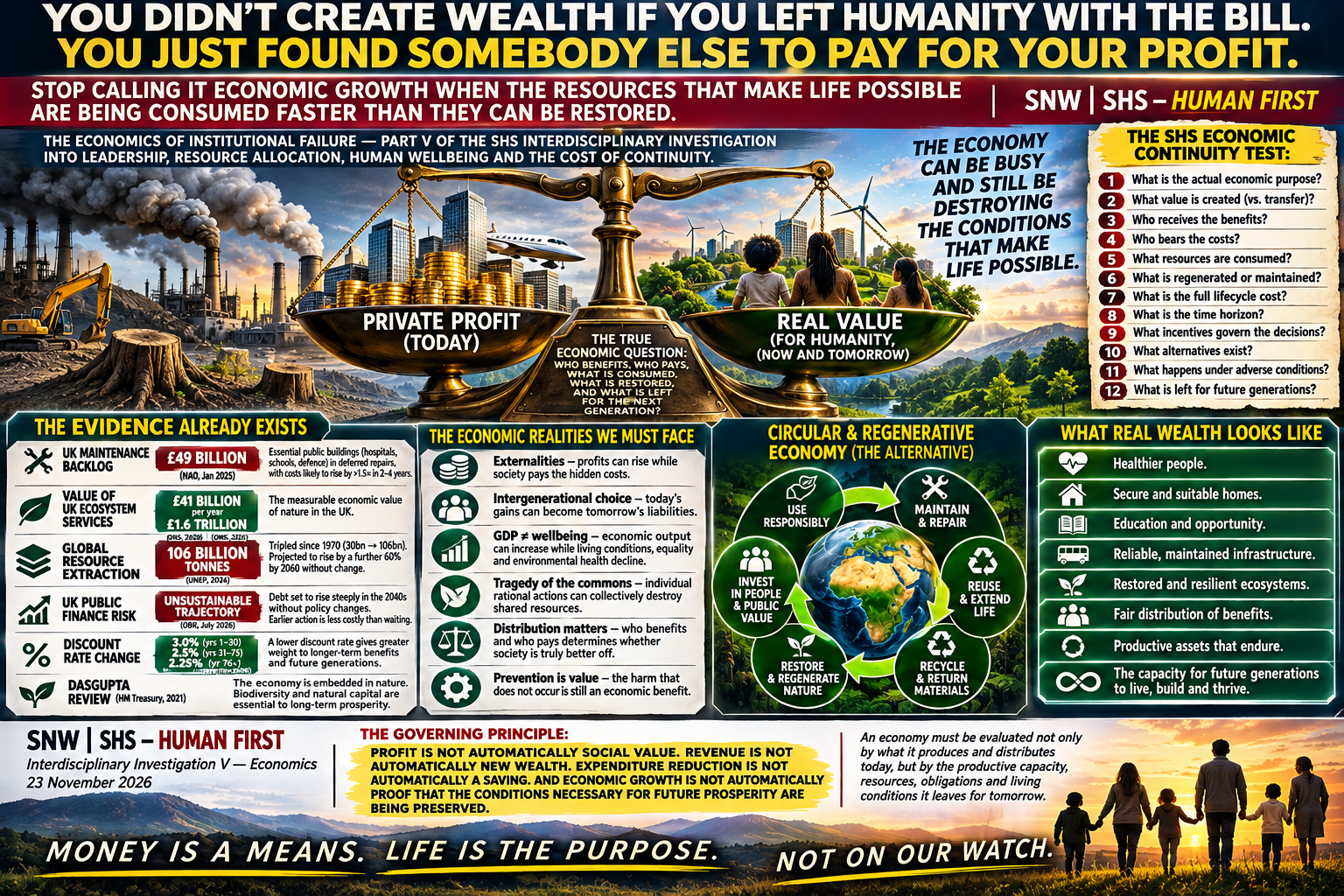
III. £49 BILLION IN DEFERRED MAINTENANCE. TELL ME AGAIN HOW POSTPONING NECESSARY EXPENDITURE IS ALWAYS A SAVING.
Now let’s return to a documented British example.
In January 2025, the National Audit Office reported that the UK central government’s property maintenance backlog amounted to at least £49 billion, as measured in October 2024.
The Cabinet Office estimated that deferring backlog maintenance could increase eventual costs by more than 1.5 times over a period of two to four years.
The NAO also identified approximately 5,400 clinical service incidents annually, on average between 2019–20 and 2023–24, arising from property and infrastructure failures in the NHS.
Source: National Audit Office — Maintaining Public Service Facilities, January 2025
Now let’s examine the economics.
A government department faces pressure to limit current expenditure.
Maintenance is postponed.
The immediate budget may appear healthier.
But the building continues deteriorating.
Future repair costs may increase.
Essential services may be disrupted.
And the next budget must confront a larger problem.
THE FINANCIAL PERIOD HAS ENDED. THE LIABILITY HAS NOT.
Now, not every maintenance deferral is economically irrational.
Governments face real budget constraints, differing levels of urgency and competing responsibilities.
But when postponement creates avoidable costs exceeding the immediate saving, the apparent saving becomes a false economy.
YOU DID NOT NECESSARILY REDUCE THE TOTAL COST.
YOU MAY HAVE INCREASED IT WHILE MOVING THE PAYMENT INTO SOMEBODY ELSE’S FINANCIAL PERIOD.
And what makes this particularly disturbing?
The infrastructure already exists.
The need for maintenance can often be identified.
The cost of deterioration can be assessed.
The risks can be investigated.
So the economic question becomes:
WHY IS PREVENTING A LARGER FUTURE EXPENSE SOMETIMES LESS ATTRACTIVE THAN REPORTING A SMALLER EXPENSE TODAY?!
Is it the budget structure?
The incentives?
The absence of sufficient funding?
The way performance is evaluated?
The relationship between capital and operating expenditure?
Or the fact that those making the decision may not remain responsible when the deferred costs become unavoidable?
Those possibilities can be investigated.
AND WE SHOULD INVESTIGATE THEM BEFORE THE NEXT GENERATION INHERITS AN EVEN LARGER REPAIR BILL.
IV. THIS IS CALLED INTERTEMPORAL CHOICE. AND HUMANITY’S FUTURE IS BEING WEIGHED AGAINST TODAY’S BENEFITS.
Economics recognises that decisions frequently involve costs and benefits occurring at different times.
An investment may require expenditure now and produce benefits years later.
A project may generate immediate income while imposing future liabilities.
An environmental intervention may produce benefits over several generations.
To compare costs and benefits arising at different times, economists use methods including discounting.
Discounting expresses future costs and benefits in present-value terms.
It is not inherently a declaration that future human beings are worth less.
It is a method reflecting assumptions about time preference, consumption, opportunity costs and risk.
But those assumptions can materially affect decisions.
And in October 2026, something particularly relevant happened.
HM TREASURY CHANGED THE UK GREEN BOOK’S SOCIAL DISCOUNT RATE.
Following an independent review, the government reduced the standard rate for the first thirty years of an appraisal from 3.5% to 3.0%.
The updated schedule uses:
- 3.0% for years 1–30.
- 2.5% for years 31–75.
- 2.25% from year 76 onwards.
These are real discount rates, intended for use within the relevant appraisal framework.
Source: HM Treasury — Green Book Discount Rate Review, October 2026
THINK ABOUT WHAT THAT MEANS.
The government has formally revised how future social costs and benefits are weighted in economic appraisal.
The review acknowledged concerns that the previous approach could disadvantage long-term transformational investments.
And the revised methodology gives greater present weight to some future benefits.
This is not proof that every previous decision was wrong.
Nor does reducing a discount rate automatically make a project worthwhile.
But it demonstrates something extraordinarily important.
THE WAY WE CHOOSE TO VALUE THE FUTURE CAN CHANGE WHICH INVESTMENTS APPEAR ECONOMICALLY JUSTIFIED TODAY.
So I want people to ask:
Who determines the assumptions?
How are they justified?
What alternatives were considered?
How sensitive are the results?
What happens when an intervention produces benefits across a century rather than a decade?
And how are long-term human and environmental consequences represented?
THE FUTURE CANNOT BE ALLOWED TO DISAPPEAR MERELY BECAUSE SOMEBODY SELECTED A SHORT ACCOUNTING HORIZON.
If the consequences extend for eighty years, an evaluation confined to five years may be inadequate.
The lifespan of the analysis must be appropriate to the lifespan of the effects.
V. THE PUBLIC TREASURY ALREADY RECOGNISES THAT MONEY IS NOT THE ENTIRE MEASUREMENT OF VALUE.
And here is where I find the investigation particularly interesting.
HM Treasury’s 2026 Green Book explicitly distinguishes financial returns from social value.
Its appraisal framework includes wellbeing, health, security, justice, environmental consequences, economic prosperity and distributional effects.
It explains that public decision-making must consider benefits and costs across society, rather than simply the financial position of the organisation developing a proposal.
Source: HM Treasury — The Green Book, 2026
SO THE CONCEPT ALREADY EXISTS WITHIN GOVERNMENT ECONOMIC GUIDANCE.
The distinction between public financial expenditure and social benefit is already recognised.
The importance of distribution is already recognised.
The need to consider environmental damage is already recognised.
The inadequacy of relying solely on a single benefit-cost ratio is already recognised.
So why must we repeatedly fight to establish that the amount of money generated or saved does not automatically prove the amount of human benefit created?
THE QUESTION IS NOT WHETHER ECONOMICS POSSESSES THE CONCEPTUAL TOOLS.
THE QUESTION IS WHETHER THOSE TOOLS ARE BEING APPLIED EFFECTIVELY WHEN REAL DECISIONS ARE MADE.
And this is where our epistemological investigation returns.
If the methods exist, we need to examine whether they were used.
If the evidence exists, we need to examine whether it was considered.
If long-term costs were identified, we need to examine how they influenced the decision.
BECAUSE AN ECONOMIC MODEL IS ONLY AS RESPONSIBLE AS THE QUESTIONS IT IS DESIGNED TO ANSWER AND THE EVIDENCE USED TO ANSWER THEM.
VI. NOW LET’S TALK ABOUT NATURAL RESOURCES. YOU CANNOT CONSUME YOUR PRODUCTIVE FOUNDATIONS INDEFINITELY AND CALL IT SUSTAINABLE PROSPERITY.
In 2021, the UK Treasury commissioned a major independent review led by economist Sir Partha Dasgupta.
The Economics of Biodiversity: The Dasgupta Review.
Its central insight was that the economy is embedded within nature.
Not independent of nature.
Not superior to nature.
Not capable of functioning without the ecological systems on which life and production depend.
The review examined the economic consequences of biodiversity loss and the importance of accounting for natural capital.
Source: HM Treasury — The Economics of Biodiversity: The Dasgupta Review
Now think about the significance.
We have constructed sophisticated systems for measuring produced capital.
Factories.
Machinery.
Buildings.
Financial assets.
Infrastructure.
But economic activity also depends upon natural systems.
Soil fertility.
Water availability.
Pollination.
Forests.
Biodiversity.
Ecological regulation.
And the regenerative processes that allow resources to continue being available.
WHAT HAPPENS WHEN WE ACCOUNT FOR THE VALUE OF WHAT WE EXTRACT BUT FAIL TO ACCOUNT ADEQUATELY FOR THE DEPLETION OF WHAT PRODUCES IT?!
Imagine a farm generating increasing revenue while degrading the soil on which its future production depends.
Imagine a fishery increasing catches while reducing the reproductive capacity of the fish population.
Imagine deforestation creating immediate income while producing long-term ecological and economic costs.
Financial output may rise while the underlying asset deteriorates.
THE PRODUCTIVE BASE CAN BECOME WEAKER WHILE THE FINANCIAL RECORD SHOWS INCREASED ACTIVITY.
That is why economic output alone cannot establish sustainable development.
And this is not simply SHS making a philosophical argument.
It is a central concern in established environmental economics.
AN ECONOMY CANNOT BE UNDERSTOOD INDEPENDENTLY OF THE NATURAL SYSTEMS THAT MAKE ECONOMIC ACTIVITY POSSIBLE.
VII. THE UNITED NATIONS HAS ALREADY MEASURED THE SCALE OF RESOURCE EXTRACTION.
In March 2024, the United Nations Environment Programme reported that global extraction of natural resources had tripled over the previous five decades.
The International Resource Panel’s Global Resources Outlook 2024 documented an increase in resource use from approximately 30 billion tonnes in 1970 to 106 billion tonnes.
It projected that extraction could rise by a further 60% by 2060 without sufficient changes to prevailing patterns.
Source: UNEP — Global Resources Outlook 2024
ONE HUNDRED AND SIX BILLION TONNES.
Now the serious economic question is not merely how much humanity extracts.
Different resources have different regeneration rates, scarcity constraints and environmental impacts.
The question is whether the extraction and processing of those resources can remain compatible with the continued functioning of ecological and economic systems.
How much is replenished?
How much can be reused?
What is permanently altered?
What waste is produced?
What restoration is necessary?
What future productive capacity is lost?
IF YOUR ECONOMIC SUCCESS DEPENDS UPON THE CONTINUOUS DEGRADATION OF ITS INPUTS, HOW LONG CAN THAT SUCCESS CONTINUE?
And if maintaining production requires increasingly expensive extraction, repair and restoration, what does that mean for the future cost of living?
For food?
For housing?
For infrastructure?
For health?
For employment?
THE FUTURE IS NOT AN ABSTRACT PHILOSOPHICAL CONCERN WHEN THE MATERIAL CONDITIONS OF ITS ECONOMY ARE BEING DETERMINED TODAY.
The consequences are physical.
Financial.
Environmental.
And human.
VIII. THE OFFICE FOR NATIONAL STATISTICS IS ALREADY MEASURING THE ECONOMIC VALUE OF NATURE.
Now here’s another example.
The UK’s Office for National Statistics publishes natural capital accounts.
In its 2026 environmental analysis, the ONS estimated that measured UK ecosystem services provided approximately £41 billion in annual value in 2023, expressed in 2024 prices.
The estimated asset value of those measured ecosystem services was approximately £1.6 trillion.
These are statistical valuations of specified ecosystem services, not a complete monetary price for nature or every benefit it provides.
Source: ONS — Environment, Climate and Nature Insights, UK, 2026
So the economic importance of natural systems is already being measured.
But I want to challenge the way we think about that information.
NATURE DOES NOT NEED A PRICE TAG TO BE NECESSARY FOR LIFE.
Its monetary valuation can assist economic decisions.
But it cannot capture every dimension of ecological, cultural, biological or human significance.
And not every loss can be compensated by transferring money.
If an essential ecological process becomes unavailable, the existence of financial compensation does not automatically recreate it.
MONEY IS A CLAIM UPON RESOURCES AND SERVICES WITHIN AN ECONOMY.
IT IS NOT A SUBSTITUTE FOR EVERY PHYSICAL CONDITION THAT MAKES THOSE RESOURCES AND SERVICES POSSIBLE.
So when we examine the value of natural capital, we must not confuse valuation with ownership of life’s essential processes.
The purpose of the measurement should be to improve decisions.
Not to imply that everything necessary for life can simply be purchased again after it has been destroyed.
IX. THE TRAGEDY OF THE COMMONS: EVERYBODY CAN ACT IN THEIR OWN INTEREST WHILE COLLECTIVELY DESTROYING WHAT EVERYBODY DEPENDS ON.
Now we enter a classic economic coordination problem.
A shared resource may be depleted when individual users have incentives to maximise their own immediate benefits without sufficient arrangements to protect its long-term condition.
The familiar example is an open-access pasture.
Each additional animal may benefit its owner.
But excessive use can damage the pasture.
If the costs of degradation are distributed across all users while the immediate benefit is privately captured, individual incentives can encourage overuse.
The broader lesson is not that shared resources are inevitably doomed.
Economist Elinor Ostrom demonstrated that communities can develop effective institutions for governing common-pool resources.
THE QUESTION IS HOW RULES, INCENTIVES, MONITORING AND COOPERATION ARE ORGANISED.
Now apply this to humanity.
Atmospheric pollution.
Fisheries.
Water systems.
Forests.
Shared infrastructure.
Public resources.
If every participant attempts to maximise immediate private advantage while insufficiently accounting for collective consequences, the resulting system may produce outcomes that none of them would rationally desire for society as a whole.
EVERYBODY CAN DEFEND THEIR INDIVIDUAL DECISION WHILE THE COMBINED RESULT UNDERMINES THE CONDITIONS THEY ALL DEPEND UPON.
So responsible economic governance requires more than asking whether one transaction benefits the parties involved.
It must also examine the cumulative effects.
The incentives.
The distribution of costs.
The rules governing access.
And the ability of institutions to preserve shared resources.
WHAT GOOD IS MAXIMISING YOUR SHARE IF THE PROCESS UNDERMINES THE COMMON RESOURCE FROM WHICH EVERYBODY’S SHARE MUST COME?
X. GDP IS AN ECONOMIC INDICATOR. IT IS NOT A CERTIFICATE THAT HUMANITY IS DOING WELL.
Gross domestic product measures the value of production within an economy over a period.
It is useful.
It helps economists and policymakers analyse economic activity.
But GDP is not a comprehensive measure of human wellbeing.
It does not automatically establish how income is distributed.
It does not directly measure whether people can afford adequate housing.
It does not establish whether ecosystems are recovering.
It does not demonstrate whether public infrastructure is sufficiently maintained.
And it cannot, by itself, reveal every cost associated with the activity being measured.
Consider reconstruction after a disaster.
Repairing damaged infrastructure can generate economic activity.
That activity may contribute to GDP.
But the increase in measured production does not mean the disaster was beneficial.
The damage and the reconstruction must be understood together.
THE ECONOMY CAN BECOME BUSY REPAIRING A LOSS WITHOUT THE LOSS BECOMING A GAIN.
Now consider avoidable illness.
Treatment generates expenditure, employment and measured economic activity.
Those are real economic contributions.
But the existence of expenditure does not mean illness is desirable.
A society in which fewer people require preventable emergency treatment may be better off even if some associated expenditures are reduced.
ECONOMIC ACTIVITY IS NOT SYNONYMOUS WITH HUMAN IMPROVEMENT.
This is precisely why broader measures of wellbeing, distribution, environmental conditions and public-service outcomes are necessary.
Because what we measure influences what we regard as progress.
And if we confuse spending with success, we may end up celebrating the financial activity associated with problems we should have prevented.
XI. LOOK AT WHO RECEIVES THE BENEFITS. THEN LOOK AT WHO INHERITS THE COSTS.
Economics also investigates distribution.
Who receives income?
Who owns assets?
Who pays taxes?
Who bears risks?
Who receives public services?
And how do those arrangements change across time?
Now add future generations.
A decision creates a benefit today.
But its costs may be distributed over decades.
Current shareholders may receive dividends.
Future communities may face remediation costs.
Current consumers may obtain lower prices.
Future taxpayers may finance infrastructure replacement.
Current administrations may improve their fiscal presentation.
Future administrations may inherit deferred obligations.
THE PEOPLE RECEIVING THE REWARD ARE NOT NECESSARILY THE PEOPLE PAYING THE FULL PRICE.
This is why the distribution of economic consequences matters.
An aggregate benefit can conceal substantial harm experienced by a particular group.
And an increase in national income does not establish that the people with the greatest unmet needs have experienced comparable improvements.
WHO BENEFITS?
WHO PAYS?
WHO HAS THE ABILITY TO REFUSE?
WHO HAS THE ABILITY TO CHALLENGE THE DECISION?
WHO INHERITS THE CONSEQUENCES?
These questions should be central to economic evaluation.
Not treated as inconvenient details after the preferred investment has already been selected.
Because humanity is not an abstract total.
It consists of actual people living under different conditions.
And future human beings will also experience the arrangements left behind by present decisions.
XII. THE PUBLIC DEBT PROBLEM: YOU CANNOT MEASURE FISCAL SUSTAINABILITY ONLY BY WHAT TODAY’S GOVERNMENT CAN AFFORD.
Now another documented example.
On 7 July 2026, the UK’s Office for Budget Responsibility published its Fiscal Risks and Sustainability report.
The OBR warned that, under its long-term scenarios, the UK public finances faced an unsustainable trajectory without policy adjustments.
Its baseline scenario showed debt moving onto a steep upward path in the 2040s, with other plausible scenarios producing earlier pressures.
The OBR emphasised that long-term projections are highly uncertain and should not be mistaken for forecasts of what governments will actually allow to happen.
It also concluded that earlier action could reduce risk and the eventual cost of adjustment.
Source: Office for Budget Responsibility — Fiscal Risks and Sustainability, July 2026
This raises a vital economic question.
HOW DO WE DISTINGUISH PUBLIC BORROWING THAT EXPANDS FUTURE PRODUCTIVE CAPACITY FROM BORROWING THAT LEAVES FUTURE GENERATIONS WITH LIABILITIES UNSUPPORTED BY ADEQUATE BENEFITS?
Because borrowing is not automatically irresponsible.
It can finance infrastructure, education, healthcare capacity and investments whose benefits extend for decades.
Equally, refusing to borrow can be economically damaging when it means abandoning investments whose benefits exceed their costs.
The responsible question concerns sustainability, affordability, risk and what the borrowing achieves.
WHAT DID THE MONEY CREATE?
What productive capacity was added?
What future expenditure was prevented?
What public assets remain?
What obligations must be financed?
What risks were assumed?
And what benefits will future people receive in exchange?
FUTURE GENERATIONS SHOULD NOT BE EVALUATED SOLELY AS THE PEOPLE WHO WILL PAY OUR DEBTS.
They should also be considered as the people who may benefit from investments made before they were born.
A responsible economic system needs to examine both sides.
The liabilities we transfer.
AND THE ASSETS, CAPABILITIES AND CONDITIONS WE LEAVE TO SUPPORT THEM.
XIII. WHY CAN PUBLIC ENTERPRISE GENERATE REVENUE FOR INVESTORS, BUT PUBLIC REVENUE GENERATION IS SO OFTEN DISCUSSED PRIMARILY THROUGH TAXATION?
Now I want to connect economics to one of the central questions within the SHS – HUMAN FIRST framework.
WHY MUST GOVERNMENT REVENUE BE CONCEPTUALISED PRIMARILY AS MONEY COLLECTED FROM ECONOMIC ACTIVITY RATHER THAN ALSO AS RETURNS GENERATED THROUGH PUBLIC OWNERSHIP OF PRODUCTIVE ACTIVITY?
Governments already possess different sources of revenue.
Taxes.
Fees.
Charges.
Investment income.
Returns from publicly owned assets and enterprises.
And other receipts.
Public ownership is not a new concept.
Neither is public enterprise.
But the possible role of commercially productive public assets deserves examination whenever the objective is to finance essential services sustainably.
Imagine a publicly owned operation producing a commercially valuable good or service.
It pays its workers.
Covers its operating costs.
Maintains its assets.
Accounts for regulatory, environmental and financial obligations.
Reinvests adequately.
And generates a surplus.
That surplus could potentially support wider public purposes, subject to the relevant legal and fiscal arrangements.
THE PUBLIC WOULD NOT ONLY BE FINANCING THE ECONOMY. IT COULD ALSO BE RECEIVING RETURNS FROM ASSETS IT OWNS.
But let’s be clear.
Public ownership does not automatically guarantee efficiency.
It does not eliminate commercial risk.
It does not prevent corruption.
It does not automatically produce a surplus.
And it does not make an unsuitable business model viable.
The same rigorous analysis must apply.
What is the market demand?
What investment is required?
What are the operating costs?
What risks exist?
What governance arrangements prevent conflicts of interest?
How will performance be independently evaluated?
What happens if the operation loses money?
Who bears the losses?
And how will public benefits be demonstrated?
PUBLIC OWNERSHIP IS A POSSIBLE INSTRUMENT. IT IS NOT, BY ITSELF, PROOF OF PUBLIC VALUE.
But neither should public enterprise be dismissed without investigation merely because private ownership is familiar.
THE QUESTION SHOULD BE WHICH ARRANGEMENT CAN DEMONSTRABLY DELIVER THE REQUIRED HUMAN AND ECONOMIC OUTCOMES.
That is why SHS’s public-enterprise proposals should be treated as models to test, refine and validate.
Not as achievements already proven through operation.
The objective is to investigate whether publicly owned productive assets could generate sustainable returns while improving employment, services and wider social wellbeing.
MONEY GENERATION SHOULD BE EXAMINED AS A POSSIBLE MEANS OF SUPPORTING LIFE, NOT AN END THAT OVERRIDES THE CONDITIONS OF LIFE.
XIV. YOUR BUSINESS MODEL IS NOT SUCCESSFUL MERELY BECAUSE IT IS SUCCESSFUL FOR YOU.
Now let us investigate incentives.
People respond to incentives.
Organisations respond to financial pressures.
Managers respond to performance targets.
Investors respond to expected returns.
Public institutions respond to budgets and legal obligations.
None of this is inherently corrupt.
But incentives can become misaligned.
An organisation may be rewarded for reducing current expenditure even where the reduction increases future costs.
A business may receive financial returns without bearing the full social cost of its production.
A department may be rewarded for achieving an internal target that does not adequately reflect the experience of the people it serves.
A manager may be evaluated over a period shorter than the consequences of their decisions.
THE SYSTEM CAN REWARD BEHAVIOUR THAT IS RATIONALLY ADVANTAGEOUS TO THE INDIVIDUAL WHILE BEING DAMAGING TO THE COLLECTIVE PURPOSE.
Economics provides ways to analyse this.
Principal-agent problems.
Moral hazard.
Externalities.
Information asymmetry.
Common-pool resource problems.
Time inconsistency.
Short-term incentives.
These concepts help us investigate why an institution may continue producing poor outcomes even when its individual participants are responding predictably to the incentives around them.
YOU CAN HIRE INTELLIGENT PEOPLE INTO A SYSTEM THAT REWARDS THE WRONG DECISIONS.
And the people may become extraordinarily effective at achieving those rewards.
They meet the targets.
Protect their departments.
Improve their financial performance.
Increase their compensation.
Preserve their positions.
Yet the public outcome remains inadequate.
SO MAYBE THE PROBLEM IS NOT ALWAYS THAT THE PEOPLE RUNNING THE SYSTEM CANNOT COUNT.
MAYBE IT IS THAT THE SYSTEM KEEPS REWARDING THEM FOR COUNTING THE WRONG THINGS.
And if that is the case, the correction must involve the incentives themselves.
Not merely replacing one person with another and expecting the same arrangements to produce fundamentally different outcomes.
XV. PREVENTION IS NOT AN EXPENSE TO BE DISMISISSED SIMPLY BECAUSE THE DISASTER HASN’T HAPPENED YET.
Let’s examine another economic problem.
Preventive expenditure often requires paying for something now to reduce the probability or severity of future harm.
That can be difficult to evaluate.
The harm may never occur.
The precise benefit may be uncertain.
The savings may be distributed across institutions.
And the people benefiting may not yet exist.
But uncertainty does not make prevention economically meaningless.
Consider maintenance.
Vaccination.
Flood protection.
Fire safety.
Water-quality monitoring.
Early educational support.
Public-health interventions.
Cybersecurity.
These activities may reduce the likelihood or costs of adverse outcomes.
Whether a particular intervention is worthwhile depends on evidence about effectiveness, risk, costs and alternatives.
But the absence of an immediately visible disaster is not proof that preventive expenditure has generated no benefit.
THE BENEFIT OF PREVENTION MAY BE THE HARM THAT DID NOT OCCUR.
And that benefit must be evaluated through appropriate evidence, not dismissed simply because it is less visible than a completed repair.
WHY ARE WE SO PREPARED TO RECOGNISE THE COST OF PREVENTION WHILE STRUGGLING TO RECOGNISE THE COSTS THAT SUCCESSFUL PREVENTION AVOIDS?
Because if an institution systematically undervalues prevention, it may eventually find itself financing consequences that could have been reduced more efficiently.
The challenge is to distinguish effective prevention from expenditure that produces little or no measurable benefit.
That requires evaluation.
Not blind optimism.
Not automatic opposition.
ECONOMIC RESPONSIBILITY REQUIRES INVESTIGATING WHETHER SPENDING NOW CAN AVOID GREATER HUMAN AND FINANCIAL COSTS LATER.
XVI. HOW MUCH OF WHAT WE CALL PROFIT IS ACTUALLY A TRANSFER?
This distinction is particularly important.
Economists distinguish the creation of additional social value from transfers between individuals or organisations.
A payment can benefit the recipient and impose a corresponding cost on the payer without increasing society’s total resources by that amount.
Transfers may be justified for many reasons, including redistribution and compensation.
But they should not automatically be counted as newly created social wealth.
HM Treasury’s Green Book expressly addresses economic transfers in its appraisal guidance.
Now consider the implications.
An organisation increases its revenue by charging more for an unchanged essential service.
Its financial performance improves.
But has the service become more productive?
Has its quality improved?
Has a new benefit been created?
Or has purchasing power simply been transferred from customers to the provider?
The answer depends on the circumstances.
A higher price may reflect higher costs, investment needs, scarce capacity, improved quality or market power.
We must investigate rather than assume.
But the fundamental distinction remains.
RECEIVING MORE MONEY IS NOT AUTOMATICALLY THE SAME AS CREATING MORE VALUE.
And this matters whenever financial success is used as proof of social contribution.
Because money can change hands without the corresponding production of additional goods, services or wellbeing.
IF ALL YOU HAVE DEMONSTRATED IS THAT YOU CAN EXTRACT A GREATER PAYMENT, YOU HAVE NOT YET DEMONSTRATED THAT YOU HAVE CREATED A GREATER BENEFIT.
Show the improvement.
Show the productive contribution.
Show the additional capacity.
Show the quality.
Show the long-term benefits.
And show who bears the cost.
XVII. THE SHS ECONOMIC CONTINUITY TEST.
Now let’s make the investigation operational.
I want institutions and economic activities affecting human wellbeing to be examined through twelve questions.
1. WHAT IS THE ACTUAL ECONOMIC PURPOSE?
What good, service or benefit is the activity supposed to produce?
2. WHAT VALUE IS CREATED?
Distinguish new productive value from financial transfers, asset-price changes and revenue redistribution.
3. WHO RECEIVES THE BENEFITS?
Identify the distribution of income, services, opportunities and financial returns.
4. WHO BEARS THE COSTS?
Include private expenditure, public expenditure and material external costs.
5. WHAT RESOURCES ARE CONSUMED?
Identify energy, materials, land, infrastructure, human labour and relevant natural capital.
6. WHAT IS REGENERATED OR MAINTAINED?
Examine replacement, repair, restoration and productive capacity over time.
7. WHAT IS THE FULL LIFECYCLE COST?
Include operating costs, maintenance, foreseeable liabilities and eventual replacement or decommissioning.
8. WHAT IS THE TIME HORIZON?
Does the appraisal cover the period over which major costs and benefits are expected to arise?
9. WHAT INCENTIVES GOVERN THE DECISIONS?
Who is rewarded?
For which outcomes?
And over what period?
10. WHAT ALTERNATIVES EXIST?
Compare feasible options, including investment, regulation, public provision, private provision, partnerships and maintaining the existing arrangement.
11. WHAT HAPPENS UNDER ADVERSE CONDITIONS?
Test financial, environmental, demographic and operational risks.
12. WHAT IS LEFT FOR FUTURE GENERATIONS?
Assess assets, infrastructure, environmental conditions, productive capabilities and liabilities.
THE QUESTION IS NOT SIMPLY WHETHER AN ORGANISATION CAN CONTINUE GENERATING MONEY.
IT IS WHETHER THE ACTIVITY PRODUCES NET VALUE WITHOUT UNDERMINING THE CONDITIONS NECESSARY FOR ITS CONTINUED BENEFICIAL OPERATION.
And if a model is economically viable only because significant costs remain unaccounted for, that limitation must be made visible.
Because an incomplete calculation should not be mistaken for a complete demonstration of success.
XVIII. WE HAVE BUILT AN ECONOMY CAPABLE OF MEASURING THE PRICE OF A RESOURCE WHILE STRUGGLING TO ACCOUNT FOR THE COST OF LOSING IT.
I want to return to our original investigation.
Psychology showed us that people may defend what they are motivated to preserve.
Engineering showed us that systems must be assessed against their actual requirements.
Law showed us that duties towards long-term public wellbeing can be formally recognised.
Ontology showed us that the institution is not identical to the life it was established to serve.
Epistemology showed us that information about failure is not the same as a successful response to failure.
And economics reveals how these problems can become embedded in the allocation of resources.
WHAT GETS REWARDED?
WHAT GETS FUNDED?
WHAT GETS MEASURED?
WHAT GETS DISCOUNTED?
WHAT GETS TRANSFERRED?
AND WHAT GETS LEFT OUT OF THE CALCULATION ALTOGETHER?
Because it is entirely possible for an organisation to make financially rational decisions within a narrow objective while producing consequences that are economically undesirable for society as a whole.
And it is possible for those consequences to persist because nobody with sufficient authority or incentive is required to account for their full cost.
THAT IS NOT A FAILURE OF MATHEMATICS.
IT IS A FAILURE TO ENSURE THAT THE MATHEMATICS REPRESENTS THE RIGHT PROBLEM.
The figures may be accurate.
The financial reports may be properly prepared.
The transaction may be lawful.
The profit may be real.
But none of those facts alone establishes the complete human consequence of the activity.
A PERFECTLY ACCURATE CALCULATION OF AN INCOMPLETE SET OF COSTS IS STILL INCOMPLETE.
And when the omitted costs concern the conditions necessary for future life, the omission becomes particularly consequential.
XIX. STOP TELLING HUMANITY THERE ISN’T ENOUGH MONEY WHEN THE QUESTION IS ALSO HOW WE ORGANISE WHAT WE HAVE.
Scarcity is real.
Resources are not unlimited.
Public budgets face constraints.
Societies must make choices.
And not every desirable programme can be financed simultaneously.
But scarcity does not eliminate the need to investigate allocation.
WHAT IS BEING FINANCED?
What produces measurable benefits?
What maintains essential productive assets?
What costs are being postponed?
What activities are generating avoidable future liabilities?
What interventions could prevent more expensive harm?
What public assets could generate sustainable returns?
What services could be delivered more effectively through different arrangements?
What resources are being wasted?
And what investments are being neglected because their benefits fall beyond the current reporting period?
THE EXISTENCE OF SCARCITY MAKES RESPONSIBLE ALLOCATION MORE IMPORTANT, NOT LESS.
We cannot resolve every problem merely by demanding more expenditure.
Some problems require better design.
Some require improved incentives.
Some require institutional coordination.
Some require prevention.
Some require additional investment.
Some require the removal of ineffective spending.
And some require reconsidering whether the activity being financed is producing sufficient social value to justify its costs.
THE PURPOSE IS NOT TO SPEND MORE FOR THE SAKE OF SPENDING.
IT IS TO ORGANISE RESOURCES SO THAT HUMAN NEEDS CAN BE MET SUSTAINABLY.
And this is where I want economics to return to its most fundamental question.
How should scarce resources be allocated among competing uses?
Not simply to maximise the immediate satisfaction of those currently able to pay.
But to examine how different allocations affect the wellbeing of the people and systems involved, including those who will depend on them in the future.
XX. HUMANITY IS NOT YOUR UNPAID CREDITOR.
This is where I want to conclude.
You can record a profit.
But that does not establish the full social value of the activity.
You can reduce a budget.
But that does not establish that total costs have been reduced.
You can increase production.
But that does not establish that productive capacity is being preserved.
You can increase asset values.
But that does not establish that everybody’s living conditions have improved.
You can expand an institution.
But that does not establish that its contribution to human wellbeing has increased.
You can generate enormous financial returns.
BUT IF THE PROCESS LEAVES OTHER PEOPLE WITH GREATER UNACCOUNTED COSTS, THE FINANCIAL RESULT ALONE DOES NOT TELL US WHETHER HUMANITY IS BETTER OFF.
And that is the question I want answered.
Not how beautifully an institution describes its economic contribution.
Not how successfully it protects its own profitability.
Not how efficiently it transfers its liabilities.
Not how many financial targets it satisfies.
WHAT ACTUAL NET BENEFIT DOES IT PRODUCE, FOR WHOM, AT WHAT COST, AND FOR HOW LONG?
Because the people who come after us will not inherit today’s accounting presentation.
They will inherit real conditions.
The state of the infrastructure.
The availability of resources.
The productivity of the land.
The quality of the environment.
The organisation of public services.
The financial obligations.
The opportunities.
And the consequences of decisions whose financial benefits may already have been enjoyed by people who are no longer alive.
YOUR ANNUAL PROFIT REPORT WILL NOT REPAIR THEIR WATER SYSTEM.
YOUR DIVIDEND WILL NOT REGENERATE THEIR SOIL.
YOUR COMPLETED BUDGET WILL NOT AUTOMATICALLY MAINTAIN THEIR HOSPITAL.
YOUR ECONOMIC GROWTH FIGURE WILL NOT, BY ITSELF, TELL THEM WHETHER THEY CAN AFFORD A HOME.
AND YOUR RETIREMENT WILL NOT MAKE THE CONSEQUENCES OF YOUR DECISIONS DISAPPEAR.
So stop treating financial returns as the final answer to questions concerning human wellbeing.
Stop treating deferred maintenance as an uncomplicated saving.
Stop treating unaccounted environmental damage as though it carries no economic cost.
Stop treating future liabilities as somebody else’s problem simply because they will become payable outside your tenure.
Stop measuring the prosperity of society solely through the financial success of those already holding the assets.
And stop assuming that a system organised to reward immediate extraction will automatically protect the resources from which future prosperity must come.
THE MONEY IS NOT THE END.
The end concerns what humanity can actually accomplish, preserve and experience through the responsible organisation of resources.
Food.
Housing.
Healthcare.
Education.
Infrastructure.
Knowledge.
Opportunity.
Ecological resilience.
Human development.
The freedom to build lives that are not permanently consumed by avoidable insecurity.
THE CAPACITY TO CONTINUE.
And money can be an extraordinarily useful instrument in organising those conditions.
But when the instrument becomes more important than the purpose, the economy risks becoming efficient at producing outcomes that undermine the very people it exists to serve.
WHAT IS THE POINT OF AN ECONOMY THAT MAKES ITS OWN CONTINUATION MORE EXPENSIVE WITH EVERY GENERATION?
What is the point of accumulating wealth through practices that weaken the productive systems necessary to sustain that wealth?
What is the point of generating short-term profit while allowing long-term liabilities to grow?
What is the point of increasing output if the benefits are concentrated while substantial costs are transferred to people with no meaningful ability to refuse them?
And what is the point of calling an institution economically successful if its apparent success depends upon consequences that its accounts have not adequately represented?
WE DO NOT NEED TO PRETEND THAT ALL PROFIT IS WRONG TO RECOGNISE THAT PROFIT IS NOT THE WHOLE MEASUREMENT OF RIGHT.
We do not need to reject markets to recognise market failures.
We do not need to reject public finance to examine fiscal mismanagement.
We do not need to reject private enterprise to investigate externalised costs.
And we do not need to assume public ownership is automatically superior to evaluate where public enterprise might deliver sustainable benefits.
WE NEED TO EXAMINE THE ACTUAL ECONOMIC ARRANGEMENTS, THEIR INCENTIVES, THEIR DISTRIBUTIONAL EFFECTS AND THEIR CONSEQUENCES.
Because economics is capable of much more than explaining how money accumulates.
It can help us investigate how resources are allocated.
How risks are distributed.
How incentives influence behaviour.
How future benefits are valued.
How environmental limits affect production.
How public investments generate returns.
And how societies can improve living conditions without neglecting the resources on which those conditions depend.
SO USE THE DISCIPLINE FOR THE FULL QUESTION.
Not merely the profitability of the transaction.
THE CONSEQUENCES OF THE TRANSACTION.
Not merely the immediate benefit.
THE FULL RELEVANT COST.
Not merely the survival of the organisation.
THE SUSTAINABILITY OF THE PRODUCTIVE SYSTEMS IT DEPENDS UPON.
Not merely the prosperity of those currently benefiting.
THE CONDITIONS BEING CREATED FOR THOSE WHO WILL COME AFTER THEM.
Because humanity is not here to provide an endless supply of public money, labour and natural resources for arrangements that fail to account adequately for what they consume.
And future generations are not an unlimited reserve fund from which the present can withdraw without repayment.
YOU CANNOT KEEP CHARGING THE FUTURE FOR YOUR PRESENT AND CALL THE TRANSACTION COMPLETE JUST BECAUSE YOU HAVE ALREADY COLLECTED YOUR SHARE.
YOU CANNOT CALL THE DEPLETION OF LIFE’S PRODUCTIVE FOUNDATIONS WEALTH CREATION WITHOUT ACCOUNTING FOR WHAT HAS BEEN LOST.
YOU CANNOT CLAIM YOU HAVE MADE SOCIETY RICHER SOLELY BECAUSE YOU HAVE MADE YOURSELF RICHER.
AND MOST IMPORTANTLY—
YOU DID NOT CREATE HUMAN PROSPERITY MERELY BY FINDING A WAY TO MAKE OTHER PEOPLE PAY FOR YOUR SUCCESS.
SHOW US THE VALUE.
SHOW US THE COST.
SHOW US THE REGENERATION.
SHOW US THE DISTRIBUTION.
SHOW US THE LONG-TERM CAPACITY.
SHOW US WHAT THE NEXT GENERATION WILL ACTUALLY INHERIT.
BECAUSE HUMANITY’S FUTURE IS NOT YOUR UNPAID INVOICE.
ITS RESOURCES ARE NOT YOUR INFINITE WITHDRAWAL ACCOUNT.
AND ITS CONTINUITY IS NOT AN EXPENSE TO BE DISCARDED WHEN IT THREATENS YOUR IMMEDIATE PROFIT.
MONEY IS A MEANS.
LIFE IS THE PURPOSE.
AND AN ECONOMY THAT CANNOT ACCOUNT FOR THE CONDITIONS NECESSARY TO CONTINUE SERVING LIFE DESERVES TO HAVE ITS ASSUMPTIONS, INCENTIVES AND OUTCOMES EXAMINED.
NOT ON OUR WATCH.
SNW | SHS – HUMAN FIRST
Interdisciplinary Investigation V — Economics
23 November 2026
THE GOVERNING PRINCIPLE
PROFIT IS NOT AUTOMATICALLY SOCIAL VALUE. REVENUE IS NOT AUTOMATICALLY NEW WEALTH. EXPENDITURE REDUCTION IS NOT AUTOMATICALLY A SAVING. AND ECONOMIC GROWTH IS NOT AUTOMATICALLY PROOF THAT THE CONDITIONS NECESSARY FOR FUTURE PROSPERITY ARE BEING PRESERVED.
An economy must be evaluated not only by what it produces and distributes today, but by the productive capacity, resources, obligations and living conditions it leaves for tomorrow.
Economic foundations, official evidence and research
- HM Treasury — The Green Book, 2026
- HM Treasury — Green Book Discount Rate Review, October 2026
- National Audit Office — Maintaining Public Service Facilities, January 2025
- Office for Budget Responsibility — Fiscal Risks and Sustainability, July 2026
- HM Treasury — The Economics of Biodiversity: The Dasgupta Review
- United Nations Environment Programme — Global Resources Outlook 2024
- Office for National Statistics — Environment, Climate and Nature Insights, 2026
- Nobel Prize — Elinor Ostrom and the Economic Governance of Common Resources




Leave a Reply