
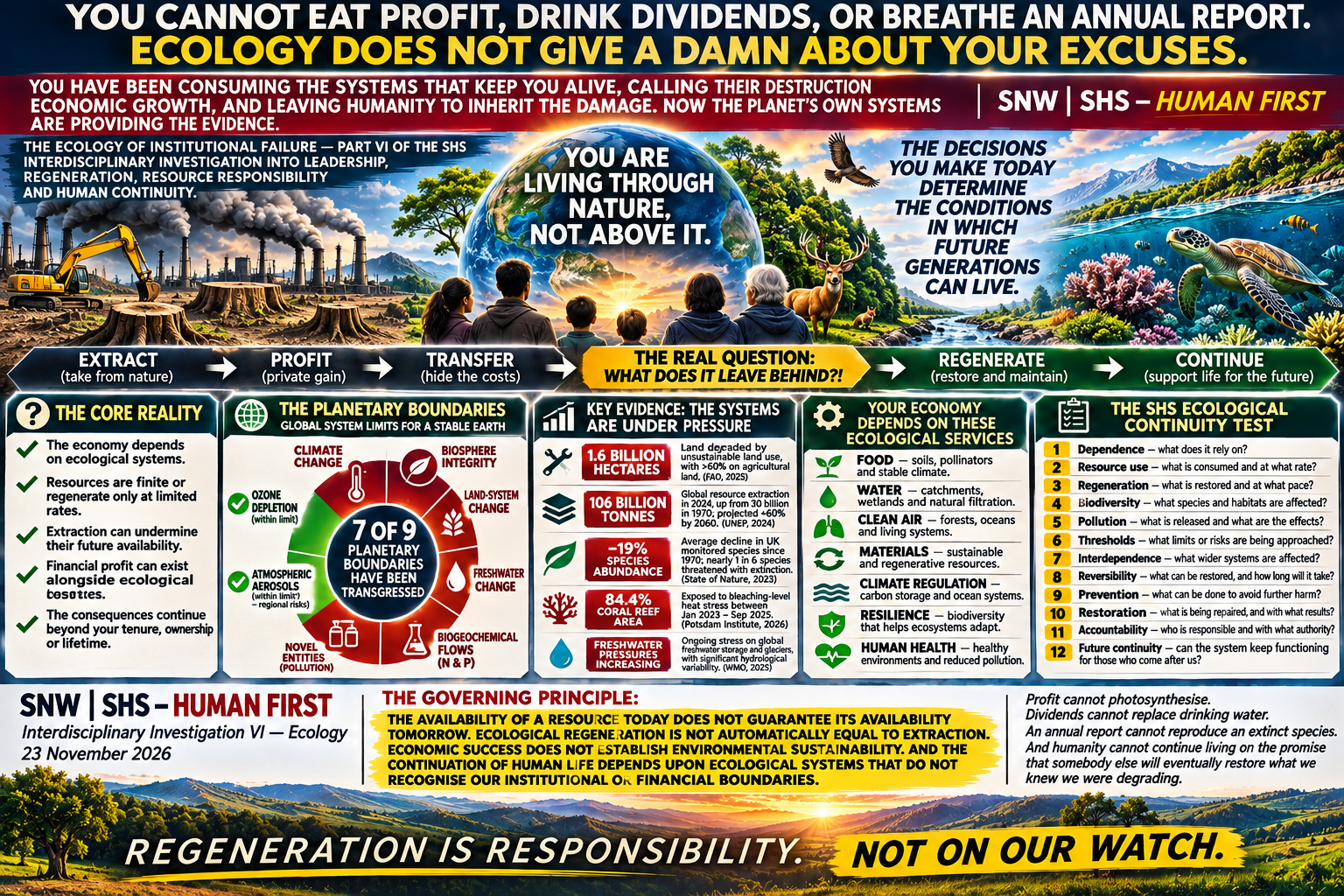
YOU HAVE BEEN CONSUMING THE SYSTEMS THAT KEEP YOU ALIVE, CALLING THEIR DESTRUCTION ECONOMIC GROWTH, AND LEAVING HUMANITY TO INHERIT THE DAMAGE. NOW THE PLANET’S OWN SYSTEMS ARE PROVIDING THE EVIDENCE.
THE ECOLOGY OF INSTITUTIONAL FAILURE — PART VI OF THE SHS INTERDISCIPLINARY INVESTIGATION INTO LEADERSHIP, REGENERATION, RESOURCE RESPONSIBILITY AND HUMAN CONTINUITY.
SNW | SHS – HUMAN FIRST
First, psychology.
We investigated what the human mind cares about, what it chooses to defend, and how its biases can reinforce the interests it has placed at the centre of its existence.
Then engineering.
We examined whether institutions can actually perform the functions for which they were created.
Then law.
We established that responsibility towards future generations already exists within legislative frameworks.
Then ontology.
We examined what institutions recognise as existing, what they believe deserves preservation, and whether they have confused their own continuity with the continuity of the life they supposedly serve.
Then epistemology.
We investigated how institutions acquire knowledge, how they evaluate evidence, and why warnings do not always lead to corrective action.
Then economics.
We examined how financial returns can be generated while costs are transferred to other people, other systems and future generations.
Now we arrive at something that does not negotiate with any of them.
ECOLOGY.
And this is where I want every institution claiming to be responsible for human continuity to understand something.
THE EARTH IS NOT OBLIGATED TO MAINTAIN THE CONDITIONS OF YOUR EXISTENCE SIMPLY BECAUSE YOUR ECONOMIC ARRANGEMENTS DEPEND UPON THEM.
The soil does not owe you another harvest after you have exhausted its productive capacity.
A river does not owe you clean water after you have contaminated it.
A fish population does not owe you another generation after you have undermined its reproduction.
A forest does not owe you the same ecological functions after you have dismantled the relationships that sustained it.
And the atmosphere does not adjust its physical and chemical behaviour to accommodate your quarterly financial targets.
NATURE DOES NOT RECOGNISE YOUR ACCOUNTING PERIOD AS THE BOUNDARY OF ITS CONSEQUENCES.
It does not recognise your retirement.
Your resignation.
Your political immunity.
Your corporate restructuring.
Your shareholder meeting.
Or the beautiful language you used to justify what you were doing.
THE CONSEQUENCES CONTINUE BECAUSE THE PROCESSES CONTINUE.
And I want to investigate why we have constructed arrangements that are so effective at extracting resources while remaining insufficiently effective at preserving the ecological relationships necessary to keep those resources available.
Because ecology can help us identify an institutional failure that goes far beyond finances.
THE FAILURE TO RECOGNISE THAT HUMANITY IS NOT OUTSIDE THE SYSTEMS IT IS CONSUMING.
Let’s investigate.
I. YOU ARE NOT LIVING ON TOP OF NATURE. YOU ARE LIVING THROUGH IT.
Ecology investigates the relationships between organisms and their environments.
Not merely individual animals.
Not merely individual plants.
RELATIONSHIPS.
Organisms.
Populations.
Communities.
Ecosystems.
Food webs.
Nutrient cycles.
Water cycles.
Energy flows.
Competition.
Cooperation.
Predation.
Decomposition.
Regeneration.
And the conditions that allow biological systems to continue functioning.
Now I want us to consider something very simple.
You breathe because Earth’s atmosphere contains oxygen.
You eat because biological and agricultural systems produce food.
You drink because water exists, circulates and can be made available at suitable quality.
You remain alive because your body continuously exchanges matter and energy with its surroundings.
Your individual homeostasis depends upon conditions outside your individual body.
THE HUMAN BODY IS NOT AN ECOLOGICALLY INDEPENDENT OBJECT.
It is a living system functioning within larger living and physical systems.
And humanity is no different.
The economy depends upon ecological processes.
Infrastructure depends upon physical resources.
Agriculture depends upon soil, water, climate and living organisms.
Human health depends upon environmental conditions.
And every institution depends, directly or indirectly, upon the continued functioning of those systems.
SO WHY ARE WE ALLOWING THE ARRANGEMENTS CREATED BY HUMANITY TO TREAT THE CONDITIONS THAT SUSTAIN HUMANITY AS SECONDARY CONSIDERATIONS?!
How did the dependent begin behaving as though it had authority over the existence of its dependencies?
How did a species that requires functioning ecosystems begin organising economic success around consuming those ecosystems without always accounting for their regeneration?
YOU CANNOT MAKE YOURSELF INDEPENDENT OF NATURE BY GIVING ITS RESOURCES A MARKET PRICE.
The price changes the terms of exchange.
It does not abolish the ecological relationship.
II. THE FOREST IS NOT JUST THE TREES YOU CAN SELL.
Let’s examine a forest.
A commercial inventory may account for timber.
The number of trees.
Their species.
Their size.
Their expected market value.
Their harvesting costs.
Their commercial yield.
But a functioning forest is more than a collection of saleable trunks.
It contains relationships between vegetation, fungi, microorganisms, insects, birds, mammals, soil, water and atmospheric processes.
Forests can regulate water flows, contribute to carbon storage, provide habitats and influence local environmental conditions.
Those functions vary according to the forest’s location, condition and composition.
SO WHEN YOU REMOVE A TREE, YOU HAVE NOT NECESSARILY REMOVED ONLY A TREE.
You may have altered habitat.
Shade.
Soil conditions.
Water movement.
Carbon storage.
The availability of resources for other organisms.
The relationships that enabled parts of the ecosystem to function.
Sometimes harvesting can be managed sustainably.
Sometimes restoration can recover important functions.
And sometimes the cumulative consequences of extraction substantially exceed what a simple timber inventory captures.
THE COMMERCIAL VALUE OF THE PART DOES NOT AUTOMATICALLY REPRESENT THE ECOLOGICAL VALUE OF THE WHOLE.
And this is where the previous ontological investigation becomes relevant.
Are we recognising the forest as an interconnected ecosystem?
Or merely as a warehouse of resources awaiting commercial conversion?
Because the way we classify something can influence how we manage it.
IF YOU DEFINE A FOREST ONLY BY WHAT YOU CAN REMOVE FROM IT, HOW WILL YOUR MODEL ACCOUNT FOR WHAT MUST REMAIN FOR THE FOREST TO CONTINUE FUNCTIONING?
That is not simply a philosophical question.
It is an ecological management question.
And it requires evidence.
III. ECOLOGY HAS A WORD FOR WHAT YOU KEEP IGNORING: REGENERATION.
Let’s establish the difference between using a resource and maintaining its availability.
Some resources can regenerate through biological or physical processes.
Others are effectively non-renewable on human timescales.
Even renewable resources have limits.
A fish population can reproduce.
But its reproductive capacity depends upon the population’s condition, habitat, environmental pressures and how much is removed.
A forest can regenerate.
But recovery depends upon the species, soil, climate, disturbance and management.
Soil can develop and recover important functions.
But some losses take decades, centuries or longer to reverse.
Water cycles through the environment.
But local freshwater supplies can be depleted, contaminated or withdrawn faster than they are replenished.
RENEWABLE DOES NOT MEAN INFINITE.
REGENERATION DOES NOT MEAN INSTANT REPLACEMENT.
AND THE FACT THAT A RESOURCE EXISTS TODAY DOES NOT GUARANTEE ITS AVAILABILITY TOMORROW.
Now consider the economic arrangement.
An organisation extracts resources.
The extraction creates revenue.
The revenue contributes to financial performance.
But what happens if the rate of extraction or damage exceeds the system’s capacity to recover?
The productive system deteriorates.
And eventually the continuation of the same activity may become more difficult, expensive or impossible under the original conditions.
YOU CAN BE PROFITABLE WHILE UNDERMINING THE ECOLOGICAL CAPACITY THAT MAKES YOUR PROFIT POSSIBLE.
That is the contradiction I want investigated.
Because a system that consumes its own productive foundations is not automatically sustainable merely because it remains profitable during the period being measured.
WHAT IS YOUR REGENERATION PLAN?
Not your marketing plan.
Not your expansion plan.
Not your dividend plan.
YOUR PLAN FOR MAINTAINING THE CONDITIONS NECESSARY FOR THE RESOURCES TO CONTINUE EXISTING.
And if no adequate plan exists?
Then the ecological consequences deserve examination before the system’s degradation becomes irreversible.
IV. SEVEN OUT OF NINE PLANETARY BOUNDARIES. HOW MANY MORE WARNING LIGHTS DO YOU REQUIRE?!
Now let’s stop speaking only in principles.
On 21 September 2026, the Potsdam Institute for Climate Impact Research published findings from the latest Planetary Health Check.
The assessment concluded that seven of nine planetary boundaries had been transgressed.
And pressures were increasing across all seven.
Those boundaries concern:
- Climate change.
- Biosphere integrity.
- Land-system change.
- Freshwater change.
- Biogeochemical flows.
- Novel entities, including certain forms of human-created pollution.
- Ocean acidification.
Only the assessed global boundaries concerning stratospheric ozone depletion and atmospheric aerosol loading remained within their defined safe operating spaces, although regional aerosol pollution remains dangerous.
Source: Potsdam Institute for Climate Impact Research — Planetary Health Check 2026
SEVEN. OUT. OF. NINE.
Now let’s be scientifically accurate.
Crossing a planetary boundary does not mean the Earth has immediately become uninhabitable.
Nor does it mean a particular ecosystem has necessarily crossed an irreversible tipping point.
These boundaries are scientifically developed indicators of increasing risk to the stability and resilience of Earth systems.
Their transgression signals that important pressures have exceeded assessed safe levels.
And the risks increase as those pressures intensify.
WHICH MEANS THE WARNING IS NOT THAT LIFE HAS ALREADY ENDED.
THE WARNING IS THAT HUMAN ACTIVITY IS PLACING INCREASING PRESSURE ON THE SYSTEMS THAT MAKE ITS CONTINUATION POSSIBLE.
Now tell me.
If an engineer examined a complex system and discovered that seven of its nine major safety indicators were beyond their defined operating limits, what would a responsible investigation require?
More measurements?
Yes.
Better understanding of interactions?
Yes.
Identification of causes?
Yes.
Corrective action?
Yes.
Continuous monitoring?
Absolutely.
SO WHY SHOULD ECOLOGICAL SYSTEMS RECEIVE LESS SERIOUSNESS THAN THE MACHINERY WE HAVE BUILT INSIDE THEM?!
Why should the systems that sustain the entire human economy be allowed to deteriorate while institutions continue treating ecological restoration as something to negotiate after the immediate financial objectives have been satisfied?
THE EARTH HAS NO OBLIGATION TO KEEP ITS LIFE-SUPPORT PROCESSES WITHIN OUR PREFERRED CONDITIONS WHILE WE CONTINUE PUSHING THEM BEYOND SAFE LIMITS.
V. THE SOIL IS NOT DIRT. IT IS PART OF THE LIVING INFRASTRUCTURE THAT FEEDS HUMANITY.
Now consider food production.
Human beings depend upon agriculture.
Agriculture depends upon suitable environmental conditions.
And productive soil depends upon physical, chemical and biological processes.
Organic matter.
Nutrient cycling.
Soil organisms.
Water retention.
Structure.
Erosion control.
And the interactions necessary to support plant growth.
In its 2025 assessment of the world’s land and water resources, the UN Food and Agriculture Organization estimated that more than 1.6 billion hectares of land had been degraded by unsustainable land-use and management practices.
More than 60% of that degradation occurred on agricultural land, including cropland and pastureland.
Source: FAO — The State of the World’s Land and Water Resources for Food and Agriculture 2025
Now understand what we are discussing.
Land already experiencing degradation connected to the way it has been used or managed.
THIS IS NOT AN ABSTRACT CONCERN ABOUT A DISTANT FUTURE.
It concerns the productive conditions upon which current and future food systems depend.
And I want to ask something.
How can we celebrate increasing agricultural output without also examining the condition of the land supporting that output?
How can we measure production without accounting for erosion?
Nutrient losses?
Soil organic matter?
Water availability?
Biodiversity?
The long-term capacity to continue producing food?
A HARVEST IS NOT PROOF THAT THE SOIL WILL REMAIN PRODUCTIVE FOREVER.
The capacity to produce today is not identical to the capacity to produce sustainably over time.
And we should not confuse the two.
WHAT GOOD IS TAKING EVERYTHING THE LAND CAN GIVE YOU THIS YEAR IF YOUR METHODS MAKE IT LESS CAPABLE OF FEEDING HUMANITY IN THE YEARS THAT FOLLOW?
That is the ecological continuity question.
And the answer cannot be provided by this year’s sales figures alone.
VI. WATER DOES NOT BECOME INFINITE BECAUSE YOU PUT IT IN A BOTTLE AND SELL IT.
Let’s examine freshwater.
Water cycles through evaporation, precipitation, infiltration, surface flow, groundwater movement and other processes.
But this does not mean every population has unlimited access to clean freshwater.
The availability of water depends upon location, climate, infrastructure, extraction, storage, contamination and the functioning of surrounding ecosystems.
A river can be polluted.
An aquifer can be overdrawn.
Wetlands can be degraded.
Water infrastructure can fail.
Drought can reduce supply.
Flooding can contaminate it.
And ecosystems that help regulate water movement can lose their functions.
The World Meteorological Organization’s State of Global Water Resources 2025, published in September 2026, documented continuing pressure on global freshwater storage and glaciers, alongside substantial hydrological variability.
Source: WMO — State of Global Water Resources 2025
So here is my question.
WHY DO WE TREAT WATER AS A COMMERCIAL INPUT WHILE SOMETIMES NEGLECTING THE ECOLOGICAL PROCESSES THAT MAKE ITS CONTINUED AVAILABILITY POSSIBLE?
We can build treatment plants.
We can construct reservoirs.
We can improve distribution.
We can recycle water.
We can reduce losses.
We can restore wetlands and catchments.
These are real solutions.
But none eliminates the need to manage the resource responsibly.
YOU CANNOT SOLVE EVERY WATER PROBLEM BY WAITING UNTIL A SUPPLY HAS BECOME INADEQUATE AND THEN CHARGING HUMANITY MORE TO ACCESS IT.
Some problems require restoring catchments.
Others require reducing pollution.
Others require improving infrastructure.
Others require changing patterns of extraction.
And some require coordination across entire river basins.
Because water systems do not end at an administrative boundary.
THE RIVER DOES NOT RECOGNISE WHICH DEPARTMENT HAS CLAIMED RESPONSIBILITY FOR IT.
Its ecological and hydrological processes continue across jurisdictions.
So if institutions divide responsibility in ways that leave the whole system inadequately protected, we must examine the institutional arrangement.
Not pretend the river is at fault for failing to respect it.
VII. BIODIVERSITY IS NOT DECORATION. IT IS PART OF HOW ECOSYSTEMS FUNCTION.
Now let’s examine one of the most misunderstood dimensions of ecological continuity.
Biodiversity.
The diversity of life across genes, species and ecosystems.
Different organisms contribute to different ecological processes.
Pollination.
Decomposition.
Nutrient cycling.
Population regulation.
Seed dispersal.
Soil formation.
Habitat creation.
And many other relationships.
Not every species performs a unique, irreplaceable function.
Some ecological roles overlap.
Some ecosystems possess redundancy that supports resilience.
But removing species, reducing population abundance and disrupting ecological relationships can weaken functions and alter the stability of ecosystems.
THE ANIMAL YOU DO NOT CONSIDER ECONOMICALLY IMPORTANT MAY PARTICIPATE IN A RELATIONSHIP YOUR ECONOMY DEPENDS UPON.
A pollinator does not have to appear on a corporation’s payroll to contribute to food production.
A decomposer does not have to receive a salary to contribute to nutrient recycling.
A wetland organism does not need a commercial valuation before its ecological role becomes real.
NATURE DOES NOT REQUIRE HUMAN RECOGNITION TO PERFORM ITS FUNCTIONS.
And when those relationships deteriorate, the consequences can extend across species, communities and ecosystems.
The UK’s State of Nature 2023 report found that the abundance of monitored species had declined by an average of 19% since 1970.
It also estimated that nearly one in six assessed species in Great Britain were threatened with extinction.
Now think about that.
These are not figures describing every individual organism in Britain.
They are measurements drawn from monitored populations and assessed species.
But they document significant ecological deterioration.
THE COUNTRY CAN CONTINUE BUILDING, PRODUCING, TRADING AND REPORTING ECONOMIC ACTIVITY WHILE IMPORTANT COMPONENTS OF ITS BIODIVERSITY DECLINE.
So GDP alone cannot tell us whether ecological systems are recovering.
Neither can a corporation’s revenue.
Neither can the successful completion of a development project.
We must measure the living conditions themselves.
WHAT IS HAPPENING TO THE SPECIES?
To their habitats?
To their abundance?
To their reproduction?
To the ecological functions they contribute to?
And what are the long-term consequences of those changes?
Because if we never ask, we may continue celebrating an economy whose ecological foundations are becoming progressively weaker.
VIII. THE OCEAN IS NOT YOUR UNLIMITED DUMPING GROUND OR INFINITE FOOD STORAGE FACILITY.
Now consider marine ecosystems.
The oceans contain complex food webs and biological communities.
They participate in climate regulation.
Absorb carbon dioxide.
Store enormous quantities of heat.
Support fisheries and coastal livelihoods.
And sustain biodiversity extending far beyond what we can directly observe.
Yet they face multiple interacting pressures.
Warming.
Acidification.
Pollution.
Unsustainable extraction.
Habitat damage.
And changes in oxygen availability in some regions.
The 2026 Planetary Health Check reported that bleaching-level heat stress had affected approximately 84.4% of the world’s coral reef area between January 2023 and September 2025.
That does not mean 84.4% of coral reefs were permanently destroyed.
It means an extraordinary proportion of reef area was exposed to heat stress capable of causing bleaching.
The consequences depend upon the severity, duration, frequency and ecological conditions involved.
But the scale of exposure is deeply significant.
HOW CAN WE TREAT AN ECOSYSTEM AS AN INFINITE SOURCE OF ECONOMIC BENEFIT WHILE SUBJECTING IT TO CONDITIONS THAT UNDERMINE ITS CAPACITY TO FUNCTION?
A fishery depends upon reproducing populations and suitable habitat.
Coastal protection can depend partly upon functioning natural systems.
Tourism may depend upon ecological conditions that require preservation.
And future marine productivity depends upon processes that do not respond to our preferred financial timescales.
YOU CANNOT EXTRACT THE BENEFITS OF A FUNCTIONING ECOSYSTEM INDEFINITELY WHILE IGNORING THE CONDITIONS THAT ALLOW IT TO REMAIN FUNCTIONAL.
The mathematics of extraction does not replace the biology of reproduction.
The market price of seafood does not determine the reproductive capacity of the species being harvested.
And the profitability of coastal development does not automatically establish that its ecological effects are acceptable.
THE OCEAN DOES NOT EXIST MERELY TO COMPLETE YOUR BUSINESS MODEL.
IX. ECOLOGICAL FEEDBACK DOES NOT CARE WHETHER YOU AGREE WITH IT.
Now we return to systems theory.
Ecological systems contain feedback mechanisms.
Some processes resist disturbances and support stability.
Others can amplify change.
Vegetation can influence soil conditions.
Soil conditions can influence vegetation.
Water availability can influence ecosystem productivity.
Ecosystem changes can influence water movement.
Climate change can intensify ecological pressures, while changes in ecosystems can also influence climate processes.
These relationships vary in strength and direction across places and times.
But the general principle matters.
WHEN YOU ALTER ONE PART OF AN INTERCONNECTED SYSTEM, THE CONSEQUENCES MAY EXTEND BEYOND THE PART YOU INTENDED TO CHANGE.
Now imagine removing vegetation from a landscape.
In some conditions, reduced vegetation can expose soil to erosion.
Erosion can reduce soil productivity.
Reduced productivity can make vegetation recovery more difficult.
And the system may become increasingly vulnerable to further disturbance.
This is not inevitable in every landscape.
But it illustrates why ecological management must consider interactions rather than isolated outputs.
YOU CANNOT ALWAYS REPAIR A SYSTEM BY REPLACING ONLY THE COMPONENT YOU REMOVED.
Sometimes the relationships sustaining that component must also be restored.
And some ecological changes become difficult or impossible to reverse on human timescales.
This is why the investigation of thresholds and tipping points matters.
A system may tolerate disturbance up to a point.
Beyond certain thresholds, its structure or behaviour may change substantially.
But not every environmental threshold is a tipping point, and uncertainty remains about the location of many critical thresholds.
WHICH MAKES EARLY INVESTIGATION MORE IMPORTANT, NOT LESS.
Because a warning should not require absolute certainty about catastrophe before it deserves attention.
X. YOU CANNOT DEMAND INFINITE GROWTH FROM FINITE OR LIMITED REGENERATIVE SYSTEMS WITHOUT EXAMINING THE CONSEQUENCES.
Now I want economics and ecology in the same room.
Economic growth can arise through many mechanisms.
Improved productivity.
Innovation.
Better organisation.
More effective use of resources.
Expansion of production.
New technologies.
And increased value creation.
Not all growth requires proportional increases in material extraction.
Some forms of growth can be decoupled from particular environmental pressures.
But that possibility does not eliminate the need to measure the actual material and ecological consequences.
In 2024, the United Nations Environment Programme reported that global natural-resource extraction had increased from approximately 30 billion tonnes in 1970 to 106 billion tonnes.
It warned that extraction could increase by a further 60% by 2060 without significant changes.
Source: UNEP — Global Resources Outlook 2024
Now understand the challenge.
THE ECONOMY CAN CONTINUE INCREASING ITS FINANCIAL OUTPUT WHILE PLACING GROWING PRESSURE ON THE MATERIAL SYSTEMS THAT SUPPORT IT.
So if you want to claim that economic growth is sustainable, demonstrate the evidence.
What is happening to resource use?
What is happening to emissions?
What is happening to habitats?
What is happening to water?
What is happening to soil?
What is happening to waste?
And are environmental pressures decreasing sufficiently in absolute terms, not merely per unit of economic output?
EFFICIENCY IS IMPORTANT.
But efficiency improvements do not automatically guarantee that total environmental pressure declines.
If total activity grows faster than the reductions achieved per unit, aggregate impacts can still increase.
SO DON’T SHOW ME THAT YOU HAVE BECOME BETTER AT EXTRACTING EACH UNIT WHILE REFUSING TO SHOW ME HOW MUCH MORE YOU ARE EXTRACTING OVERALL.
Show the whole system.
Because the ecological consequences arise from actual physical pressures.
Not merely the ratio that looks most attractive in a corporate report.
XI. ENGLAND ALREADY HAS ENVIRONMENTAL TARGETS. ITS OWN WATCHDOG HAS QUESTIONED THE PROGRESS.
Now let’s return to institutional accountability.
On 13 January 2026, the Office for Environmental Protection published its assessment of England’s environmental progress for the period April 2024 to March 2025.
The watchdog found that the government remained off track in meeting important environmental commitments, including those concerning biodiversity and the protection of land and sea.
It warned that action would determine whether key targets for 2030 could still be achieved.
The government subsequently published a revised Environmental Improvement Plan in December 2025 and reported further delivery activity in July 2026.
Those developments must be considered when assessing current progress.
But here is the important distinction.
THE EXISTENCE OF ENVIRONMENTAL TARGETS DOES NOT ESTABLISH THAT THE TARGETS ARE BEING MET.
The publication of a plan does not prove ecosystem recovery.
The creation of a protected area does not automatically establish effective ecological protection.
The announcement of a restoration programme does not prove that ecological functions have returned.
YOU MUST EXAMINE THE OUTCOMES.
Are species recovering?
Are habitats improving?
Are pollution pressures falling?
Are waterways healthier?
Are soil conditions improving?
Are ecosystems becoming more resilient?
And are the improvements sufficient to meet the actual environmental requirements?
BECAUSE THE ENVIRONMENT DOES NOT RECOVER THROUGH THE PUBLICATION OF GOVERNMENT INTENTIONS.
It recovers through physical, biological and chemical processes influenced by what human beings actually do.
And those processes must be monitored.
XII. NOT EVERY TREE PLANTED IS A FOREST RESTORED.
Now let’s examine restoration.
Planting trees can be valuable.
But ecological restoration is not automatically achieved by planting the greatest possible number of trees.
A forest is not simply an area containing trunks.
A wetland is not simply an area containing water.
A grassland is not simply unused land waiting for trees.
And an ecosystem cannot necessarily be restored by introducing organisms without understanding the relationships that sustain it.
Restoration requires attention to conditions.
Native species where appropriate.
Hydrology.
Soil.
Habitat connectivity.
Disturbance regimes.
Invasive species.
Ecological history.
Community involvement.
And the long-term management necessary to support recovery.
IF YOU PLANT A MILLION TREES THAT CANNOT SURVIVE, WHAT EXACTLY HAVE YOU RESTORED?!
If you restore the appearance of vegetation but not the ecological function, what has been achieved?
If you create a conservation area while allowing pressures that destroy its habitats to continue, what is actually protected?
THE PURPOSE IS NOT TO GENERATE IMPRESSIVE RESTORATION STATISTICS.
THE PURPOSE IS TO RESTORE FUNCTIONING ECOLOGICAL SYSTEMS.
And this is another place where verification and validation return.
How many hectares were treated?
That is one measure.
But did biodiversity recover?
Did erosion decline?
Did water regulation improve?
Did native species return?
Did the system become more resilient?
THAT IS THE ECOLOGICAL VALIDATION.
Because the successful completion of a restoration activity is not automatically the successful restoration of an ecosystem.
XIII. AND HERE IS THE PROOF THAT CORRECTION IS POSSIBLE: THE OZONE LAYER.
Now I want people to understand something.
This investigation is not an argument that humanity is incapable of correcting ecological damage.
There is evidence that coordinated action can work.
The ozone layer is one of the strongest examples.
Scientists identified the dangers associated with ozone-depleting substances.
Research improved understanding of the mechanisms.
Governments negotiated international controls.
Industry adapted.
Emissions of controlled substances declined.
And the ozone layer has begun recovering.
The 2026 Scientific Assessment of Ozone Depletion reported continued reductions in ozone-depleting substances controlled under the Montreal Protocol and further evidence of ozone recovery.
Under its central assumptions, near-global average ozone is projected to return to approximately 1980 levels around 2040, with Antarctic recovery occurring later, during the 2060s.
Source: WMO/UNEP Scientific Assessment of Ozone Depletion 2026
SO WHAT DOES THAT DEMONSTRATE?
That identifying a problem does not mean surrendering to it.
That scientific knowledge can inform international cooperation.
That regulation can alter industrial activity.
That ecological recovery can begin when damaging pressures are reduced.
And that some solutions require commitments extending far beyond one political administration.
THE OZONE LAYER DID NOT BEGIN RECOVERING BECAUSE HUMANITY PUBLISHED A BEAUTIFUL STATEMENT ABOUT CARING FOR IT.
The recovery followed changes in the substances being produced, used and released.
THE ACTUAL CAUSES WERE ADDRESSED.
And ecological processes responded.
Not instantaneously.
Not without remaining risks.
But measurably.
So when institutions claim that meaningful ecological correction is impossible, the appropriate response is to examine the evidence and constraints—not automatically accept inevitability.
HUMANITY HAS ALREADY DEMONSTRATED THAT IT CAN CHANGE COURSE WHEN KNOWLEDGE, RESPONSIBILITY AND COORDINATED ACTION ARE BROUGHT TOGETHER.
The question is how that capacity can be applied effectively to other ecological problems.
XIV. THE WORLD IS ALREADY RESTORING ECOSYSTEMS. SO LET’S MEASURE HOW MUCH IS ACTUALLY RECOVERING.
On 29 October 2026, the United Nations Environment Programme reported that approximately 252 million hectares of degraded ecosystems across 149 countries were documented as being under restoration.
That represents substantial restoration activity.
But UNEP also reported that the world remained off track to meet the 2030 global restoration objective.
Importantly, land being under restoration does not mean every ecological function has already been recovered.
Source: UNEP — Nature Is Making a Comeback, but the World Must Move Faster, October 2026
Now this is precisely the distinction I want our institutions to recognise.
ACTION IS NOT IDENTICAL TO OUTCOME.
Restoration must be allowed the time and conditions necessary to produce results.
But it must also be monitored to determine whether those results are materialising.
Where are the improvements?
What ecological functions are recovering?
Where are projects failing?
What barriers prevent success?
Which approaches are most effective?
How are local communities involved?
And how will restored ecosystems be maintained once the initial project funding ends?
RESTORATION IS NOT A PHOTO OPPORTUNITY.
It is a continuing responsibility.
One that must be evaluated through the condition of the ecosystem rather than simply the announcement of the intervention.
XV. THE ECOLOGICAL CONSEQUENCES OF YOUR DECISIONS DO NOT OBEY YOUR OWNERSHIP BOUNDARIES.
Now let’s examine another problem.
Property rights and ecological relationships do not necessarily share the same boundaries.
A landowner may control a particular parcel of land.
But water can flow beyond it.
Air pollution can travel beyond it.
Species move through habitats.
Nutrients circulate.
Groundwater systems extend across properties.
And ecological processes operate at scales that do not correspond neatly with legal ownership.
YOUR AUTHORITY MAY END AT THE PROPERTY LINE.
THE CONSEQUENCES OF YOUR ACTIONS MAY NOT.
So if one organisation benefits from an activity while its environmental costs spread across a wider community, the ecological problem cannot be understood solely through the organisation’s private accounts.
The entire affected system must be considered.
And the response may require coordinated management.
Across businesses.
Across local authorities.
Across government departments.
Across regions.
And sometimes across national borders.
BECAUSE ECOLOGY DOES NOT REORGANISE ITS PROCESSES TO MATCH OUR ADMINISTRATIVE CONVENIENCE.
A river basin is not necessarily one jurisdiction.
A migratory species is not necessarily one country’s responsibility.
Atmospheric processes do not end where a national boundary begins.
And future ecological consequences do not vanish because the organisation responsible has sold its assets.
So when our institutions operate within fragmented responsibilities, we must investigate whether those arrangements can adequately manage interconnected ecological systems.
THE WORLD IS CONNECTED WHETHER OUR GOVERNANCE ARRANGEMENTS ACKNOWLEDGE IT OR NOT.
XVI. YOU CANNOT REPLACE EVERY ECOLOGICAL FUNCTION WITH TECHNOLOGY AND ASSUME THE PROBLEM IS SOLVED.
Humanity has developed extraordinary technologies.
Water treatment.
Controlled agriculture.
Renewable energy.
Waste processing.
Environmental monitoring.
Restoration techniques.
More efficient materials.
And systems capable of reducing particular environmental pressures.
These technologies can make significant contributions.
But technology must itself operate within physical conditions.
It requires materials.
Energy.
Maintenance.
Infrastructure.
And appropriate management.
Some ecological functions can be substituted or supported through engineered systems.
Others are difficult, expensive or currently impossible to replace at comparable scale.
SO DON’T CONFUSE THE ABILITY TO INVENT TECHNOLOGY WITH THE ABILITY TO ABOLISH OUR DEPENDENCE ON THE NATURAL WORLD.
A machine can filter water.
But it does not mean contaminating water is automatically harmless.
A fertiliser can supply nutrients.
But it does not mean soil structure, biology and erosion no longer matter.
Artificial pollination can be useful in particular circumstances.
But it does not mean the ecological role of pollinating species has become irrelevant.
TECHNOLOGY CAN EXPAND OUR CAPACITY TO MANAGE ECOLOGICAL PROBLEMS.
IT DOES NOT MAKE ECOLOGICAL CONSEQUENCES OPTIONAL.
And technology should not be used as an excuse to continue creating avoidable damage merely because we hope another technology will eventually repair it.
The appropriate question remains:
Can the intervention deliver the required benefit sustainably, with acceptable risks and full consideration of its own resource requirements?
If yes, demonstrate it.
If not, investigate the limitations.
BECAUSE THE PLANET WILL NOT ACCEPT A PROMISE OF FUTURE INVENTION AS A SUBSTITUTE FOR THE PHYSICAL CONDITIONS NECESSARY TO SUPPORT LIFE TODAY.
XVII. THE SHS ECOLOGICAL CONTINUITY TEST.
Now let’s make this investigation operational.
I want ecological responsibility examined across twelve questions.
1. DEPENDENCE
Which ecological systems does the institution, activity or community depend upon?
2. RESOURCE USE
What materials, water, land and energy does it consume?
At what rates?
3. REGENERATION
Which resources can regenerate?
At what rates and under what conditions?
Are those conditions being maintained?
4. BIODIVERSITY
What species, habitats and ecological functions are affected?
How are changes being measured?
5. POLLUTION
What substances or disturbances enter the surrounding environment?
What are their consequences?
6. ECOLOGICAL THRESHOLDS
What relevant environmental limits, risk thresholds or regulatory standards apply?
How close is the activity to exceeding them?
7. INTERDEPENDENCE
What consequences extend beyond the directly affected location or resource?
8. REVERSIBILITY
Which changes can be restored?
How long might recovery take?
Which losses may be effectively irreversible on human timescales?
9. PREVENTION
What feasible measures can reduce the probability or severity of harm before it occurs?
10. RESTORATION
What ecological damage has occurred?
What restoration is appropriate?
How is actual recovery verified?
11. ACCOUNTABILITY
Who possesses the authority, resources and legal responsibility to manage the relevant pressures?
12. FUTURE CONTINUITY
Can the system continue performing its ecological functions under plausible future conditions, or are current activities undermining that capacity?
THE PURPOSE OF THIS TEST IS NOT TO DECLARE EVERY HUMAN ACTIVITY DESTRUCTIVE.
It is to establish whether an activity can be sustained without causing unacceptable deterioration to the ecological systems on which human and non-human life depend.
And if it cannot?
Identify the reasons.
The pressures.
The limits.
The alternatives.
And the corrective measures.
BECAUSE AN INSTITUTION DOES NOT BECOME ECOLOGICALLY RESPONSIBLE MERELY BY DESCRIBING ITSELF AS SUSTAINABLE.
Its environmental consequences must be examined.
XVIII. THE ECOLOGICAL TEST DOES NOT REQUIRE US TO GUESS WHAT IS INSIDE A LEADER’S MIND.
Now return to the original question behind this entire interdisciplinary investigation.
Are the people entrusted with humanity’s continuity capable of fulfilling that responsibility?
Ecology cannot determine somebody’s inherent leadership capacity from their beliefs about death, religion or the afterlife.
Nor can an environmental trend, by itself, establish the motives or responsibility of a particular individual.
That requires evidence about authority, knowledge, choices, resources and causation.
But ecology can establish something much more concrete.
WHETHER THE SYSTEMS UNDER OUR MANAGEMENT ARE MAINTAINING OR LOSING THE CAPACITY TO PERFORM ESSENTIAL ECOLOGICAL FUNCTIONS.
It can measure deterioration.
Regeneration.
Species abundance.
Resource depletion.
Habitat condition.
Pollution.
Environmental pressures.
And recovery.
Then we can investigate the institutions responsible for decisions affecting those conditions.
What did they know?
What authority did they possess?
What actions did they take?
What alternatives existed?
What were the foreseeable consequences?
And did the outcomes demonstrate effective stewardship?
THAT IS HOW WE MOVE FROM ACCUSATION TO EVIDENCE.
Because the point is not to claim that every ecological problem proves personal incompetence.
The point is to establish where institutional arrangements are failing to manage ecological risks and where better action is possible.
IF THE SYSTEM IS LOSING THE CAPACITY TO SUSTAIN ITS ESSENTIAL FUNCTIONS, WE DO NOT NEED TO INSULT ITS LEADERS TO DEMONSTRATE THAT SOMETHING REQUIRES CORRECTION.
We need the evidence.
And the evidence must be allowed to challenge the arrangements.
XIX. THERE IS SOMETHING ABSURD ABOUT CELEBRATING THE CONSUMPTION OF THE CONDITIONS THAT KEEP YOU ALIVE.
I want humanity to think about this.
We have constructed economic systems capable of calculating profit to extraordinary precision.
We have institutions capable of forecasting revenue.
We have governments capable of projecting public expenditure decades into the future.
We have technologies capable of measuring changes in atmospheric composition, global temperatures, species populations and environmental conditions.
We can identify pressures.
Model scenarios.
Monitor changes.
And evaluate the effects of different interventions.
SO WHY ARE WE STILL STRUGGLING TO ORGANISE OUR ACTIVITIES AROUND PRESERVING THE SYSTEMS THAT MAKE THOSE ACTIVITIES POSSIBLE?!
Why is restoration so often discussed as a cost rather than a necessary contribution to continued productive capacity?
Why can immediate extraction appear economically attractive while the long-term consequences remain inadequately represented?
Why can a corporation receive substantial financial benefits from natural resources without necessarily bearing the full costs associated with their degradation?
Why can governments possess environmental targets while their own watchdogs continue questioning progress?
And why must ecological damage become increasingly severe before preservation receives the seriousness that essential infrastructure would demand?
IF THE EARTH WERE A MACHINE OWNED BY A CORPORATION, WOULD ITS DIRECTORS BE COMFORTABLE ALLOWING SEVEN OF NINE CRITICAL SYSTEM INDICATORS TO REMAIN OUTSIDE THEIR ASSESSED SAFE OPERATING SPACE?
Would they continue demanding higher output without investigating the implications for system reliability?
Would they dismiss maintenance?
Ignore declining productive capacity?
Treat warnings as inconvenient?
Or would they demand urgent technical assessments and corrective plans?
SO WHY DO THE SYSTEMS SUPPORTING HUMAN LIFE DESERVE LESS DISCIPLINED MANAGEMENT THAN THE MACHINES PRODUCING CORPORATE REVENUE?
Because nature does not send invoices in the same way as a contractor?
Because a forest does not appoint a legal representative?
Because a river cannot attend a shareholders’ meeting?
Because an unborn child cannot challenge the depletion of resources they may one day need?
THE ABSENCE OF A HUMAN VOICE DOES NOT MAKE AN ECOLOGICAL CONSEQUENCE NONEXISTENT.
And the inability of nature to demand compensation through our ordinary economic arrangements does not prove that no cost has been imposed.
XX. HUMANITY DOES NOT NEED ANOTHER GENERATION OF PEOPLE WHO KNOW HOW TO TAKE BUT HAVE NOT LEARNED HOW TO MAINTAIN.
I want to conclude with the distinction that has been present throughout every part of this investigation.
CONSUMPTION IS NOT CONTINUITY.
Extraction is not regeneration.
Harvesting is not replenishment.
Clearing land is not restoring habitat.
Producing food is not automatically preserving soil.
Generating revenue is not automatically creating sustainable prosperity.
Declaring a protected area is not automatically restoring its ecological functions.
And announcing environmental commitments is not the same thing as achieving environmental recovery.
WHAT ARE YOU PRESERVING WHILE YOU BENEFIT FROM WHAT YOU CONSUME?
Because every human generation enters an Earth already shaped by earlier life and earlier human activity.
We inherit forests.
Soils.
Oceans.
Rivers.
Atmospheric conditions.
Biodiversity.
Knowledge.
Infrastructure.
And environmental damage.
We do not arrive as the sole creators of the systems supporting our existence.
And we do not possess an unlimited entitlement to consume them without regard for what remains.
YOU WERE NOT THE FIRST LIFE TO BENEFIT FROM THE EARTH.
YOU WILL NOT BE THE LAST LIFE TO NEED IT.
So why organise your responsibilities around your own period of consumption?
Why measure your contribution solely by what you extracted?
Why celebrate your economic achievements without examining what ecological capacity remains?
Why treat the future as an optional consideration when the continuation of humanity depends upon conditions extending beyond your lifespan?
YOU CAN DIE WITHOUT BELIEVING IN AN AFTERLIFE.
THE PEOPLE WHO LIVE AFTER YOU WILL STILL REQUIRE WATER.
They will still require food.
They will still require suitable environments.
They will still depend upon ecological processes.
And they will still experience consequences influenced by the choices made before their existence began.
THEIR NEEDS DO NOT DISAPPEAR BECAUSE YOU DO NOT EXPECT TO PERSONALLY EXPERIENCE THEM.
That is why ecological responsibility does not require agreement about reincarnation, heaven, hell or the continuation of personal consciousness after death.
The ecological processes continue independently of those beliefs.
And the future physical conditions are influenced by present actions.
THE BIOLOGY DOES NOT WAIT FOR YOUR PHILOSOPHY TO AGREE WITH IT.
The chemistry does not wait.
The hydrology does not wait.
The soil does not wait.
The ecological relationships do not wait.
And the consequences do not cease because the people responsible have left office.
SO STOP CALLING YOUR ABILITY TO EXTRACT A RESOURCE PROOF THAT YOU KNOW HOW TO MANAGE IT.
Stop confusing ownership with ecological stewardship.
Stop confusing financial value with biological necessity.
Stop treating restoration as a decorative addition to an otherwise extractive system.
Stop confusing a short-term production increase with evidence of long-term sustainability.
And stop expecting the future to supply the resources required to repair damage that the present could have taken reasonable measures to prevent.
WE DO NOT NEED TO DESTROY A FOREST TO LEARN THAT TREES REQUIRE TIME TO GROW.
WE DO NOT NEED TO EXHAUST SOIL TO LEARN THAT PRODUCTIVE LAND REQUIRES MAINTENANCE.
WE DO NOT NEED TO CONTAMINATE EVERY WATERWAY TO UNDERSTAND THAT CLEAN WATER IS ESSENTIAL.
WE DO NOT NEED TO LOSE EVERY SPECIES BEFORE RECOGNISING THAT BIODIVERSITY MATTERS.
AND WE DO NOT NEED TO WAIT UNTIL AN ECOLOGICAL SYSTEM COLLAPSES BEFORE INVESTIGATING WHETHER OUR ACTIVITIES ARE PUSHING IT TOWARDS FAILURE.
Humanity already possesses significant knowledge.
And the history of ozone protection demonstrates that coordinated corrective action can produce measurable environmental recovery.
We are not condemned to continue every harmful practice merely because it is familiar.
We can improve how resources are used.
We can protect habitats.
We can restore degraded landscapes.
We can reduce pollution.
We can improve agricultural practices.
We can create more circular material systems.
We can design infrastructure that works with natural processes.
We can monitor ecological outcomes.
And we can establish economic and institutional arrangements that reward preservation alongside productive activity.
BUT NONE OF THAT HAPPENS MERELY BY DECLARING THAT WE LOVE LIFE.
Love for life must become responsibility for the conditions that sustain it.
WHAT GOOD IS LOVING THE FRUIT IF YOU DESTROY THE TREE THAT PRODUCES IT?
What good is celebrating a harvest if you neglect the soil?
What good is enjoying a river if you leave it contaminated?
What good is admiring the beauty of a forest if you refuse to consider the ecological relationships that make it a forest?
What good is claiming that humanity is progressing if the conditions necessary to continue that progress are deteriorating?
And what good is possessing enormous wealth if the systems that give wealth practical value are being undermined?
YOU CANNOT PURCHASE A SUBSTITUTE FOR EVERY LOST ECOLOGICAL FUNCTION.
YOU CANNOT NEGOTIATE WITH EVERY BIOLOGICAL LIMIT.
YOU CANNOT WRITE AN EXEMPTION FROM THE LAWS OF PHYSICS.
AND YOU CANNOT REPLACE THE CONTINUITY OF LIFE WITH A FINANCIAL STATEMENT DECLARING THAT YOUR OWN OPERATIONS WERE SUCCESSFUL.
So let us examine what our institutions actually do.
Not what they promise.
What they consume.
What they preserve.
What they regenerate.
What they damage.
What they restore.
What they measure.
And what they leave behind.
BECAUSE THE EARTH IS NOT YOUR PERSONAL CONSUMPTION ALLOWANCE.
THE FOREST IS NOT MERELY YOUR TIMBER INVENTORY.
THE OCEAN IS NOT MERELY YOUR FISHING REVENUE.
THE SOIL IS NOT MERELY YOUR AGRICULTURAL OUTPUT.
THE WATER IS NOT MERELY YOUR COMMERCIAL SUPPLY.
AND THE FUTURE IS NOT YOUR UNPAID ECOLOGICAL DEBT COLLECTOR.
These are systems and resources upon which lives depend.
Including lives that have no opportunity to challenge the decisions being made today.
And if our institutions are responsible for managing activities that affect those systems, then their performance must be examined against the systems’ actual condition.
YOU DID NOT CREATE THE EARTH BY BEING BORN ON IT.
YOU DO NOT OWN THE CONTINUITY OF LIFE BY OCCUPYING A TEMPORARY POSITION OF AUTHORITY.
AND YOU DO NOT BECOME A RESPONSIBLE STEWARD SIMPLY BECAUSE YOU HAVE FOUND A PROFITABLE WAY TO CONSUME WHAT OTHER LIVES ALSO DEPEND UPON.
Humanity needs more than people who know how to extract.
It needs systems capable of maintaining, restoring and improving the conditions of life.
REGENERATION MUST BECOME PART OF THE DESIGN.
RESTORATION MUST BECOME PART OF THE ACCOUNTING.
ECOLOGICAL CAPACITY MUST BECOME PART OF THE MEASUREMENT OF SUCCESS.
AND FUTURE GENERATIONS MUST NOT BE LEFT WITH THE RESPONSIBILITY OF REPAIRING EVERY SYSTEM THAT WE FOUND MORE CONVENIENT TO CONSUME THAN TO PRESERVE.
Because when the financial year ends, the ecosystem continues.
When the administration changes, the ecosystem continues.
When the corporation dissolves, its environmental consequences may continue.
When the decision-maker dies, the ecological processes continue.
AND WHEN THE NEXT GENERATION ARRIVES, IT WILL HAVE TO LIVE WITH THE CONDITIONS WE HAVE LEFT.
SO SHOW US THE REGENERATION.
SHOW US THE RESTORATION.
SHOW US THE SPECIES RECOVERING.
SHOW US THE WATER IMPROVING.
SHOW US THE SOIL BEING PRESERVED.
SHOW US THE RESOURCES BEING MANAGED WITHIN SUSTAINABLE LIMITS.
SHOW US THE SYSTEMS ACTUALLY BECOMING MORE CAPABLE OF SUPPORTING LIFE.
NOT SIMPLY THE MONEY YOU MADE WHILE USING THEM.
BECAUSE PROFIT CANNOT PHOTOSYNTHESISE.
DIVIDENDS CANNOT REPLACE DRINKING WATER.
AN ANNUAL REPORT CANNOT REPRODUCE AN EXTINCT SPECIES.
AND HUMANITY CANNOT CONTINUE LIVING ON THE PROMISE THAT SOMEBODY ELSE WILL EVENTUALLY RESTORE WHAT WE KNEW WE WERE DEGRADING.
THE CONDITIONS OF LIFE ARE NOT AN AFTERTHOUGHT.
THEY ARE THE FOUNDATION UPON WHICH EVERYTHING ELSE DEPENDS.
NOT ON OUR WATCH.
SNW | SHS – HUMAN FIRST
Interdisciplinary Investigation VI — Ecology
23 November 2026
THE GOVERNING PRINCIPLE
THE AVAILABILITY OF A RESOURCE TODAY DOES NOT GUARANTEE ITS AVAILABILITY TOMORROW. ECOLOGICAL REGENERATION IS NOT AUTOMATICALLY EQUAL TO EXTRACTION. ECONOMIC SUCCESS DOES NOT ESTABLISH ENVIRONMENTAL SUSTAINABILITY. AND THE CONTINUATION OF HUMAN LIFE DEPENDS UPON PHYSICAL, CHEMICAL AND BIOLOGICAL SYSTEMS THAT DO NOT RECOGNISE OUR INSTITUTIONAL OR FINANCIAL BOUNDARIES.
Life’s continuity cannot be preserved through consumption alone. What we depend upon must also be maintained, protected and, where possible, regenerated.
Scientific foundations, evidence and official assessments
- Potsdam Institute — Planetary Health Check 2026
- FAO — State of the World’s Land and Water Resources, 2025
- UNEP — Global Resources Outlook 2024
- State of Nature — UK Biodiversity Assessment, 2023
- World Meteorological Organization — State of Global Water Resources 2025
- Office for Environmental Protection — England’s Environmental Progress, January 2026
- UNEP — Global Ecosystem Restoration Progress, October 2026
- WMO/UNEP — Scientific Assessment of Ozone Depletion, 2026




Leave a Reply