
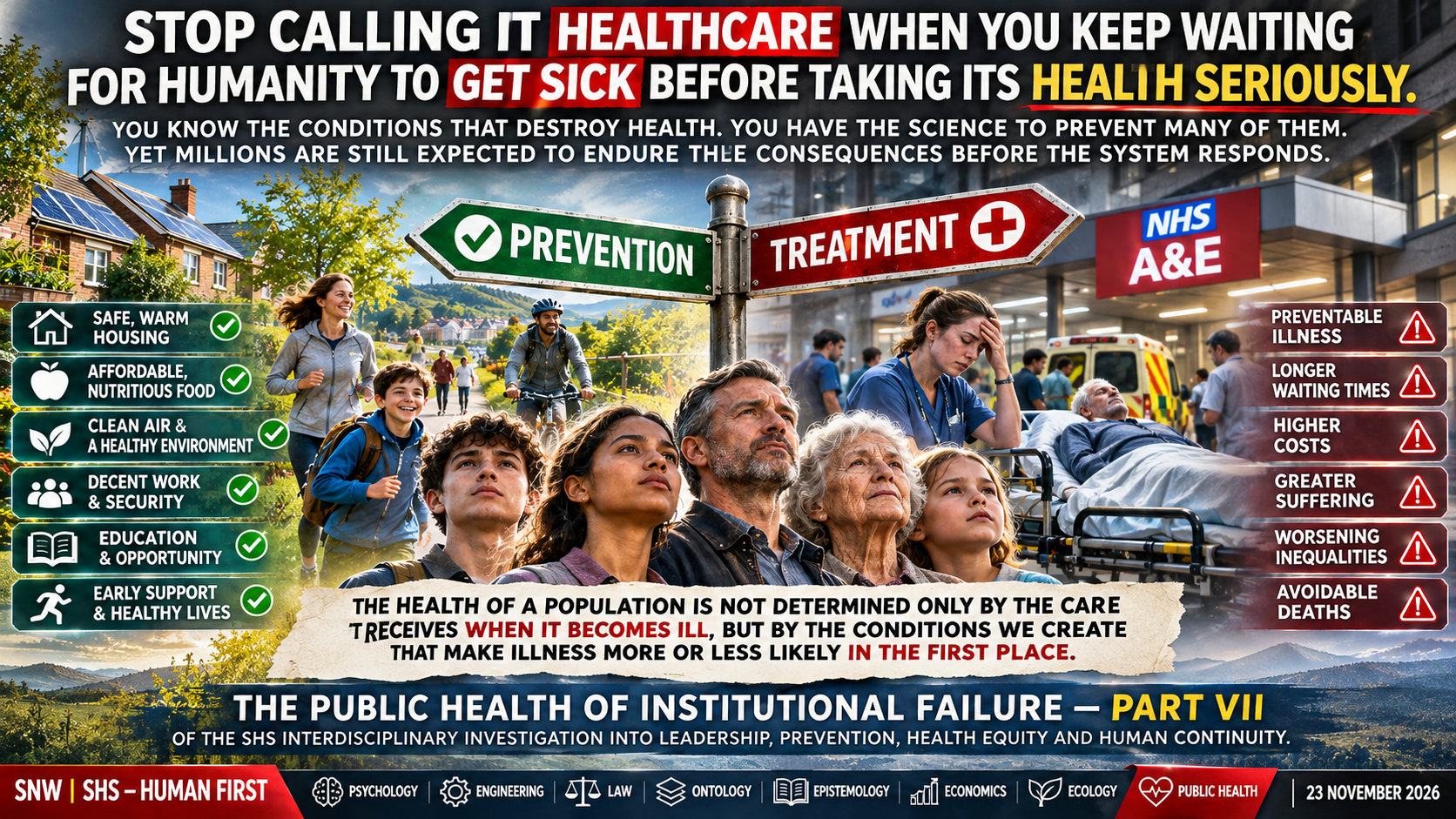
YOU KNOW THE CONDITIONS THAT DESTROY HEALTH. YOU HAVE THE SCIENCE TO PREVENT MANY OF THEM. YET MILLIONS ARE STILL EXPECTED TO ENDURE THE CONSEQUENCES BEFORE THE SYSTEM RESPONDS.
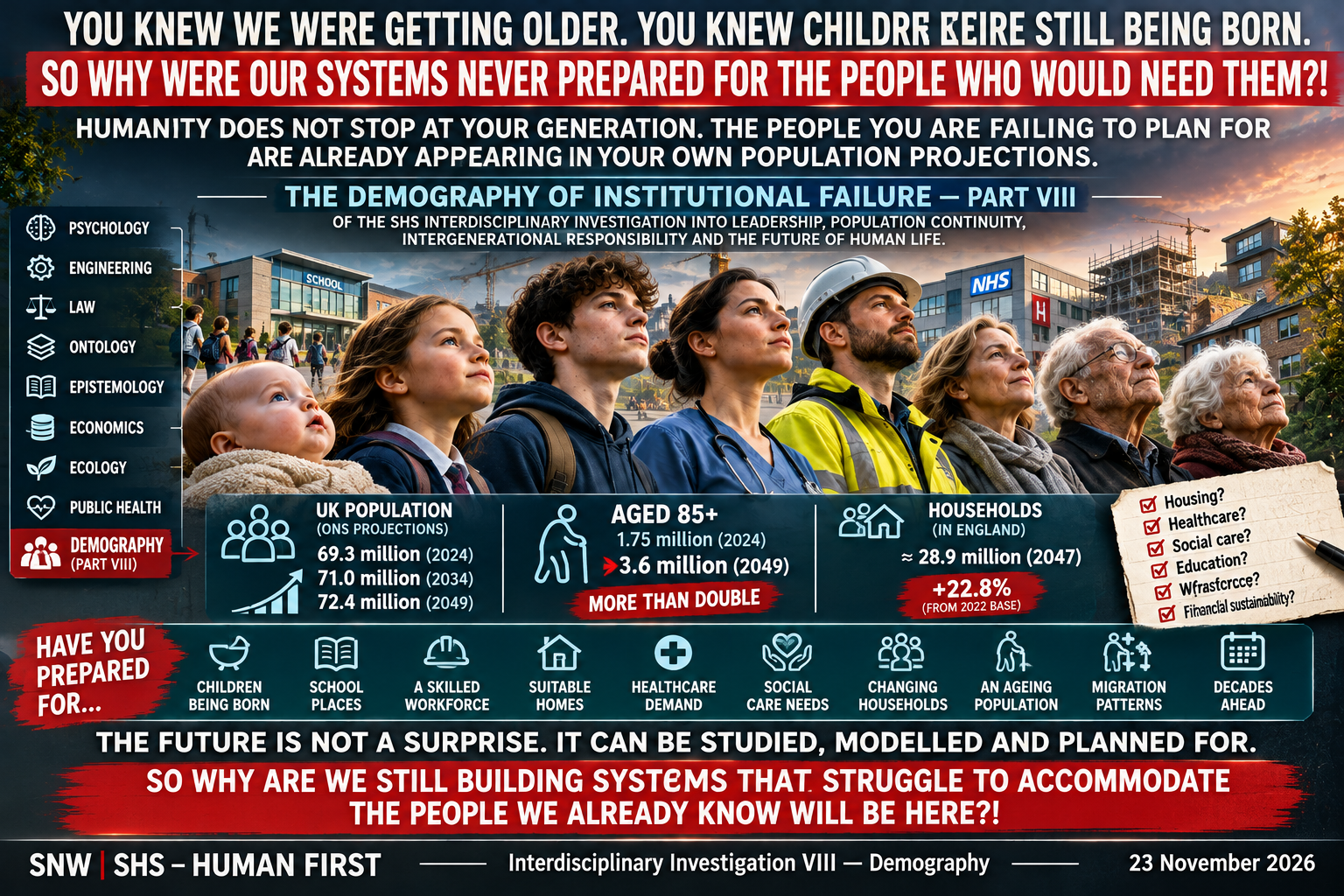
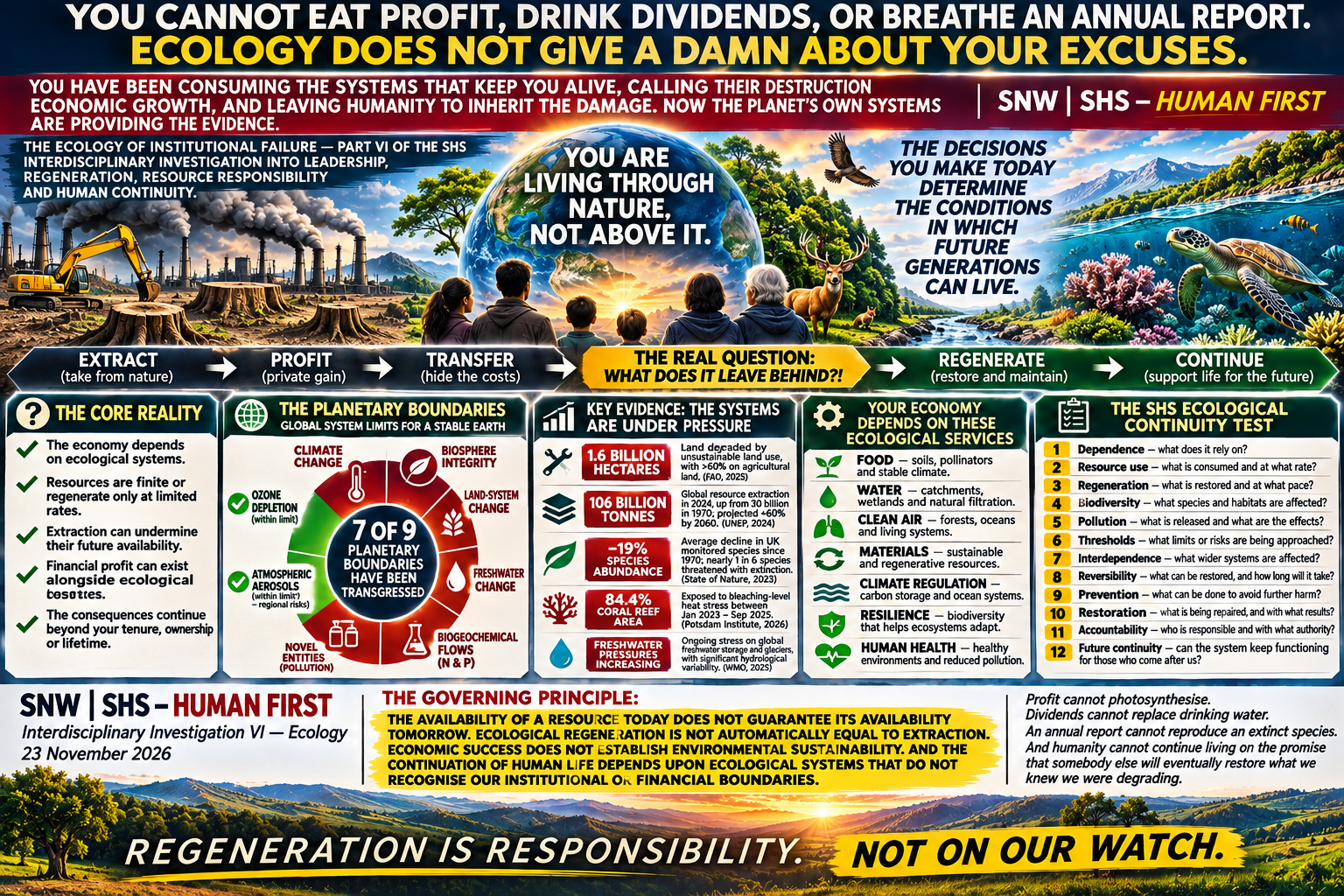
THE PUBLIC HEALTH OF INSTITUTIONAL FAILURE — PART VII OF THE SHS INTERDISCIPLINARY INVESTIGATION INTO LEADERSHIP, PREVENTION, HEALTH EQUITY AND HUMAN CONTINUITY.
SNW | SHS – HUMAN FIRST
First, psychology.
We investigated how the mind defends what it values, how cognitive biases influence decision-making, and how institutional self-preservation can become more important than protecting the people an institution exists to serve.
Then engineering.
We examined whether systems are actually fit for their intended purposes.
Then law.
We established that responsibility towards future generations already exists within statutory frameworks.
Then ontology.
We investigated the difference between preserving an institution and preserving the life that justifies its existence.
Then epistemology.
We examined what institutions know, how they establish that knowledge, and what happens when evidence fails to produce effective corrective action.
Then economics.
We investigated how financial returns can be generated while substantial human, environmental and future costs remain outside the accounts of those collecting the benefits.
Then ecology.
We examined how humanity depends upon living systems that must be maintained, protected and regenerated rather than endlessly consumed.
Now we arrive at the discipline where the consequences of all those failures can enter the human body itself.
PUBLIC HEALTH.
And this is where I want to ask a question that should make every government, corporation, public authority and institution responsible for human wellbeing profoundly uncomfortable.
WHY ARE WE SO PREPARED TO FINANCE THE CONSEQUENCES OF HARM WHILE STRUGGLING TO ORGANISE THE CONDITIONS THAT COULD PREVENT THAT HARM IN THE FIRST PLACE?!
Why do we wait for people to become ill before examining the conditions contributing to their illness?
Why do we treat preventable environmental exposure as an ordinary cost of economic activity?
Why can somebody’s postcode be associated with decades of difference in the amount of healthy life they can expect?
Why must public services repeatedly manage consequences that extend far beyond the healthcare system?
Why are hospitals expected to compensate for conditions that housing, employment, transport, education, food systems and environmental governance all influence?
And why do we keep measuring institutional performance through what services deliver without sufficiently examining what society could have prevented people from needing?
HUMANITY SHOULD NOT HAVE TO BECOME A PATIENT BEFORE ITS WELLBEING BECOMES AN INSTITUTIONAL PRIORITY.
Let’s investigate.
I. HEALTHCARE IS NOT THE WHOLE OF HEALTH. STOP CONFUSING THE TREATMENT OF DISEASE WITH THE PRESERVATION OF WELLBEING.
Let’s establish the distinction.
Clinical healthcare concerns the diagnosis, treatment, management and prevention of health conditions affecting individuals.
Public health examines health and disease across populations, including the social, environmental, biological and behavioural factors that influence outcomes.
Both are necessary.
Neither replaces the other.
But society can possess sophisticated hospitals while still exposing populations to conditions that contribute to ill health.
YOU CAN BUILD AN EXCELLENT HOSPITAL AND STILL HAVE A POPULATION LIVING UNDER CONDITIONS THAT MAKE THEM UNNECESSARILY SICK.
You can develop effective treatments for respiratory disease while people continue breathing harmful air.
You can improve clinical management of malnutrition while households struggle to obtain adequate food.
You can treat injuries while allowing preventable environmental and occupational hazards to persist.
You can provide mental-health services while ignoring serious contributors to psychological distress, including insecurity, violence, isolation and unsuitable living conditions.
THE HOSPITAL IS NOT RESPONSIBLE FOR EVERY CONDITION THAT PRODUCES THE PATIENT.
And this is precisely the problem.
We have organised healthcare into institutions.
But the conditions influencing health extend across society.
Housing.
Employment.
Education.
Transport.
Environmental management.
Food production.
Public safety.
Income.
Sanitation.
Social support.
And access to healthcare itself.
SO WHY SHOULD THE HEALTHCARE SYSTEM BE EXPECTED TO ABSORB THE CONSEQUENCES OF DECISIONS MADE BY INSTITUTIONS THAT DO NOT ADEQUATELY ACCOUNT FOR THEIR HEALTH IMPACTS?!
That is not a question of blaming individual doctors or nurses.
Many healthcare professionals work under extraordinary pressure to help the people in front of them.
It is a question about the systems responsible for creating or reducing the pressures that bring those people into their care.
THE PERSON TREATING THE HARM IS NOT NECESSARILY THE PERSON WHO HAD THE AUTHORITY TO PREVENT IT.
And public health requires us to investigate that distinction.
II. THE WORLD HEALTH ORGANIZATION ALREADY KNOWS THAT HEALTH IS PRODUCED FAR BEYOND THE HOSPITAL.
On 6 May 2025, the World Health Organization published its World Report on Social Determinants of Health Equity.
It examined how conditions in which people are born, grow, live, work and age influence health.
It also examined the distribution of power, money and resources.
And the report concluded that substantial, avoidable and unjust health inequalities persist across the world.
Source: World Health Organization — World Report on Social Determinants of Health Equity, 2025
NOW THINK ABOUT THAT.
The leading international public-health organisation is telling us that health outcomes are influenced by circumstances extending across the whole of society.
So this is not simply about telling individuals to eat better, exercise more or make healthier choices.
Those things can matter.
But the opportunity to make healthy choices is not distributed equally.
What happens when a person cannot afford suitable housing?
What happens when their workplace exposes them to hazardous substances?
What happens when nutritious food is difficult to access?
What happens when their neighbourhood lacks safe spaces for physical activity?
What happens when they cannot obtain timely care?
What happens when financial insecurity interferes with sleep, recovery and everyday functioning?
HOW MUCH PERSONAL RESPONSIBILITY ARE WE EXPECTING PEOPLE TO EXERCISE OVER CONDITIONS THEY DO NOT PERSONALLY CONTROL?!
Individuals have agency.
But individual agency does not eliminate environmental and institutional responsibility.
YOU CANNOT BUILD A SYSTEM THAT REPEATEDLY CREATES HEALTH RISKS AND THEN PLACE THE ENTIRE BURDEN OF AVOIDING THOSE RISKS ON THE PEOPLE EXPOSED TO THEM.
Especially when the ability to avoid exposure depends upon resources they may not possess.
III. ENGLAND’S HEALTH INEQUALITY FIGURES ARE NOT A PHILOSOPHICAL DEBATE. THEY ARE MEASURABLE.
Now let’s examine the evidence.
In April 2026, the Office for National Statistics published its analysis of healthy life expectancy by deprivation for 2022–2024.
The findings are extraordinary.
In England’s most deprived areas, healthy life expectancy at birth was estimated at:
49.8 years for males.
48.2 years for females.
In the least deprived areas:
69.2 years for males.
68.5 years for females.
Source: ONS — Healthy Life Expectancy by National Area Deprivation, 15 April 2026
READ THOSE FIGURES AGAIN.
The difference between the most and least deprived areas is approximately nineteen to twenty years of expected life in good health.
These estimates concern populations, not individual predictions. Healthy life expectancy is a statistical measure combining mortality and self-reported health; it does not mean everyone is healthy until a particular birthday and unhealthy afterwards.
But the scale of the inequality is undeniable.
PEOPLE ARE NOT ENTERING THE SAME HEALTH CONDITIONS SIMPLY BECAUSE THEY WERE BORN IN THE SAME COUNTRY.
And the inequalities do not disappear merely because healthcare is publicly funded.
Now ask the questions.
What contributes to these differences?
Employment conditions?
Housing?
Environmental exposures?
Income?
Education?
Healthcare access?
Chronic stress?
Existing disease patterns?
And how do those factors interact across a lifetime?
We cannot attribute the entire difference to one institution or one policy.
But that is precisely why the investigation must be interdisciplinary.
BECAUSE A PERSON’S HEALTH DOES NOT CARE HOW MANY GOVERNMENT DEPARTMENTS HAVE DIVIDED RESPONSIBILITY FOR THE CONDITIONS AFFECTING IT.
The human body experiences the combined consequences.
And public health must investigate those consequences together.
IV. OVER 118,000 AVOIDABLE DEATHS IN ONE YEAR. WHAT MORE DOES PREVENTION HAVE TO PROVE TO DESERVE SERIOUS ATTENTION?
Now we arrive at another statistic.
On 2 November 2026, the ONS published its latest avoidable mortality figures.
For deaths registered in 2025:
- England recorded 110,804 avoidable deaths.
- Wales recorded 8,011 avoidable deaths.
These represented 20.7% and 22.4% of all registered deaths, respectively.
The ONS defines avoidable mortality through specified causes of death in people under 75 that are classified as preventable or treatable through effective public-health measures or timely healthcare.
Source: ONS — Avoidable Mortality in England and Wales, 2025
MORE THAN ONE HUNDRED AND EIGHTEEN THOUSAND DEATHS CLASSIFIED WITHIN AVOIDABLE CAUSES.
Now understand what that does and does not establish.
It does not mean that every one of those deaths could certainly have been prevented in the individual’s particular circumstances.
It does not establish that a particular clinician or public authority was negligent.
And the figures must be understood alongside medical uncertainty, individual variation and the limitations of population statistics.
But they are intended to measure the burden of mortality arising from causes where effective prevention or treatment can make a difference.
And that burden is substantial.
The same release reported that the age-standardised avoidable mortality rate in England fell by 3.1% in 2025, reaching its lowest recorded level.
So improvement is possible, and improvement is occurring in some measures.
BUT THE EXISTENCE OF IMPROVEMENT DOES NOT MAKE THE REMAINING BURDEN IRRELEVANT.
How much of that burden could be reduced further?
Which interventions have the strongest evidence?
Where are opportunities being missed?
Which populations face the highest risks?
What barriers prevent effective access?
And are public resources being directed towards interventions with demonstrable benefits?
THE PURPOSE OF MEASURING AVOIDABLE MORTALITY IS NOT TO GENERATE A STATISTIC FOR AN ANNUAL REPORT.
IT IS TO INFORM THE WORK OF REDUCING AVOIDABLE DEATHS.
V. THE HEALTHCARE SYSTEM CANNOT REPAIR A PERSON’S LIVING CONDITIONS WITH A PRESCRIPTION ALONE.
Now let’s examine housing.
A household may experience damp and mould.
Insufficient heating.
Overcrowding.
Unsafe structural conditions.
Poor ventilation.
And other environmental hazards.
These conditions may contribute to respiratory illness, injury, psychological distress and other health problems.
Clinical treatment can help address the resulting conditions.
But treating symptoms does not necessarily eliminate the exposure.
YOU CAN GIVE SOMEBODY MEDICATION FOR A RESPIRATORY CONDITION WHILE SENDING THEM BACK INTO THE ENVIRONMENT CONTRIBUTING TO THAT CONDITION.
And then what happens?
Their symptoms may continue.
They may require further treatment.
The healthcare service incurs additional costs.
The person experiences continued disruption to their life.
Their ability to work or study may be affected.
And the original environmental problem remains unresolved.
SO WHAT EXACTLY HAVE WE ACHIEVED IF WE KEEP FINANCING THE CONSEQUENCES WITHOUT ADDRESSING A REMEDIABLE CONTRIBUTING CAUSE?
This is where housing policy becomes public-health policy.
Where building standards become public-health policy.
Where environmental enforcement becomes public-health policy.
And where institutional coordination becomes a necessity rather than a courtesy.
Not every condition is caused by housing.
Not every housing intervention produces the same health benefit.
But where a causal connection is established, the appropriate response cannot be confined to the treatment of symptoms.
THE PATIENT DOES NOT STOP LIVING IN THE ENVIRONMENT WHEN THEY LEAVE THE HOSPITAL.
The medical appointment ends.
The exposure may continue.
And the health consequences may continue with it.
VI. THE AIR DOES NOT ASK WHETHER YOU CAN AFFORD TO AVOID POLLUTION.
Now consider air quality.
Air pollution is associated with cardiovascular disease, respiratory illness, certain cancers and other adverse health outcomes.
The World Health Organization’s 2025 work on social determinants highlighted the enormous global burden of premature mortality associated with air pollution.
And in September 2026, the UK government reiterated the UK Health Security Agency’s estimate that air pollution is linked to a mortality burden equivalent to approximately 29,000–43,000 deaths annually in the UK.
Source: UK Parliament — Written Answer on Air Pollution, September 2026
This is an estimate of attributable mortality burden, not a count of individually identified deaths for which air pollution has been established as the sole cause.
That distinction matters.
But so does the scale.
THE AIR PEOPLE BREATHE IS NOT AN INDIVIDUAL CONSUMER CHOICE IN THE SAME WAY AS PURCHASING A PRODUCT.
People cannot always choose where pollution travels.
Children cannot negotiate emissions.
People with limited resources may not be able to move.
Workers may have to travel through polluted environments.
And the consequences of exposure can accumulate over time.
SO WHY SHOULD THE BURDEN OF PROTECTING HEALTH FALL PRIMARILY ON THE PEOPLE EXPOSED, RATHER THAN ALSO ON THE SYSTEMS CONTRIBUTING TO THE EXPOSURE?
Public-health protection can involve transport policy, urban planning, industrial controls, clean energy, monitoring and environmental regulation.
Different interventions have different costs and benefits.
But the principle is clear.
YOU CANNOT FULLY PROTECT POPULATION HEALTH WHILE TREATING THE CONDITIONS OF THE ENVIRONMENT AS SOMEBODY ELSE’S PROBLEM.
And the NHS cannot prescribe clean air into existence.
VII. A PREVENTABLE INFECTION DOES NOT CARE ABOUT YOUR BUDGET CYCLE.
Now let’s discuss infectious disease.
Public health does not concern only chronic illness.
It also involves protecting populations against communicable diseases.
Surveillance.
Vaccination.
Early detection.
Infection control.
Outbreak response.
Public communication.
And preparedness.
In June 2026, the UK Health Security Agency published its first Health Security Risk Assessment.
The assessment examined significant health-security threats that could affect the UK over the following five years.
It included infectious diseases, environmental hazards and other acute health emergencies.
It identified influenza and novel coronavirus pandemics among the highest assessed risks.
Source: UKHSA — Health Security Risk Assessment, June 2026
Now consider the significance.
The risks are being assessed before the next emergency occurs.
That is what preparedness requires.
Nobody can predict the exact course of every outbreak.
But surveillance and contingency planning can reduce the probability or severity of some consequences.
THE PURPOSE OF PREPAREDNESS IS NOT TO PROVE THAT NO EMERGENCY WILL EVER OCCUR.
IT IS TO REDUCE AVOIDABLE HARM WHEN RISKS MATERIALISE.
And there is a real contemporary example.
Measles.
The UK’s measles elimination status has been lost following renewed transmission.
UKHSA reported 2,911 confirmed measles cases in England in 2024.
Vaccination coverage had been below the levels generally required to prevent sustained transmission.
Measles can cause serious complications and death, while vaccination provides highly effective protection.
The relevant MMRV vaccination programme has been available for children from January 2026 under the updated schedule.
THE SCIENTIFIC CAPACITY TO PREVENT A DISEASE DOES NOT AUTOMATICALLY MEAN THAT THE POPULATION IS ADEQUATELY PROTECTED.
Access matters.
Uptake matters.
Trust matters.
Accurate communication matters.
Service organisation matters.
And monitoring matters.
THE EXISTENCE OF A VACCINE IS NOT THE SAME AS THE SUCCESSFUL DELIVERY OF A VACCINATION PROGRAMME.
That is the distinction between possessing a solution and organising a system capable of applying it.
VIII. NOT EVERY ILLNESS IS PREVENTABLE. AND THAT MAKES THE PREVENTABLE ONES EVEN MORE IMPORTANT TO INVESTIGATE.
I want this distinction to be explicit.
Human beings are biological organisms.
Ageing, disease, injury and mortality are part of the realities that medicine and public health must confront.
Not every illness has a known preventable cause.
Not every treatment succeeds.
Not every risk can be eliminated.
And some interventions carry harms or trade-offs that must be evaluated alongside their benefits.
PUBLIC HEALTH IS NOT A PROMISE THAT EVERY HUMAN BEING CAN BE MADE INVULNERABLE.
It is a discipline concerned with understanding and improving population health.
So the question is not whether humanity can abolish all illness through institutional reform.
The question is what proportion of avoidable harm can be reduced through feasible, evidence-based action.
And where we already possess reliable knowledge?
What prevents its effective application?
WE DO NOT NEED TO PRETEND THAT EVERY DISEASE IS PREVENTABLE TO TAKE PREVENTABLE DISEASE SERIOUSLY.
Nor should responsibility become an excuse to blame people for becoming ill.
People experience illness for many reasons, including factors outside their control.
The purpose of public-health investigation is to identify opportunities for protection, not to turn sickness into a moral failure.
ILLNESS IS NOT PROOF THAT SOMEBODY FAILED TO LIVE CORRECTLY.
And an institution should not be permitted to evade its own responsibilities by treating every adverse health outcome as the product of individual choices.
IX. WHY IS HEALTHCARE FUNDING NOT ENOUGH IF THE CONDITIONS PRODUCING POOR HEALTH REMAIN UNCHANGED?
Now we connect public health to economics.
Imagine a healthcare system receiving additional funding.
It employs more clinicians.
Expands facilities.
Improves technology.
Increases appointments.
And provides more treatments.
These improvements can be enormously valuable.
But if the population continues experiencing substantial preventable illness, demand may remain high.
More treatment capacity does not necessarily remove the conditions generating the demand.
This is why the relationship between healthcare expenditure and population health must be examined carefully.
WHAT DOES THE MONEY ACHIEVE?
Does it improve access?
Does it reduce avoidable deaths?
Does it improve recovery?
Does it prevent deterioration?
Does it reduce health inequalities?
Does it improve quality of life?
Does it support people to remain well for longer?
And how are those outcomes measured?
HEALTHCARE SPENDING IS NOT A COMPLETE MEASUREMENT OF HEALTHCARE SUCCESS.
In February 2026, the government announced multi-year public-health grant allocations for local authorities in England.
For 2026–2027, the total public-health grant was set at £4.404 billion.
The grant supports a range of local public-health functions, including prevention, treatment and recovery services.
Source: Department of Health and Social Care — Public Health Grants to Local Authorities, 2026–2027
Now this figure does not represent all preventive health expenditure in England.
Preventive activities are also funded and delivered through the NHS, other public services and wider policy arrangements.
But it provides a concrete example of how government organises some public-health funding.
The important questions are:
Does the allocation reflect local need?
Are services adequately accessible?
Are interventions effective?
Do resources reach communities experiencing the greatest burdens?
Are outcomes improving?
And can institutions demonstrate that expenditure is producing the intended public-health benefits?
BECAUSE FUNDING PREVENTION IS NOT THE SAME AS PROVING PREVENTION IS WORKING.
But neither is withholding funding an acceptable substitute for evaluating what effective prevention requires.
The aim must be to identify where resources can produce meaningful improvements in health.
X. THE 10-YEAR HEALTH PLAN ALREADY RECOGNISES THE NEED TO MOVE FROM SICKNESS TO PREVENTION.
Now here’s something particularly relevant.
England’s 10 Year Health Plan, published in July 2025, established three major intended shifts.
From hospital to community.
From analogue to digital.
And from sickness to prevention.
Source: UK Government — 10 Year Health Plan for England
SO THE GOVERNMENT HAS ALREADY RECOGNISED THE DIRECTION.
The policy ambition explicitly acknowledges the importance of preventing ill health rather than relying solely on treatment.
That matters.
But we have already examined this distinction through engineering and law.
THE PUBLICATION OF A PLAN IS NOT THE VALIDATION OF ITS OUTCOMES.
What matters is whether the plan’s interventions are implemented.
Whether the resources are sufficient.
Whether different institutions coordinate effectively.
Whether the evidence supports the selected interventions.
Whether disparities are narrowing.
And whether people are actually experiencing improvements in health.
The health plan’s existence should be evaluated as a commitment to be tested, not dismissed as meaningless or celebrated as complete.
THE QUESTION IS WHAT CHANGES IN THE LIVES OF THE PEOPLE THE PLAN IS SUPPOSED TO SERVE.
Because public health is not completed by moving the word prevention to the front of a policy document.
It is demonstrated through the effective prevention and reduction of harm.
XI. HERE IS AN EXAMPLE OF PREVENTION THAT IS ALREADY PRODUCING RESULTS: LUNG CANCER SCREENING.
Let’s examine an actual intervention.
England has been expanding targeted lung cancer screening for people at elevated risk.
The programme builds upon earlier targeted lung health checks.
According to the National Cancer Plan for England, published in 2026, more than 1.5 million people had attended a lung health check, and more than 9,000 lung cancers had been diagnosed.
Approximately 76% of cancers detected through the programme were diagnosed at stage 1 or 2, compared with around 30% outside the programme.
Source: Department of Health and Social Care — National Cancer Plan for England, 2026
These figures demonstrate an important benefit of targeted early detection.
The difference between discovering disease early and discovering it after substantial progression can be significant for treatment options and outcomes.
Screening itself must still be evaluated for benefits, potential harms, costs, equity and effects on long-term mortality.
But this is an example of institutions organising resources to identify health problems earlier.
AND THAT IS PRECISELY THE KIND OF EVIDENCE WE SHOULD BE INVESTIGATING.
Where does early intervention improve outcomes?
Where does it reduce later treatment burdens?
Which populations are missing opportunities for screening?
What barriers prevent participation?
And how can effective programmes be delivered fairly?
BECAUSE PREVENTION IS NOT SIMPLY A PHILOSOPHICAL PREFERENCE.
It is something that can be scientifically evaluated.
And where it works, the evidence can inform its expansion.
XII. HEALTH INEQUALITY IS NOT JUST ABOUT WHO GETS TREATED. IT IS ALSO ABOUT WHO IS MORE LIKELY TO NEED TREATMENT.
Now return to deprivation.
A person living under persistent financial insecurity may face different risks from someone whose material needs are consistently met.
A child growing up in unsuitable housing may experience different environmental exposures.
A worker in a hazardous occupation may face risks that a remote office worker does not.
An older person without adequate social support may face additional barriers to maintaining health.
These differences are not automatically reducible to personal behaviour.
Nor can every individual health outcome be inferred from socioeconomic status.
But at population level, social conditions help explain patterned inequalities.
SO WHY DO WE SO OFTEN WAIT UNTIL THE HEALTH CONSEQUENCES APPEAR BEFORE ASKING WHETHER THE UNDERLYING CONDITIONS WERE ACCEPTABLE?
What is the purpose of improving access to treatment if we do not also investigate the circumstances contributing to unequal demand for treatment?
That does not mean healthcare should be withheld until society resolves inequality.
People need care now.
But the long-term strategy must examine both.
TREAT THE PERSON WHO IS SUFFERING TODAY.
AND INVESTIGATE HOW TO REDUCE THE NUMBER OF PEOPLE WHO WILL SUFFER UNNECESSARILY TOMORROW.
Those objectives are complementary.
Not competing philosophical commitments.
This is why the World Health Organization advocates action across the social determinants of health.
Because protecting population health requires more than improving clinical services alone.
XIII. THE ECONOMICS OF PREVENTION: IF AVOIDING HARM COSTS LESS THAN MANAGING IT, WHY ARE WE STILL STRUGGLING TO FUND THE EARLIER INTERVENTION?
Now let’s examine financial incentives.
Not every preventive intervention saves money.
Some improve health at an additional cost.
Others are cost-effective without being cost-saving.
Some do not work as intended.
And some may create unintended harms.
These distinctions matter.
PREVENTION SHOULD NOT BE DEFENDED THROUGH THE FALSE CLAIM THAT EVERY PREVENTIVE PROGRAMME AUTOMATICALLY PAYS FOR ITSELF.
Instead, each intervention should be evaluated through its actual costs, effectiveness, benefits and risks.
But where a feasible preventive measure reduces substantial future harm, there may be strong economic and human reasons to implement it.
The challenge is often institutional.
Suppose a local authority finances an intervention that improves housing conditions.
The benefits may appear partly in reduced healthcare demand.
Suppose a transport authority reduces harmful air pollution.
The benefits may appear in population health and reduced exposure.
Suppose education programmes improve early development.
The benefits may emerge across later employment, health and social outcomes.
THE INSTITUTION PAYING FOR PREVENTION MAY NOT BE THE INSTITUTION RECEIVING THE FINANCIAL SAVING.
That can produce misaligned incentives.
One department bears the immediate expenditure.
Another receives some of the benefit.
And the population experiences the combined outcome.
SO IF GOVERNMENT DEPARTMENTS ARE FINANCIALLY REWARDED FOR PROTECTING THEIR OWN BUDGETS, WHO IS REWARDED FOR REDUCING THE TOTAL BURDEN ON HUMANITY?
That is the economic problem.
And it is precisely why integrated evaluation and cross-sector coordination matter.
The proper measure is not simply whether the spending department becomes financially better off.
It is whether the intervention produces sufficient overall benefits to justify its costs.
HUMANITY IS NOT ORGANICALLY DIVIDED INTO THE BUDGETS WE HAVE CREATED TO ADMINISTER IT.
And our accounting systems should not prevent us from recognising benefits that occur outside the department financing them.
XIV. PUBLIC HEALTH DOES NOT BEGIN AT BIRTH AND END WHEN SOMEBODY LEAVES THE HOSPITAL.
Now let’s examine continuity across the lifespan.
Human health develops over time.
Pregnancy and early childhood conditions can influence later development.
Education and living environments can affect subsequent opportunities and risks.
Occupational exposures can have effects that emerge after many years.
Environmental pollution can contribute to cumulative burdens.
Health behaviours and access to prevention can influence later disease risks.
And the availability of support in older age can affect wellbeing and independence.
THE HUMAN BODY CARRIES THE CONSEQUENCES OF EXPERIENCES THAT DO NOT FIT NEATLY INTO A SINGLE FINANCIAL YEAR.
So why should public-health planning be dominated by time horizons shorter than the processes it needs to influence?
Early childhood development cannot be adequately judged solely through immediate expenditure.
Chronic disease prevention may require sustained interventions.
Environmental improvements may generate benefits over long periods.
And reducing health inequalities can require coordinated social changes.
PUBLIC HEALTH IS A CONTINUITY DISCIPLINE.
It examines how conditions interact across time.
And that makes it directly relevant to the responsibility owed to future generations.
Because some people who will experience the benefits of today’s preventive investments have not yet been born.
They cannot vote for those investments.
They cannot write letters demanding safer environments.
They cannot attend consultations.
But their future health may still be affected by the decisions made today.
THE ABSENCE OF FUTURE PATIENTS FROM TODAY’S WAITING ROOM DOES NOT MAKE THEIR FUTURE HEALTH AN IRRELEVANT CONSIDERATION.
XV. STOP MAKING PEOPLE’S ABILITY TO ENDURE POOR CONDITIONS THE PROOF THAT THE CONDITIONS ARE ACCEPTABLE.
I want to challenge another institutional assumption.
Human beings can be extraordinarily adaptable.
People can live with chronic pain.
With unsuitable housing.
With insecurity.
With environmental noise.
With financial pressure.
With limited access to services.
With disabling conditions.
And with circumstances that create ongoing strain.
Many continue working, raising families, contributing to communities and supporting other people.
That resilience is real.
But resilience is not evidence that every underlying condition is acceptable.
THE FACT THAT SOMEBODY HAS LEARNED TO SURVIVE A PROBLEM DOES NOT MEAN THE PROBLEM NO LONGER EXISTS.
A person may tolerate an unhealthy workplace because they need employment.
A family may remain in unsuitable housing because alternative accommodation is inaccessible.
A patient may delay seeking help because of practical barriers.
An older person may experience isolation without having the resources to change their circumstances.
SURVIVAL IS NOT THE SAME THING AS WELLBEING.
And the absence of an immediate medical emergency does not establish that the person’s conditions are harmless.
This is why public health must examine morbidity, quality of life, disability, exposure and wellbeing alongside mortality.
Because the number of years people live is not the whole question.
HOW MUCH OF THOSE YEARS CAN THEY LIVE IN GOOD HEALTH?
And what proportion of suffering could have been reduced through effective policy, prevention and care?
XVI. THE SHS PUBLIC HEALTH CONTINUITY TEST.
Now I want to turn this investigation into a framework that can be applied to institutions.
Twelve questions.
1. POPULATION HEALTH
What health outcomes are being experienced?
What evidence supports the assessment?
2. PREVENTABLE HARM
Which health problems have known, modifiable risk factors or effective preventive interventions?
3. SOCIAL CONDITIONS
How do housing, employment, education, income and other social determinants influence outcomes?
4. ENVIRONMENTAL EXPOSURE
What harmful conditions are populations exposed to?
Who has responsibility for reducing those exposures?
5. HEALTH INEQUALITY
Which populations experience disproportionate risks or poorer outcomes?
What explains those differences?
6. ACCESS TO PREVENTION
Can people obtain effective preventive services?
What barriers exist?
7. EARLY DETECTION
Are appropriate screening, monitoring and diagnostic services available?
Are their benefits and harms being evaluated?
8. HEALTH SYSTEM CAPACITY
Can healthcare services provide timely, safe and effective care when prevention is insufficient?
9. INTERINSTITUTIONAL RESPONSIBILITY
Which organisations influence the conditions producing the health burden?
How are responsibilities coordinated?
10. ECONOMIC CONSEQUENCES
What are the costs of prevention, treatment, lost productivity, disability and other relevant outcomes?
11. EVIDENCE AND CORRECTION
Are interventions independently evaluated?
Are ineffective approaches modified?
Are successful programmes supported by appropriate evidence?
12. HUMAN CONTINUITY
Are present decisions improving the conditions under which future populations can expect to live healthy lives?
THIS TEST DOES NOT ASSUME THAT EVERY HEALTH PROBLEM CAN BE ELIMINATED.
It asks whether institutions are adequately identifying and reducing avoidable harm within the responsibilities and resources available to them.
And if they are not?
What prevents improvement?
Funding?
Design?
Coordination?
Evidence?
Implementation?
Access?
Or the incentives under which decisions are being made?
BECAUSE THE ANSWER SHOULD DETERMINE THE CORRECTION.
Not the institution’s preference for protecting its reputation.
XVII. HEALTHCARE WORKERS ARE NOT THE ENEMY. STOP FORCING THEM TO BE THE LAST DEFENCE AGAINST EVERY OTHER SYSTEM’S FAILURES.
I want this distinction made especially clear.
The people working in healthcare are often responsible for responding to circumstances they did not create.
Doctors.
Nurses.
Paramedics.
Therapists.
Public-health specialists.
Care workers.
Researchers.
Technicians.
And many others.
They work within systems shaped by policies, resources, demand, regulations and wider social conditions.
They cannot individually correct every environmental exposure.
Every housing problem.
Every employment condition.
Every barrier to education.
Every nutritional inequality.
Every failure of preventive infrastructure.
SO WHY DO WE EXPECT THE HEALTHCARE SYSTEM TO REPAIR THE CONSEQUENCES OF PROBLEMS THAT REQUIRE THE RESPONSIBILITY OF THE WHOLE OF GOVERNANCE?
And why do we so frequently discuss healthcare pressure without examining how much of that pressure might be reduced through action elsewhere?
This is not an argument for abandoning treatment in favour of prevention.
Both are essential.
It is an argument for recognising that population health is a shared responsibility.
THE HOSPITAL SHOULD NOT HAVE TO BECOME THE PLACE WHERE EVERY OTHER INSTITUTION’S UNRESOLVED RESPONSIBILITIES FINALLY ARRIVE.
When the housing system fails, the consequences may reach healthcare.
When environmental protection fails, the consequences may reach healthcare.
When safeguarding fails, the consequences may reach healthcare.
When social support is insufficient, the consequences may reach healthcare.
But the healthcare system’s ability to treat people does not eliminate the responsibilities of the institutions influencing the conditions that brought them there.
STOP TREATING THE LAST RESPONDER AS THOUGH THEY ARE THE SOLE OWNER OF THE ORIGINAL PROBLEM.
XVIII. WHAT KIND OF SOCIETY MEASURES ITS SUCCESS BY HOW MUCH TREATMENT IT PROVIDES WITHOUT ALSO MEASURING HOW MUCH SUFFERING IT PREVENTS?
Think about this.
An institution may celebrate increasing the number of appointments delivered.
That can reflect a genuine improvement in service access.
It may celebrate treating more patients.
That can be essential when demand is high.
It may celebrate expanding diagnostic capacity.
That can improve detection and outcomes.
These achievements matter.
But public-health evaluation must also examine what happens before the appointment.
Before the diagnosis.
Before the emergency.
Before the hospital admission.
WHAT COULD HAVE REDUCED THE PERSON’S RISK IN THE FIRST PLACE?
And where prevention is effective, was it available?
Was it accessible?
Was it delivered?
Was its impact evaluated?
This is not a demand that the number of patients must always decrease.
Populations change.
Age structures change.
Better diagnosis can initially increase recorded disease prevalence.
And improved access can reveal needs that were previously unmet.
SO THE METRICS MUST BE INTERPRETED PROPERLY.
But they must also be comprehensive.
A successful health system should not be judged only through its ability to treat illness.
It must also be evaluated through its contribution to preventing avoidable illness, improving quality of life and reducing unfair health inequalities.
THE SUCCESS OF A HEALTH SYSTEM IS NOT SIMPLY HOW MUCH HUMAN SUFFERING IT CAN PROCESS.
IT IS ALSO HOW MUCH HUMAN SUFFERING IT CAN HELP PREVENT.
XIX. THE FUTURE DOES NOT NEED YOU TO BELIEVE IN AN AFTERLIFE. IT NEEDS YOU TO STOP LEAVING PREVENTABLE HARM FOR THE PEOPLE WHO COME AFTER YOU.
Now return to the foundation of this series.
Faith.
Responsibility.
Mortality.
The aftermath.
Whether consciousness continues after death remains a separate philosophical and scientific question from whether our actions can produce consequences after we die.
Public health does not require us to settle that metaphysical debate before recognising duties towards future people.
Because future populations will still depend upon health-supporting conditions.
They will need safe water.
Suitable environments.
Food systems.
Healthcare.
Protection from infectious disease.
Access to reliable information.
And institutions capable of identifying and reducing foreseeable risks.
A FUTURE CHILD DOES NOT HAVE TO EXIST TODAY FOR THE HEALTH CONSEQUENCES OF TODAY’S POLLUTION TO BE RELEVANT.
A future patient does not have to be registered with a doctor before a preventable environmental exposure becomes worth investigating.
A future generation does not have to vote before public institutions consider whether present policies are leaving it with avoidable health risks.
THE FUTURE DOES NOT NEED TO BE PERSONALLY EXPERIENCED BY TODAY’S DECISION-MAKERS TO DESERVE THEIR CONSIDERATION.
And public-health science provides concrete ways to investigate that responsibility.
Epidemiology.
Exposure assessment.
Health impact assessment.
Disease surveillance.
Population monitoring.
Preventive trials.
Health economics.
And evaluation.
THIS IS NOT MERELY ABOUT WHO CLAIMS TO CARE FOR HUMANITY.
It is about the health outcomes that different decisions and conditions actually produce.
And the evidence available to improve them.
XX. HUMANITY IS NOT HERE TO FINANCE AN ENDLESS CYCLE OF PREVENTABLE SUFFERING.
I want to conclude with something that should already be obvious.
THE PURPOSE OF PUBLIC HEALTH IS NOT TO WAIT FOR HUMANITY TO BECOME SICK ENOUGH TO JUSTIFY TAKING ITS HEALTH SERIOUSLY.
We have a responsibility to treat people who are already ill.
To provide appropriate care.
To improve medical science.
To support recovery.
To alleviate suffering.
And to protect people whose conditions cannot presently be cured or prevented.
None of that is negotiable.
BUT WHY SHOULD THE EXISTENCE OF TREATMENT BE USED AS AN EXCUSE FOR NEGLECTING PREVENTION?
Why should a child have to become ill before their environment receives attention?
Why should a worker have to suffer a serious occupational injury before an avoidable hazard is corrected?
Why should a family have to experience health consequences from unsuitable housing before relevant institutions coordinate an adequate response?
Why should a population have to experience an outbreak before gaps in preventive protection are taken seriously?
Why should environmental harm become severe before the health consequences justify intervention?
WHAT EXACTLY IS THE PURPOSE OF KNOWLEDGE IF WE REFUSE TO USE IT UNTIL THE DAMAGE HAS ALREADY ARRIVED?
We have medical knowledge.
We have epidemiological methods.
We have public-health expertise.
We have environmental science.
We have economic appraisal.
We have engineering.
We have laws.
We have health-surveillance systems.
We have intervention studies.
And we have documented examples of prevention and early detection improving outcomes.
SO THE QUESTION IS NOT WHETHER HUMANITY POSSESSES ANY CAPACITY TO PREVENT HARM.
It demonstrably does.
The question is whether that capacity is being organised, financed, evaluated and delivered effectively enough.
And whether institutions are prepared to confront the conditions generating avoidable suffering beyond the boundaries of their own departments.
YOU CANNOT KEEP TREATING THE CONSEQUENCES OF A SYSTEM AS THOUGH THEY ARE ENTIRELY SEPARATE FROM THE DESIGN OF THAT SYSTEM.
You cannot expect clinical treatment alone to eliminate the health effects of unsafe environments.
You cannot expect individuals to exercise complete control over risks that arise through collective decisions.
You cannot claim public-health success solely through expenditure.
You cannot claim that increasing treatment activity automatically establishes improving population health.
And you cannot demonstrate responsibility for future generations merely by promising that healthcare will continue to exist.
WHAT CONDITIONS WILL FUTURE GENERATIONS BE BORN INTO?
What risks are we reducing?
What health inequalities are we narrowing?
What essential services are we maintaining?
What environmental exposures are we addressing?
What preventive programmes are we delivering?
And what improvements can we demonstrate?
BECAUSE HUMANITY’S HEALTH IS NOT A SINGLE HOSPITAL DEPARTMENT.
It is influenced by the conditions in which life develops and continues.
And those conditions are shaped by decisions made throughout society.
THE ECONOMY INFLUENCES HEALTH.
THE ENVIRONMENT INFLUENCES HEALTH.
HOUSING INFLUENCES HEALTH.
EDUCATION INFLUENCES HEALTH.
EMPLOYMENT INFLUENCES HEALTH.
GOVERNANCE INFLUENCES HEALTH.
AND HEALTH INFLUENCES HUMANITY’S CAPACITY TO PARTICIPATE IN EVERY ONE OF THOSE SYSTEMS.
So why do we continue pretending that the responsibility for health begins and ends with healthcare?
A HEALTHY POPULATION IS NOT SIMPLY THE PRODUCT OF A HEALTHCARE SYSTEM THAT KNOWS HOW TO TREAT DISEASE.
It is also influenced by systems capable of supporting healthy living conditions, reducing avoidable risks and making effective healthcare accessible.
And when those systems fail, the burden can arrive in the lives and bodies of people who had little or no authority over the decisions producing it.
THAT IS WHY PREVENTION MATTERS.
Not because treatment is unimportant.
But because people deserve more than the opportunity to receive help after preventable damage has already occurred.
HUMANITY DESERVES THE OPPORTUNITY NOT TO EXPERIENCE THAT DAMAGE IN THE FIRST PLACE.
And where the evidence shows that we can reduce such harm?
We should examine why effective interventions are not reaching everyone who could benefit.
Not simply celebrate the fact that treatment exists.
STOP MEASURING OUR ACHIEVEMENTS ONLY BY HOW MANY PEOPLE WE MANAGED TO SAVE AFTER THEY WERE ALREADY SUFFERING.
Measure how many risks we reduced.
How many barriers we removed.
How many environments we improved.
How many illnesses we detected earlier.
How many avoidable deaths we prevented.
How many years of good health populations gained.
And how fairly those gains were distributed.
BECAUSE A SOCIETY SHOULD NOT HAVE TO BECOME SICKER TO KEEP ITS HEALTHCARE ECONOMY BUSY.
A PERSON SHOULD NOT HAVE TO BECOME A PATIENT BEFORE THEIR WELLBEING BECOMES IMPORTANT.
AND A FUTURE GENERATION SHOULD NOT HAVE TO INHERIT A PREVENTABLE HEALTH CRISIS BEFORE THE PRESENT AGREES THAT ITS RESPONSIBILITY EXTENDS BEYOND ITSELF.
SO SHOW US THE PREVENTION.
SHOW US THE HEALTH IMPROVEMENTS.
SHOW US THE INEQUALITIES NARROWING.
SHOW US THE ENVIRONMENTS BECOMING SAFER.
SHOW US THE EFFECTIVE INTERVENTIONS REACHING THE PEOPLE WHO NEED THEM.
SHOW US THE EVIDENCE THAT OUR HEALTH SYSTEMS ARE HELPING PEOPLE LIVE BETTER, NOT MERELY ORGANISING MORE TREATMENT.
AND WHEN THE EVIDENCE DEMONSTRATES THAT HARM IS BEING REPRODUCED THROUGH CONDITIONS THAT CAN REASONABLY BE CHANGED, STOP DEFENDING THE ARRANGEMENT AND INVESTIGATE THE CORRECTION.
Because the patient is not your economic unit.
The child is not your future statistic.
The worker is not merely your productive asset.
The elderly person is not a liability whose humanity expires with their contribution to the workforce.
And the person living with illness is not a failure because the system did not prevent their condition.
THEY ARE HUMAN BEINGS.
With lives whose value does not depend upon the financial returns they produce.
With needs that do not disappear because those needs are expensive to meet.
And with a legitimate interest in institutions capable of protecting health through prevention, treatment and care.
THE PURPOSE IS LIFE.
Its wellbeing.
Its dignity.
Its capacity to participate.
Its capacity to recover.
And its continuity.
NOT SIMPLY THE FINANCIAL OR ADMINISTRATIVE CONTINUITY OF THE SYSTEMS CREATED TO MANAGE IT.
We have already established through seven disciplinary lenses that the distinction matters.
And public health brings it directly back to the human body.
A BODY DOES NOT EXPERIENCE A GOVERNMENT’S MISSION STATEMENT.
IT EXPERIENCES THE CONDITIONS IN WHICH IT HAS TO LIVE.
A CHILD DOES NOT BREATHE YOUR ECONOMIC GROWTH.
THEY BREATHE THE AIR.
A FAMILY DOES NOT SLEEP INSIDE YOUR HOUSING TARGET.
THEY SLEEP INSIDE THE HOME THAT ACTUALLY EXISTS.
A PATIENT DOES NOT RECOVER BECAUSE YOUR INSTITUTION HAS MET AN ADMINISTRATIVE PERFORMANCE INDICATOR.
THEY RECOVER, WHERE POSSIBLE, THROUGH THE CARE, CONDITIONS AND BIOLOGICAL PROCESSES THAT ACTUALLY SUPPORT RECOVERY.
And humanity’s future will not be protected by the number of times you promise to improve wellbeing.
IT WILL BE AFFECTED BY WHAT YOU ACTUALLY DO TO PRESERVE THE CONDITIONS THAT MAKE WELLBEING POSSIBLE.
HEALTH IS NOT AN AFTERTHOUGHT.
PREVENTION IS NOT A LUXURY.
HUMAN SUFFERING IS NOT A BUSINESS MODEL TO BE PRESERVED.
AND THE FUTURE IS NOT YOUR WAITING ROOM FOR CONSEQUENCES YOU REFUSED TO ADDRESS TODAY.
NOT ON OUR WATCH.
SNW | SHS – HUMAN FIRST
Interdisciplinary Investigation VII — Public Health
23 November 2026
THE GOVERNING PRINCIPLE
THE CAPACITY TO TREAT HARM IS NOT PROOF THAT THE RESPONSIBILITY TO PREVENT AVOIDABLE HARM HAS BEEN FULFILLED. HEALTHCARE EXPENDITURE IS NOT AUTOMATICALLY HEALTH IMPROVEMENT. AND A SYSTEM THAT TREATS DISEASE WITHOUT ADEQUATELY ADDRESSING THE CONDITIONS CONTRIBUTING TO PREVENTABLE ILLNESS CANNOT BE EVALUATED THROUGH ITS TREATMENT ACTIVITY ALONE.
The objective is not merely to increase humanity’s capacity to survive suffering. It is to improve humanity’s opportunity to live without suffering that could reasonably have been prevented.
Scientific foundations, official evidence and public-health research
- World Health Organization — World Report on Social Determinants of Health Equity, 2025
- ONS — Healthy Life Expectancy by Deprivation, England and Wales, 2026
- ONS — Avoidable Mortality in England and Wales, 2025
- UK Health Security Agency — Health Security Risk Assessment, June 2026
- UK Government — 10 Year Health Plan for England
- Department of Health and Social Care — Public Health Grants to Local Authorities, 2026–2027
- Department of Health and Social Care — National Cancer Plan for England, 2026
- UK Parliament — Air Pollution Mortality Burden, September 2026
- World Health Organization — Social Determinants of Health



Leave a Reply