

Words I was owed in the opposite context.
THEY CALLED IT UBUNTU. BIOLOGY CALLS IT INTERDEPENDENCE. RELIGIONS CALL IT COMPASSION. AND OUR INSTITUTIONS KEEP ACTING AS THOUGH WE EXIST ALONE.
DIFFERENT CIVILISATIONS. DIFFERENT LANGUAGES. DIFFERENT DISCIPLINES. THE SAME RECURRING TRUTH: YOUR EXISTENCE IS INDIVIDUAL, BUT THE CONDITIONS THAT MAKE YOUR EXISTENCE POSSIBLE ARE COLLECTIVE.
FROM ANCESTRAL PHILOSOPHY TO BIOLOGY, ECOLOGY, RELIGION, ECONOMICS, LAW AND HUMAN GOVERNANCE — AN INTERDISCIPLINARY INVESTIGATION INTO THE PRINCIPLE OF SHARED CONTINUITY.
SNW | SHS – HUMAN FIRST
I recently came across the African parable of children who were offered a basket of fruit as a reward for winning a race.
Instead of racing against one another, they held hands, ran together and shared the fruit.
When asked why they had not competed for the reward, they reportedly answered with the philosophy of Ubuntu:
“How can one of us be happy if all the others are sad?”
Now, although the particular story is widely circulated without reliable verification of its origins, Ubuntu itself is an established African philosophical tradition.
And the more I examined its underlying principle, the more interesting the investigation became.
Because this is not simply a philosophy of sharing fruit.
IT IS A PHILOSOPHY OF RECOGNISING THE CONDITIONS THAT MAKE INDIVIDUAL EXISTENCE POSSIBLE.
And apparently, humanity has been discovering expressions of this relationship across different civilisations, religions, scientific disciplines and systems of knowledge for a very long time.
Which leaves me with a question.
IF SO MANY BRANCHES OF HUMAN KNOWLEDGE RECOGNISE OUR INTERDEPENDENCE, WHY DO WE CONTINUE BUILDING INSTITUTIONS THAT TREAT HUMAN BEINGS AS THOUGH THEIR EXISTENCE WERE INDEPENDENT OF EVERYBODY ELSE’S?
Let’s investigate.
I. ANCESTRAL PHILOSOPHIES — DIFFERENT CIVILISATIONS, SIMILAR RECOGNITIONS
Before modern corporations, economic theories, contemporary governments and the international legal structures we know today, different human communities developed philosophies concerned with relationships, reciprocity and shared wellbeing.
Not all the same.
Not culturally interchangeable.
But with remarkable philosophical correspondences.
UBUNTU, HUNHU AND BOTHO — SOUTHERN AFRICA
“I am because we are.”
Ubuntu, together with related traditions such as Hunhu and Botho, is concerned with personhood, human dignity, relationships and community.
The individual is not understood as developing entirely independently of others.
Other human beings contribute to the conditions through which personhood is recognised, expressed and cultivated.
What a remarkable starting point.
Because instead of asking only:
“What can I become?”
It invites another question:
“What relationships make my becoming possible?”
I exist as an individual.
But the language I speak, the knowledge I inherit, the care I receive, the food I consume and the social conditions through which I develop are not entirely my own inventions.
And neither are yours.
AKAN PHILOSOPHY — WEST AFRICA
Akan philosophical traditions also recognise the importance of communal relationships, obligation and the contribution of others to individual wellbeing.
Across African societies, different forms of communal responsibility and reciprocity have emerged.
This does not mean African communities have always been free from competition, oppression, conflict or inequality.
IT MEANS THAT AFRICAN INTELLECTUAL HISTORY CONTAINS DEVELOPED PHILOSOPHIES THAT RECOGNISE THE HUMAN BEING AS RELATIONAL, NOT MERELY ISOLATED.
And these philosophical contributions deserve to be examined as knowledge, not romanticised into folklore.
AYNI — ANDEAN COMMUNITIES
Travel across the planet to the Andes.
Among Andean communities, Ayni expresses principles of reciprocity and mutual assistance.
People contribute labour, resources and support within relationships of reciprocal obligation.
The recognition is not that everyone possesses identical resources or capabilities.
It is that contributions can move between people over time.
I MAY BE ABLE TO HELP YOU TODAY IN A WAY THAT YOU CAN HELP ME TOMORROW.
And neither contribution becomes meaningless simply because it was not immediately compensated with money.
WHANAUNGATANGA — MĀORI PHILOSOPHY
Within Māori traditions, Whanaungatanga concerns relationships, kinship, belonging and the connections through which people understand their place within communities.
This recognition extends into contemporary approaches to wellbeing, including healthcare.
Because an individual does not arrive at a hospital detached from every relationship, responsibility, experience and circumstance contributing to their condition.
Their life exists within a wider context.
CARING FOR A PERSON CAN REQUIRE RECOGNISING THE RELATIONSHIPS THAT CONTRIBUTE TO THEIR WELLBEING.
LANGAR AND SEVA — SIKH TRADITION
Now observe Sikhism.
Through Langar, gurdwaras provide communal meals to people regardless of wealth, background or religious identity.
Seva expresses selfless service.
And here is the part that connects directly with the children and their basket of fruit.
NOBODY HAS TO WIN A RACE TO DESERVE A MEAL.
The food is not presented as a trophy proving one person’s superiority over another.
It is offered through a practice of service and shared human dignity.
Different cultural and religious origins.
Different historical development.
Yet we find another expression of human interdependence translated into practical behaviour.
And THAT is what interests me.
HUMANITY HAS NOT BEEN WAITING FOR ONE MODERN INSTITUTION TO INVENT COOPERATION.
We have been developing ways of understanding and practising it across generations.
II. RELIGION — THE BODY AS A MODEL OF COLLECTIVE RESPONSIBILITY
Now let’s examine religion.
Because some of the most interesting parallels are found in the way different religious traditions describe the relationship between an individual and a larger whole.
CHRISTIANITY
In Acts 2:44–45, early believers are described as sharing possessions and distributing resources according to need.
And in 1 Corinthians 12:26, the relationship between members of a community is expressed through the metaphor of one body.
When one member suffers, the others suffer with it.
When one is honoured, the others share in that honour.
ONE BODY. MANY MEMBERS. DIFFERENT FUNCTIONS. SHARED CONSEQUENCES.
Now consider what that metaphor actually proposes.
Your lungs do not need to become your heart.
Your heart does not need to become your kidneys.
Your kidneys do not need to become your brain.
Their differences are essential to their contributions.
But none can maintain the living organism independently.
DIFFERENCE DOES NOT CANCEL INTERDEPENDENCE.
ISLAM
The Qur’an, in 59:9, praises those who give preference to others despite experiencing need themselves.
And a hadith recorded in Sahih Muslim compares believers to one body that responds collectively when one part suffers.
Again.
The body.
The relationship.
The recognition that suffering does not become irrelevant simply because it is experienced by another member.
BUDDHISM
Buddhist philosophy offers another important perspective through dependent origination.
Phenomena arise in dependence upon causes and conditions.
They do not exist as entirely independent, self-producing realities.
Now, dependent origination is not identical to Ubuntu, nor is it simply a teaching about sharing resources.
But the philosophical correspondence is significant.
THINGS EXIST THROUGH CONDITIONS.
And when you begin examining those conditions, the imagined separation between an individual and everything contributing to their existence becomes increasingly difficult to maintain.
So I want to ask something.
IF YOUR LIFE DEPENDS UPON CONDITIONS BEYOND YOURSELF, WHY SHOULD YOUR RESPONSIBILITY AUTOMATICALLY END AT YOURSELF?
The observation of dependence does not, by itself, establish a moral obligation.
That ethical conclusion still requires reasoning.
But surely recognising dependence provides an important starting point for questioning what we owe to one another.
Because we cannot pretend that our decisions concern only ourselves when their consequences extend beyond us.
III. BIOLOGY — YOUR OWN BODY DOES NOT FUNCTION THROUGH TOTAL INDEPENDENCE
Now, forget religion for a moment.
Forget philosophy.
Forget nationalities and ideologies.
LET’S EXAMINE THE BODY THAT MAKES IT POSSIBLE FOR YOU TO ARGUE ABOUT ALL OF THEM.
A multicellular organism consists of specialised cells performing different functions through coordinated biological processes.
Cells communicate.
They exchange signals.
They participate in maintaining tissues and organs.
Organs contribute to maintaining the organism.
And the organism depends upon a continuous relationship between multiple systems.
Your circulatory system cannot perform every function of your respiratory system.
Your digestive system cannot simply replace your nervous system.
Your immune system contributes to protecting an organism whose survival also depends on processes outside the immune system.
NO SINGLE ORGAN CAN CLAIM EXCLUSIVE CREDIT FOR YOUR CONTINUED EXISTENCE.
Now imagine your heart declaring:
“I am the most important organ. Therefore, I shall retain everything for myself.”
Or your lungs deciding:
“I will only contribute oxygen to the organs that can afford my services.”
Or your kidneys announcing:
“My performance indicators are excellent, so the deterioration of the rest of the body is none of my concern.”
How long would that organism remain healthy?
And yet, how many of our institutions are organised as though their independent performance matters more than the condition of the wider society they exist within?
Of course, human society is not literally one biological organism, and cells do not exercise the same moral agency as human beings.
But the structural comparison exposes something important.
A SYSTEM CAN CONTAIN PARTS THAT PERFORM THEIR ASSIGNED FUNCTIONS WHILE THE CONDITION OF THE WHOLE CONTINUES TO DETERIORATE.
And if we measure only the performance of the parts, we may fail to recognise the deterioration of the system they collectively sustain.
Is that not precisely what we have been investigating throughout the SHS interdisciplinary accountability series?
An institution can report financial success.
An industry can report growth.
A department can meet its targets.
An organisation can comply with its internal procedures.
AND HUMANITY CAN STILL BE EXPERIENCING PREVENTABLE HARM.
The figures may be accurate.
The indicators may be improving.
But are we measuring the condition of the whole?
That is the question.
IV. ECOLOGY — LIFE HAS BEEN PRACTISING INTERDEPENDENCE LONG BEFORE HUMANITY NAMED IT
Let’s leave the human body and examine the living environment.
CORAL AND ALGAE
Many reef-building corals maintain relationships with microscopic photosynthetic algae.
The corals provide a protected environment and materials that support the algae.
The algae produce compounds through photosynthesis that help nourish the corals.
Different organisms.
Different biological capabilities.
A relationship that can benefit both.
THEIR DIFFERENCES ARE NOT THE PROBLEM. THEIR DIFFERENCES HELP MAKE THE RELATIONSHIP POSSIBLE.
And when the environmental conditions supporting this relationship deteriorate, the partnership can break down, contributing to coral bleaching.
Suddenly, a change in the surrounding environment becomes a threat to the continuation of the relationship.
POLLINATION
Plants contribute to supporting pollinators through resources such as nectar and pollen.
Pollinators facilitate reproduction in many flowering plants.
Other organisms depend upon the fruits, seeds and habitats associated with those plants.
And human agriculture benefits enormously from animal pollination.
How interesting.
A person eating fruit may not have seen the pollinator that contributed to its production.
They may not have cultivated the soil.
They may not have planted the tree.
They may not have maintained the conditions required for the tree to survive.
Yet they receive the fruit of multiple relationships.
THE FINAL BENEFICIARY IS NOT NECESSARILY THE SOLE CREATOR OF THE BENEFIT.
Apply that to an economy.
Who produces the food?
Who cultivates the land?
Who maintains the transport routes?
Who provides the water?
Who generates the electricity?
Who teaches the workers?
Who protects public health?
Who maintains the infrastructure?
Who develops the knowledge?
And how many of those contributions become invisible when we recognise only the individual or corporation receiving the final payment?
HUMAN EVOLUTION
Cooperation and food-sharing behaviours are studied in humans and other primates.
Our evolutionary history includes social relationships, parental care, collective activity and various forms of resource-sharing.
Competition is also part of evolutionary history.
So this is not an argument that nature is universally peaceful or morally cooperative.
NATURE CONTAINS BOTH COOPERATION AND CONFLICT.
But cooperation has demonstrably contributed to the survival, reproduction and development of living organisms.
Which means that cooperation is not some imaginary ideal that modern humanity invented because people became too sentimental.
IT IS A REAL MECHANISM THROUGH WHICH LIVING SYSTEMS CAN MAINTAIN THEMSELVES.
And what fascinates me is that humanity possesses the consciousness to examine these relationships and deliberately improve the systems through which we coexist.
We are not limited to reproducing every conflict we observe in nature.
We can investigate its consequences.
We can compare alternatives.
We can develop institutions that encourage beneficial cooperation while protecting individuality and addressing exploitation.
That is one of the capabilities of human consciousness.
WE CAN OBSERVE THE CONDITIONS OF LIFE AND CHOOSE HOW WE CONTRIBUTE TO THEM.
V. ECONOMICS, LAW, ENGINEERING AND PUBLIC HEALTH — EVEN OUR MODERN DISCIPLINES RECOGNISE THE PRINCIPLE
Now we arrive at the institutions.
And this is where the investigation becomes particularly important.
Because we are no longer discussing ancestral philosophies alone.
We are discussing established fields through which modern societies attempt to organise and preserve human life.
ECONOMICS — THE COMMONS
Economist Elinor Ostrom investigated how communities can develop institutions for governing shared resources.
Her work challenged simplistic assumptions that shared resources must inevitably be destroyed unless controlled exclusively through private ownership or central government intervention.
Communities can establish rules, responsibilities, monitoring and accountability mechanisms that support the sustainable management of common resources.
Notice something.
COOPERATION DOES NOT REQUIRE THE ABSENCE OF RULES.
It can require better rules.
Rules developed with an understanding of the resource, the participants, their incentives and the consequences of their behaviour.
The question becomes:
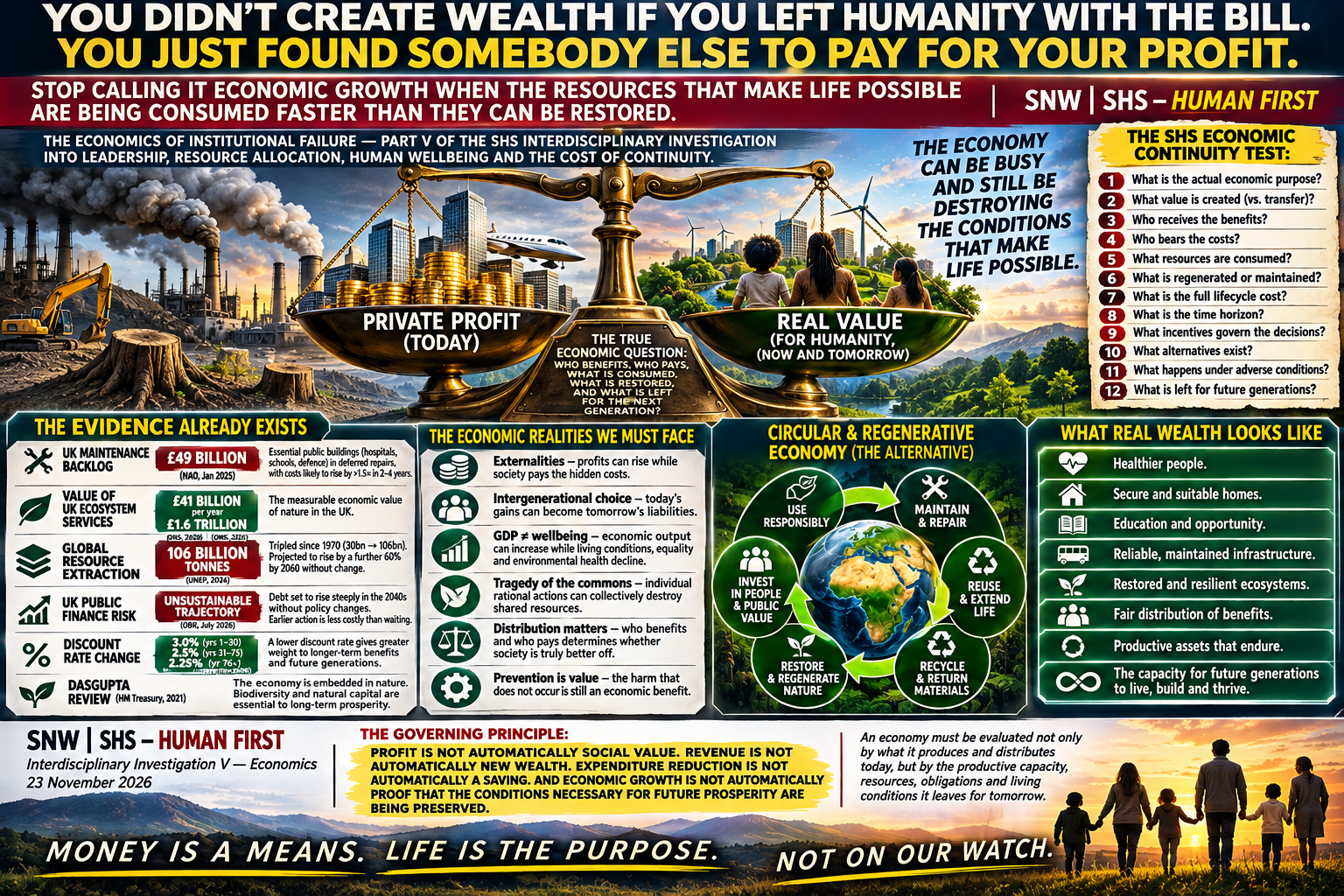
Are we organising economic activity to sustain the resources upon which people depend?
Or are we rewarding short-term extraction even when it compromises their continued availability?
LAW — UBUNTU AND HUMAN DIGNITY
South Africa’s Constitutional Court considered Ubuntu in the landmark 1995 case S v Makwanyane, concerning the constitutionality of the death penalty.
Ubuntu appeared within judicial reasoning addressing human dignity and the relationship between individuals and communities.
The significance is not that Ubuntu automatically supplies an answer to every legal question.
It is that a relational understanding of human dignity can contribute to legal reasoning.
HUMAN DIGNITY DOES NOT HAVE TO BE UNDERSTOOD AS AN ENTIRELY ISOLATED PROPERTY DETACHED FROM THE HUMAN COMMUNITY.
And now extend the legal investigation to future generations.
The Well-being of Future Generations (Wales) Act 2015 places duties upon specified public bodies to pursue sustainable development, including consideration of long-term needs.
Here the relationship is not only between living people.
It extends across time.
The generations who cannot yet vote.
The children who cannot yet object.
The people who will inherit infrastructure, environmental conditions, public debt, institutional decisions and consequences they did not participate in creating.
THE PEOPLE WHO COME AFTER US ARE NOT PRESENT TO PARTICIPATE IN OUR DECISIONS.
Does their absence make their future welfare irrelevant?
Of course not.
ENGINEERING — INTERCONNECTED SYSTEMS
Electricity networks.
Water systems.
Transport infrastructure.
Telecommunications.
Waste management.
Healthcare facilities.
Food distribution.
Modern infrastructure is built upon relationships between specialised systems.
A failure in one can compromise the operation of another.
A transport disruption can affect food supplies.
An electricity outage can compromise communication networks and medical equipment.
A water-system failure can affect sanitation, healthcare and public health.
YOU CANNOT ASSESS THE RELIABILITY OF THE WHOLE BY EXAMINING ONLY THE SUCCESS OF EACH PART IN ISOLATION.
Engineering recognises dependencies, feedback mechanisms, points of failure and the need for coordinated design.
Why should human governance be exempt from examining those same relationships?
PUBLIC HEALTH — SHARED EXPOSURE, SHARED CONSEQUENCES
Infectious diseases make human interdependence particularly visible.
One person’s exposure can affect others.
For some vaccine-preventable infections, high levels of immunity across a community can reduce transmission and help protect vulnerable people.
Public health also concerns sanitation, nutrition, clean water, environmental conditions and access to care.
Individual wellbeing is influenced by conditions that no single individual controls entirely.
YOU CANNOT ALWAYS PROTECT YOUR OWN HEALTH BY IGNORING THE CONDITIONS AFFECTING EVERYBODY AROUND YOU.
Not every public-health issue is collective in the same way, and interventions still require evidence, proportionality and respect for individual rights.
But the underlying relationship remains.
The conditions of human life are interconnected.
EDUCATION — KNOWLEDGE IS AN INHERITANCE
Consider how much of what you know was discovered before you existed.
Your language.
Your mathematics.
Your medicine.
Your engineering.
Your agricultural knowledge.
Your laws.
Your scientific instruments.
Your technological capabilities.
Generations of human beings contributed to foundations upon which you can now build.
YOU DID NOT HAVE TO REDISCOVER EVERYTHING HUMANITY ALREADY LEARNED BEFORE YOU WERE BORN.
And neither should your children.
Knowledge develops through accumulation, transmission, correction, criticism and discovery.
An educated generation can contribute knowledge that becomes available to the next.
And that knowledge can be developed further.
Which means education is not merely an individual purchase.
IT IS ALSO ONE OF THE MECHANISMS THROUGH WHICH HUMANITY CONTINUES DEVELOPING ITS COLLECTIVE CAPABILITIES.
DEMOGRAPHY — GENERATIONS ARE CONNECTED THROUGH TIME
Demography studies populations, including births, deaths, ageing and migration.
But examine the implications of generational succession.
Today’s children inherit circumstances shaped by yesterday’s adults.
Tomorrow’s children will inherit circumstances shaped by us.
Our present decisions influence the material and institutional conditions available to people who do not yet exist.
THE FUTURE DOES NOT ARRIVE DETACHED FROM THE PRESENT.
It develops through it.
And every generation becomes part of the conditions inherited by the next.
VI. THE THREE LEVELS OF INTERDEPENDENCE — BIOLOGICAL, ETHICAL AND INSTITUTIONAL
Now let me distinguish three things that I consider essential.
Because recognising a pattern across disciplines is not the same as demonstrating that all those disciplines are making identical claims.
1. BIOLOGICAL INTERDEPENDENCE
I EXIST THROUGH CONDITIONS AND RELATIONSHIPS BEYOND MYSELF.
This is an observation about living systems.
Human beings depend upon biological processes, ecological conditions and relationships contributing to their survival and development.
It describes what is.
2. ETHICAL RESPONSIBILITY
BECAUSE OTHERS CONTRIBUTE TO MY EXISTENCE, I HAVE REASONS TO CONSIDER MY RESPONSIBILITIES TOWARDS THEM.
This is a moral proposition.
It does not automatically follow from biology.
It requires ethical reasoning about dignity, reciprocity, fairness, harm and obligation.
But it is a proposition that humanity has developed across numerous philosophical and religious traditions.
It asks what ought to be.
3. INSTITUTIONAL RESPONSIBILITY
IF WE RECOGNISE OUR INTERDEPENDENCE, WE SHOULD EXAMINE WHETHER OUR SYSTEMS ARE DESIGNED TO SUPPORT IT.
This concerns governance.
How we organise resources.
How we distribute responsibilities.
How we measure success.
How we protect rights.
How we prevent harm.
How we establish accountability.
How we preserve conditions for future generations.
And importantly, how we do so without turning collective welfare into an excuse for coercion, exploitation or the destruction of individuality.
THE FIRST LEVEL DESCRIBES OUR CONDITION.
THE SECOND EXAMINES OUR OBLIGATIONS.
THE THIRD DETERMINES HOW THOSE OBLIGATIONS CAN BE TRANSLATED INTO PRACTICE.
And this is where I believe an enormous amount of humanity’s institutional confusion can be investigated.
Because acknowledging a responsibility in a philosophy or mission statement does not guarantee that the systems supposedly implementing it actually fulfil that responsibility.
You can declare human dignity while administering undignified conditions.
You can praise sustainability while exhausting the resources necessary for continued life.
You can celebrate healthcare while failing to investigate preventable causes of illness.
You can declare education important while allowing knowledge to become inaccessible.
You can promise future generations prosperity while transferring unresolved costs and deteriorating infrastructure to them.
RECOGNITION IS NOT IMPLEMENTATION.
And implementation is not proof of effectiveness.
The consequences still have to be examined.
VII. WE ARE ALL AFRICANS — BUT OUR SHARED ORIGIN DOES NOT REQUIRE IDENTICAL CULTURES
Now, return to my earlier point.
WE ARE ALL AFRICANS.
From the perspective of our species’ evolutionary origins, Africa is the birthplace of Homo sapiens, with evidence extending back approximately 300,000 years.
Our ancestry is complex, involving ancient populations, migrations and relationships across time.
But modern humanity shares that deep evolutionary origin.
This does not mean everybody possesses one identical ancestral philosophy.
It does not mean every African society historically practised Ubuntu.
It does not mean every non-African civilisation simply copied one African ethical system.
And it certainly does not mean that Africa has ever been one culturally uniform place.
OUR BIOLOGICAL RELATEDNESS IS NOT EVIDENCE OF CULTURAL IDENTICALNESS.
But isn’t it extraordinary that human beings, across different continents and historical circumstances, developed so many ways of recognising relational existence?
Ubuntu.
Ayni.
Whanaungatanga.
Seva.
Religious teachings about shared suffering and responsibility.
Philosophies of dependent origination.
Communal practices of sharing and reciprocity.
And modern research into the mechanisms of cooperation.
ONE HUMAN SPECIES. MANY EXPRESSIONS OF A RECURRING INSIGHT.
We developed different languages.
Different traditions.
Different institutions.
Different methods of describing existence.
Yet we repeatedly encountered the same practical condition:
WE DO NOT LIVE ENTIRELY THROUGH OURSELVES.
And if we cannot ignore that condition biologically, why are we so willing to ignore it institutionally?
VIII. SHS – HUMAN FIRST — FROM SHARING THE FRUIT TO SUSTAINING THE ORCHARD
Now, here is where the philosophy connects with the systems I have been proposing through SHS – HUMAN FIRST.
Because I am not interested in stopping at the observation that cooperation is beautiful.
I WANT TO INVESTIGATE WHAT MAKES IT WORK.
What makes a cooperative arrangement sustainable?
How does it protect the contributors?
How does it prevent exploitation?
How does it distribute resources without destroying the capacity to produce them?
How does it respond when people contribute different things?
How does it identify preventable deprivation?
How does it preserve the arrangement for future generations?
Consider some of the solutions I have been developing.
FOOD DISTRIBUTION
If edible food remains at the end of a commercial day, why should safe redistribution not be developed as a routine possibility before disposal?
Not by pretending food safety, logistics and storage requirements do not exist.
But by designing systems capable of addressing them.
WHY SHOULD THE EXISTENCE OF A LOGISTICAL PROBLEM AUTOMATICALLY BECOME AN EXCUSE FOR ACCEPTING A HUMAN PROBLEM?
Investigate the logistics.
VACANT PROPERTIES
If buildings remain unused while people lack adequate shelter, investigate whether those properties can be safely and economically renovated and returned to productive use.
Not every building will be suitable.
But suitability is something to determine through assessment, not assumption.
PUBLIC ENTERPRISE
If governments require sustainable resources to finance public services, investigate whether publicly owned commercial activities can generate additional revenue alongside taxation.
Develop viable enterprises.
Employ people.
Produce useful goods and services.
Measure costs and returns.
Reinvest appropriate surpluses in public benefit.
THE PUBLIC CAN POTENTIALLY BENEFIT NOT ONLY FROM THE SERVICES AN ECONOMY PROVIDES, BUT ALSO FROM OWNERSHIP OF PRODUCTIVE ASSETS.
With transparency, oversight and proper safeguards, of course.
INTERGENERATIONAL PARTICIPATION
If older generations possess knowledge, experience and time that they would voluntarily like to contribute, why not create accessible opportunities for intergenerational teaching, gardening, mentoring and community activities?
Not compulsory labour.
Not the exploitation of retirement.
VOLUNTARY CONTRIBUTION, CONNECTION AND CONTINUITY.
REFORESTATION AND ECOLOGICAL REGENERATION
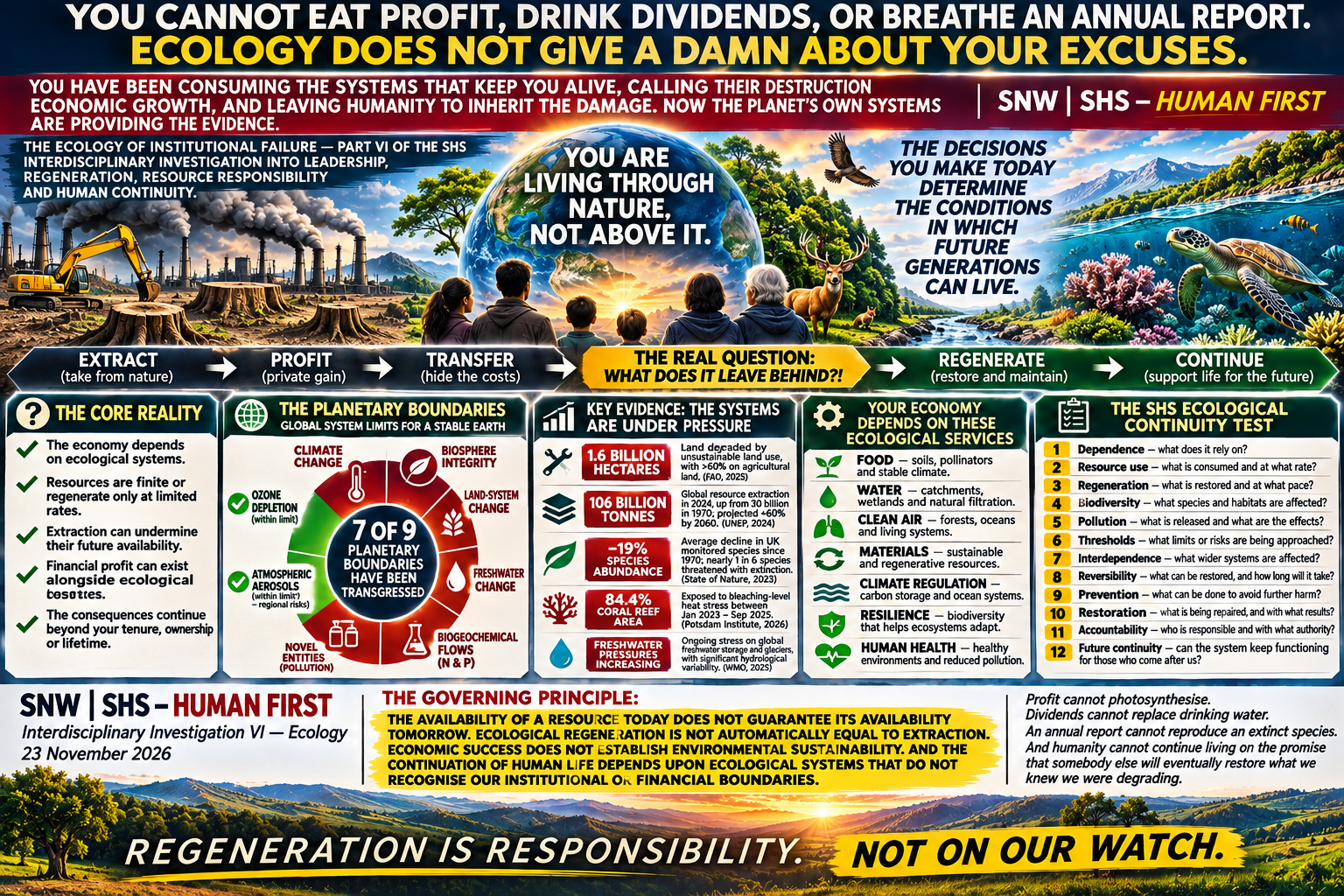
If human activity consumes ecological resources, investigate how restoration, conservation and sustainable production can contribute to their renewal.
Because a generation cannot reasonably claim to have preserved prosperity while exhausting the ecological conditions upon which future prosperity depends.
And here is the principle connecting these proposals.
THE OBJECTIVE IS NOT MERELY TO SHARE WHAT ALREADY EXISTS.
It is to investigate the conditions through which resources are produced, preserved, accessed, regenerated and made available for continued human use.
In other words:
THE CHILDREN SHARED THE BASKET OF FRUIT.
BUT HUMANITY ALSO NEEDS TO LEARN HOW TO SUSTAIN THE ORCHARD.
How do we protect the trees?
Who maintains the land?
Who understands the soil?
Who provides the water?
Who harvests the fruit?
Who distributes it?
Who ensures that contributors are treated fairly?
Who investigates what is being wasted?
Who plants for the next generation?
And who remains accountable when the orchard deteriorates?
Because an arrangement that distributes every available fruit today while destroying the capacity to grow fruit tomorrow has not solved the problem of continuity.
IT HAS MERELY TRANSFERRED THE COST TO THE FUTURE.
And THAT is precisely the problem I keep returning to.
IX. INDIVIDUALITY IS NOT THE OPPOSITE OF INTERDEPENDENCE
Let me make something very clear.
I am not advocating for the elimination of individuality.
I am not suggesting that every human being must have identical ambitions, capabilities, preferences or contributions.
I am not suggesting that people should indefinitely sacrifice their wellbeing for others who refuse responsibility or reciprocity.
Nor am I claiming that competition is inherently wrong.
Competition can encourage innovation, performance, discovery and personal development.
But competition is a method of organising certain activities.
IT IS NOT A UNIVERSAL MORAL JUSTIFICATION FOR PREVENTABLE HUMAN SUFFERING.
And neither is cooperation automatically ethical merely because it is collective.
A group can cooperate to exploit others.
An institution can coordinate its employees to conceal wrongdoing.
A government can organise departments around an objective that violates human dignity.
COOPERATION IS A CAPABILITY. WHAT WE COOPERATE TO ACCOMPLISH STILL MATTERS.
That is why the distinction between collective power and collective responsibility is so important.
The objective cannot simply be to make people act together.
It must include examining whether their cooperation produces outcomes consistent with the preservation of human dignity, freedom, wellbeing and continuity.
YOUR HEART DOES NOT NEED TO BECOME YOUR LUNGS.
YOUR LUNGS DO NOT NEED TO BECOME YOUR BRAIN.
Their distinct capabilities contribute to the organism.
And similarly, human beings do not have to surrender their individuality to recognise that their actions have consequences for one another.
INDIVIDUALITY AND INTERDEPENDENCE ARE NOT MUTUALLY EXCLUSIVE.
The problem begins when individuality is confused with an absence of responsibility.
Or when collective responsibility is confused with the right to consume an individual.
Neither is necessary.
X. HUMANITY DID NOT JUST FORGET HOW TO SHARE THE FRUIT. IT FORGOT HOW MUCH OF THE ORCHARD WAS NEVER ITS INDIVIDUAL ACHIEVEMENT.
Now consider the full investigation.
Ancestral philosophies recognise relationships.
Religious traditions describe shared obligations.
Biology demonstrates functional interdependence.
Ecology reveals relationships through which life is sustained.
Economics investigates cooperative resource governance.
Law can recognise dignity, community and responsibilities extending into the future.
Engineering examines how interconnected systems function and fail.
Public health studies shared conditions affecting human wellbeing.
Education transmits knowledge across generations.
Demography examines populations whose circumstances are continuously shaped by the generations before them.
DIFFERENT DISCIPLINES. DIFFERENT QUESTIONS. DIFFERENT METHODS.
Not identical conclusions.
Not universal moral agreement.
But a recurring recognition that the individual exists through a wider network of conditions and relationships.
And still, look at how easily our institutions can become absorbed in protecting their own continuation.
A corporation protects its profits.
A government protects its authority.
An industry protects its commercial interests.
A department protects its performance indicators.
A professional protects their reputation.
A shareholder protects their returns.
And somewhere inside that arrangement, the actual conditions of human life can become secondary.
WHO IS PROTECTING THE WHOLE?
Not by claiming authority over everybody.
Not by demanding that every individual surrender their rights.
But by ensuring that the interactions between our institutions are examined against the human purposes they are supposed to serve.
Who investigates the consequences that fall between departments?
Who examines the costs that are never entered into a company’s accounts?
Who measures the damage transferred to the next generation?
Who recognises that financial growth can coexist with ecological deterioration?
Who examines whether the success of one institution is being purchased through the failure of another?
And who is willing to question the rules of the race rather than merely congratulating the winner?
Because the most remarkable thing about the children in that Ubuntu parable was not that they were incapable of competing.
IT WAS THAT THEY DID NOT AUTOMATICALLY ACCEPT COMPETITION AS THE ONLY WAY TO ORGANISE THEIR RELATIONSHIP TO THE REWARD.
They recognised another possibility.
And humanity possesses the capacity to do the same.
We can recognise a problem.
Investigate its causes.
Examine the relationships producing it.
Test alternative arrangements.
Measure their consequences.
Correct what fails.
Preserve what works.
And continue improving the conditions inherited by those who come after us.
THAT IS WHAT OUR INTELLIGENCE SHOULD ENABLE US TO DO.
Not merely win existing competitions.
But investigate whether the competitions are serving the purposes for which they were created.
Not merely accumulate resources.
But understand the systems through which those resources remain available.
Not merely establish institutions.
But maintain accountability for the human consequences of their existence.
And not merely describe interdependence in our philosophies.
BUT DEVELOP THE PRACTICAL CAPABILITY TO LIVE RESPONSIBLY WITHIN IT.
XI. THE QUESTION I LEAVE HUMANITY WITH
If your body depends upon coordination between its organs…
If the food you eat depends upon relationships between ecological and human systems…
If the knowledge you possess depends upon generations of discoveries…
If your health is influenced by conditions beyond your individual control…
If your economy depends upon contributions extending far beyond those who receive the final financial rewards…
If your institutions exist because human beings collectively establish and maintain them…
And if the generations who come after you will inherit the consequences of what you decide today…
THEN WHY SHOULD YOUR RESPONSIBILITY STOP AT THE BOUNDARIES OF YOUR IMMEDIATE SELF-INTEREST?
I am not asking humanity to abandon self-interest.
I am asking humanity to examine whether its understanding of self-interest is complete.
Because protecting only your immediate advantage while damaging the conditions upon which your future depends may not be self-preservation at all.
It may be a failure to understand the full extent of your own dependence.
AND WHAT IS THE VALUE OF WINNING THE FRUIT IF YOU HAVE HELPED DESTROY THE ORCHARD THAT MUST FEED YOUR CHILDREN?
The children in the parable recognised that they could arrive together.
Our challenge is greater.
We must investigate how the resources, knowledge, rights, institutions and ecosystems necessary for human wellbeing can remain available beyond the present generation.
Because the goal is not merely for everyone alive today to share a basket.
IT IS FOR THE ORCHARD TO REMAIN CAPABLE OF PRODUCING FRUIT LONG AFTER WE ARE GONE.
And perhaps this is the distinction we have been missing.
UBUNTU REMINDS US THAT OUR PERSONHOOD EXISTS THROUGH RELATIONSHIPS.
BIOLOGY REMINDS US THAT OUR EXISTENCE DEPENDS UPON CONDITIONS BEYOND OURSELVES.
ECOLOGY REMINDS US THAT LIFE IS SUSTAINED THROUGH INTERCONNECTED PROCESSES.
HISTORY REMINDS US THAT WE INHERIT WHAT OTHERS HAVE BUILT.
ETHICS ASKS WHAT RESPONSIBILITIES FOLLOW FROM THOSE RELATIONSHIPS.
AND GOVERNANCE MUST DETERMINE HOW THOSE RESPONSIBILITIES CAN BE FULFILLED WITHOUT DESTROYING THE FREEDOM, DIGNITY OR CONTINUITY OF THE PEOPLE INVOLVED.
One human species.
Many cultures.
Many capabilities.
Many generations.
One shared planet.
And an extraordinary amount of work still to be done.
WE ARE NOT REQUIRED TO BECOME IDENTICAL TO RECOGNISE THAT OUR FUTURES ARE INTERCONNECTED.
WE DO NOT NEED TO DEPRIVE ONE ANOTHER TO PROVE THAT WE ARE CAPABLE OF ACHIEVEMENT.
AND WE DO NOT NEED TO WAIT UNTIL THE ORCHARD IS DYING BEFORE WE QUESTION WHO HAS BEEN RESPONSIBLE FOR MAINTAINING IT.
Humanity did not merely forget how to share the fruit.
IT DEVELOPED ENTIRE SYSTEMS CAPABLE OF OBSCURING HOW MUCH OF THE ORCHARD DEPENDS UPON EVERYBODY ELSE’S CONTRIBUTIONS.
So perhaps the next stage of human development is not simply learning how to win.
IT IS LEARNING HOW TO BUILD, MAINTAIN AND IMPROVE SYSTEMS IN WHICH HUMAN ACHIEVEMENT DOES NOT REQUIRE THE UNNECESSARY DEPRIVATION OF OTHER HUMAN BEINGS.
Because what good is being first…
IF THE CONDITIONS THAT ALLOWED YOU TO ARRIVE ARE NO LONGER THERE FOR THOSE WHO FOLLOW?
I AM BECAUSE WE ARE.
AND WHAT WE LEAVE BEHIND WILL CONTRIBUTE TO WHAT THEY BECOME.
HUMAN FIRST. CONTINUITY ALWAYS.
SNW | SHS – HUMAN FIRST
23 November 2026
References and further reading
- African philosophy: Internet Encyclopedia of Philosophy — African ethics, Ubuntu and communal personhood.
- Andean reciprocity: Smithsonian Institution, The Great Inka Road: Engineering an Empire — Ayni and reciprocal labour.
- Sikhism: Sikh Coalition — Langar and Seva.
- Māori philosophy: Health Quality & Safety Commission New Zealand — Whanaungatanga and culturally informed wellbeing.
- Christianity: Acts 2:44–45 and 1 Corinthians 12:26.
- Islam: Qur’an 59:9; Sahih Muslim, the comparison of believers to one body.
- Buddhist philosophy: Stanford Encyclopedia of Philosophy — dependent origination.
- Biology and ecology: NOAA — coral-algae symbiosis; scientific research on multicellularity and cooperation.
- Economics: Elinor Ostrom, Governing the Commons (1990).
- Law: Constitutional Court of South Africa, S v Makwanyane (1995); Well-being of Future Generations (Wales) Act 2015.
- Public health: World Health Organization — immunisation and community protection.
- Human evolution: Smithsonian National Museum of Natural History — Human Origins Program.
The comparisons in this investigation are interdisciplinary parallels, not claims that every tradition, organism or scientific field expresses the same philosophy or moral conclusion.



Leave a Reply