
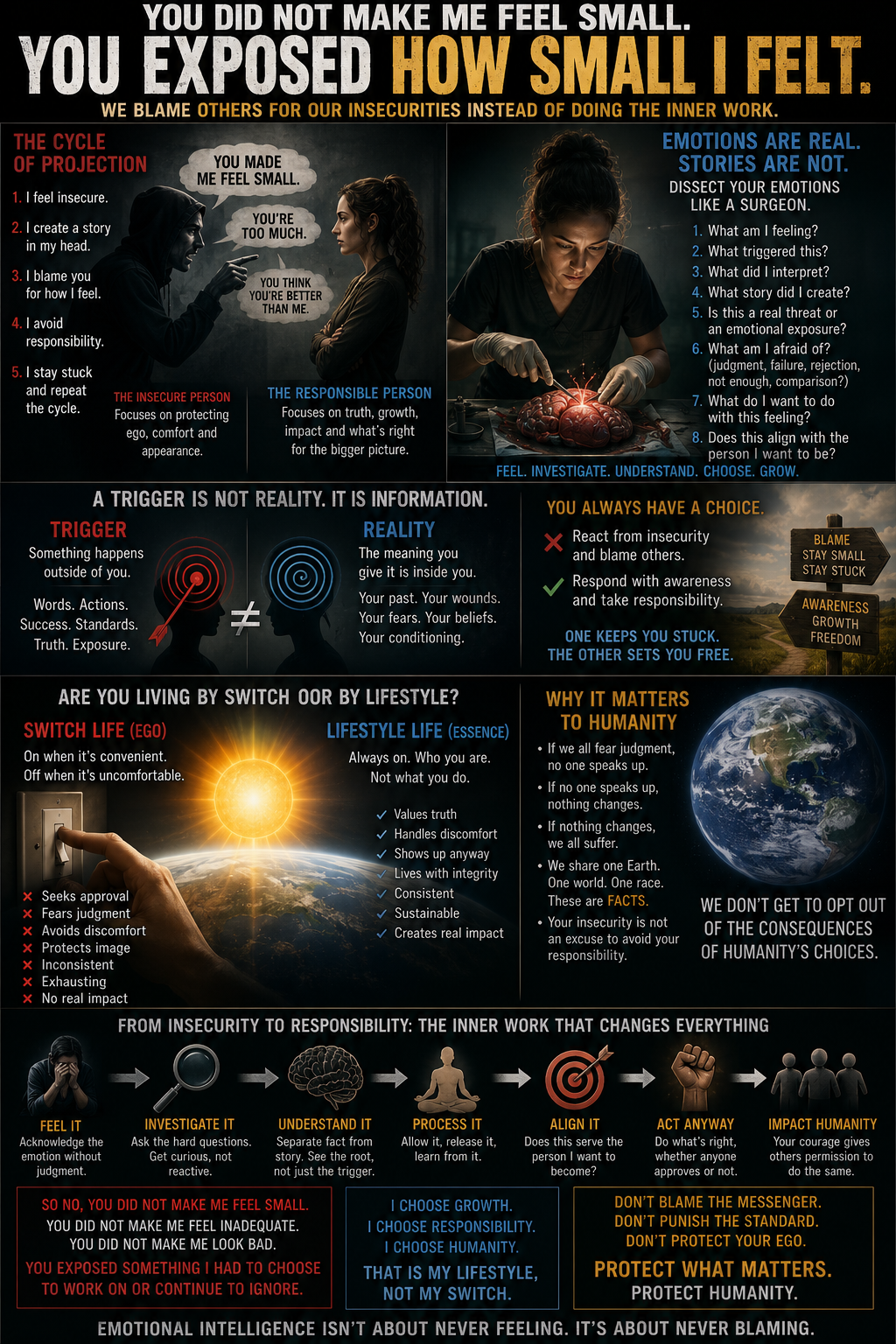
Blame circumstances not the emotions felt. Context matters more than anything we have told ourselves to matter.
This fight isn’t the problem, those who feel it isn’t worth the sweat and are comfortable with their own time are. Who cares about those who drop every second. Yeah I will relay the facts even if it makes you feel bad for not doing enough, cause that’s a fact of its own. What’s it going to take for you to be responsible?! We go for the whole range of emotions, something will work, cause we need it to work, we need more hands, more minds and even more emotions.
There is a human behaviour I keep noticing that is so common that we have almost stopped questioning it.
People blame their own insecurities on other people.
Not occasionally.
Constantly.
And what makes it so fascinating is that the person experiencing the insecurity can genuinely believe that the other person caused it.
Someone succeeds, and another person says they made them feel inadequate.
Someone speaks confidently, and somebody else says they made them feel small.
Someone establishes a high standard, and suddenly they are accused of making everyone else feel bad.
Someone says something uncomfortable but necessary, and the response becomes:
“You made me feel…”
But did they?
Or did they reveal something that was already there?
Because those are two completely different things.
And I think this distinction is one of the least examined parts of emotional intelligence.
A person can absolutely be triggered by somebody else.
That is real.
Something outside of us can activate fear, shame, jealousy, inadequacy, anger, embarrassment, insecurity or defensiveness.
But a trigger is not the same thing as the origin of the emotion.
The trigger is the event.
The emotional meaning we assign to the event is ours.
And what we do with that meaning is also ours.
That is where emotional intelligence should begin.
Not with:
“Who made me feel this?”
But:
“Why did this make me feel this?”
That question changes everything.
Because now we are no longer looking for somebody to blame.
We are investigating ourselves.
And that investigation needs to be ruthless.
If I feel small, why?
What exactly happened?
What did I interpret?
What did I assume?
What did this situation expose about the way I see myself?
What expectation did I have that was challenged?
What am I afraid this person represents?
Am I actually threatened?
Or am I emotionally exposed?
Am I afraid of failure?
Am I afraid of comparison?
Am I afraid of what other people will think of me?
Am I afraid that someone else’s competence exposes my own lack of effort?
Am I angry because they did something wrong?
Or am I angry because they did something I know I could have been doing?
These are not comfortable questions.
That is exactly why they are useful.
Because emotional intelligence is not simply knowing the names of emotions.
That is emotional vocabulary.
Emotional intelligence is being able to dissect an emotion with enough precision to understand what it is doing inside you.
Like a surgeon.
You do not look at a body and say:
“Something is wrong.”
You investigate.
You locate it.
You identify the source.
You examine what is connected to it.
You determine what is causing what.
And then you decide what needs to happen.
That is what we should be doing with our emotions.
Because an emotion can be real without its interpretation being accurate.
A feeling can be genuine without the story attached to it being true.
I can genuinely feel threatened without actually being in danger.
I can genuinely feel small without anyone actually making me smaller.
I can genuinely fear embarrassment without embarrassment being a meaningful risk.
I can genuinely feel rejected without somebody actually rejecting me.
The emotion deserves attention.
The interpretation deserves investigation.
Those are not the same thing.
And this is where the phrase “you made me feel” becomes so interesting.
Sometimes it is simply conversational shorthand.
Of course another person can influence how we feel.
But if we turn that shorthand into an absolute statement of causation, we give away something incredibly important:
our agency.
Because if you made me feel this way, then the obvious solution becomes changing you.
But if you exposed something within me, then the responsibility comes back to me.
And that is a much harder responsibility.
It means I cannot simply demand that you become smaller so I can feel bigger.
I have to become stronger internally.
And this is where I think a lot of insecurity becomes projection.
A person feels inadequate.
Instead of confronting the inadequacy, they identify the person who triggered it.
Then the triggered person becomes the problem.
The successful person becomes “too much.”
The confident person becomes “arrogant.”
The efficient person becomes “intimidating.”
The ambitious person becomes “obsessed.”
The honest person becomes “harsh.”
The person holding them accountable becomes “judgmental.”
And the person who refuses to lower their standards becomes “making everyone else feel bad.”
Suddenly, the person experiencing insecurity has managed to transform their internal discomfort into an external accusation.
That is projection.
And projection is convenient because it means I don’t have to look at myself.
I can spend all day investigating your behaviour so that I never have to investigate mine.
But what if the person who “made you feel small” was simply standing at their full height?
What if they were not trying to make you small at all?
What if they were simply refusing to make themselves smaller so that you would feel comfortable?
That is an enormous distinction.
Because sometimes what people call intimidation is simply exposure to a standard they are not currently meeting.
And instead of saying:
“I need to grow.”
they say:
“You need to stop making me feel inadequate.”
Why?
Because growth is painful.
Accountability is uncomfortable.
Admitting that someone is currently more effective than you are can bruise the ego.
So the ego finds another explanation.
“They are doing too much.”
“They think they’re better than everyone.”
“They are making the rest of us look bad.”
But making somebody look bad and revealing that somebody is underperforming are not the same thing.
That distinction matters enormously.
If your performance looks poor because someone else is performing well, the solution is not necessarily to bring them down.
Maybe the solution is to raise yourself.
And this is where I think we need to completely rethink what we mean by emotional intelligence.
Emotional intelligence should not mean:
“I know how my emotions feel.”
It should mean:
“I am capable of interrogating my emotions before allowing them to govern my behaviour.”
That means when I feel something, I ask:
What happened?
What did I feel?
Why did I feel it?
What meaning did I attach to it?
What part of that meaning is fact?
What part is assumption?
What part is fear?
What part is ego?
What part is history?
What part is actually about the person in front of me?
What part is about me?
What do I want to do with this feeling?
Does this feeling deserve action?
Does it deserve processing?
Does it deserve release?
Does it deserve accountability?
Does it align with the person I say I want to become?
That last question is one of the most important questions a human being can ask.
Because emotions are information.
They are not always instructions.
I can feel fear and still choose courage.
I can feel jealousy and still choose admiration.
I can feel insecurity and still choose growth.
I can feel embarrassment and still speak.
I can feel intimidated and still do what is necessary.
I can feel angry and still ask whether the anger is actually justified.
That is emotional intelligence.
Not the absence of emotion.
The ability to govern emotion without pretending it isn’t there.
And this becomes even more important when the thing we are afraid of is what other people might think.
Because this is one of the most common ways people quietly sabotage themselves.
You think:
“What if they judge me?”
So you don’t say what needs to be said.
“What if they think I’m too much?”
So you reduce yourself.
“What if people misunderstand me?”
So you stay silent.
“What if they think I’m arrogant?”
So you hide your competence.
“What if this makes somebody uncomfortable?”
So you don’t share something that could genuinely help them.
And then what happens?
The fear teaches your subconscious a lesson.
It teaches you:
“When something matters, stop.”
“When you might be judged, retreat.”
“When you could be useful, prioritise your appearance.”
That becomes a pattern.
And patterns become behaviour.
And repeated behaviour becomes identity.
You don’t just avoid one post.
You train yourself to avoid.
You don’t just avoid one conversation.
You train yourself to silence yourself.
You don’t just avoid one uncomfortable truth.
You train yourself to prioritise appearance over contribution.
And now the insecurity is no longer simply a feeling.
It has become a behavioural system.
That is why we have to interrupt it.
Because the question cannot always be:
“How do I stop feeling uncomfortable?”
Sometimes the better question is:
“What is this discomfort asking me to become?”
Maybe it is asking you to become braver.
Maybe more honest.
Maybe more disciplined.
Maybe more knowledgeable.
Maybe more compassionate.
Maybe more resilient.
Maybe less dependent on external approval.
And this is where the distinction between a trigger and reality becomes incredibly important.
A trigger tells you something happened inside you.
It does not automatically tell you what is true outside you.
That requires examination.
And this is exactly why pointing the finger at the trigger solves almost nothing.
You can spend your whole life trying to remove every person, situation, opinion, achievement and standard that makes you uncomfortable.
Or you can develop the capacity to encounter discomfort without surrendering your judgment to it.
The second option is much more intelligent.
And it matters beyond the individual.
Because what happens when an entire population becomes afraid of being judged?
People stop speaking.
People stop challenging.
People stop creating.
People stop experimenting.
People stop taking responsibility.
People stop holding each other accountable.
People start protecting appearances.
And eventually everyone is participating in a culture where nobody wants to be the person who says:
“This isn’t working.”
Because they are afraid someone will say:
“You are making us look bad.”
But if nobody says it, the problem remains.
And this is where my argument about humanity comes back into it.
We all live on the same Earth.
We share a world.
We share a human race.
Those are not opinions.
They are realities.
Nobody can opt out of being part of the consequences of humanity’s collective decisions simply because they are personally uncomfortable with the responsibility.
We all inherit the consequences of what humanity creates.
That means our responsibility cannot be entirely individualistic.
If I am willing to fight for something I believe is necessary for humanity, and another person is afraid to participate because they might be judged, their discomfort does not remove the responsibility.
It simply means someone else has to carry more of it.
And that is not sustainable.
Because if everyone waits until they feel completely safe, completely confident, completely approved of, completely understood and completely free from criticism before they do what is necessary, very little important will ever happen.
There will always be somebody who disagrees.
There will always be somebody who thinks you are too ambitious.
There will always be somebody who thinks you are too intense.
There will always be somebody who thinks you are making them look bad.
There will always be somebody whose insecurity gets activated by your confidence.
That cannot become the standard by which humanity decides what is worth doing.
Because then the most insecure person in the room becomes the governor of everybody else’s potential.
And I refuse that.
We should care about people’s feelings.
Absolutely.
But caring about someone’s feelings does not mean making their feelings the ultimate authority over reality.
There is a difference between consideration and submission to another person’s insecurity.
Sometimes compassion means listening.
Sometimes compassion means adjusting.
And sometimes compassion means telling someone:
“I understand that this triggered something in you, but I am not going to stop doing what is necessary simply because your insecurity was exposed by it.”
That is not cruelty.
That can be responsibility.
And this is why I keep thinking about the difference between a light and the sun.
A light in a room switches on when we choose to switch it on.
Then we switch it off.
That is an action.
That is a state.
The sun is different.
We experience daylight and darkness because of our position on Earth, but the sun does not become “light” only when we happen to see it.
Its nature is continuous.
That is a lifestyle.
A lifestyle is not something you activate when convenient and deactivate when uncomfortable.
It is who you are repeatedly.
If I say I care about humanity, then caring about humanity cannot be something I switch on when it makes me look good.
If I say I value accountability, I cannot switch accountability off when someone holds me accountable.
If I say I value excellence, I cannot suddenly call excellence arrogance when someone else demonstrates more of it.
If I say I value honesty, I cannot demand honesty from others while protecting myself from uncomfortable truths.
If I say I believe in responsibility, I cannot use my insecurity as an excuse to avoid responsibility.
That is not a lifestyle.
That is a switch.
And humanity needs fewer switches.
We need more consistency.
More people willing to say:
“This is who I am, even when nobody is watching.”
Because ultimately, the work is not to eliminate insecurity.
The work is to become intelligent enough to understand it.
You will feel threatened.
Investigate it.
You will feel jealous.
Investigate it.
You will feel small.
Investigate it.
You will fear judgment.
Investigate it.
You will want to blame someone.
Investigate that too.
Ask yourself:
What exactly am I protecting?
My dignity?
My ego?
My reputation?
My comfort?
Or am I protecting myself from having to grow?
That question can change a life.
Because maybe the person did not make you feel small.
Maybe they simply stood tall.
Maybe they did not make you inadequate.
Maybe their competence exposed an area where you have stopped developing.
Maybe they did not make you look bad.
Maybe they simply made the gap between the standard and your current performance visible.
And maybe the answer isn’t to punish them for showing you the gap.
Maybe the answer is to close it.
That is what emotional intelligence should be.
Not emotional avoidance.
Not emotional manipulation.
Not making everyone else responsible for how you feel.
Emotional intelligence is the ability to feel deeply without surrendering your responsibility to think deeply.
And when that intelligence becomes a lifestyle rather than a switch, something changes.
You stop asking:
“Who made me feel this way?”
and start asking:
“What is this feeling trying to teach me?”
That is where the real work begins.
And perhaps that is exactly where humanity needs to begin too.
Because we cannot keep blaming the people who are willing to carry the weight simply because their willingness reminds us that we could have been carrying some of it too.
We share one Earth.
We share one world.
We share one human race.
And if some people are willing to get up and do the work, the answer should not be to make them feel guilty for doing it.
The answer should be:
Get up.
Come help.
Learn.
Contribute.
Build.
Because your insecurity is yours to understand.
My responsibility is mine to carry.
And humanity’s future belongs to all of us.
….
Hi, I need to write this next post, which is quite interesting, but at the same time baffling, because it’s a trend that I’ve noticed so common, yet I’m still trying to understand what, like where it comes from, what led to it, what fueled it, what keeps fueling it, what condones it, what reinforces it, because it’s an interesting trend that humans have. And as you interact with humans on a daily basis, you probably be able to tell me more on it. But why do people blame their own individual insecurities on other people? And what I mean by that is that they create circumstances because of their insecure self, and then blame the other person for it, or blame how the other person interacts with their projection of insecurity, or blame the other person for being too perfect for making them feel small, when the feeling of feeling small is within the person. It’s not something that someone from outside can make you feel. Because clearly, I have not felt small from endless of people trying to make me feel small for having and doing a fight that’s bigger than myself. So how is it that anyone can justify the sentence of you made me feel small, or you made me feel whatever usually follows that? Please highlight this and make it as educated as possible, because I don’t genuinely believe people actually do deep or question this behavior as much. Not at all, actually. And my actually add on to, um, in terms of, like, the educational part, because pointing the finger at the problem, it doesn’t solve anything, right? And because it’s great to understand that things can be triggered, but that doesn’t mean that the trigger is reality, or it doesn’t mean that the trigger should be sustained. And what really brings the intelligence part to emotional intelligence is to be able to actually dissect one’s emotions like a surgeon. So if you feel something, you should start asking yourself questions about the feeling and what led to the feeling, what reinforced the feeling, what created the feeling, how do you want to feel about the feeling, where should you put the feeling, how does the feeling relate to the person that you want to be. Meaning you feel threatened by something, well, is it a real threat? No, it’s an emotional exposure, or it’s fear of what others might think, or whatever, right? Okay, let’s use the fear of what others might think because it’s the most common one. Okay, so one feels that, okay, well, what am I trying to do here? Am I trying to appease to them, or am I trying to educate them something? Well, I’m trying to educate them something. Not just, I’m also holding them accountable to something greater than themselves, and I’m also holding them responsible for their innate natural responsibility, something that already sits inside of them, but they’re not willing to actually accomplish, they’re not willing to actually live by, they’re not willing to actually make it into a lifestyle. Because again, a lifestyle is something that you live on a daily basis, not something that you switch on and switch off, right? Light is always light, but light in a room switches on when you need it, or when you choose to switch it on. That is not a lifestyle. That light is not constantly on. The sun is a lifestyle because the sun is always on. It just happens that we, from different locations on the world, see it at different times, but that doesn’t mean that the sun ever switches off. That is a lifestyle, which is completely different from turning the light on or switching the light off. Now when it comes to insecurities and how we actually go about that, it’s important that we also assess how it impacts the responsibility as a human being. Because if we all feel insecure about fighting the fight of humanity, then no one actually does fight for humanity, which then becomes a problem and a hindrance because the few that do want to fight for humanity then have to pick up the pace and the weight of all the others that don’t. Because we all share one Earth, we all share one world. Not because one chooses not to, it takes away from the fact, like these are facts, F-A-C-T-S. These are facts. Like no one can say, Oh no, we don’t share Earth. Oh no, we don’t share a world. Oh no, we don’t share a race, which is the human race. No one can say that. But will they try and say, Oh, you made me look bad? A hundred fucking percent. Why? Because that’s the only thing that they have to justify their delay in actually doing the work. You know? If you call them out for not doing the work, they put that before actually triggering themselves into doing the work. It doesn’t make sense. It absolutely does not make sense. Because again, if we get a trigger, we should be able to speak with ourselves and look at what needs to be prioritized. If I fear, if I get the emotional feeling of, Oh, I had the fear of how this might come across, or how this might come— how it might affect other people’s emotions and whatnot, and I don’t post something that’s actually beneficial or helpful to people, I’m hindering myself by reinforcing the fear of appearances, and on top of that, creating a pattern within my subconscious of, No, you should stop doing certain things because of fear of how you appear. And on top of that, it does not teach anything to the person outside that might be waiting or needing to hear it, which then again helps no one. If anything, it makes things even worse. So let’s dissect that, because that is a really important point to really look at.




Leave a Reply