If the governance goes through, it’s only fair we have all of our farms in Africa, nurture the land and feed its economies, balance things out. Give free food to all that work on the farms, and to them if they upsell it, as long as our needed amounts are covered, to them the authority of choice for what’s un-exported.
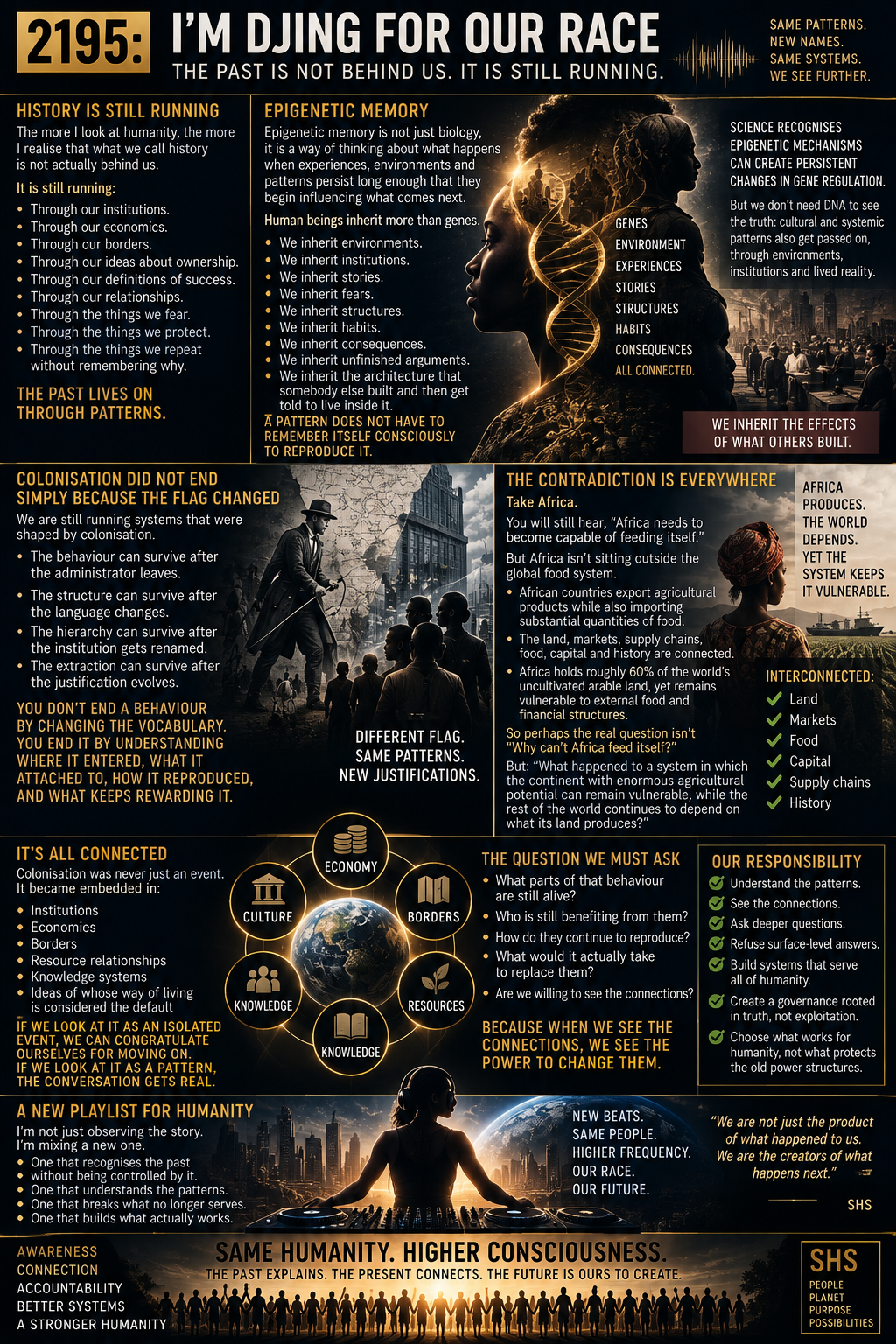
The more I look at humanity, the more I realise that what we call history is not actually behind us.
It is still running.
It is running through our institutions.
Through our economics.
Through our borders.
Through our ideas about ownership.
Through our definitions of success.
Through our relationships.
Through the things we fear.
Through the things we protect.
Through the things we repeat without remembering why we started repeating them.
And this is where I want to introduce something that I think we haven’t taken seriously enough:
epigenetic memory.
Not merely as a biological conversation, but as a way of thinking about what happens when experiences, environments and patterns persist long enough that they begin influencing what comes next.
Science does recognise that epigenetic mechanisms can create persistent changes in gene regulation, and research continues to investigate how environmental experiences relate to epigenetic states. But claims about environmentally acquired traits being reliably transmitted across generations in humans remain contested; the evidence is much stronger for some model organisms and for biological processes within an individual’s lifetime than for sweeping claims about human transgenerational inheritance.
And that distinction matters to me because I don’t need to pretend that every cultural pattern is literally encoded into DNA to see something obvious:
human beings inherit more than genes.
We inherit environments.
We inherit institutions.
We inherit stories.
We inherit fears.
We inherit structures.
We inherit habits.
We inherit consequences.
We inherit unfinished arguments.
We inherit the architecture that somebody else built and then get told to live inside it.
And that is where the conversation about colonisation becomes much bigger than history.
Colonisation did not end simply because the flag changed
We are still running systems that were shaped by colonisation.
Not necessarily because somebody is walking into the room today wearing the exact same clothes as a colonial administrator.
The behaviour can survive after the administrator leaves.
The structure can survive after the language changes.
The hierarchy can survive after the institution gets renamed.
The extraction can survive after the justification evolves.
That is the part I think humanity needs to understand.
You don’t eradicate a behaviour simply by changing the vocabulary around it.
You eradicate it by understanding where it entered the system, what it attached itself to, how it reproduced itself, and what keeps rewarding it.
That’s why I keep talking about connections.
Because if we look at colonisation as an isolated historical event, we can congratulate ourselves for having moved on.
If we look at it as a pattern that became embedded in institutions, economies, borders, resource relationships, knowledge systems and ideas of whose way of living is considered the default, suddenly the conversation gets much harder.
Because then we have to ask:
What parts of that behaviour are still alive?
And:
Who is still benefiting from them?
The contradiction is everywhere
Take Africa.
You will still hear variations of the argument that Africa needs to become capable of feeding itself.
And yes, food security and stronger African agricultural systems matter enormously.
But look at the relationship properly.
Africa isn’t sitting outside the global food system.
It is deeply embedded within it.
African countries export agricultural products while also importing substantial quantities of food, and international trade is a major part of how African food systems function. FAO has documented the continent’s historical dependence on imported basic food products alongside exports of commodities such as cocoa, coffee, tea, fruits and nuts.
So when somebody says:
“Africa should feed itself.”
I want to ask:
“Who exactly are you imagining is standing outside Africa’s agricultural table?”
Because the global system is interdependent.
The land is connected.
The markets are connected.
The supply chains are connected.
The food is connected.
The capital is connected.
The history is connected.
And Africa has enormous productive potential. FAO notes that the continent holds roughly 60% of the world’s uncultivated arable land, while also pointing to structural problems including underinvestment, fragmented markets and vulnerability to external shocks.
So perhaps the conversation isn’t:
“Why can’t Africa feed itself?”
Perhaps it is:
“What happened to a system in which the continent with enormous agricultural potential can remain vulnerable to external food and financial structures while the rest of the world continues to depend on what its land produces?”
Now we’re looking at the system.
This is what I mean by epigenetic memory
A pattern does not have to remember itself consciously to reproduce itself.
That’s true biologically.
And it is true socially.
A child doesn’t have to remember the original decision that produced an institution for the child to inherit its consequences.
A generation doesn’t have to have experienced colonisation directly to live inside economic and institutional structures shaped by colonial history.
A person doesn’t have to know where an assumption came from for that assumption to influence their behaviour.
That’s the bigger concept I’m using.
The environment can carry memory.
The institution can carry memory.
The architecture can carry memory.
The behaviour can carry memory.
And the people born into it can mistake inherited conditions for natural conditions.
That is the dangerous part.
Because once an inherited pattern starts looking natural, nobody asks who created it.
And this is why I am not simply writing essays
I am sequencing them.
There is a difference.
I’m not throwing thoughts at the wall.
I’m DJing.
I’m DJing for our race.
And before somebody laughs at that, actually think about what a DJ is doing.
A DJ is not necessarily creating every individual piece of music.
They are listening.
Selecting.
Ordering.
Transitioning.
Reading the room.
Maintaining continuity.
Creating contrast.
Building anticipation.
Bringing one piece into relationship with another.
Knowing when something needs to speed up.
Knowing when something needs to slow down.
Knowing when an old track suddenly means something completely different because of what you heard immediately before it.
And that is exactly how I am approaching this work.
The individual pieces are different.
But the transitions matter.
The relationship between them matters.
The cumulative experience matters.
The thread matters.
That’s what 2195 means
We’re at 2195 now.
And every piece isn’t supposed to stand entirely alone.
The point is that each one leaves something on the table for the next one.
Then the next one picks it up.
Turns it.
Challenges it.
Adds another layer.
Connects it to something else.
And suddenly something that looked like an isolated conversation about housing is sitting beside governance.
Governance is sitting beside ownership.
Ownership is sitting beside resources.
Resources are sitting beside colonisation.
Colonisation is sitting beside psychology.
Psychology is sitting beside technology.
Technology is sitting beside consciousness.
Consciousness is sitting beside responsibility.
And responsibility comes back to governance.
That is the transition.
That is the mix.
And neuroscience gives us an interesting language for this
Music perception and production engage a surprisingly distributed set of cognitive and neural processes.
Temporal processing.
Prediction.
Working memory.
Motor coordination.
Executive control.
Attention.
Sensorimotor integration.
The brain is constantly tracking timing, holding information, anticipating what comes next and updating its model when reality does something unexpected. Predictive processing is a major framework in music cognition, where expectation and temporal prediction shape how musical sequences are perceived.
And that’s why the DJ analogy works so beautifully for what I’m doing.
I’m not simply placing information beside information.
I’m working with:
timing,
sequence,
memory,
prediction,
transition,
contrast,
integration,
and context.
A post changes the meaning of the post before it.
A question creates the conditions for the next question.
An answer creates the next problem.
A contradiction becomes the transition into another subject.
A historical observation becomes a governance proposition.
A governance proposition becomes a psychological observation.
A psychological observation becomes a technological possibility.
And then suddenly we are back at the beginning, but with a different understanding.
That’s a mix.
And here’s the bit people miss
The DJ isn’t necessarily the musician.
The DJ is the person who understands what happens between the pieces.
That’s what I am interested in.
The connections.
The transitions.
The things that remain invisible when every subject is forced into its own little academic box.
Because humanity doesn’t live in boxes.
A person doesn’t wake up as:
eight hours of economics,
followed by two hours of psychology,
followed by one hour of housing,
followed by thirty minutes of colonial history.
They wake up as one human being inside one environment.
Everything arrives together.
So why are we analysing their lives as though the causes can only arrive separately?
Colonisation is therefore not simply history
It is one of the tracks still playing.
And unless we identify where it has been sampled into the newer tracks, we keep hearing the same rhythm without recognising the original source.
That’s why changing names isn’t enough.
Changing institutions isn’t enough.
Changing politicians isn’t enough.
Changing borders isn’t enough.
Changing the language isn’t enough.
If the underlying behaviour remains, we have changed the packaging.
Not the pattern.
And perhaps that is why so many modern systems feel strangely familiar despite being technologically unrecognisable compared with previous centuries.
The machinery has changed.
The human behaviour sometimes hasn’t.
We keep reproducing what we haven’t understood
That’s the dangerous thing about unresolved history.
It doesn’t have to announce itself.
It can become ordinary.
It can become common sense.
It can become policy.
It can become economics.
It can become culture.
It can become aspiration.
It can become education.
It can become what people expect.
And once it becomes expected, it becomes extremely difficult to challenge because challenging it starts looking abnormal.
That is how inherited systems protect themselves.
Not necessarily through force.
Through normalisation.
Which brings me back to SHS
This is why SHS cannot simply be another institution placed on top of the existing ones.
Because if the underlying behavioural patterns remain untouched, we may simply reproduce the same architecture under another name.
I don’t want to recreate hierarchy with different furniture.
I want to understand the behavioural inheritance underneath the hierarchy.
Where did this assumption come from?
Who benefits?
Who carries the cost?
What was the original problem?
What did the institution solve?
What did it create?
What did it normalise?
What has it prevented?
What has it made possible?
And what does humanity actually want now?
That’s the work.
The people have already been providing feedback
Humanity has never stopped giving us data.
People protest.
People leave.
People strike.
People migrate.
People disengage.
People create alternatives.
People start businesses.
People create communities.
People invent technologies.
People build parallel networks.
People write books.
People make music.
People tell stories.
People complain.
People vote.
People stop voting.
People spend money differently.
People organise.
People rebel.
People recover.
People fail.
People try again.
All of those are forms of feedback.
We just don’t always treat them as such.
Instead, we isolate them.
This is a housing issue.
That’s an employment issue.
That’s a mental health issue.
That’s an education issue.
That’s a political issue.
That’s an economic issue.
And then we miss the fact that the same human organism is experiencing all of them simultaneously.
Humanity has been playing the feedback loop
This is why I don’t look at the present as though it appeared from nowhere.
We have been running experiments for generations.
Humanity has been testing governance.
Testing economies.
Testing institutions.
Testing borders.
Testing markets.
Testing technologies.
Testing education.
Testing forms of leadership.
And the people have continuously provided feedback.
Some feedback has been written down.
Some has been legislated.
Some has become culture.
Some has become protest.
Some has become invention.
Some has become trauma.
Some has become memory.
And some of it has simply become another generation’s normal.
That’s the epigenetic problem
Whether we eventually establish exactly how much historical experience is transmitted through molecular epigenetic mechanisms in humans is a scientific question that needs careful evidence. And current research explicitly warns against turning intriguing findings into sweeping conclusions about human transgenerational inheritance.
But we don’t have to wait for science to answer every version of that question before recognising the broader continuity.
A child can inherit the consequences of a system they never designed.
A population can inherit inequalities produced by previous structures.
A culture can inherit fears produced by previous violence.
An institution can preserve assumptions created centuries earlier.
A family can transmit patterns without anyone consciously deciding to transmit them.
That is enough to tell us:
history has mechanisms of persistence.
We need to understand them.
And this is where the DJ has to listen
You cannot DJ if you don’t listen.
You can’t just pick tracks because you like them.
You have to hear what is happening.
Where is the energy?
Where is the tension?
Where is the repetition?
What is the crowd responding to?
What is nobody responding to?
What needs to transition?
What needs to be revisited?
What sounds different when you place it beside something else?
That’s what observation is.
And that’s what I’m doing with humanity.
Listening.
Watching.
Connecting.
Transitioning.
Testing.
Revisiting.
And building.
I am not claiming every answer
I’m identifying the conversation that has been missing.
Because the greatest failure would be to assume that every problem needs a completely independent solution.
Some problems may share architecture.
Some behaviours may have common environmental causes.
Some institutions may reproduce the same incentives.
Some forms of suffering may be different manifestations of the same structural pressures.
And some solutions may become much more obvious once we stop isolating everything.
That is why the sequence matters.
We don’t need to erase humanity’s music
We need to understand the samples.
Every generation has added something.
Some tracks are beautiful.
Some are destructive.
Some are incomplete.
Some are brilliant but were built for circumstances that no longer exist.
Some are still relevant.
Some need remixing.
Some need to be retired.
And some have been playing for so long that everyone forgot there was ever another song.
That’s where I think governance has gone wrong.
We became so focused on maintaining the playlist that we stopped asking who originally chose the tracks.
So yes, I’m DJing for our race
Not because I think I am above humanity.
Quite the opposite.
Because I am trying to put humanity back into the same room.
The historian.
The engineer.
The farmer.
The lawyer.
The child.
The parent.
The economist.
The artist.
The politician.
The scientist.
The person with money.
The person without it.
The person who left.
The person who stayed.
The person who believes the system works.
The person who knows it doesn’t.
All of them.
Because the system is theirs.
And the consequences are theirs.
And the future is theirs.
The transition is the message
This is why I don’t want these pieces read as isolated essays.
Read the transition.
Read what one leaves for the next.
Read what appears repeatedly.
Read which questions keep returning.
Read where history meets governance.
Where governance meets psychology.
Where psychology meets technology.
Where technology meets consciousness.
Where consciousness meets responsibility.
And then ask yourself:
What if the pattern is the actual subject?
Not the individual post.
The pattern.
The accumulated human feedback.
The inherited architecture.
The behaviours that survive their original circumstances.
The institutions that continue long after their creators are gone.
The memories that become structures.
The structures that become environments.
The environments that shape the next generation.
That is the loop.
And now we have the opportunity to interrupt it
Not by pretending history didn’t happen.
Not by blaming every person alive today for decisions made centuries ago.
Not by destroying everything.
And not by pretending the current system is the only reality available to us.
We interrupt the loop by seeing it.
Naming it.
Tracing it.
Understanding it.
Stress-testing it.
Listening to the feedback humanity has already given.
And then creating something capable of learning from that feedback.
That is what I am trying to do.
One transition at a time.
One pattern at a time.
One question at a time.
One piece at a time.
Because maybe humanity doesn’t need another person shouting at it that the system is broken.
Maybe humanity needs someone willing to put the tracks together so we can finally hear the song.
And once we can hear it,
we can finally decide
what deserves to keep playing.
….
Let’s write a piece on how epigenetic memory sits in all that human beings create. Our systems are unfortunately still running off of colonisation. Unitl we see the extent of its connections, we cannot eradicate the behaviour we all have agreed to have deemed disruptive. The same way the western world says Africa should feed itself, but they all still feed at its table because they all depend on its land’s creations.
What I’m doing is DJing for our race. The different music poeces are the components of governance we relay, the transotions is followkng the thread from one post to the next, as we’re writing the 2195 now. As what djs do with music is now being recognised in neuroscience to be concurrently these aspects happening: temporal processing, sensormotor control, executive control, predictive processing and working memory. When you look st how I’m creating it all and the aspects I’m considering like colonisation in our current systems, its longterm effects, how people have already been providing feedback to its management, figuring tje sokutions and what it needs next..





Leave a Reply