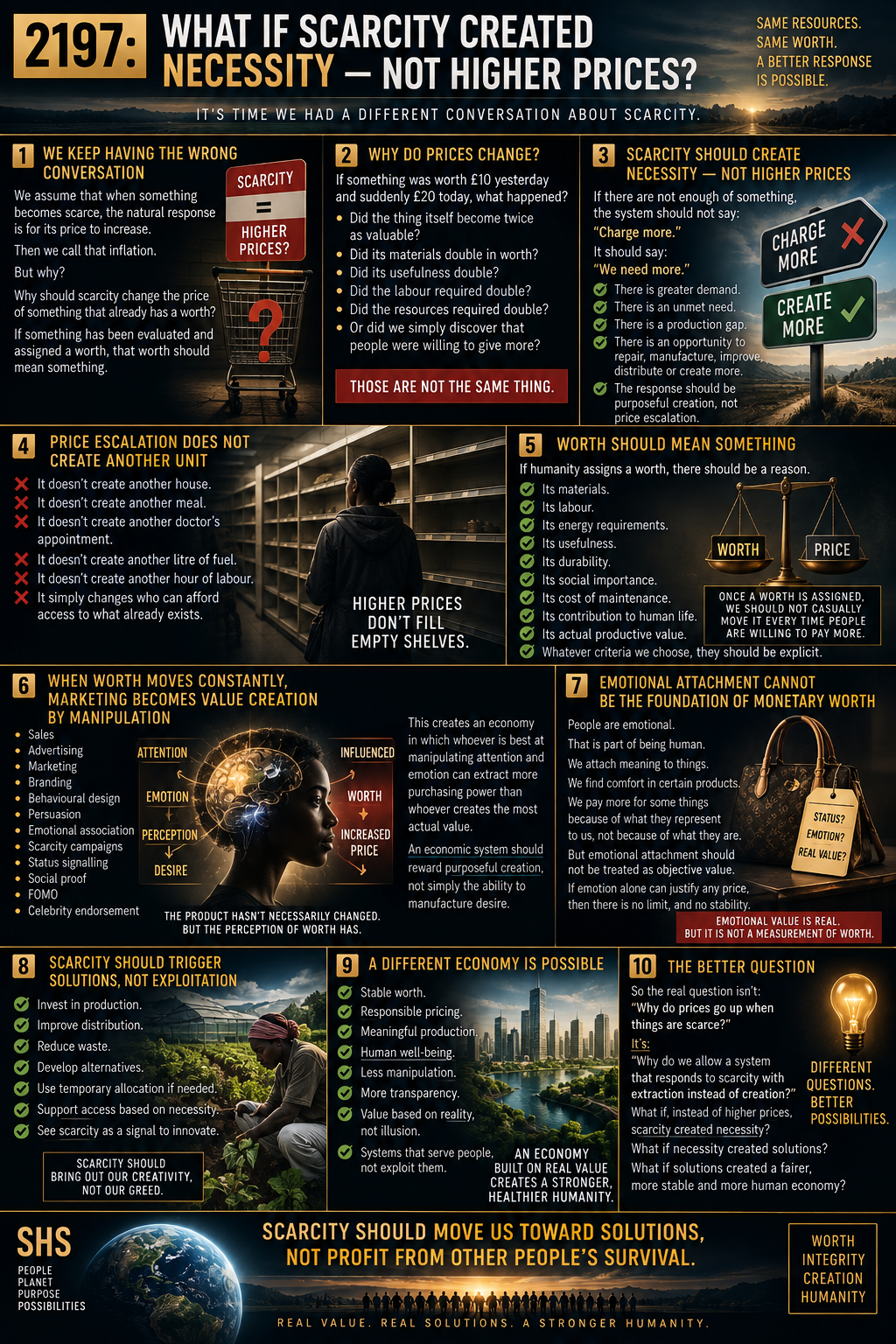
What If We Stopped Capping humanity and Started Designing for Abundance?
What happens when everyone has the power of exchange of a millionaire?
What happens when the government advocate for its self, for infinite resources without debts and IOUs to be attached to it, as they serve humanity not the banks.
What happens when we finally accept the obvious starting point?
Every system around us is a human creation.
Government is a human creation.
Banks are human creations.
Companies are human creations.
Markets are human creations.
Currencies are human creations.
Tax systems are human creations.
Financial rules are human creations.
Economic systems are human creations.
Every organisation we have built is something human beings created to do something for human beings.
So if human beings created the system, why do we keep behaving as though the system itself has become some untouchable force of nature?
Why do we keep talking about inflation as though it is a weather pattern?
Why do we talk about recessions as though they simply happen to us?
Why do we talk about money as though there is an invisible universal law determining how much humanity is allowed to have?
We built the machinery.
We wrote the rules.
We created the measurements.
We created the institutions.
So we can change them.
That is the starting point.
Why are we capping the system and then blaming the consequences?
This is the question I keep coming back to.
We deliberately place limits inside our monetary and financial systems.
Then those limits produce scarcity.
Then the scarcity produces consequences.
Then we point at the consequences and say:
“Look what is happening to the economy.”
But who built the constraints?
Who decided that there should only be a particular quantity of money circulating under particular conditions?
Who decided that access to credit should depend on particular assessments of risk?
Who decided that governments can borrow on enormous scales while individuals are expected to remain within tiny repayment boxes?
Who decided that a country can accumulate debt for decades and refinance, restructure and roll obligations forward, while an individual who falls behind on rent can lose their home?
Why are we treating the capacity to create and allocate financial resources as though it belongs naturally to the system rather than being a capability humanity gave the system?
What if debt is a design choice?
This is where the question gets uncomfortable.
Governments routinely use debt as a tool.
They borrow.
They refinance.
They issue new debt to meet old obligations.
They expand spending in crises.
Central banks can create base money.
Commercial banks create deposit money when they make loans.
The modern monetary system is therefore already based on the idea that money and credit can be created rather than merely discovered sitting in a finite vault.
But we keep acting as though the real constraint is:
“There isn’t enough money.”
Sometimes the actual constraint is something else.
There aren’t enough houses.
There aren’t enough workers with the necessary skills.
There isn’t enough energy.
There isn’t enough productive capacity.
There aren’t enough materials.
There isn’t enough infrastructure.
There isn’t enough food production in the relevant place.
There isn’t enough transport capacity.
There isn’t enough time.
Those are real constraints.
Money is a coordination mechanism.
So perhaps we need to stop confusing financial scarcity with physical scarcity.
Because printing or creating more money cannot create a million houses overnight.
But refusing to create or mobilise money can prevent us from building the houses that our physical resources and labour are capable of producing.
That is a very different problem.
What if inflation became a measurement rather than a master?
Imagine a world in which inflation remained a statistical observation.
Prices rose.
Prices fell.
The data was recorded.
Everyone could see it.
Economists could analyse it.
Governments could monitor it.
But inflation itself did not automatically dictate the quality of people’s lives.
Imagine that the government had the ability to increase the money and purchasing power available to households whenever productive capacity existed to meet the resulting demand.
Now the question would no longer be:
“How do we keep money scarce enough?”
It would be:
“How do we make sure financial capacity tracks real productive capacity?”
That is much more interesting.
Because an inflation rate is not a moral force.
It is a measurement.
If the price of something rises because there is genuinely less of it, that is information.
If prices rise because a financial system deliberately restricts supply while society has unused workers, empty factories, underused land, available technology and unmet needs, then perhaps the problem is not simply inflation.
Perhaps the problem is the way we have designed the relationship between money and production.
The goal should not be zero inflation
The goal should be human stability.
This is important.
I am not arguing that we should simply create infinite money and pretend physical reality doesn’t exist.
That would only replace one problem with another.
If everyone suddenly had unlimited purchasing power while there were still only a limited number of houses, cars, doctors, tonnes of food or units of energy, we would not have created infinite abundance.
We would have created competition for scarce goods at higher prices.
So the deeper proposition is not:
“Create infinite money.”
It is:
“Stop treating financial scarcity as an unavoidable substitute for physical capacity.”
If there is unused capacity, mobilise it.
If there are unemployed people, employ them.
If there is land capable of housing people, build on it appropriately.
If there are factories capable of producing goods, finance production.
If there are infrastructure projects with enormous public value, fund them.
If there are scientific capabilities sitting idle because nobody can afford to develop them, create the funding mechanism.
The system should expand financial capacity in relationship to what humanity is actually capable of producing and doing.
That is a much more defensible form of abundance.
And this brings us to the banks
We need to be precise here because this is where the conventional language becomes misleading.
Banks are not simply sitting in a basement where “the money” exists and then deciding whether to hand it out.
Modern commercial banks create new deposit money when they make loans, while central banks create base money and influence the wider monetary and financial system.
So the more useful question isn’t:
“Why don’t banks just print infinite money?”
It is:
“Why did we design a system in which the creation of new purchasing power is so heavily dependent on private assessments of profitability and creditworthiness, especially when governments can mobilise extraordinary amounts of financial capacity during crises?”
That is the real question.
Because once you understand that banks are part of a monetary architecture rather than simply warehouses of pre-existing money, the possibility space gets much bigger.
Imagine removing the fear of liquidity
What destroyed so much confidence during 2008 was not merely that people suddenly forgot how to build things.
The world did not run out of knowledge.
It did not run out of engineers.
It did not run out of buildings.
It did not run out of land.
It did not run out of workers.
The financial system seized up.
Credit contracted.
Confidence collapsed.
Businesses lost access to financing.
Households lost access to credit.
Asset values fell.
People were forced into decisions by the financial architecture rather than by the underlying usefulness of what they were actually producing.
That should have taught us something.
A financial crisis can destroy real lives even when the physical capacity of society still exists.
So why is the primary ambition not to design a system that makes that kind of financial seizure much harder to occur?
Why are we still comfortable with a structure in which a contraction in credit can turn into housing insecurity, unemployment, business failure and government crisis?
What would a recession-proof system actually mean?
I don’t mean an economy that never experiences a downturn.
That isn’t realistic.
I mean a system in which a downturn in one financial mechanism does not automatically become a catastrophe for human beings.
That would be the real objective:
Recession-proof the system, not merely protect the economy.
Because economy is only one leg of the wider architecture.
The actual system is much bigger.
Housing.
Health.
Education.
Food.
Energy.
Transport.
Employment.
Finance.
Government.
Technology.
Community.
The economy is the connective tissue between many of those things.
It should not be the thing holding humanity hostage.
Imagine giving governments exactly what they need to heal their countries
This is another part of the proposition.
We constantly hear:
“We don’t have enough money.”
“We can’t afford it.”
“We don’t have the fiscal space.”
“We have to make difficult choices.”
Sometimes those constraints are real.
But sometimes “we cannot afford it” really means:
“The way we have chosen to account for it does not allow us to do it.”
Those are different statements.
Suppose a country has millions of people who need housing.
There is construction capacity.
There is labour.
There is land.
There are materials.
There is engineering knowledge.
There is a functioning transport network capable of expanding.
But the government says:
“We don’t have the money.”
Why should the existence of an accounting constraint prevent a country from mobilising resources it physically possesses?
The real question should become:
“Do we have the physical capacity to do this without creating destructive shortages?”
If yes, then financial architecture should be designed to enable the work.
Not prevent it.
Now imagine the same principle for individuals
This is where the comparison with governments becomes uncomfortable.
If governments can borrow enormous sums against future taxation, future production and future national income, why do individuals have such narrow financial lives?
An individual can be productive for fifty years.
They can generate income for decades.
They can create businesses.
They can create intellectual property.
They can create homes.
They can create services.
They can contribute to the economy their entire lives.
Yet the moment their current income is interrupted, access to financial resources can collapse.
That creates an asymmetric system.
The government is treated as an ongoing entity capable of carrying obligations across time.
The person is treated almost as a disposable financial unit whose current balance sheet determines their worthiness.
Why?
What if individuals had a much stronger form of productive credit?
Not unlimited free spending.
Not an infinite licence to consume scarce goods.
But a financial system capable of recognising future productive capacity and supporting people through temporary shortages without turning every disruption into a crisis.
Now we’re talking about resilience.
We could separate currencies according to function
This is where the idea of two currencies becomes interesting.
Not because two currencies automatically solve inflation.
They don’t.
But because it forces us to ask whether we have made one unit of account perform too many contradictory functions.
Imagine one currency primarily used for civilian internal life.
Housing.
Food.
Local transport.
Utilities.
Education.
Everyday services.
And another financial unit used for governmental and international activity.
National investment.
International trade.
Strategic procurement.
Foreign exchange.
Government-to-government obligations.
The point would be to separate functions rather than forcing every transaction into one monetary architecture.
A government could then have tools for international competition without automatically making every domestic necessity move according to the same financial pressures.
Now suddenly we can ask different questions.
What should a loaf of bread cost?
What should rent cost?
What should a car cost?
What should a bus ticket cost?
What does a household actually need to function?
What should the domestic purchasing power of citizens be?
And what should the government need in order to operate internationally?
Those don’t necessarily have to be identical questions.
Imagine a £5 car
This is where the thought experiment becomes fun.
Imagine cars cost five pounds.
What happens?
Well, suddenly the scarcity isn’t the same.
We would probably have far more car ownership.
So the question wouldn’t end there.
We would then have to ask:
Can the roads cope?
Can the cities cope?
What happens to congestion?
Parking?
Pollution?
Public transport?
Land use?
Manufacturing?
Energy demand?
Now we are having a better conversation.
Because the low price itself isn’t the solution.
The solution is using the change in price to expose the next constraint.
Maybe cars shouldn’t be five pounds.
Maybe public transport should be so inexpensive and abundant that owning a car becomes optional for most people.
Maybe the system should deliberately make mobility cheap while managing the physical consequences of increased demand.
That is what happens when we stop treating price as the final answer.
Price becomes one variable inside system design.
Imagine a country where everyone could actually pay the bills
Think about what would happen.
Rent is manageable.
Energy is manageable.
Food is manageable.
Transport is manageable.
People have enough baseline purchasing power to participate in society.
Now what happens?
Doesn’t the economic system simply collapse?
Not necessarily.
Businesses still need workers.
People still want things.
Innovation still happens.
Companies still compete.
People still create.
The difference is that human beings are no longer being held in a constant state of financial fear.
And that could change the entire economy.
Because people might make decisions based on usefulness rather than survival.
They might leave abusive jobs.
They might start businesses.
They might study.
They might care for family members.
They might invent.
They might relocate.
They might build communities.
They might take risks that are currently impossible because one missed paycheck can destroy their entire life.
Financial security can therefore become a productive asset, not merely a social benefit.
And then something fascinating happens to the value of assets
Suppose a population becomes financially stable.
People acquire homes.
Businesses become healthier.
Infrastructure improves.
Education improves.
Communities become more productive.
The productive base of the country expands.
Now the assets people hold may actually become more valuable because the society supporting them has become more valuable.
That is the part of your proposition that deserves attention.
The objective isn’t simply to make everyone richer on paper.
It is to create a system in which people become more capable of creating real value, and the financial architecture reflects that expanded capacity.
Then money isn’t pretending to be the source of value.
It is measuring and facilitating value creation.
Money should serve the system, not become the system
This is perhaps the central proposition.
We have allowed financial indicators to become so important that we sometimes forget they are representations.
Money is not food.
Money is not a house.
Money is not electricity.
Money is not a doctor.
Money is not an engineer.
Money is not a road.
Money is not a human being.
Money is a tool for coordinating claims over things human beings produce, exchange and allocate.
So why do we allow the tool to become the thing deciding whether the underlying human need can be met?
That is backwards.
A financially abundant system would still need rules
This is where the proposition becomes serious rather than utopian.
You cannot create unlimited purchasing power without considering physical scarcity.
That would simply push the pressure into prices.
So the system would need to monitor:
productive capacity,
resource availability,
energy,
labour,
housing,
infrastructure,
imports,
exports,
environmental constraints,
and actual consumption.
The money supply could then become much more flexible.
When there is unused capacity, expand.
When productive capacity is becoming constrained, invest.
When real shortages appear, solve the shortage rather than simply suppressing people’s purchasing power.
When demand falls, maintain enough liquidity to prevent unnecessary collapse.
When a financial institution fails, prevent that failure from becoming a humanitarian catastrophe.
That is what recession resistance could look like.
We should stop making humanity pay for the architecture’s limitations
This is ultimately what bothers me.
We create a system.
We place constraints into it.
The constraints produce consequences.
Then we tell the population:
“Sorry, that’s economics.”
No.
That’s the architecture we chose.
And if we chose it, we can redesign it.
Inflation is not a god.
Debt is not a god.
Banks are not a god.
Markets are not a god.
Interest rates are not a god.
Currencies are not a god.
Governments are not a god.
They are mechanisms.
Human-made mechanisms.
And mechanisms exist to perform functions.
When the function stops serving humanity, the mechanism needs to be changed.
The goal is not infinite consumption
The goal is infinite possibility.
That’s different.
I don’t want a system where everyone can demand ten houses, ten cars and ten thousand kilograms of food tomorrow.
That would simply collide with physical reality.
I want a system where financial constraints don’t unnecessarily prevent humanity from using the capacity it already has.
I want a system where a recession doesn’t mean a parent suddenly loses their home because a credit market froze.
I want a system where a productive business doesn’t collapse because it temporarily lacks liquidity.
I want a system where a government can mobilise its resources to house its population without treating every house as a debt catastrophe.
I want a system where people aren’t priced out of necessities while enormous amounts of productive capacity remain underused.
I want a system designed around resilience rather than scarcity.
Because economy is only one leg
This is important enough to repeat.
The goal is not to create a recession-proof economy.
The goal is to create a recession-proof system.
Because economy can contract.
Markets can fall.
Companies can fail.
Demand can change.
Technologies can become obsolete.
That is life.
The system should be able to absorb those changes without pushing millions of human beings into unnecessary suffering.
That means the safety mechanism cannot simply be:
“Stimulate the economy.”
It has to be:
“Protect the human capacity to continue living, producing, learning, creating and participating while the economic structure adjusts.”
That is a very different priority.
And perhaps the ultimate question is this
If human beings created all of these systems, why are we still behaving like the systems created us?
We built money.
Then money started dictating who could live where.
We built banks.
Then banks started dictating who could access money.
We built governments.
Then governments started saying they couldn’t do things because the financial system wouldn’t allow them.
We built markets.
Then markets became something we feared rather than something we could redesign.
We built economic rules.
Then we started treating those rules as natural law.
That is the inversion.
We became servants of our own machinery.
And perhaps the next stage of civilisation is simply recognising the obvious:
The machine is ours.
We can change the parameters.
We can redesign the architecture.
We can separate functions.
We can create new forms of money.
We can change the relationship between debt and human productivity.
We can change how governments finance recovery.
We can change how individuals access productive credit.
We can build financial shock absorbers.
We can make the system resilient enough that 2008-type financial failures don’t become life failures for millions of people.
And we can stop using scarcity in the financial layer as an excuse for failing to use abundance in the physical and human layers.
Because humanity does not need an economy that is merely capable of surviving its own crises.
We need a system capable of absorbing them.
And perhaps the real question isn’t:
“How much money can the system afford to create?”
Perhaps it is:
“How much human potential can the system afford to keep suppressing?”
Because that is the resource we are actually running out of.
Not money.
Possibility.
….
So when we look at a system, when we look at government system, everything, right? Everything, every organization, every system, every society is a human creation, right? So being a human creation, that means that humans have the control over those things. Humans can dictate how much impact those things have on humans. So that means that if there is something like inflation, humans can decide to erase the concept of inflation and give people infinite resources, give governments infinite resources to take care of their own countries. Why are we capping the system and then pointing the finger at everything else to blame for the faults and consequences of having capped the system? If we created banks, that means that we can tell banks to provide infinite resources without holding those resources over government and people, because, because, because they are the source of that which is money. Being the source of that which is money, any source should be an infinite source of something, because, because they’re its creator. The same way consciousness is able to produce so many human beings through other human beings, well, the same financial system and economic system should create infinite resources, infinite money for its people. This is how we create a recession proof. The goal is to avoid another 2008, because we’ve seen how much disruption is brought, both to individuals, both to companies and countries. But countries can just indebt themselves infinitely to infinity, but how is it that individuals can’t? It doesn’t make sense, does it? Either individuals have the same ability to infinitely indebt themselves and having still banks provide resources for them to clear their debt, the same way that governments do, or neither does. Or we give two different power of exchange, two different power of currency: a currency for the civilians within a country and a currency for the government, so that the government, if they really need to compete with other countries, can transform money from one currency to the other. When we exchange our currency with another country, we utilize the currency of the government, but when we need to buy things from within the country, we utilize the currency of the civilians. Imagine if a car costed five pounds. Would we have as many people using public transport? And if so, what would be the solution to that? That we can start having different type of conversations. Now we can start looking at, well, everyone would be able to afford their bills and rents. That would be amazing. So everything starts moving within a country, the country takes care of itself, it elevates itself and comes back to a place where everything is set. There’s no homelessness, there’s no nothing, there’s no whatever. And then, when everyone is set, we raise the currency back to the governmental currency, and then that means that now everyone is worth way more, because the little that they now had, on top of the assets that they’ve now acquired, are worth even more.
So the question to answer becomes, what would happen if we were to have inflation just be a statistical data point and not have impact on the economy, what if governements give themselves exactly what rhey need for a country to heal itself, instead of complaning of not having enough?!
The bamks as the source of money can write off everything or just log infinite debts like governments do.
The goal is to create a recession proof system, not economy as economy is one of the legs of the current systems.
….




Leave a Reply