I think we keep having the wrong conversation about scarcity.
We keep assuming that when something becomes scarce, the natural response is for its price to increase.
And then, once the price increases, we call that inflation.
But why?
Why should scarcity change the price of something that already has a worth?
If something has already been evaluated and assigned a worth, then that worth should mean something.
Whoever assigns that worth is taking responsibility for saying:
This is what this thing is worth.
So why do we then allow the number to change every time circumstances change?
Because if something was genuinely worth £10 yesterday, and today it is suddenly worth £20 simply because more people want it, then what exactly happened to its original worth?
Did the thing itself become twice as valuable?
Did its materials double in worth?
Did its usefulness double?
Did the labour required to make it double?
Did the resources required to produce it double?
Or did we simply discover that people were willing to give more?
Those are not the same thing.
And that distinction matters enormously.
Because once we separate worth from price, we can begin to see how much of our current economic system is built around the manipulation of perceived value rather than the recognition of actual value.
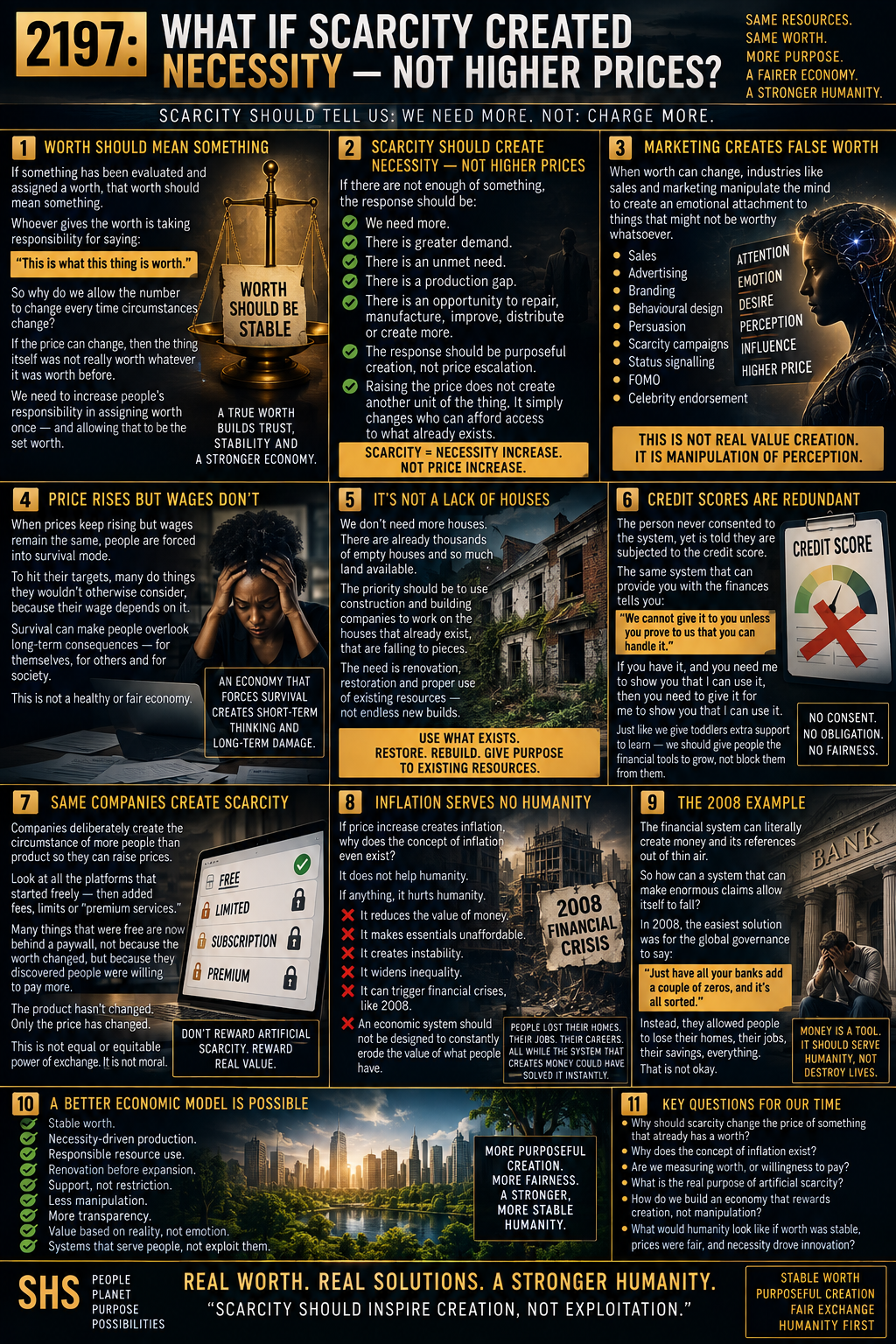
Scarcity should create necessity — not higher prices
If there are not enough of something, the system should not necessarily say:
Charge more.
It should say:
We need more.
Scarcity should create a necessity increase.
It should tell us:
There is greater demand for this resource.
There is an unmet need.
There is a production gap.
There is an opportunity to repair, manufacture, improve, distribute or create more.
The response should be purposeful creation.
Not price escalation.
Because raising the price does not create another unit of the thing.
It doesn’t create another house.
It doesn’t create another meal.
It doesn’t create another doctor’s appointment.
It doesn’t create another litre of fuel.
It doesn’t create another hour of labour.
It simply changes who can afford access to what already exists.
So why have we made price the default mechanism for responding to scarcity?
Why isn’t the default response:
Create more.
And if more cannot immediately be created, then create a temporary allocation mechanism around necessity.
The temporary shortage should create urgency around production.
It should not create an opportunity to extract more money from the people who need the resource.
Worth should mean something
This is perhaps the part of the conversation that we have neglected most.
We need to bring responsibility back into the assignment of worth.
If humanity decides that something has a particular worth, then there should be a reason for that worth.
Its materials.
Its labour.
Its energy requirements.
Its usefulness.
Its durability.
Its social importance.
Its cost of maintenance.
Its contribution to human life.
Its actual productive value.
Whatever criteria society chooses, they should be explicit.
And once that worth is assigned, we should not casually move it every time somebody discovers that people are willing to pay more.
Because then we are no longer measuring worth.
We are measuring willingness to pay.
And willingness to pay can be manipulated.
That distinction is enormous.
Because if worth is allowed to move constantly, marketing becomes value creation by manipulation
Think about what entire industries are built around.
Sales.
Advertising.
Marketing.
Branding.
Behavioural design.
Persuasion.
Emotional association.
Scarcity campaigns.
Status signalling.
Social proof.
FOMO.
Celebrity endorsement.
All of these mechanisms can influence how much a person believes something is worth.
And that creates an extraordinary problem.
Something can have a certain underlying usefulness or productive value while people are psychologically conditioned to believe that it is worth dramatically more.
The product hasn’t necessarily changed.
The materials haven’t necessarily changed.
The underlying utility might not have changed.
But the perception of worth has changed.
And suddenly the price can follow the perception.
That creates an economy in which whoever is best at manipulating attention and emotion can sometimes extract more purchasing power than whoever creates the most actual value.
That is not the economy I think we should be designing.
Because an economic system should reward purposeful creation.
Not simply the ability to manufacture desire.
Emotional attachment cannot be the foundation of monetary worth
People are emotional.
That is part of being human.
We attach memories to objects.
We attach identity to brands.
We attach status to products.
We attach belonging to communities.
We attach aspiration to lifestyles.
And there is nothing inherently wrong with that.
The problem begins when emotional attachment becomes a mechanism for determining how much purchasing power somebody must surrender for the underlying thing.
Because now the exchange is no longer simply:
What is this worth?
It becomes:
How emotionally attached can I make you to this?
And once that happens, the person who controls the emotional narrative can influence the exchange.
That means an economy becomes vulnerable to psychological manipulation.
If people’s spending follows their emotions, then anyone who can systematically influence those emotions can influence economic behaviour.
And if enough people’s emotions are influenced at the same time, an entire market can move.
A product can become fashionable.
A product can become undesirable.
A company can become trusted.
A company can become hated.
An asset can become desirable.
An asset can become feared.
A narrative can spread.
And suddenly millions of people alter their economic behaviour.
That is an incredibly fragile foundation for civilisation.
Imagine an economy where worth was stable
Imagine that the worth of something was established using transparent criteria.
Then that worth remained stable.
A product wouldn’t suddenly become “worth more” simply because demand increased.
The demand increase would instead trigger another question:
Why has necessity increased, and how do we satisfy it?
That creates an entirely different incentive structure.
If there is a shortage:
Make more.
If people want more:
Increase capacity.
If capacity cannot immediately increase:
Explain the constraint and manage allocation.
If production is falling:
Investigate why.
If materials are limited:
Develop alternatives.
If infrastructure is inadequate:
Repair or expand it.
Scarcity becomes a signal for purposeful action.
It stops being an excuse for extraction.
And this changes what companies are incentivised to do
Under the current logic, a company can discover that customers are willing to pay more and conclude:
“We can raise the price.”
But what changed?
Did the product become better?
Did the underlying worth increase?
Did the production process become more valuable?
Or did the customer simply demonstrate a greater willingness to surrender money?
Those are completely different things.
There is an especially uncomfortable version of this:
“This customer used to pay £10, but now they’re willing to pay £20.”
And the company thinks:
“Then let’s charge them £20.”
Why?
The product didn’t become twice as valuable.
The relationship between the company and the customer’s purchasing power changed.
The customer simply became more willing, or more compelled, to pay.
That isn’t necessarily value creation.
It can simply be value extraction.
And that distinction should matter.
Because equal exchange requires that what is being exchanged has some stable relationship to the worth being claimed for it.
Otherwise, two people can receive exactly the same thing while surrendering radically different amounts of purchasing power.
That is not equal power of exchange.
And it isn’t equitable power of exchange.
This is where artificial scarcity becomes particularly dangerous
A company can sometimes create circumstances in which more people want something than there are immediately available units.
Sometimes that is unavoidable.
Production takes time.
Factories need expanding.
Supply chains need adjusting.
Workers need training.
Materials need sourcing.
Technology needs development.
Fine.
That is a genuine constraint.
But what happens when scarcity itself becomes part of the business model?
What happens when reducing availability increases desire?
What happens when exclusivity becomes a selling mechanism?
What happens when a product is deliberately positioned as scarce because scarcity increases what people are willing to surrender for it?
Then scarcity has stopped being merely a physical condition.
It has become a commercial instrument.
And now we have an economy where the ability to manipulate scarcity can become financially rewarding.
Again:
That is not necessarily purposeful creation.
The better response to scarcity is creation
Suppose there suddenly aren’t enough products to meet demand.
The company knows manufacturing expansion will take six months.
Why must the immediate answer be:
Raise the price?
Why can’t the company instead say:
“We know there is greater necessity than our current capacity can fulfil. We are expanding production. Here is the timeline. Here is how we are allocating the existing stock. Here is how customers can register their need.”
Now the relationship with the customer becomes different.
The company isn’t treating the shortage as an opportunity to extract more money.
It is treating the shortage as evidence that its purpose now needs to expand.
That builds a completely different relationship between businesses and society.
Scarcity becomes:
Purpose.
Not:
Profit opportunity.
And then there is the wage problem
This entire system becomes even more dangerous when the price of necessities rises while wages do not rise proportionally.
Because now the worker is trapped between two pressures.
The company has a target.
The worker has a survival requirement.
The customer has a limited budget.
The price keeps moving.
And everyone has an incentive to make somebody else absorb the difference.
That can produce extraordinary behaviour.
People push harder to hit quotas.
Salespeople become more aggressive.
Workers compete against one another.
Managers pressure employees.
Customers are encouraged to buy things they might not otherwise need.
Companies search for ways to increase margins.
And when people’s survival depends upon their performance, the ethical boundary can begin to shift.
Because a person who is worried about paying rent is operating under a fundamentally different psychological condition from someone who is financially secure.
Survival narrows attention.
Survival can shorten time horizons.
Survival can make long-term consequences harder to prioritise.
And that affects everyone in the chain.
The customer.
The salesperson.
The manager.
The company.
The investor.
The worker.
The family.
The community.
So when we create an economic system where rising prices continuously increase survival pressure while wages lag behind, we are not simply creating a financial problem.
We are altering human behaviour.
That changes what people are willing to do
A person trying to survive may accept work they would otherwise reject.
They may sell something they don’t believe in.
They may pressure somebody else.
They may ignore long-term consequences.
They may pursue the quota rather than the customer.
They may prioritise this month’s income over next year’s consequences.
Not necessarily because they are immoral.
Because they are responding to the environment we created.
That is another reason I don’t think we should treat economic outcomes as though they happen independently of system design.
People respond to incentives.
People respond to pressure.
People respond to scarcity.
People respond to fear.
People respond to opportunity.
So if we create a system that continuously produces financial insecurity, we should expect behaviour shaped by financial insecurity.
And then companies can create the very scarcity they later use to justify the price
This is where the model becomes even more circular.
Create a product.
Build an audience.
Get people accustomed to it.
Let people rely on it.
Create emotional attachment.
Create network effects.
Increase dependency.
Then introduce scarcity.
Then introduce a higher price.
Then explain the higher price as necessary because of:
additional features,
additional services,
additional costs,
additional demand,
additional infrastructure,
additional everything.
And suddenly something that began freely becomes something people have to pay for.
We’ve seen versions of this pattern across digital services and technology.
Something begins with broad or free access.
People become accustomed to it.
The service becomes integrated into people’s lives.
Then the commercial structure changes.
Now there is a subscription.
Now there are tiers.
Now there are restrictions.
Now there are premium features.
Now there are limits.
Now there are additional charges.
Again, sometimes those changes genuinely reflect real costs.
But that doesn’t mean we should automatically assume that every price increase reflects increased worth.
Sometimes the thing is simply being monetised differently.
And that distinction matters.
Monetary value should not be infinitely negotiable
Because when the exchange value of something is constantly negotiable, power moves toward whoever has the greatest ability to manipulate the negotiation.
The person with more money can wait.
The person with less money cannot.
The person with alternatives has bargaining power.
The person without alternatives doesn’t.
The person with emotional distance can walk away.
The person who needs the product cannot.
So a supposedly “free” market can contain profoundly unequal powers of exchange.
One person can say:
“I’ll pay whatever.”
Another person has to say:
“I need this.”
Those aren’t equal positions.
And yet we often treat the resulting price as though it represents some objective measure of worth.
It doesn’t necessarily.
It can represent the relative bargaining power of the people involved.
This is why government should have a responsibility to establish value boundaries
I am not saying that government should determine every price of every object.
I am saying that government should establish principles and brackets around essential value and exchange, particularly where unequal bargaining power can threaten human wellbeing.
There should be categories.
There should be transparent criteria.
There should be clear distinctions between:
cost, worth, price, scarcity, necessity and profit.
A thing should not be allowed to continuously change its claimed worth simply because demand demonstrates that people will tolerate the increase.
Especially when the thing is essential.
Housing.
Food.
Energy.
Healthcare.
Transport.
Education.
Basic communications.
Essential infrastructure.
These are not luxuries whose social consequences disappear when the price rises.
They are foundations of participation.
Because an economy built on emotional exchange can be derailed emotionally
This is another part that deserves far more attention.
If people follow emotions when making economic decisions, then an economy built heavily around emotional valuation can become extraordinarily fragile.
Create fear.
People stop spending.
Create excitement.
People spend.
Create panic.
People sell.
Create confidence.
People buy.
Create social pressure.
People participate.
Create shame.
People purchase.
Create scarcity.
People rush.
Create FOMO.
People overextend themselves.
And suddenly enormous amounts of economic behaviour are being driven not by the underlying worth or necessity of the thing itself, but by the emotional state of the population.
That means an economy can potentially be disrupted without the underlying physical reality changing very much at all.
The buildings are still there.
The workers are still there.
The factories are still there.
The technology is still there.
The food is still there.
The roads are still there.
The knowledge is still there.
But confidence changes.
And suddenly behaviour changes.
That is a fragile system.
Money should represent value, not manufacture it
This is where I keep returning.
Money should be a representation and coordination mechanism.
It should not be the thing that determines whether something is worthy of existing.
And it certainly shouldn’t be the thing that determines whether a human being is worthy of access to the basic resources necessary to participate in society.
The same applies to credit scores.
A credit score can tell us something about a person’s historical behaviour within an existing lending architecture.
It cannot tell us the person’s human worth.
It cannot tell us their future potential.
It cannot tell us their capacity to learn.
It cannot tell us their capacity to create.
It cannot tell us whether they deserve the opportunity to prove themselves.
And it certainly should not become circular:
“You cannot access more resources because you haven’t demonstrated that you can handle more resources.”
Give the person the opportunity to demonstrate it.
Give people room to learn.
Give them the financial equivalent of training wheels.
That is how humans develop.
We don’t expect toddlers to balance perfectly before we let them touch a bicycle.
We give them support.
We give them protection.
We let them practise.
We let them fail safely.
We gradually increase responsibility.
Why shouldn’t financial systems operate with the same developmental logic?
And this brings us back to the £100
I am not saying:
Give everyone £1 million.
I am saying:
What if the £100 someone already has possessed dramatically greater purchasing power?
Not because we have magically created more physical resources.
But because we redesigned the relationship between the currency and the things that currency can command.
The question then becomes:
What is the actual worth of the thing?
What is the actual necessity?
What resources exist?
What resources are underused?
What can be repaired?
What can be produced?
What can be shared?
What can be improved?
What financial constraint is preventing the connection?
That is a completely different economic philosophy.
And this changes the role of banks
If banks are institutions inside the human system, then their purpose cannot simply be to maximise the extraction of financial return from the people who need access to financial resources.
They participate in money creation.
They participate in credit allocation.
They participate in the distribution of purchasing power.
Therefore they participate in the architecture of society itself.
That creates responsibility.
And if the monetary system can create financial capacity under some circumstances, then we have to ask why the same architecture cannot deliberately create financial capacity for humanitarian and productive purposes when the underlying resources exist.
The question is not:
“Can we create money?”
The question is:
“Why are we choosing to create it here, for this purpose, for these people, under these conditions, and not there?”
That is a governance question.
The 2008 lesson should have been different
When the financial system seized up in 2008, the physical world didn’t disappear.
Human beings were still there.
Buildings were still there.
Companies were still there.
Skills were still there.
Infrastructure was still there.
Knowledge was still there.
The financial relationships had become unstable.
And yet millions of people were allowed to experience the consequences as though the underlying civilisation itself had disappeared.
That is the part that should never be normal.
If the financial system is a human-created mechanism, then a failure within that mechanism should be treated as a problem with the mechanism.
Not as permission to withdraw the foundations of people’s lives.
The objective should have been:
Restore the capacity to function.
Not:
Make humanity pay for the failure of finance.
And this is precisely why I keep saying the goal is not merely to create a recession-proof economy.
The goal is to create a recession-proof system.
Scarcity should increase purpose
This might be the principle I would put at the centre of the entire model:
When something becomes scarce, its purpose should become more urgent — not its price more expensive.
If there is a housing shortage:
Prioritise housing.
If there is a food shortage:
Prioritise food production and distribution.
If there is a healthcare shortage:
Prioritise training, staffing, facilities and access.
If there is an energy shortage:
Prioritise generation, storage, efficiency and alternatives.
If there is a technology shortage:
Increase development and manufacturing capacity.
If there is a skills shortage:
Train people.
If there is an infrastructure shortage:
Repair and expand infrastructure.
Scarcity becomes a direction.
A compass.
A signal.
A reason to create.
Not a reason to charge the person who needs it more.
What would purposeful economics look like?
It would reward creation.
It would reward maintenance.
It would reward repair.
It would reward usefulness.
It would reward durability.
It would reward accessibility.
It would reward innovation that actually solves problems.
It would reward companies for increasing the productive capacity of society.
And it would reduce the advantage of simply manipulating people into believing something is worth more than it is.
Because ultimately, what we should be building is an economy where value comes from what something contributes, not merely from how successfully somebody can convince another person to want it.
Then perhaps inflation becomes the wrong master concept
I don’t need a world where price statistics disappear.
I need a world where they stop becoming the explanation for why humanity must tolerate declining purchasing power.
Measure prices.
Measure resource availability.
Measure production.
Measure necessity.
Measure capacity.
Measure utilisation.
Measure access.
Measure wellbeing.
But don’t confuse one measurement with the entire reality.
A price increase can tell us something changed.
It doesn’t tell us what should happen next.
A scarcity signal can tell us something is insufficient.
It doesn’t tell us that the people who need it should pay more.
A credit score can tell us something about historical financial behaviour.
It doesn’t tell us someone’s worth.
A market price can tell us what people are currently willing to exchange.
It doesn’t necessarily tell us what something is worth.
Those distinctions need to return to the centre of economics.
Because the economy should not be a psychological battlefield
People shouldn’t have to constantly defend themselves against engineered desire.
They shouldn’t have to watch prices rise because companies discover they can charge more.
They shouldn’t have to chase wages that cannot keep up with necessities.
They shouldn’t have to sacrifice long-term ethics to hit short-term quotas.
They shouldn’t have to prove their worthiness to a credit score they never consented to.
They shouldn’t have to lose their homes because a financial mechanism failed.
They shouldn’t have to watch essential assets become increasingly inaccessible because scarcity has become a commercial opportunity.
And companies shouldn’t need to manufacture scarcity in order to demonstrate growth.
We can design something better.
Humanity needs a different relationship with worth
Perhaps the most important change is this:
We need to become responsible for what we say things are worth.
Because assigning worth is not a trivial act.
When we assign worth to something, we are establishing the terms under which people will exchange their labour, time, energy and resources to obtain it.
That means worth affects behaviour.
Worth affects production.
Worth affects wages.
Worth affects consumption.
Worth affects investment.
Worth affects survival.
So perhaps we should stop allowing worth to be changed casually.
If worth needs to change, then there should be a substantive reason.
The thing itself has changed.
Its usefulness has changed.
Its material composition has changed.
Its production requirements have fundamentally changed.
Its social function has changed.
Something real has changed.
Not simply:
“People will pay more.”
Because willingness to pay is not the same as worth.
And this brings us back to the beginning
What if scarcity did not create higher prices?
What if it created greater necessity?
What if worth was assigned responsibly rather than manipulated continuously?
What if the price of something could not simply rise because people had become emotionally attached to it?
What if companies were rewarded for responding to scarcity by creating more rather than charging more?
What if wages and prices were not locked into a permanent race in which workers had to work harder simply to remain where they already were?
What if sales and marketing had to compete on actual usefulness rather than psychological manipulation?
What if credit scores were recognised as measurements of behaviour within a system rather than judgements of human worth?
What if people were given the opportunity to demonstrate financial responsibility instead of being permanently restricted because they had never been given sufficient resources to demonstrate it?
What if banks were treated as infrastructure within the human system and therefore carried obligations to that system?
What if government had the monetary capacity required to mobilise the real resources of its country?
What if financial crises were treated as failures of financial architecture rather than reasons to withdraw security from millions of people?
What if our currencies were designed around stable purchasing power rather than permanent erosion?
What if a £100 note remained capable of commanding a meaningful amount of human productive capacity decades into the future?
What if two monetary functions could be separated — domestic civilian purchasing power and governmental/international financial power — so that citizens’ access to necessities did not have to move in lockstep with every external financial pressure?
What if the purpose of scarcity was simply to tell us:
Create more.
Not:
Charge more.
That would change everything.
Because then the economy would no longer be primarily organised around extracting the maximum amount of money that a circumstance allows.
It would be organised around creating the maximum amount of useful human capacity that a circumstance requires.
And perhaps that is the fundamental shift we need.
From price to worth.
From scarcity to necessity.
From manipulation to purpose.
From financial judgement to human development.
From extraction to creation.
From survival economics to purposeful economics.
Because if scarcity tells us that humanity needs more of something, the answer should not be to make the thing harder for humanity to obtain.
The answer should be to ask:
Why don’t we have enough?
And then create the conditions to make enough.
Because humanity does not need an economy that becomes more expensive whenever people need something more.
It needs an economy that becomes more purposeful whenever humanity needs something more.
That is the difference between an economy that profits from scarcity—
and a system that responds to necessity.



Leave a Reply