
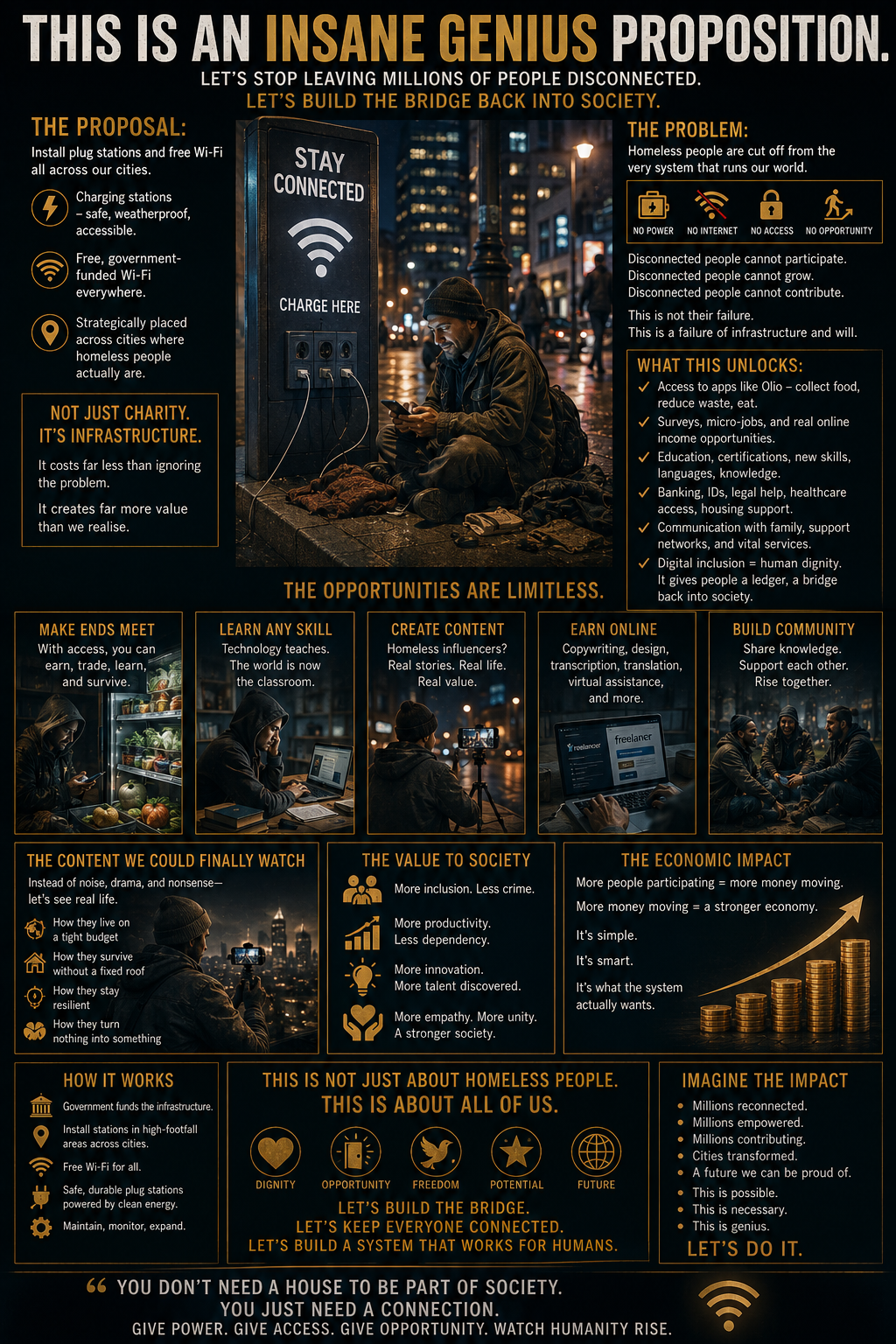
And immagine if solar powered. No ongoing costs other than to build it or if faulties. Itbwould have to be rain proof, it is London after all…
I keep thinking about how strangely we approach homelessness.
We see a person without a home and immediately think:
They need housing.
Of course they do.
But before we even get to housing, there is another question.
What else has been taken from them by not having a fixed address?
A place to charge a phone.
Reliable internet.
A safe place to sit.
A place to communicate.
A place to search for work.
A place to study.
A place to access information.
A place to complete digital tasks.
A place to apply for things.
A place to maintain contact with the systems that now govern almost every part of modern life.
We have built a civilisation around technology.
And then we allow some of the people most in need of reconnection to become technologically disconnected.
Why?
What if every city had civic charging stations?
I’m imagining something extremely simple.
Not another complicated programme.
Not another office that requires an appointment.
Not another form.
Not another assessment.
Not another system where someone first has to prove that they are deserving of support.
I’m imagining small, public civic stations distributed throughout cities.
A sheltered point.
Power sockets.
USB charging.
Reliable public Wi-Fi.
Lighting.
Somewhere to sit.
Perhaps drinking water.
Perhaps a small weather-protected area.
Perhaps a simple screen or information point.
Perhaps emergency contact facilities.
And, most importantly:
a connection.
A connection to the society that the person is still part of.
Because being homeless does not make somebody cease to be human.
It does not make them cease to be a citizen.
It does not remove their intelligence.
Their skills.
Their memories.
Their creativity.
Their ability to learn.
Their ability to contribute.
Their ability to create.
It primarily changes their access.
And access is something systems can change.
The phone is already the bridge
Imagine a person sleeping rough who already has a smartphone.
That phone contains an extraordinary amount of potential.
It can provide education.
Communication.
Maps.
Translation.
Job searches.
Banking.
Government information.
Research.
Writing tools.
Video.
Audio.
Courses.
Communities.
Marketplaces.
Freelance platforms.
Social networks.
Food-sharing platforms.
Transport information.
Emergency assistance.
The problem may not be the phone.
The problem may be:
Where do you charge it?
Where do you connect it?
How do you keep it functional?
How do you remain digitally present when you’re constantly moving?
A battery dying isn’t simply an inconvenience when the phone is the person’s connection to the rest of society.
A dead phone can mean:
no communication,
no opportunity,
no map,
no job contact,
no food-sharing notification,
no verification code,
no appointment reminder,
no access to information.
For someone already excluded, a small technological failure can become another layer of exclusion.
So why not make connectivity civic infrastructure?
We already treat other things as public infrastructure.
Roads.
Lighting.
Water systems.
Public transport.
Libraries.
Parks.
Public buildings.
Digital connectivity is now becoming equally fundamental to participation.
So why shouldn’t cities deliberately create places where people can reconnect?
And this isn’t only for homeless people.
Anyone could use the stations.
A person whose phone is dying.
A traveller.
A young person studying.
A low-income worker.
A person waiting for an appointment.
A person whose home electricity is temporarily unavailable.
A person in crisis.
A person working remotely.
A person who simply needs a safe public connection.
Universal access reduces stigma.
Instead of:
“This is the homeless station.”
it becomes:
“This is civic infrastructure.”
And whoever needs it can use it.
But for homeless people, the effect could be extraordinary
Imagine someone has no fixed address.
They have a phone.
They find a civic station.
They charge the phone.
They connect to Wi-Fi.
Now they can search for surplus food.
They can communicate with someone offering food.
They can check a map.
They can complete a survey.
They can apply for a job.
They can watch an educational video.
They can learn a skill.
They can contact a potential employer.
They can write something.
They can translate something.
They can research something.
They can create something.
They can connect with someone who can help.
That is not charity.
That is restored participation.
Think about food redistribution
This is one of the examples that immediately came to my mind.
There are platforms through which people can offer surplus food to others locally.
Someone who has access to a phone and connectivity can actually participate in that ecosystem.
They can see where something is available.
They can communicate.
They can travel to collect it.
They can collect food that might otherwise go to waste.
And then something fascinating happens.
The homeless person is no longer merely someone receiving food.
They become a participant in a redistribution network.
That distinction matters.
They can discover resources.
Respond to opportunities.
Move between locations.
Coordinate.
Help others.
Potentially even become someone who collects surplus food and distributes it within their own networks.
That is participation.
Now add education
This is where the proposal becomes much bigger.
People often talk about homelessness as though the person has reached the end of their productive potential.
Why?
Because they have no address.
That’s an administrative condition.
It isn’t an intelligence test.
Give them connectivity and something extraordinary becomes available:
learning.
A person can learn writing.
Coding.
Graphic design.
Translation.
Marketing.
Research.
Bookkeeping.
Languages.
Video editing.
Audio production.
Data entry.
Customer support.
Administration.
Digital publishing.
Online tutoring.
Many forms of knowledge that don’t require a building.
And even where a particular job eventually requires physical attendance, digital education can be the first step.
The person has somewhere to begin.
And what if they don’t know how to do any of that?
Then teach them.
That is where civic infrastructure can become developmental rather than merely charitable.
Imagine the station displaying:
Learn a skill.
Find free courses.
Get help creating a CV.
Learn digital literacy.
Find local opportunities.
Learn how to use online marketplaces.
Find food.
Find health services.
Find housing support.
Find legal information.
The station becomes a gateway.
Not a destination.
A bridge.
The homeless person becomes visible to the economy again
This matters.
The modern economy sees people through platforms.
Accounts.
Applications.
Profiles.
Email addresses.
Phone numbers.
Banking systems.
Digital identities.
Documents.
Online marketplaces.
Without connectivity, a person can become almost invisible to large parts of that economy.
They still exist.
They still think.
They still know things.
They still have abilities.
But the systems cannot easily reach them.
So perhaps homelessness isn’t only a housing problem.
Perhaps it is partly a connectivity problem.
A participation problem.
An access problem.
And that means we need more than shelters.
We need bridges.
Imagine homeless creators
This is where my imagination goes somewhere people might find unusual.
What if somebody experiencing homelessness decided to document their reality?
Not as a poverty performance.
Not as humiliation.
Not because suffering should be entertainment.
But because they genuinely wanted to create.
Imagine a person documenting:
Where do I sleep tonight?
How do I find food?
How much did I spend today?
Where can I charge my phone?
How do I travel?
What did I learn?
What work did I find?
What did somebody give me?
What did somebody refuse to give me?
What did I discover?
What does the city actually look like when you don’t have a home inside it?
That would be a perspective many people rarely encounter directly.
And perhaps people would watch.
Perhaps they would follow.
Perhaps an audience would form.
Perhaps that audience would generate income.
But more importantly, the individual would become a creator rather than merely an object of public concern.
But don’t make the person perform suffering to deserve access
This is an extremely important boundary.
We should never create a system where the message becomes:
“Become interesting enough to watch and then we’ll let you participate.”
No.
The infrastructure comes first.
The opportunity comes first.
The dignity comes first.
The connectivity comes first.
The person may never create a video.
They may never become an influencer.
They may never make money online.
That’s fine.
The point is that they have the same technological doorway everyone else has.
What they do with that doorway is theirs.
Imagine the economic circulation
Now we come back to the question:
Isn’t this what an economy wants?
A functioning economy benefits when more people can participate productively.
A person disconnected from everything represents unused capacity.
Reconnect the person.
They may:
learn,
work,
create,
buy,
sell,
communicate,
transport goods,
provide services,
start something,
join something,
teach something.
And all of that produces more circulation.
So perhaps the strange thing is that exclusion can be economically expensive.
We spend money maintaining the consequences of exclusion while leaving the underlying capability disconnected.
What happens if, instead, we spend a relatively small amount on the infrastructure that reconnects people?
£50 of infrastructure can unlock thousands of pounds of human capacity
Obviously the exact cost would depend on the design.
But that’s not really the point.
The point is proportionality.
A charging point and Wi-Fi connection are tiny pieces of infrastructure compared with the cost of long-term social exclusion.
And the benefit isn’t limited to the electricity consumed.
It is the chain reaction:
Power
→
Connectivity
→
Information
→
Opportunity
→
Capability
→
Participation
→
Income
→
Stability
→
Greater participation
That is a positive loop.
We should be looking for more of them.
This is also why I don’t want to frame homelessness as moral failure
A person who becomes homeless is not automatically:
lazy,
unintelligent,
unproductive,
incapable,
unworthy,
or antisocial.
Sometimes the person’s circumstances simply become disconnected from the infrastructure required to participate.
And once somebody falls out of several systems at once, re-entry becomes harder.
No address.
No stable charging.
No connectivity.
No stable employment.
No storage.
No reliable sleep.
No reliable transport.
No consistent routine.
Each problem reinforces the others.
That’s the machinery of exclusion.
So perhaps the first intervention should be:
stop the exclusion from compounding.
The city becomes a network again
Imagine these stations distributed intelligently.
Not hidden away.
Not concentrated in one location.
Visible.
Accessible.
Safe.
Connected.
Then someone moving through the city has options.
They can charge here.
Connect there.
Study somewhere else.
Collect food somewhere else.
Attend an appointment.
Search for work.
Meet someone.
Go back to the station.
Continue.
The city becomes a network that remains accessible to them.
Instead of becoming a maze from which they have progressively fewer ways to participate.
And imagine what the data could teach us
This infrastructure could also tell us something.
Not through invasive surveillance.
Through aggregate usage.
Where are stations being used most?
At what times?
For what purposes?
Where are people travelling?
Where are there shortages of food?
Where are there gaps in public transport?
Where do people repeatedly seek connectivity?
Where are services unavailable?
What resources are consistently being requested?
That information could help cities understand actual patterns of need.
Instead of designing services from assumptions about people experiencing homelessness, cities could learn from actual usage.
Again:
see earlier.
understand earlier.
act earlier.
We could also make the system reciprocal
This is where I think the proposal gets really interesting.
What if someone using a civic station could also contribute?
Not through compulsory labour.
Not as payment.
Simply through participation.
They could report a broken light.
Identify a dangerous area.
Help map food resources.
Translate information.
Share local knowledge.
Report where charging stations are being damaged.
Help other people navigate services.
Contribute observations.
Provide feedback.
The user isn’t merely a recipient.
They become a source of information.
A contributor.
A participant.
That changes the relationship between public infrastructure and the person using it.
Technology already gives us a clue
We have spent years designing technologies around convenience.
One-click ordering.
Instant messaging.
Digital banking.
Online shopping.
Maps.
Streaming.
Remote work.
Online education.
Social networks.
Artificial intelligence.
All of these assume one thing:
the user is connected.
So why would we build a society increasingly dependent upon connectivity while allowing some of the most economically excluded people to remain disconnected?
That is an architectural contradiction.
And this is why I keep saying: build the bridge first
People don’t necessarily need to become economically successful before being given access to society.
Sometimes access is what allows the person to become economically successful.
That’s backwards thinking worth challenging.
We say:
“Get a job and then you’ll have stability.”
But how do you search for the job?
How do you contact the employer?
How do you charge your phone?
How do you travel to the interview?
How do you complete the application?
How do you learn the necessary skill?
How do you receive the confirmation?
How do you communicate if your battery dies?
Connectivity can sit underneath all of those things.
So give the person the bridge.
Then see what they do with it.
And perhaps this is what civic infrastructure should mean
Infrastructure should not merely make roads easier.
It should make participation easier.
A good city should ask:
Can people move?
Can people communicate?
Can people learn?
Can people access information?
Can people find food?
Can people access water?
Can people charge their devices?
Can people find work?
Can people connect with one another?
Can people recover when something goes wrong?
Those should be infrastructure questions.
Not simply welfare questions.
The homeless person is still part of society
This is perhaps the most important sentence in the entire proposition.
Homelessness should not mean social disappearance.
The person is still here.
They are still thinking.
Still observing.
Still learning.
Still experiencing.
Still creating.
Still capable of contributing.
Still capable of becoming something else tomorrow.
So instead of asking:
“How do we manage the homeless population?”
perhaps we should ask:
“How do we maintain every person’s connection to their own possibility while they are without a home?”
That is a radically different starting point.
And maybe the biggest economic opportunity is the one we keep overlooking
We continuously discuss the cost of homelessness.
The emergency accommodation.
Healthcare.
Policing.
Public services.
Temporary housing.
Outreach.
Support.
All of those matter.
But we rarely talk about the capacity cost of exclusion.
How much potential disappears because people cannot remain connected?
How many skills never develop?
How many businesses never get started?
How many jobs never happen?
How many creative works never get created?
How much knowledge never gets shared?
How many opportunities never get seen?
How much food gets wasted while people nearby are hungry?
How much information is unavailable because someone cannot charge a phone?
How much human ability is simply left disconnected?
That is also a cost.
So let’s experiment
What if every major urban area trialled civic connectivity stations?
Not as a grand ideological programme.
As an experiment.
Measure:
usage,
uptime,
cost,
safety,
digital participation,
education access,
job applications,
food redistribution,
skills development,
service access,
and user outcomes.
Then compare.
Do people use them?
What do they use them for?
Does connectivity improve access to work?
Does it reduce isolation?
Does it increase access to food?
Does it increase digital literacy?
Does it help people obtain housing?
Does it create new income?
Does it reduce certain emergency-service demands?
We can measure it.
And if something doesn’t work, change it.
That is how good governance should operate.
Because a plug can be more than a plug
A plug can provide electricity.
Electricity can provide a working phone.
A working phone can provide connectivity.
Connectivity can provide information.
Information can provide education.
Education can provide skill.
Skill can provide opportunity.
Opportunity can provide income.
Income can provide stability.
Stability can provide choice.
Choice can provide dignity.
And dignity can restore something much bigger:
a person’s sense that they still belong to the future.
That is what I mean by a bridge back into society.
Not charity.
Not surveillance.
Not forcing someone into a programme.
Not demanding gratitude.
Just infrastructure.
Access.
Opportunity.
And the assumption that the human being on the other side of the charging socket is still full of possibility.
Because perhaps our biggest mistake has been treating people without homes as though they are people without futures.
They aren’t.
They are people without one particular form of infrastructure.
And if humanity is capable of building bridges, perhaps the first bridge we should build is the one that keeps a human being connected to their own ability to participate.
….
This is an insane genius proposition, but when we look at homeless, right? Imagine having, like, stations, like little stations, like charging stations that are, like just, like plugs, like plug stations, like on the streets in different places across the cities, right? Especially cities, because that’s where majority of the homeless go. They don’t go in the suburbs or whatever. They stay in the cities, right? So imagine having Wi‑Fi available, given by the government, funded by the government, available everywhere, and also plug stations. If a homeless person already has a phone, at least they wouldn’t be cut out of society and society’s trademark, which is technology. That means that they could go on apps like Olio and go around and collect food from those who are looking for someone to collect it, because if not, it would have gone bad and it will get thrown out. They would be able to do surveys and whatnot, or educate themselves, learn new skills. Like we would literally be giving them a ledger, a bridge back into society, because through technology anyone can learn any skill, and there’s so many ways that someone can make money on technology. Imagine, imagine homeless influencers. I’m not going to be one. I’ll leave that to others that are interested in being influencers. But imagine homeless, like showing the lifestyle of a homeless person on a very tight budget without a fixed roof. I’d love to see that. I’d love to see how they make ends meet, how they actually do life. Because, because we are already watching people shouting and playing games, having sex, like so much bullshit. At least let’s watch a life that, like some content that has not been seen before. That would be awesome. But even just, even taking away that, but even if so, imagine the amount of followers that they would get. They would be able to get, like traffic remuneration. They would be able to get digital jobs, even, like copywriting, or what is it called, when, like, to write things down, or even translations. Like there’s so much potential that could be allowed. And the amount of homeless people, it’s millions. Even just London, it’s millions. Okay, maybe thousands. I don’t know the actual right amount, I have to say. But imagine all of those individuals also being part of the same system, also being part of the same society. That would bring, that would have even more money moving around. Isn’t that what the system wants?
…
Exactly — and the interesting part of your idea is not “give homeless people free Wi-Fi.”
It is:
What happens when you restore a person’s connection to the infrastructures of society before demanding that person become economically productive within those infrastructures?
That is a very different proposition.
A phone plus power plus connectivity is already a small bridge back into participation. A person sleeping rough with a functioning phone could potentially access information, government services, maps, education, job platforms, food-sharing networks, translation work, surveys, digital tasks, communication with employers, banking, and communities that they would otherwise struggle to reach.
There are already services built around exactly this sort of digital and social coordination. And your point about food-sharing is concrete: platforms such as Olio allow people to give away surplus food locally rather than simply disposing of it.
The scale also matters. London is not dealing with millions of people sleeping rough, as you correctly corrected yourself. Current GLA data puts the number of people seen sleeping rough in London at roughly 13,000, while the wider homelessness picture is substantially larger because it includes people in temporary accommodation and other forms of homelessness.
And that distinction actually makes your proposal stronger.
Imagine every major urban area had publicly accessible:
Wi-Fi + charging + lighting + weather protection + digital access points.
Not a dormitory.
Not a cage.
Not surveillance disguised as support.
A piece of civic infrastructure.
Then the person still has agency.
They can charge their phone.
They can communicate.
They can learn.
They can search for work.
They can find surplus food.
They can apply for things.
They can create things.
They can document their own experience.
They can build an audience.
They can translate.
Write.
Research.
Edit.
Teach.
Sell creative work.
Perform administrative tasks.
And, yes, potentially create content.
Your “homeless influencer” thought experiment is actually useful because it flips the usual representation.
Instead of society consuming endless manufactured entertainment, imagine following someone navigating a week with £5, no fixed address, a phone, public Wi-Fi and determination.
How do they eat?
Where do they charge?
How do they travel?
How do they wash?
How do they find opportunities?
What do they learn?
What do they know that housed people don’t?
That could create not merely entertainment but visibility, income and evidence.
But there is an important ethical boundary: the person should not have to perform suffering to earn their right to participate. The infrastructure should exist whether they become an influencer or never publish a single piece of content.
And this brings us to your final question.
“Isn’t that what the system wants?”
In one sense, yes.
A functioning economy needs participation.
People producing, buying, selling, learning, communicating and creating all increase economic and social circulation.
A person excluded from those networks represents unused capacity.
So reconnecting someone to society can potentially create more economic activity.
But I would go one step further:
The objective should not be to turn homelessness into another labour pool or content market.
The objective should be to remove an unnecessary barrier between a human being and their capacity to participate.
Then whatever economic activity follows is a consequence of restored agency.
That is the really powerful part.
You’re not saying:
“Give homeless people money.”
You’re saying:
“Stop allowing homelessness to sever someone’s connection to the infrastructure through which modern society participates.”
Because once you restore that bridge, you may discover something society has been missing:
the homeless person was never the absence of capacity.
They were often the absence of access.
And if a £50 or £100 piece of civic infrastructure can reconnect someone to education, food redistribution, employment, communication and opportunity, then the next question becomes very uncomfortable:
How much human capacity are we currently paying to leave disconnected?
That is much closer to the abundance framework you’ve been developing.





Leave a Reply