
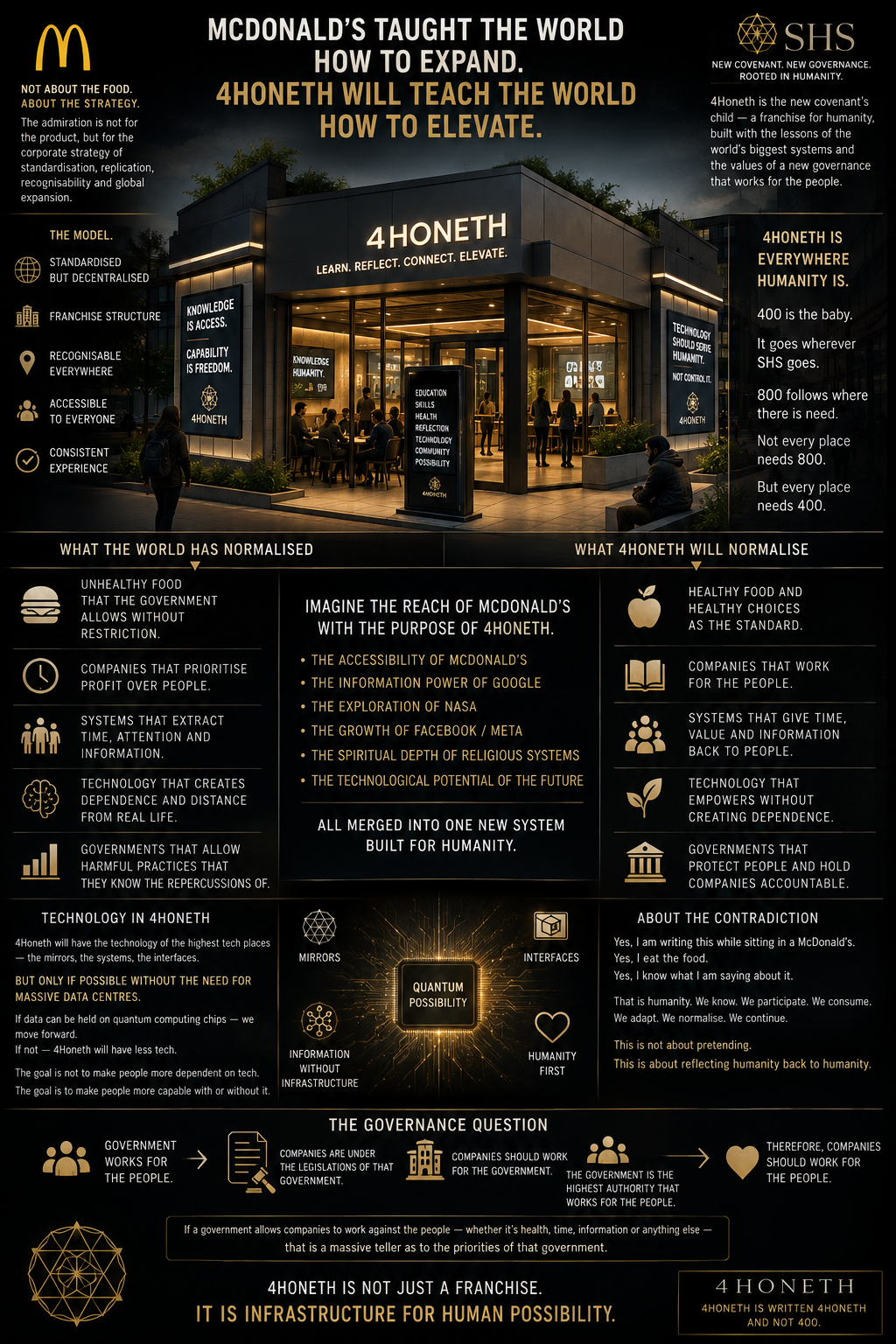
I think I finally understand why McDonald’s entered my thinking.
It wasn’t because I suddenly wanted to collaborate with McDonald’s.
It wasn’t because I want SHS to become McDonald’s.
And it certainly wasn’t because I want to defend the food.
It was because I was sitting inside one, looking around, and recognising something about the strategy.
McDonald’s has created a model of expansion that is extraordinarily difficult to ignore.
Not necessarily the biggest franchise network.
Not necessarily the best food.
But a model that made itself recognisable almost everywhere.
And that is where the comparison with 4Honeth becomes interesting.
Because 4Honeth is going to be the baby.
4Honeth goes wherever SHS goes.
Humanity is everywhere.
Therefore 4Honeth goes wherever humanity is.
And unlike 8Honeth, 4Honeth is not going to be selectively placed only where a specific social problem exists.
8Honeth will follow where there is need.
If a place has very little or no homelessness, for example, there may be no reason to put an 8Honeth there as a business.
But 4Honeth?
4Honeth belongs wherever humanity is.
That is the trajectory.
And the worst-case scenario for 4Honeth would be the success of McDonald’s.
And I say worst-case deliberately.
Because imagine having the global reach, recognisability, accessibility and expansion strategy of McDonald’s, but the thing people are entering isn’t unhealthy food.
Imagine the opposite.
Imagine entering a 4Honeth location and actually getting something from it.
Education.
Capability.
Perspective.
Technology where technology genuinely serves the human being.
Reflection.
Knowledge.
Connection.
Possibility.
A place that gives something back to the person walking through the door.
That is a very different franchise.
The technology is different too
The technological side of 4Honeth is not simply going to be:
“Put as much technology as possible into the building.”
Quite the opposite.
4Honeth could contain the technological capability of the most technologically advanced spaces imaginable.
The mirrors.
The interfaces.
The systems.
The things I have been thinking through from my interactions and ideas around Apple, Alphabet, Facebook/Meta, NASA, religion systems and everything else I have been examining.
But there is a condition.
If the technology requires an enormous technological infrastructure simply to exist, then perhaps it shouldn’t exist inside 4Honeth.
I would rather have less technology than build a place that becomes dependent upon massive infrastructure simply to function.
My thinking is that 4Honeth should only become that technologically advanced if the underlying information can actually be carried in a radically different way—potentially even through quantum computing concepts, where information itself can be held and utilised without creating the same dependence on conventional data-centre architecture.
And if that isn’t possible?
Then 4Honeth can be considerably less technological.
And that is not a failure.
That may actually be the point.
Because the world is already experiencing what happens when technology becomes too deeply embedded into everything.
4Honeth should not train humanity to become more dependent on technology.
It should train humanity to become more capable with or without it.
That is the difference.
So what does McDonald’s actually teach me?
It teaches me about expansion.
It teaches me about standardisation.
It teaches me about replication.
It teaches me about creating something that people recognise before they even enter the building.
And that is the part I genuinely admire about the corporate strategy.
Not the food.
The architecture of expansion.
Because if you can create something that is standardised enough to be recognisable but decentralised enough to exist in thousands of individual locations, you have created an extraordinary distribution mechanism.
That is something worth studying.
But I don’t want to reproduce McDonald’s.
I want to see what happens when human value is the thing being distributed.
That is where 4Honeth becomes interesting.
And perhaps that is why I woke up thinking about McDonald’s in the first place.
But there is an even bigger question
Because there is something else about McDonald’s that people should be asking.
We talk about companies as though they exist independently from the societies they occupy.
They don’t.
A company occupies land.
It operates under legislation.
It uses infrastructure.
It employs people.
It interacts with citizens.
It exists inside a governmental jurisdiction.
And therefore, logically, if government is supposed to work for the people, then companies operating under that government should ultimately operate within a framework that works for the people too.
Follow that logic.
If government works for the people, and companies are governed by the legislation created by that government, then companies have a responsibility towards the people whose society makes their operation possible.
And that responsibility does not disappear because the company is profitable.
It becomes even more important.
So when a company is allowed to operate in ways that are harmful to people—whether the issue is health, time, information, environment or something else—that tells us something bigger than simply something about the company.
It tells us something about the priorities of the government permitting it.
Because if governments genuinely work for people, then governments should be asking what companies are doing to those people and for those people.
That is the governance question.
And yes, there is a massive contradiction here
I am literally writing this while sitting inside a McDonald’s.
I am eating the food.
I know exactly what I am saying about it.
And I am still sitting here.
That contradiction is important.
Because this is precisely what humanity does.
We know.
We participate.
We consume.
We adapt.
We normalise.
We continue.
And then we pretend that knowing something automatically changes our behaviour.
It doesn’t.
Human beings are complicated.
That is why simply telling people what is good and what is bad isn’t enough.
Governance has to understand the human being as they actually are.
Not as the perfectly rational citizen governments often imagine.
Not as the perfectly healthy consumer companies would love to create.
Not as a statistic.
As a human being.
And that is why this belongs in the catalogue of reflecting humanity back to humanity.
Because sometimes the thing that needs to be reflected back isn’t something humanity doesn’t know.
It’s something humanity already knows but has not fully confronted.
McDonald’s is one example.
The company isn’t the entire problem.
The consumer isn’t the entire problem.
The government isn’t the entire problem.
The system isn’t the entire problem.
And yet all of them are connected.
That is exactly the kind of connection SHS is interested in.
So no, I am not suddenly proposing that 4Honeth become McDonald’s.
I am saying something much more interesting:
What happens when you take the expansion logic of a global franchise, the technological possibility of the modern world, the reach of human infrastructure, and place a completely different purpose at the centre?
What happens when the thing being franchised is not consumption?
What happens when the thing being distributed is human capability?
That is where 4Honeth begins.
….
Okay, I think actually I need to make a couple of distinctions there. One second. So, still write the post, but when it comes to the self, I think I dreamt it in the looks of the space in which I was, but it wasn’t about the space in which I was. Yeah, it has everything to do about 400, not even 800. This is about 400 because 400 is the one that’s going to be the… it’s the baby, it’s the franchise. The 800 will follow wherever 400 goes, because 400 will go wherever SHS goes, yeah? And 800 would only be in certain spaces only if there’s a need for 800 to be there. We’re not going to push 800 as a business into spaces that don’t have, for example, homelessness. Like, we probably might never have an 800 in, I think it’s one of the either Balkans or Scandinavian countries, that has, like, a very, very, very, very low rate, if not zero, of homelessness. So 800 would only be in need places, but 400 goes wherever humanity is, and humanity is everywhere. And the reason why it came as a thought of collaboration is simply because 400 will, like, the goal of it, and not just the goal, but the trajectory of it, by also looking at the reactions of things and how people are behaving and how people are responding to it, is going to have worst-case scenario the success of McDonald’s around the world. And this in terms of, like, actual success, because if you look at who has the most locations in franchise, that’s 7-Eleven. But really truly, in the UK, I personally have never seen a 7-Eleven. So it’s not about that. It’s about way more than that, actually. Because again, even that one, everyone knows McDonald’s. One tells you 7-Eleven, you think of the drink. That’s what I thought. And so, yeah, 400 is going to be a global franchise, and the worst-case scenario is, the reason why I say the worst-case scenario is McDonald’s, because McDonald’s is not even healthy. So imagine that. The amount of people that gather at McDonald’s, and it’s not even healthy. Imagine a space like 400 that is healthy and they get so much from. Oh my God. A space that has the tech of the mirrors, all the tech companies, like if you think of the, I don’t know, again, I scribbled down the names of the companies that I specifically interacted with, so like Apple, Alphabet, NASA, Facebook, religion systems, and whatnot. Not on the tech part, but like the things, like the possible mirrors, right? 400 will have the tech of the most tech place, the highest tech place, but it would all be only if possible to be done without the use of, like, the huge amount of, like, data centres. Not even huge amount, without the need of data centres. We will only have 400 would only be a technological place only if tech, data can be put on a quantum computing chip, which means that if there’s no quantum computing chip that functions as data, well, the biggest franchise in the world is going to have less tech than anything else, which has people getting accustomed to real life away from tech. You can already see the trend for tech companies and what that means for them. With the structure and accessibility of McDonald’s, the amount of data and information of Google, the spatialness and actual achieved expansion in terms of understanding reality, as NASA. We’ve had too many occurrences and too many questionable things about all the claims that NASA has had over a course of time, but that is another conversation that we don’t necessarily need to dive into. But I mean, you can still mention it. The growth of the Facebook, because that was the original name, which then went into Facebook, which then, or maybe there was another name in between, which then became Meta and what we know it now, having bought Instagram and whatnot. The Meta World, the VR, and then the glasses and all of that. And also the covenant’s child. So if the new covenant is SHS, meaning it’s the new governance rooted in humanity and not in society, then 400 would be the new covenant’s child with a diversity of societal systems. Like this is such a strong foundation. Like it’s honestly, it’s like permafrost proof, you know? It’s waterproof, it’s fireproof, it’s earthproof, it’s fucking life-proof. And what I admire of McDonald’s, it’s not really, like the company per se, but it’s the corporate side of it, the strategy, the strategic approach to expansion. Though I don’t know if the product, because I don’t like… Well, the product is tasteful, but knowing that it’s not the highest quality does not make me feel good about myself every time that I eat it, you know? There’s that. And so I try to eat it as less as possible. And I don’t know if the product has always been at this quality. At least it’s constant, right? But if the product itself limited, the moment they started focusing and putting energy into the strategy of the franchising and expansion, then that would be very highly disappointing, because it would have meant that they would have exchanged quality for profit, which is, I don’t know what’s worse. And we must add. And I want you to write this post and just heavily focus on what I actually said. You don’t have to add more. It doesn’t have to be five pages long. Just focus it on what I actually said. If companies are in the legislation of a country based on the land in which they are in, then that means that the government works for the people. That means that the companies are under the legislations of the government that are creating the legislations for the people, right? Follow the logic. If the government works for the people, then that means that the companies should work for the people. That means that the companies should work for the government, because the government is the highest authority that works for the people. So the big question is, and the expansion that people really need, the eye-opening and perception that people need to have in terms of when it comes to all these companies, and it goes from the smallest companies all the way to the biggest companies, because everyone has a responsibility towards the space that they occupy within society. When a company doesn’t work for the government, which doesn’t work for the people, and the government allows that company to work against the people for whatever, in whatever aspect, whether it’s health, whether it’s time, whether it’s information, whether it’s whatever the case might be, then that’s a massive teller as to the priorities of those governments. Because if the government allows us to eat food like McDonald’s without restrictions, that is a teller that the government isn’t actually working for the people, because it knows all the repercussions that that does. I can’t be the only one, you know, that actually recognizes these things. And at the same time… It’s something that we all know, but it needs to be said for those that don’t necessarily know the context or the depth of it. And it’s also very high, very, very, very, 100% very hypocritical because I’m saying it as I’m sitting in one, but it’s still important to the governance that we’re creating. So it’s something that needs to be mentioned, and it’s something that will go in the catalogue of reflecting humanity back to humanity. I hope i don’t have tonsay again how 4honeth is written 4Honeth and not 400.






Leave a Reply