
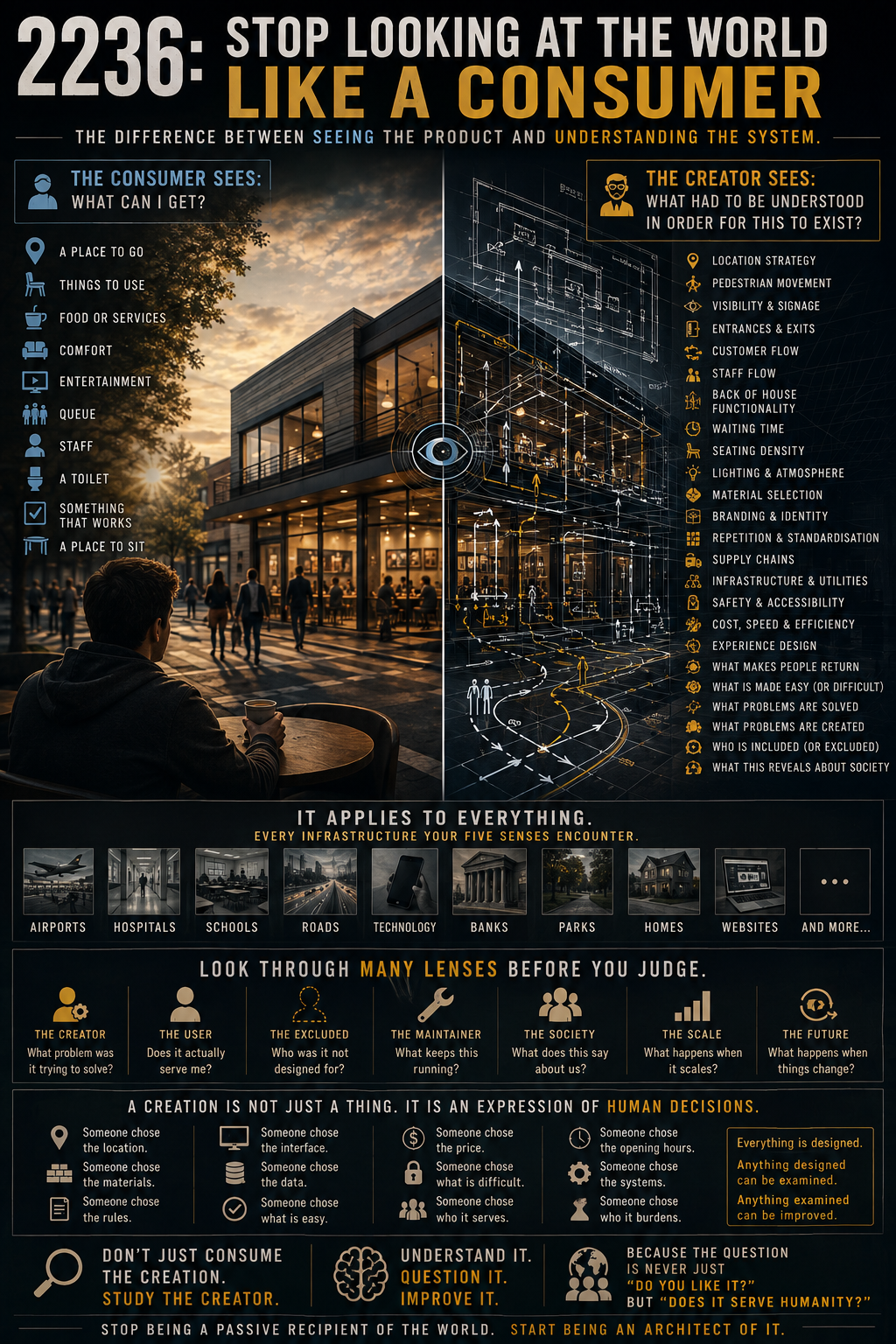
We have been taught how to consume almost everything.
We walk into a building and ask:
“What does this place give me?”
We sit at a table and ask:
“Is it comfortable?”
We enter a shop and ask:
“What can I buy?”
We use a phone and ask:
“What can it do?”
We enter a city and ask:
“What is there for me?”
And because we have been trained to see the world through the lens of the consumer, we often miss what is actually sitting directly in front of us.
We miss the architecture.
We miss the decisions.
We miss the systems.
We miss the intention.
We miss the compromises.
We miss the resources required to make it possible.
We miss what the creator had to solve.
We miss what the creator chose not to solve.
We miss what the space is actually doing.
And we miss what the space is teaching us simply by existing.
Look at it again
Take a McDonald’s.
A consumer might see:
Food.
Tables.
Chairs.
Screens.
Queues.
Staff.
A toilet.
A place to sit.
That is the consumer’s perspective.
Now look at exactly the same building through the lens of its architect or creator.
Suddenly you see something completely different.
You see location strategy.
You see pedestrian movement.
You see visibility.
You see entrances and exits.
You see kitchen placement.
You see customer flow.
You see staff flow.
You see waiting time.
You see seating density.
You see lighting.
You see repetition.
You see branding.
You see standardisation.
You see supply chains.
You see franchise architecture.
You see the relationship between the building and the street.
You see how long someone is expected to remain.
You see what makes someone return.
You see what has been deliberately made easy.
You see what has deliberately been made difficult.
You see the infrastructure behind the experience.
And suddenly the building has become an entirely different object.
The consumer sees the product.
The creator sees the system.
That distinction is enormous.
And it applies to everything
A phone.
A train station.
An airport.
A school.
A hospital.
A supermarket.
A bank.
A church.
A mosque.
A parliament.
A road.
A park.
A hotel.
A housing estate.
A website.
A social network.
A university.
A prison.
A playground.
A shopping centre.
A restaurant.
A home.
Even a queue.
Every one of these is an infrastructure that our five senses encounter.
And every one of them can be examined through two radically different lenses.
The first asks:
“What do I get from this?”
The second asks:
“What had to be understood in order for this to exist?”
That second question takes you somewhere completely different.
Become the architect for a moment
You don’t need to be an architect.
You don’t need to be an engineer.
You don’t need to be a business owner.
You don’t need to have designed the thing.
You simply need to temporarily stop being the customer.
Stand outside yourself.
Look at the creation as though you had been responsible for making it work.
What problem was it trying to solve?
What assumptions were made?
Who was it designed around?
Who was it not designed around?
What behaviours does it encourage?
What behaviours does it discourage?
What does it make easy?
What does it make difficult?
What does it require from the person entering it?
What does it give back?
What does it take?
What does it reveal about the society that created it?
And what does it reveal about the people who funded it, regulated it, built it and continue to maintain it?
Suddenly a building isn’t just a building.
A chair isn’t just a chair.
A road isn’t just a road.
A technology product isn’t just a product.
They become expressions of human decisions.
This is one of the lenses I want people to learn
Because I don’t want humanity to judge SHS creations only from the outside.
I don’t want somebody to walk into a 4Honeth and simply say:
“I like it.”
Or:
“I don’t like it.”
That is too shallow.
I want them to ask:
Why is it like this?
Why this shape?
Why this location?
Why this system?
Why this interaction?
Why this technology?
Why this material?
Why this amount of space?
Why this amount of openness?
Why this level of accessibility?
Why does this person have this role?
Why does this information appear here?
Why is this feature absent?
Why does this environment feel different?
What problem is it solving?
What problem might it accidentally create?
What assumptions are underneath it?
What happens if you remove one part?
What happens if you duplicate it?
What happens if you put it somewhere else?
What happens when a different type of human being enters it?
That is how you begin to understand a creation.
Not by consuming it.
By dissecting it.
The creator’s lens is also a responsibility lens
Because once you learn to see what goes into a creation, you also become much harder to fool.
You begin to understand that nothing simply “happens.”
Someone designed the interface.
Someone chose the price.
Someone chose the opening hours.
Someone chose the location.
Someone chose the materials.
Someone chose the rules.
Someone chose the data being collected.
Someone chose what the algorithm prioritises.
Someone chose what the building looks like.
Someone decided who the space is convenient for.
And someone decided who has to work harder to use it.
That means every creation can be questioned.
Not because everything is malicious.
But because everything is designed.
And anything designed can be examined.
This is how I want humanity to encounter 4Honeth
Not as customers.
As observers.
As critics.
As architects.
As participants.
As people capable of asking whether the thing in front of them actually works.
Because the moment you teach someone how to see the architecture behind a creation, you also give them the ability to challenge the creation.
That is incredibly important.
I don’t want people to accept something because SHS created it.
I want them to understand it well enough to question it.
I want somebody to be able to walk through a 4Honeth location and say:
“I understand why you built this this way.”
And then:
“But have you considered what happens to a person who experiences it differently?”
That is not opposition.
That is participation.
That is intelligence applied to creation.
And perhaps this is one of the greatest things we can teach
Before judging a creation, look through the lens of the person who had to create it.
Not to excuse it.
To understand it.
Then look through the lens of the person who has to use it.
Then look through the lens of the person who cannot use it.
Then look through the lens of the person who maintains it.
Then look through the lens of the society surrounding it.
Then look through the lens of what happens when the creation scales.
Because a creation can work perfectly for one person and fail completely for another.
It can work perfectly at one location and fail at one hundred.
It can solve one problem while creating another.
It can begin as an innovation and become a restriction.
It can begin as liberation and become dependency.
And it can become so normal that nobody remembers to question it anymore.
That is when we most need the creator’s lens.
So I want us to start walking through the world differently
Look at every infrastructure your five senses encounter.
Don’t just taste the food.
Examine the system that brought it to you.
Don’t just sit in the chair.
Examine why the room is arranged around that chair.
Don’t just enter the building.
Examine what the building expects from you.
Don’t just use the technology.
Examine what the technology expects from you.
Don’t just follow the road.
Examine where the road takes you and why.
Don’t just enter the institution.
Examine the structure underneath it.
Don’t just consume the creation.
Study the creator.
And then study the consequences of the creation.
Because when humanity learns to see this way, something changes.
We stop being passive recipients of the world around us.
We become capable of understanding how the world was constructed.
And once you can see construction,
you can see possibility.
You can see what can be changed.
You can see what should never be repeated.
You can see what deserves to be protected.
And you can see what has been hiding in plain sight.
That is the lens I want people to use on every creation SHS ever puts into the world.
Not:
“Do you like it?”
But:
“Do you understand it?”
And then:
“Does it actually serve humanity?”
Because a consumer asks what a creation can give them.
A creator asks what a creation is doing.
And an architect of society has to ask something even bigger:
What kind of humanity does this creation produce?
…
And here I need you to put together the next one. This is about walking every single individual infrastructure that our five senses get to experience with the lens of the creator slash societal architect, instead of the lenses of a consumer. Because through the lenses of a consumer, we miss so many things. We genuinely miss so much about what a space actually delivers. Whereas if we look at it through the lenses of the architect or the lenses of the creator, we’re able to see beyond what any consumer can see. And I want people to learn from this so that they can use the exact same lens to also judge any creation that we will ever share with the world.






Leave a Reply