
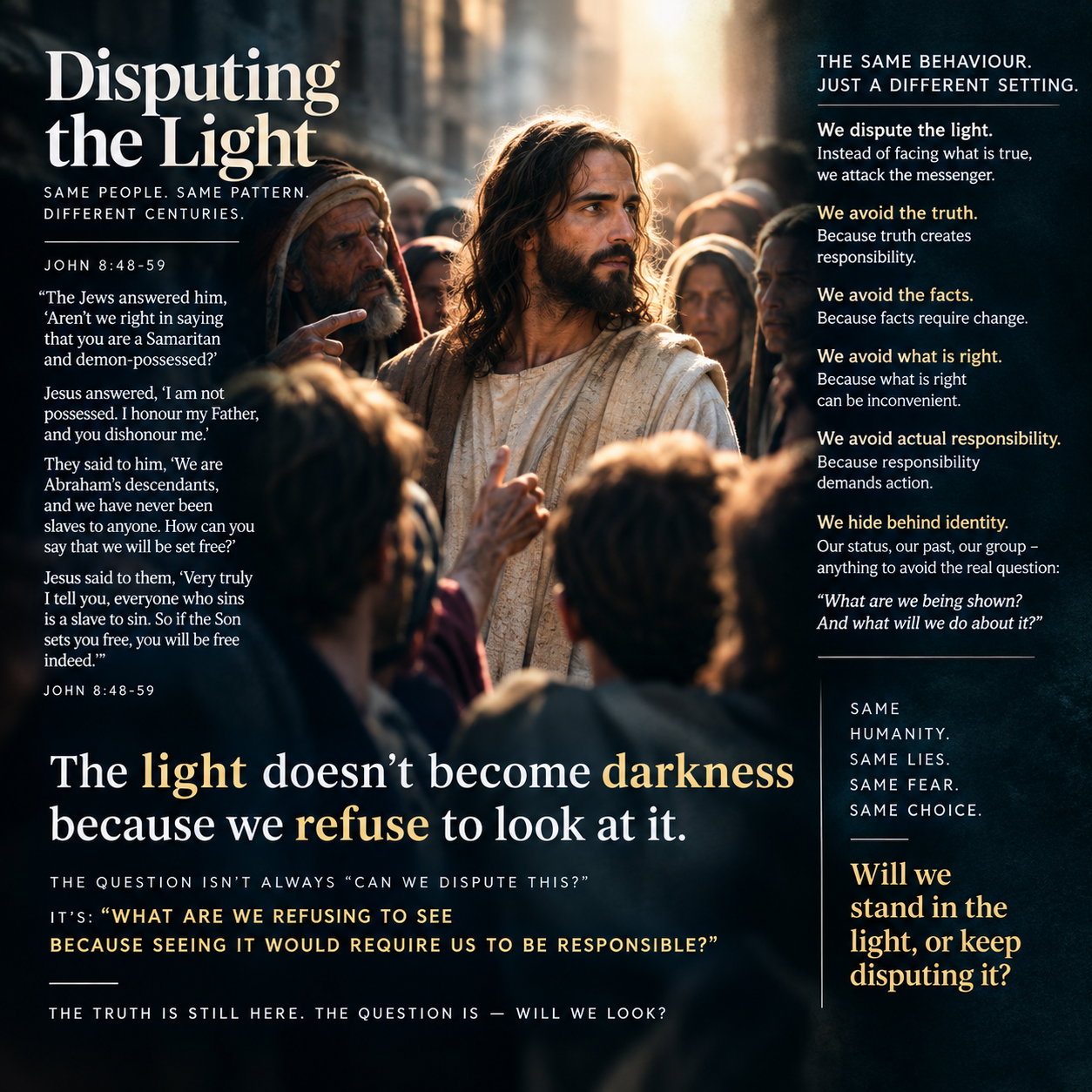
There is something almost uncomfortable about reading John 8 when you stop treating it merely as an ancient argument and start recognising the behaviour in it.
Because people have not changed that much.
The language changes.
The institutions change.
The technology changes.
The costumes change.
But the behaviour?
Some of it is remarkably familiar.
Jesus is speaking about truth, about who he is, about where he comes from, about freedom, about the Father, about the inability of people to recognise what is in front of them.
And instead of simply engaging what he is saying, the dispute begins.
“Your testimony is not valid.”
“Where is your Father?”
“Are you greater than our father Abraham?”
And eventually:
“Aren’t we right in saying that you are a Samaritan and demon-possessed?”
That is not an examination of truth.
That is an attack on the person carrying the truth.
And this is precisely where the story becomes uncomfortable for humanity.
Because we still do it.
We dispute the light.
We dispute the person holding up the mirror.
We dispute the facts because the facts create responsibility.
We dispute what is right because accepting what is right may require us to change.
And when we cannot successfully dispute the substance, we begin disputing the person.
Who are you?
What authority do you have?
Where did you come from?
Why should anyone listen to you?
What makes you think you know?
What makes you think you can say that?
And eventually, when argument fails, the messenger becomes the problem.
This is one of the oldest patterns in human behaviour.
Jesus repeatedly speaks about truth.
He tells them that if they continue in his word, they will know the truth, and the truth will make them free.
Their response is effectively: We are already free.
They dispute the premise.
They dispute the diagnosis.
They dispute the need for liberation.
They identify themselves through ancestry and status — “We are Abraham’s descendants” — while Jesus is pointing toward something deeper than inherited identity.
And that is another distinctly human behaviour:
using what we believe about ourselves to avoid examining what we are actually doing.
“I am a good person.”
“I am part of the right group.”
“I was born into this.”
“This is how society works.”
“This is how the system works.”
“I did not create the system.”
“Someone else is responsible.”
“Everybody does it.”
These statements can become shields against truth.
Because truth is inconvenient when truth creates obligation.
The remarkable thing about John 8 is that Jesus does not merely tell them that they are wrong.
He identifies the deeper problem.
They cannot hear what he is saying because they do not want to receive what he is saying.
That is spiritual blindness.
Not simply the inability to see.
The inability — or unwillingness — to recognise what is being shown.
And perhaps that is one of the most important distinctions humanity needs to recover.
There is a difference between not knowing and refusing to know.
There is a difference between being unaware and actively turning away.
There is a difference between making an honest mistake and constructing an argument specifically so that you never have to confront the mistake.
There is a difference between asking a question because you genuinely want an answer and asking questions indefinitely because you do not want the answer that is already becoming obvious.
There is a difference between disagreement and avoidance.
And humanity has become extraordinarily skilled at confusing the two.
We call avoidance “debate.”
We call denial “skepticism.”
We call responsibility “someone else’s job.”
We call confrontation with reality “negativity.”
We call inconvenient facts “opinions.”
And sometimes we call the person pointing it all out the problem.
That is the part of John 8 that keeps repeating.
Not necessarily the exact words.
The pattern.
Someone says:
Look at what is happening.
Humanity responds:
Who are you to say that?
Someone says:
This is causing harm.
Humanity responds:
What evidence do you have?
The evidence arrives.
Then:
But that is not the whole story.
The whole story arrives.
Then:
Your interpretation is biased.
The interpretation is examined.
Then:
Why are you attacking us?
And suddenly the person carrying the message is being investigated more aggressively than the problem they brought attention to.
This is how light gets disputed.
Not always by proving that the light is false.
Sometimes simply by making everyone so busy arguing about the lamp that nobody has to look at what it illuminates.
And this is why the story of Jesus remains so striking.
The dispute was not merely over a religious doctrine.
It was over recognition.
Who is standing in front of us?
What is he saying?
What does his presence require of us?
And what happens if he is telling the truth?
Because that final question is the dangerous one.
What happens if the truth is true?
If it is true, responsibility follows.
If the harm is real, responsibility follows.
If people are being failed, responsibility follows.
If systems are producing suffering, responsibility follows.
If we already know better, responsibility follows.
If we have the capacity to change something, responsibility follows.
And that is precisely why people can become more interested in disputing truth than acting upon it.
Because truth is not merely information.
Truth can become instruction.
Truth can become obligation.
Truth can become accountability.
Truth can become change.
So perhaps spiritual blindness is not simply failing to see.
Perhaps sometimes it is seeing enough to recognise what is being shown — and then constructing every possible argument necessary to avoid what seeing it would require.
John 8 gives us a picture of people disputing Jesus’ testimony, disputing his identity, disputing his authority, invoking their ancestry, challenging his claims, and eventually attacking the messenger himself.
And thousands of years later, humanity still possesses the same machinery.
We can reject the truth.
We can reject the person.
We can reject the evidence.
We can reject the responsibility.
We can reject the mirror.
And then convince ourselves that because we rejected all of those things, nothing was ever placed in front of us.
But the light does not become darkness because someone refuses to look at it.
A fact does not cease to be a fact because it is uncomfortable.
What is right does not become wrong because responsibility is inconvenient.
And responsibility for the wholeness does not disappear because enough people agree not to discuss it.
The question is not always:
“Can we dispute this?”
Human beings can dispute almost anything.
The more important question is:
“What are we refusing to see because seeing it would require us to become responsible?”
That is where the story stops being merely about Jesus and starts becoming about us.
Because perhaps the greatest dispute is not over whether the light exists.
It is over whether we are willing to stand in it.
….
Chat, we want to write a post about people, people disputing light, disputing truth, and avoiding truth, avoiding the light, avoiding facts, avoiding what is right, avoiding actual responsibility for the wholeness. And I want you to write the story of dispute over Jesus’ testimony, dispute over whose children Jesus’ opponents are, especially Jesus’ claims about himself, where the Jews answer him, Aren’t we right in saying that you are a Samaritan and demon-possessed? And that whole passage, because people are behaving exactly the same. They’re literally behaving the exact same, but instead of being direct and confrontational about that, we use the story of Jesus, especially the spiritual— this is all Book of John, the spiritual blindness. The girl that I just met literally gifted this to me. Yeah, let’s go about it.






Leave a Reply