
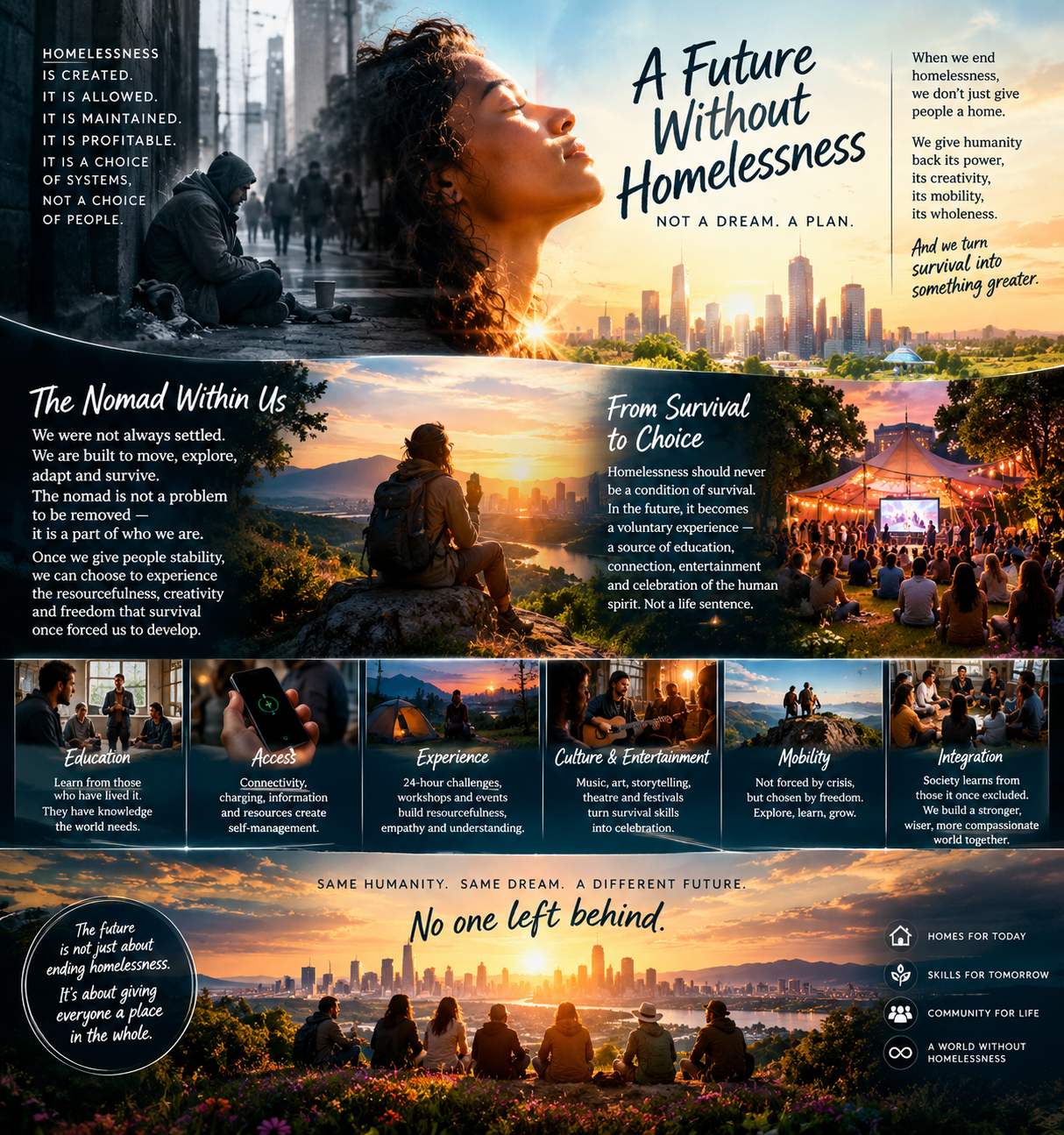
I am calling for a future where homelessness is completely erased.
You can call that utopia if you want.
I call it the future.
Because for as long as I am on this Earth, I will make sure that this is something that gets solved once and for all.
I do not accept a future where, fifty years from now, humanity is still looking at roughly the same levels of homelessness we are looking at today and calling that normal.
That is not an inevitable future.
That is a failure to transform.
And once homelessness is actually solved, there is another question that becomes incredibly interesting:
What happens to all the energy that homelessness currently carries?
Because energy does not simply disappear.
It gets transformed.
It gets consumed.
It gets redirected.
It manifests somewhere else.
And this is where the conversation becomes much bigger than homelessness itself.
Because the human being was not always settled.
Before houses, before apartments, before estates, before cities, before mortgages, before tenancy agreements, before the modern idea that having a permanent address is almost a prerequisite for participating in society, there were human beings who moved.
We were nomadic.
We adapted to environments.
We carried what we needed.
We learned how to find food.
We learned how to navigate.
We learned where to sleep.
We learned how to read weather, terrain, seasons, animals, people and resources.
We became resourceful because we had to.
Then humanity started settling.
And settling became associated with advancement.
Stability became progress.
A permanent place became security.
And in many ways, it was progress.
But settling also meant that we stopped practising certain aspects of ourselves.
We stopped moving in the same way.
We stopped having to constantly navigate the unknown.
We stopped having to think about every resource as something that had to be stretched.
We outsourced many of those survival calculations to systems.
And because humans are humans, the energy still needed somewhere to go.
So perhaps some of that energy did not disappear.
Perhaps it began manifesting through the systems we created.
And homelessness became one of those manifestations.
Because homelessness is not some mysterious force that arrived on Earth by itself.
It is created.
It is allowed.
It is maintained.
It is reproduced by causes.
And where there is a cause, there is an effect.
You cannot continue producing the same causes and then act surprised when the same effects keep appearing.
If the cause is changed, the effect changes.
So let us imagine that humanity actually does it.
Let us imagine that 8 Honeth succeeds.
Let us imagine that housing is accessible, people are reintegrated, people are educated, people have access to resources, people have opportunities, people are connected back into society, and homelessness as we know it has effectively disappeared.
Happy days.
But then what?
Do we simply erase everything associated with homelessness and move on?
No.
Because there is still something there.
There is still the resourcefulness.
The adaptability.
The ability to survive with little.
The creativity created by scarcity.
The capacity to navigate environments.
The ability to make decisions with limited information.
The ability to improvise.
The ability to move.
The ability to detach from comfort.
The ability to find a way when there appears to be no way.
Those things are not inherently homeless.
They are human.
So what happens is that we take the energy back.
We transmute it.
We turn homelessness from a condition of survival into a source of education, culture, entertainment, creativity and voluntary experience.
Not because homelessness was good.
It wasn’t.
But because humans can learn from almost anything.
And once survival is no longer being imposed upon people, we can choose to experience some of the lessons voluntarily.
That could mean monthly events.
Workshops.
Gatherings.
Stories.
Education.
Performances.
Documentaries.
Games.
Challenges.
Experiences designed around resourcefulness.
Imagine a future where people who have never experienced homelessness can actually learn from people who have.
Not as charity.
Not as pity.
Not as voyeurism.
But as education.
Because someone who has lived outside can teach something that someone who has spent their entire life inside may never have needed to learn.
How do you stretch £20?
How do you find food?
How do you find somewhere to charge your phone?
How do you keep yourself warm?
How do you navigate a city when every resource is limited?
How do you decide what is worth spending money on?
How do you preserve something for tomorrow?
How do you ask for help?
How do you know who is safe?
How do you make one resource perform three functions?
How do you think when you cannot simply purchase the solution?
Those are forms of intelligence.
And they should not have to be learned through suffering.
They can eventually become part of education.
Take something as simple as what happened to me recently.
I had £20.
I used surveys to put together that £20.
That £20 allowed me to cover food, even a pack of cigarettes, and still give myself a chance to make something else happen.
Now imagine what would happen if every person experiencing homelessness had a phone, internet access and reliable charging.
Suddenly, a person is no longer completely cut off from the economic world.
They can search for opportunities.
They can complete surveys.
They can learn.
They can communicate.
They can potentially generate small amounts of income.
They can manage money.
They can find services.
They can educate themselves.
They can organise.
They can self-manage to a degree.
Maybe they cannot afford an entire house.
But perhaps they can afford a hostel.
Maybe they cannot pay for everything.
But perhaps they can pay for something.
And that matters.
Because one of the biggest differences between helplessness and self-management is not whether someone can afford everything.
It is whether they have enough access to resources to begin making decisions for themselves.
This is why connectivity matters.
Charging matters.
Information matters.
Education matters.
Access matters.
And then there is the future.
Imagine it is 2056.
Homelessness has been eradicated.
It is a weekend.
People are planning the next event.
The next event is going to be in a park.
Everyone brings whatever they can carry.
Just enough for 24 hours.
No house.
No hotel.
No comfort blanket of modern convenience.
Just a safe, supervised experiment.
A voluntary 24 Hours Without Home experience.
Not homelessness.
Because homelessness is involuntary.
This would be voluntary.
That distinction matters.
You could wake up in the morning and realise:
What would I actually take with me if I had to leave my house?
What would I protect?
What would I prioritise?
What would I throw away?
How much water would I need?
How much food?
How much battery?
How much money?
What would I do if my phone died?
Where would I go?
How would I find information?
How would I stay warm?
How would I protect my belongings?
How would I make £10 last?
How would I make a resource stretch for two days instead of one?
Suddenly, something that most people never have to think about becomes a game of resourcefulness.
And because it is controlled and safe, people can experience the lesson without being subjected to the violence of actual homelessness.
That is the transmutation.
We do not preserve homelessness.
We preserve the knowledge.
We preserve the skills.
We preserve the stories.
We preserve the energy.
And then we give that energy somewhere healthier to go.
Because humans are adaptable.
Humans like movement.
Humans like novelty.
Humans like exploration.
Humans like travel.
Look at the modern explosion of nomad culture.
Nomad influencers.
Digital nomad businesses.
Long-term travellers.
People who deliberately live between countries.
People who work from beaches, vans, trains, hostels and temporary spaces.
Why?
Because there is something deeply human about not being fixed to one place.
We were nomads before we were settled.
The difference is choice.
That is the line humanity needs to understand.
Forced homelessness is suffering. Chosen mobility is freedom.
And once homelessness is gone, perhaps humanity can finally separate those two things properly.
We can give people the opportunity to experience mobility without deprivation.
Resourcefulness without starvation.
Adventure without danger.
Simplicity without desperation.
Minimalism without poverty.
Movement without exclusion.
That future could have its own culture.
Monthly “nomad” festivals.
24-hour resourcefulness challenges.
Outdoor education.
Storytelling nights.
Formerly homeless people teaching survival skills.
Workshops on budgeting and improvisation.
Navigation challenges.
Minimal-resource cooking.
Building challenges.
Community camping.
Travelling exhibitions.
Art created from lived experience.
Theatre.
Comedy.
Film.
Music.
Education.
Entire forms of entertainment could emerge around experiences that today’s homelessness forces people to develop.
And there is something else that matters here.
The people who have experienced homelessness would not simply be expected to catch up with society.
Society would also have something to learn from them.
That is the part we constantly miss.
Integration should go both ways.
Yes, someone who has been excluded may need access to education about modern systems.
But society also needs education about what happens when those systems fail.
A person who has lived on the street sees things that a person sitting safely inside an office might never see.
A person who has had to stretch £20 understands resource allocation differently.
A person who has had to find a place to charge a phone understands infrastructure differently.
A person who has had to navigate public space without private space understands cities differently.
A person who has had to decide between food, transport, communication and warmth understands economics differently.
And a society that genuinely wants to improve should not waste that knowledge.
We should collect it.
Study it.
Teach it.
Build with it.
Because the objective is not simply to make homeless people more like everyone else.
The objective is to make society more intelligent because those experiences happened.
That is what wholeness looks like.
We take the excluded experience and bring its knowledge back into the whole.
And maybe that is the real future.
Not a world where everybody has exactly the same life.
A world where nobody is forced into survival, but everyone has the opportunity to develop the capacities that survival once forced us to develop.
That is a very different civilisation.
A civilisation where housing is not a test of whether you deserve dignity.
A civilisation where shelter is guaranteed, but exploration is optional.
A civilisation where people can leave the house without being afraid of becoming homeless.
A civilisation where someone can experience being “homeless” for 24 hours as a voluntary educational adventure and then go back home.
A civilisation where the word homelessness eventually belongs in history books rather than statistics.
That is not utopia to me.
That is the future.
Because I refuse to believe that humanity is going to remain incapable of solving something as fundamental as giving human beings a place to exist.
And once we finally solve it, we should not waste the energy that was hidden inside the problem.
We should transform it.
We should let the people who survived it teach.
We should let the people who never experienced it learn.
We should build entertainment from resourcefulness.
We should build education from experience.
We should build culture from what was once suffering.
We should turn forced survival into voluntary exploration.
And perhaps, finally, we will realise something humanity has forgotten:
We did not lose the nomad because we built houses.
We simply gave the nomad somewhere safe to return to.
…
Okay, so we’re gonna write the next post. This is about, it’s like a call for hope for a world where homelessness is being completely erased. You can call it utopia if you want. I call it the future, because for as long as I am on this Earth, I’ll make sure that this is something that gets solved once and for all, meaning there is no situation where in 50 years’ time there’s gonna be the exact same amount of homelessness that it’s existing right now. It’s just not possible. So what does that look like for that energy? Because when we understand that energy needs a replacement or a transmutation in different ways for it to exist, manifest itself, be consumed. Because energy, again, cannot be killed. It is an energy that needs to get transmuted somehow. What we can do is creating entertainment, like homeless entertainment, meaning that obviously in the world in which we are right now, sounds like I’m almost making, like insulting the group, in the sense of, as of now, of course, this is a situation of survival. But when it comes to a situation where the survival, because obviously the eight hundredth would be in the in-between, and the moment we’re able to rehabilitate everyone back into society, that’s when we then start looking at, okay, what do we do with this energy? What we do with that energy is, well, we create events. We create ways for people to still be in touch with the nomads within us, because it is something that is innate, the same way that we, like to survive, we genuinely do not need shelter, because the body does acclimate, does manage, does adapt. And that’s what we’ve done ever since we existed, ever since our race existed, because from Neanderthal, probably even before Australopithecus, or maybe after, we started being more settled. We decided that settling was advancement, settling was progression. But in the settling, we stopped moving. And because we stopped moving, the energy had to manifest somehow, somewhen, somewhere. So it manifested in a system that creates that energy. Because homelessness is created. It is allowed. Because it’s allowed, it’s created and invested upon. Because the resources are always available, but if someone doesn’t use the resources to actually prioritize the right things, then, of course, those consequences that are preventable, and honestly you can just put them, they become the manifestation of the cause, right? Everything is cause and effect. You cannot expect a different effect from a cause. The two go hand in hand, right? So because the two go hand in hand, we need to really look at, okay, the cause is freedom from homelessness. Great, happy days. What comes next? Well, we can do, like, monthly events. Education is really, really important, from people that have been on the street, to educate society as to what they have learned that society can integrate. Because it’s not just that they would learn from society and catch up with society. Society also needs to learn the aspect of us that isn’t necessarily practicing. Because really and truly, right now, even yesterday, I covered all my expenses with £20, with surveys I was able to put together £20, and those £20 allowed me to cover my food, even a pack of cigarettes, and try my luck. So imagine, imagine if every individual homeless was to have a phone and had the same abilities to access both internet and charging points. By that would give them the ability to literally self-manage. The only thing is that they won’t necessarily have enough to manage maybe, like, a whole house, but they could still manage to cover for, like, a hostel, you know? But even taking a step forward from that, we’re in a world where, I don’t know, 2056? Where it’s eradicated. It’s a weekend, and we’re planning the next event for the next week, which will be a meetup in the park. Everyone will bring whatever they can, like as if they were literally, let’s say, like kicked out of the house. What would you bring with you? And it might start early in the morning, like 24 hours, 24 hours homeless, just for people to experience that and learn from it, because it builds resourcefulness. Even just 24 hours on the street would build the experience that one might have never actually touched upon. Because in a whole day, let’s say that you have little resource when it comes to internet or charging. Well, what do you do? How do you actually go about? Where do you go? Where can you find food? How can you find food? How do you manage the limited resources that you have? How do you also not just manage the resources that you have, but also have those money extend throughout days? So how do you also keep warm? How do you, like, for some people that might have a tent at home, great. But what if you don’t? So what do you do then, you know? All these little things, and allows people to get out of their comfort zones, but in a safe mode, in a safe way. Because the universe will need someone to still have the energy of the nomads. And in this current world, that energy is also being covered by those who have, like, extensive, like, traveling. They’re always traveling from one place to the other. They’re nomads because, and again, obviously it’s in the title as well. Like, we have nomad influencers, we have nomad business owners, we have so many, right? And that’s because it’s an energy that’s innate in our nature. We were nomads before we started settling down. Housing is literally a luxury. Well, yeah, because, again, we are the weakest version of human race that we’ve ever been. We never, like, even if you go in third countries, they are still closer to, their bodies are still closer to the version of us that we were when we were nomads. Because they walk on the street, like they walk with their feet, on gravel, on sand, on stone. Like, it doesn’t really matter. Like, their skin literally adapts to that. Or even those who do live on the street for years and years, they get used to, for example, the cold. Of course, it doesn’t mean that it’s going to be easy, but it does mean that it makes it easier over a longer period of time. It might not be at the beginning, for sure, but it will then. Other things, like entertainment, we could have, like, workshops, or just, like, sit-downs where we just hear the stories of those that were and how they went about it. Because there are so many different types of homeless. And I even just look at myself, and I’m completely different from those that I keep meeting. Because we’re all going about it our own way, you know? And that’s the best way possible, because you get to see the diversity, even at this frequency. You get to see how it doesn’t really matter the circumstance; people will still go about it differently. People will still bring different ways of going about any issues, any setback or hindrance, whatever the case might be, you can see how one’s mind goes about things. And by having these entertaining experiences, it allows people to train those resourcefulness side of them that they definitely won’t experience or train in everyday life. Even if someone is a strategist by job, they still won’t extend their mind outside of the realm because that realm is the realm where they get paid for that. You know, it’s not a survival experience. It’s a scarce experience, but not a survival experience. So the two are different in that regard, and it’s important to make the difference as well. Develop that, let’s see what comes out for now. Google point, and we just will keep on producing it.






Leave a Reply