
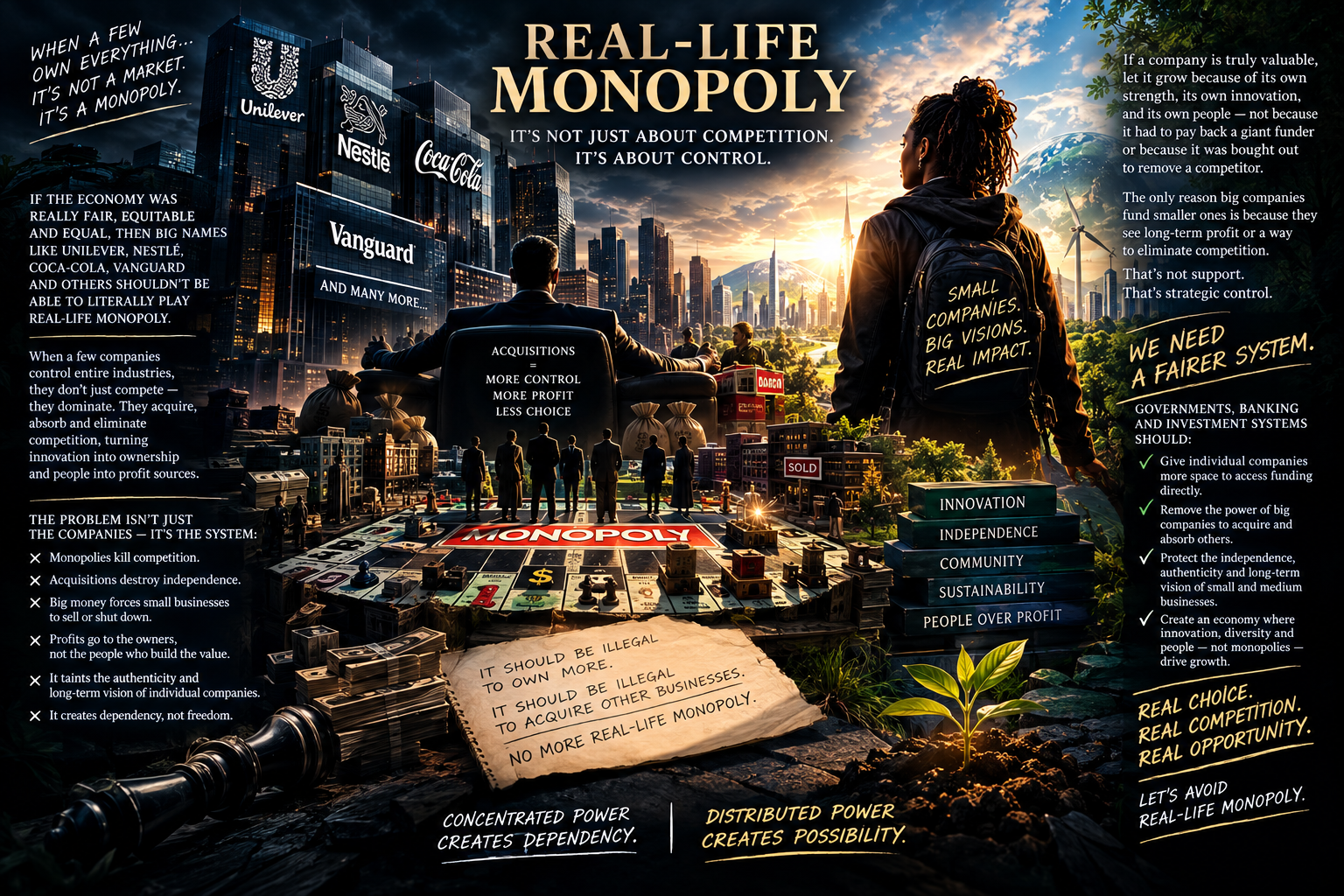
If the economy were genuinely fair, equitable and equal, we would have to ask a very simple question:
Why are we allowing a handful of organisations to play Monopoly with the real economy?
Look at the scale of some of the world’s biggest companies and investment organisations — Unilever, Nestlé, Coca-Cola, Vanguard and countless others.
The problem isn’t simply that they are big.
The problem is what happens when size becomes ownership, ownership becomes influence, and influence becomes the ability to determine what survives.
Because real-life M¹onopoly isn’t just owning lots of properties.
It is being able to keep acquiring more of the board.
It is buying the spaces around you.
Ita is buying the businesses that might have become your competitors.
It is owning enough of the infrastructure that other people eventually have to play by your rules.
And when that happens in the real economy, the consequences are much bigger than winning a board game.
They affect people’s jobs.
They affect what products exist.
They affect prices.
They affect innovation.
They affect which ideas receive funding.
They affect which businesses survive long enough to become something of their own.
And ultimately, they affect who gets to create.
Imagine an individual company starting because somebody has an idea.
They have a vision.
They have a product.
They have identified something they believe humanity needs.
They build it.
They develop it.
They find customers.
They create relationships.
They begin to grow.
Then a much larger organisation comes along with the funding.
On the surface, that can look like an opportunity.
But funding is rarely just money.
Funding can become ownership.
Ownership can become influence.
Influence can become control.
And control can eventually mean that the original creator is no longer the person determining the future of what they created.
Because the organisation providing the money isn’t necessarily funding the idea simply because it believes the idea deserves to exist.
It may see the long-term financial return.
It may see the strategic value.
It may see an opportunity to remove a competitor.
It may see intellectual property, distribution networks, customers, technology, talent or market access that it can absorb into something much larger.
And that changes the nature of the original creation.
The company may still exist.
The brand may still exist.
The founders may still be there.
But the independent vision can be gone.
That matters.
Because a company is not simply an asset.
It is the physical expression of somebody’s idea.
It is somebody’s vision organised into a structure.
It is people working towards something.
It is a particular way of solving a problem.
It is an identity.
So when another company acquires it, you’re not simply moving money from one account to another.
You can be changing the trajectory of that entire creation.
And that’s why I think we need to stop pretending that unlimited acquisition is automatically a sign of a healthy economy.
Why should the objective of every successful company be to acquire more companies?
Why should growth automatically mean consolidation?
Why should success mean buying the competitor?
Why should a business have to sell itself in order to obtain the resources necessary to survive?
Why aren’t we building an economy where an independent company can remain independent because it has alternative ways of accessing capital?
That is where governments, banking systems and financial institutions have a completely different responsibility.
Instead of building an economy where small and independent businesses eventually have to look upwards towards enormous corporations for survival, we should be creating financial structures that allow businesses to grow without having to surrender their identity to whoever has the most money.
Because otherwise we create a self-reinforcing cycle.
The large organisation has more money.
Because it has more money, it has more opportunities.
Because it has more opportunities, it acquires more businesses.
Because it acquires more businesses, it gains more resources, customers, information and influence.
Because it gains more influence, it has even greater capacity to acquire.
And eventually the economy starts concentrating power in fewer and fewer hands.
That isn’t an accident.
It is what happens when the system continuously rewards accumulation without placing enough value on independence.
And I don’t think the answer is to tell small businesses:
“Just compete harder.”
Compete against what?
A company with vastly greater access to capital?
An organisation with enormous purchasing power?
A company that can absorb years of losses because it has other revenue streams?
An investment organisation that can spread its money across thousands of assets?
At some point, saying “just compete” stops describing a competition.
It starts describing an imbalance of power.
So perhaps we need to rethink the architecture entirely.
Maybe companies shouldn’t be encouraged to acquire one another simply because they have the money to do so.
Maybe there should be far stronger structural protection for independent businesses.
Maybe funding should be available in ways that allow a company to remain its own company.
Maybe banking should be designed not merely to evaluate how much money can be extracted from an enterprise, but how much value that enterprise could create if it were given the resources to develop properly.
Because there is a huge difference between:
funding a company so it can become itself
and
funding a company so that you can eventually own it.
Those are not the same thing.
One builds independence.
The other can build dependency.
And that distinction matters enormously.
Because I don’t want an economy where every great idea eventually has to belong to somebody bigger.
I don’t want a world where the natural progression of a successful independent company is:
start → grow → attract investment → surrender ownership → get acquired → become part of something else.
I want an economy where another progression is possible:
start → grow → receive support → remain independent → collaborate when appropriate → develop its own identity → continue creating value.
Businesses should be able to succeed without having to become somebody else’s property.
And that means we have to stop treating acquisition as the automatic end goal of economic success.
Because what happens when every successful company keeps buying another successful company?
Eventually you’re not looking at an ecosystem of businesses anymore.
You’re looking at a hierarchy of ownership.
And once ownership becomes concentrated enough, the people at the top don’t just own companies.
They begin to influence the conditions under which everybody else gets to operate.
That is the real-life Monopoly problem.
Not simply that somebody has become wealthy.
Not simply that somebody has built a successful company.
But that the economic game can become structured so that the people who already control the most of the board have the greatest ability to acquire whatever remains.
And if we genuinely believe in a fair, equitable and equal economy, then we should be asking a completely different question:
How do we make it easier to create without making it easier to capture?
How do we fund businesses without swallowing them?
How do we support growth without requiring ownership?
How do we allow competition without allowing the board itself to be bought?
How do we protect the authenticity of individual visions?
And how do we build financial systems that help more people create value rather than concentrating the power to decide which value gets to exist?
Because the objective should not be:
“Who can own the most?”
The objective should be:
“How much can humanity create when ownership doesn’t determine who gets to participate?”
I don’t want a real-life Monopoly board.
I want an economy where there are millions of spaces on the board — and nobody gets to buy the whole thing.
…..
And now, I need you to write the next piece, which is: if the economy was really fair, equitable and equal, then all these big names like Unilever, Nestle and whatnot, Coca-Cola Company, Vanguard and whatnot, they shouldn’t be able to literally play real-life Monopoly, because playing real-life Monopoly, that means that it monopolises individual companies and all the profits goes to the owner, but then the owner also affects those individual companies because it literally creates for profits, right? Because if one company starts their business and it’s because they want to provide their value or whatever, and then a big one comes with the fundings, those companies with the fundings, they will want that funding back and more. But the only reason why they would put their money into it is because they see the value of long-term profiting that they can get, or by taking out a competitor out of the market. And that’s really important because when we look at how all these companies are building monopolies, it should be illegal to have and own more, to acquire more than anything. It should be illegal to acquire other businesses because you’re also tainting the ability that that individual company can have in the long run, the authenticity of that project or of that individual vision. Because instead of allowing acquisitions from companies, the governments, banking, all of that, they should allow individual companies more space to be able to acquire more funding, so that they don’t have to look up to big companies to put funding in them because, again, it creates the fact that then they are owned by those big companies and what those big companies say goes. So we’re trying to literally avoid real-life Monopoly.





Leave a Reply