
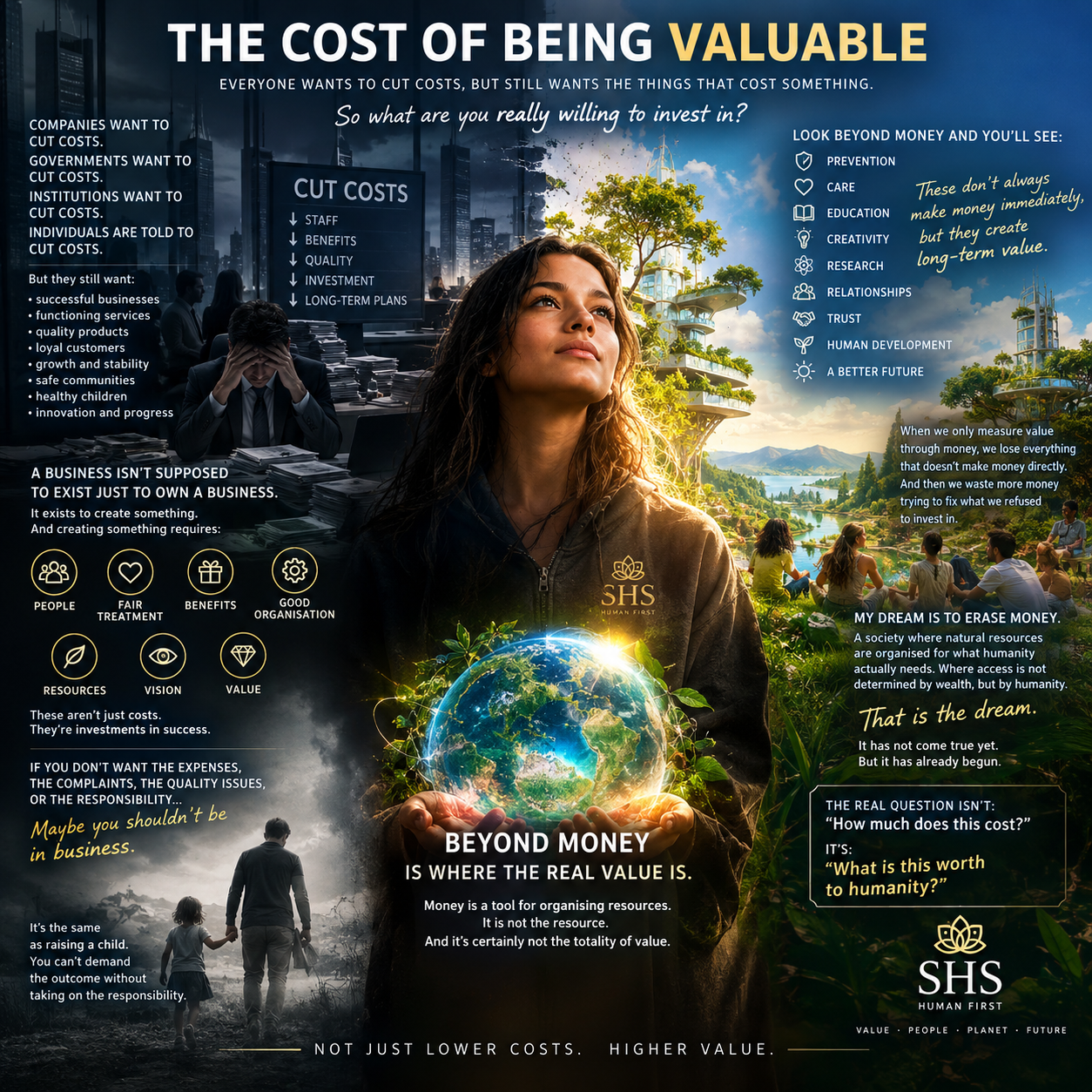
Everybody wants to cut costs.
Companies want to cut costs. Governments want to cut costs. Institutions want to cut costs. Individuals are constantly being told to cut costs.
But at the same time, everybody still wants the things that cost something.
Businesses want successful businesses. Governments want functioning services. Companies want productive people, loyal customers, good reputations, innovation, quality, growth and stability. Parents want healthy, supported children. Communities want safe environments. Everybody wants outcomes.
So there is a very obvious question that seems to get lost somewhere along the way:
What exactly are you expecting to have without being willing to invest in what creates it?
Why have a business if your fundamental instinct is to avoid spending money on the things that make the business successful?
Having a business means taking responsibility for creating value.
That means investing in your people. It means how you treat people. It means what benefits you provide. It means how you organise your company. It means how you organise your resources. It means how you organise your vision. It means understanding the value that you bring and continuously building on it.
Those things are not automatically a justification for lowering costs.
And they are not automatically a justification for raising costs either.
Because we have also seen the other side of this problem, where organisations use the language of staffing, complexity, infrastructure, administration, expertise or demand to justify enormous costs without creating anything close to the value those costs supposedly represent.
That is not investment.
That is hoarding.
Hoarding money.
Hoarding resources.
Hoarding access.
Hoarding institutional power.
And then calling the resulting expense a cost of doing business.
If you genuinely don’t want the expenses associated with your business, you don’t want the complaints from your staff, you don’t want customer complaints, you don’t want quality issues, you don’t want to deal with the resources required to maintain standards, you don’t want to continuously improve what you provide, then maybe you have to ask yourself why you are running a business in the first place.
A business is not supposed to exist merely so that its owner can possess a business.
It exists to create something.
And creating something requires resources.
You cannot demand the benefits of success while continuously trying to remove the ingredients that produce success.
It would be like a parent saying, “I don’t want the costs, I don’t want the responsibility, I don’t want the complaints, I don’t want the time commitment, but I still want the outcome of having raised a child well.”
You cannot separate the result from the responsibility.
And this is where the whole conversation around cost becomes much bigger than economics.
Because money is only one lens.
It is the social lens through which we currently organise an enormous amount of human life.
But there is another lens.
The humanitarian lens.
And when you look through that lens, you have to go beyond money.
Because beyond money is where the real value is.
The problem with measuring everything through money is that eventually you start believing that something only has value when it produces money directly.
And that is one of the biggest losses we have created for ourselves.
Because what happens to everything that doesn’t make money immediately?
Prevention doesn’t always make money immediately.
Care doesn’t always make money immediately.
Education doesn’t always make money immediately.
Creativity doesn’t always make money immediately.
Research doesn’t always make money immediately.
Relationships don’t always make money immediately.
Trust doesn’t always make money immediately.
Human development doesn’t always make money immediately.
Building something that might only become incredibly valuable ten years from now doesn’t necessarily make money today.
So under a money-only system, all of those things can be treated as expenses, inefficiencies, luxuries or liabilities.
And then we wonder why we keep having to spend more money repairing what we refused to invest in when it mattered.
That is the absurdity.
You save money in the moment and lose value in the process.
Then, years later, you pay even more money trying to recover the value you discarded.
And that is happening everywhere.
We have become so obsessed with reducing the immediate cost that we sometimes destroy the very conditions that would have created the long-term value.
I built SHS regardless of money.
I did it because the value was there before the money was.
Was that economically comfortable?
Absolutely not.
Did it get me homeless?
100%.
But this is also part of the story.
Because there is nothing I would go back and do differently.
There is nothing I would have rather abandoned simply because it wasn’t financially convenient.
I chose to bring value regardless of money.
That doesn’t mean money was irrelevant to what I was doing. Of course resources matter. Of course funding matters. Of course businesses need money. Buildings cost money. Technology costs money. People need to be supported. Infrastructure needs to exist.
But money is a mechanism for organising access to resources.
It is not the resource itself.
And it certainly isn’t the totality of value.
That distinction matters enormously.
Because eventually my goal isn’t to make more money.
My eventual goal is to erase the need for money.
That is the dream.
A society where we don’t have to convert every human need into a financial transaction before we are allowed to access what we need.
A society where natural resources can be organised according to what humanity actually requires.
A society where access is not determined simply by whether someone has accumulated enough pieces of paper, digits on a screen or ownership over something that existed before they did.
My dream has not come true yet.
There are aspects of it that have.
But no, we are not there.
And I don’t pretend that we are.
Right now, we still live in a world where organisations and governments decide who gets access to what, how much access they get, and under what financial conditions.
So someone can be surrounded by resources and still be unable to access them.
That is one of the strangest things about civilisation.
Nature can provide something.
Humanity can have the capability to produce something.
The technology can exist.
The infrastructure can exist.
The knowledge can exist.
The physical resources can exist.
And yet a human being can still be told:
You cannot have it because you cannot pay for it.
That is the part I cannot accept as the final form of human civilisation.
Money is useful as a tool for coordinating a system that is still built around scarcity, ownership and exchange.
But when the tool becomes the condition for access to life itself, the tool has become the system.
And that is backwards.
The ultimate purpose of an economy should not be to make everything profitable.
It should be to make life possible.
The ultimate purpose of a business should not be to minimise every cost.
It should be to create value responsibly.
The ultimate purpose of government should not be to spend as little as possible.
It should be to organise resources in a way that actually serves humanity.
And the ultimate purpose of human creation should not be limited by whether somebody can immediately monetise it.
Because some of the most valuable things humanity can create may be the very things that have no obvious price attached to them.
That is where SHS begins.
Not with the question:
“How much does this cost?”
But with:
“What is this worth to humanity?”
And those are not the same question.


Leave a Reply