
I made cancelling people out of my story functional and remunerable. Go figures!!! Nepotism will count as concession. F&F, gets a say and kinder representation, as the relationship is kinder to me. Every relationship will be represented for what it is. Nepotism is just an excuse title. To all the homeless I encountered, they get paid for representation or choose to get priority in the project post 8Honeth reintegration.
..just some thoughts over a free full english at a homeless food bank. Why not? I paid in advance for the food, so let me create the next revenue. SHS TV opens the world to ID(Individual’s Digital) Real Estate. Fees and all will be projected i 2027. End of today last proposals to collaborate, otherwise as creative works the chosen path, I’ll continue forever indipendent. Probably even greater freedom, so please hold your offers. Give me this one last wish.
So there is another part of the SHS TV architecture that I think makes the whole thing even more interesting.
Because if this platform is built from one real life and the people, encounters, events, conversations and circumstances that actually passed through it, then what happens to the people who appear in that story?
They get a choice too.
And I think that choice should be explicit.
Every person gets a door
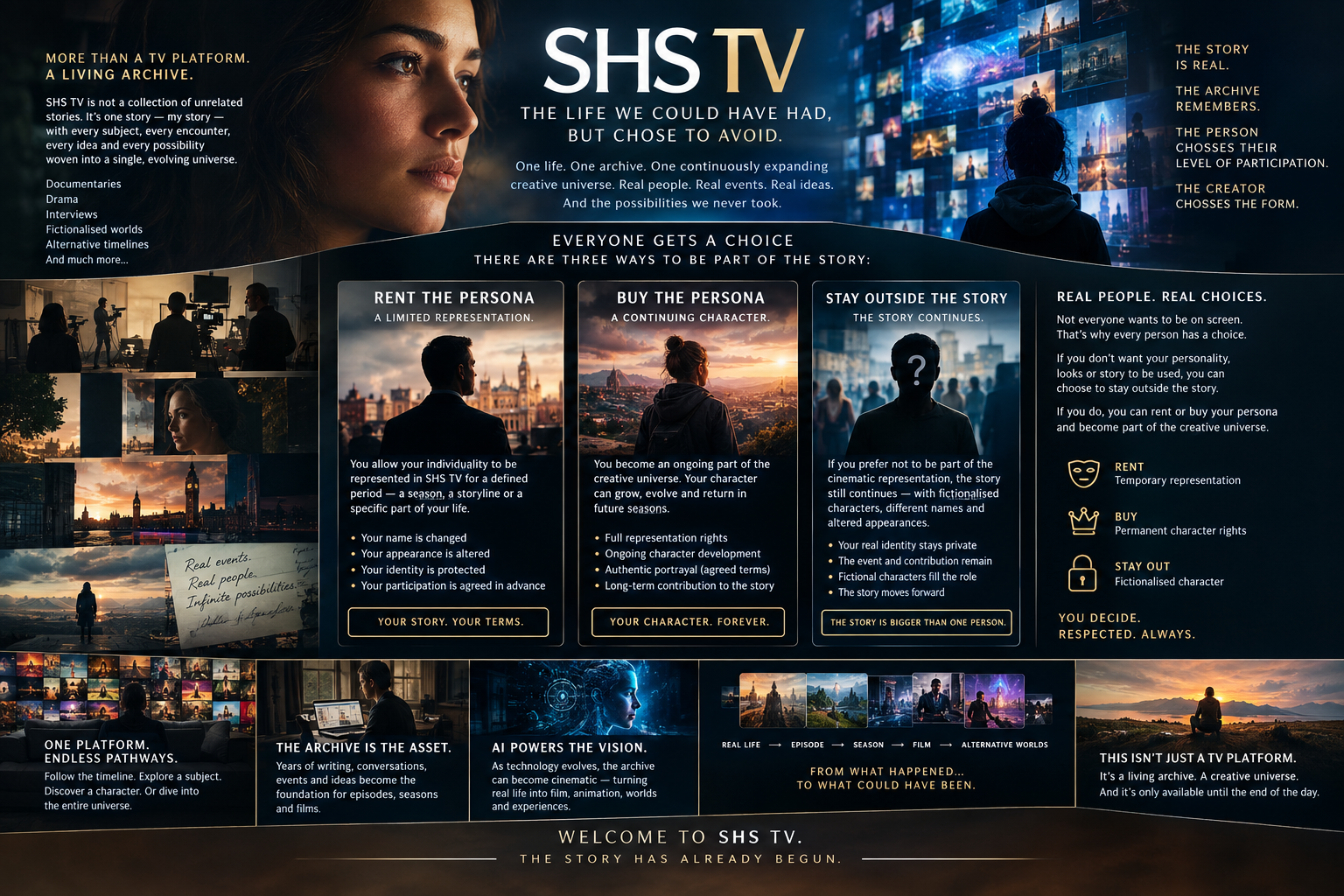
Within the SHS TV creative model, a person who becomes part of my story can choose whether they want their individuality to be represented as themselves.
Their personality.
Their character.
Their presence.
Their contribution.
Their part in the storyline.
Their version of themselves.
If they want that, there can be a contractual arrangement for it.
I call it renting the persona.
The idea is simple:
You are allowing SHS TV to represent a version of your individuality within the story for a defined period, season, production or set of circumstances.
Or you could take it much further.
You could buy the persona.
Meaning that your participation becomes an ongoing part of the creative structure, with agreed rights around how that continuing character is represented and developed.
That is the version where the character can keep evolving because the individual has chosen to remain connected to the storyline.
And then there is the other door.
Stay outside the story.
That is perfectly possible too.
And in that case, the person themselves does not become the authentic on-screen representation.
The story can still continue.
Because the event happened.
The interaction happened.
The contribution happened.
The experience happened.
But the cinematic character can become fictionalised.
Different name.
Different appearance.
Different details.
Potentially a different background.
A different presentation entirely.
The purpose is not to erase what happened.
It is to preserve the storyline without pretending that the fictional character is the actual individual who lived it.
That distinction matters.
Because SHS TV is not supposed to stop functioning every time one human being says:
“I don’t want to be in the film.”
Fine.
You don’t have to be.
The story continues.
The archive remains the archive
This is where the written SHS archive becomes important.
The real-world record can preserve the original context of what was actually written, proposed or experienced.
But the cinematic version can operate differently.
A person might be named in the original material.
A politician might appear in the written archive.
A company might appear in a documented exchange.
A conversation might exist exactly as it happened.
But when the story moves into cinematic production, the representation can be adapted.
That gives everyone a little more space.
Because the person can decide:
“Yes, represent me.”
Or:
“No, leave my identity outside of the cinematic version.”
And then the character belongs to the creative work rather than pretending to be a literal reproduction of the person.
And here is where the commercial idea comes in
I like the language of renting and buying because it makes the choice understandable.
Rent the persona.
You allow your individuality to be represented under defined terms.
Perhaps for one season.
Perhaps for one storyline.
Perhaps for one particular period of your life.
Perhaps for a particular set of events.
What gets represented is what was actually agreed to represent.
Everything outside that agreement remains open for creative interpretation.
Buy the persona.
Now the relationship is different.
You have chosen to remain part of the character.
The character can continue.
Develop.
Change.
Return.
Appear in future seasons.
Contribute to future storylines.
And the authenticity of the portrayal becomes part of the value of that agreement.
In other words:
renting creates a bounded representation.
buying creates an ongoing character relationship.
That is a creative business model.
And it is also a way of recognising that people are not all equally interested in being part of someone else’s art.
Some will want it.
Some won’t.
Some will want to participate deeply.
Some will want a small piece.
Some will want nothing.
All of those choices can exist.
And what I don’t know, I create
This is perhaps the most important part.
When someone chooses not to have their real individuality represented, I am not then required to invent their actual feelings, actual intentions, actual private life or actual future and pretend those things belong to them.
That is where fiction takes over.
I can create.
I can interpret.
I can dramatise.
I can combine characteristics.
I can construct dialogue.
I can build a fictional character inspired by the function that person played in my story without presenting that character as the real human being.
And that gives me enormous creative freedom.
Because the question changes from:
“What exactly did this person think?”
to:
“What character represents what happened here in the story I am telling?”
That is art.
The underlying event can be real.
The emotional meaning can be real.
The effect on my life can be real.
But the character can still become a work of imagination.
Good, bad, ugly — that isn’t the point
And another thing:
I am not interested in creating some ridiculous system where people only participate if the portrayal makes them look wonderful.
That isn’t authenticity.
If someone chooses to have their character represented authentically, then the authentic version may not always flatter them.
Sometimes people are beautiful in the story.
Sometimes difficult.
Sometimes generous.
Sometimes selfish.
Sometimes brilliant.
Sometimes confusing.
Sometimes contradictory.
Sometimes they did something that helped me.
Sometimes they did something that hurt me.
Sometimes they simply became part of the circumstances through which I changed.
That’s life.
The question isn’t:
“Does this make me look good?”
The question is:
“Is this how I choose to be represented?”
That is the meaningful choice.
And for everyone else?
The story belongs to the person whose life is being told.
That does not mean every person encountered becomes property.
It means the creative universe has a source.
And its source is the life through which the archive was created.
So I can tell the story of what happened to me.
I can tell the story of what I experienced.
I can tell the story of what something meant to me.
I can build fictional characters around those experiences when someone does not choose authentic representation.
And I can offer people the opportunity to participate more deeply where they actually want to.
That is the difference between using someone as content and giving someone a choice about their place inside the creative universe.
The really interesting thing is that nobody disappears
Even if someone chooses not to participate authentically, their contribution to the story does not necessarily vanish.
It changes form.
The real person stays where they belong:
in their own life.
The fictionalised character stays where it belongs:
inside the art.
The event stays where it belongs:
inside the archive.
And the creator continues building.
That means SHS TV can preserve continuity without requiring every human being who ever touched the story to become a cast member.
That would be impossible anyway.
A life is full of people.
You meet thousands.
You speak to hundreds.
A few change the direction of your life.
Some appear once.
Some stay for years.
Some are there for one conversation.
Some become entire seasons.
You cannot turn all of them into conventional television characters.
But you can create an architecture where each one gets a choice.
And perhaps this becomes another SHS principle
The story is real.
The archive remembers.
The person chooses their level of participation.
The creator chooses the form.
That is the balance.
You can participate.
You can license your persona.
You can remain outside the cinematic representation.
You can become a recurring character.
You can contribute to the development of that character.
Or you can simply remain part of the historical circumstances from which the story emerged.
And the universe continues.
One life. Many characters.
That is another reason SHS TV can become so enormous.
Because the platform isn’t only documenting one person’s life.
It is documenting the intersection between one life and the many people, institutions, ideas and realities that passed through it.
Some become characters.
Some become fictionalised characters.
Some become brief appearances.
Some become entire seasons.
Some become permanent parts of the mythology.
Some remain names in the archive and nowhere else.
And that is fine.
Because not everybody needs to be an actor in order to matter to a story.
Sometimes you only need to have been there.
And sometimes, if you want to, you can choose to step back onto the stage.
That choice belongs to you.
The story keeps going either way.
…
And as a follow-up to that, SHS TV will give the chance to each and individual, each and every single individual that happens to be part of my story, the chance to rent out their personality. If not, it will be fictionalized so that the personality, like the story goes, but the person in particular isn’t mentioned. So there will be an alias, so a change of name, a change of looks, so that the story continues, meaning that the story and the individuals were real characters, but they get fictionalized just because they chose to stay outside of the story, or they simply are individuals that are not willing to rent their own personality within SHS TV, which means that they won’t also have the representation of their figure, of their individuality, of their story, and their contribution to my story parts in my existence. And as my existence is what created SHS TV, only that story goes. So, for example, the name of all the politicians, for example, the name of all those that have been emailed, they stand originally on the written platform, but when it comes to turning it into a movie, their names will be changed, their emails will be changed, and that’s simply to make sure that we leave the land open for them to invest in themselves. If people want their personalities, want their individuality, want their character to be represented in our platform, they will have to rent out their persona, or they can buy the persona and forever have the rights to contribute to the storyline of their individual persona. If they don’t and they rent it, then it might be just for, like, a season or whatever. Because if they buy it, that means that every single individual parts and aspects will have to be included to hold on to the authenticity of their individuality. If they don’t and they choose to rent it, that means that their individuality only gets represented in specific occasions or specific moments, and everything else gets left out, and it gets created from my own mind, from my own perceptions, and that’s outside of what they might have experienced or what they might have wanted to be shared. So what people don’t want to be authentically about stays out for my own creation, for my own creativity. What people want to be represented as is stood, whether it makes them look good or bad doesn’t really matter, then that’s how it will be.



Leave a Reply