
” We want to say sorry for not learning or be willing to practice humanity’s languages to help humanity embody the work, not talk about the work. So many of us came from Buddha, to Mohammed, to Christ, to Lucifer, to Krishna, to Susan.. we knew better, yet still chose our purity sitting beside humanity perishing. How could have we done it differently is yet to be discovered but we’re utterly grateful as an individual stripped of the Christ, for the love received. “
….
Let’s wrote a post at the intersection of these 3 exerpts cause realistically it is not just just Buddha that learned to think for self and tried to excite the other for a better world and a better relationship with self, in fact there has been cointless, but ojt od all of them only a religion happened, books about them,emories of them, but not real practice as them, not that it brings purpose in these times either. And i feel like that’s ehere capitalism exists and gets reinforced. By the exact same notion of not listenjing to value we loved the lack there of, and capitalism is really not listening to the histoeic failures of all civilisations that prevailed upon the separation of a couple of few and the masses. They all failed and in not listening capotalism csme through. The religion of systematical failure. Just like the projected failure that created the religions, otherwise the wisdom had been lived wirhou its religion. Ome doesnt have to be all about buddha, jesus, mohammed or else to develop the mind to sustain it all, in fact by doing that they put another person before them. No one that has achieved that state of thinking wants that in fact they’d rather the practice without thw following.
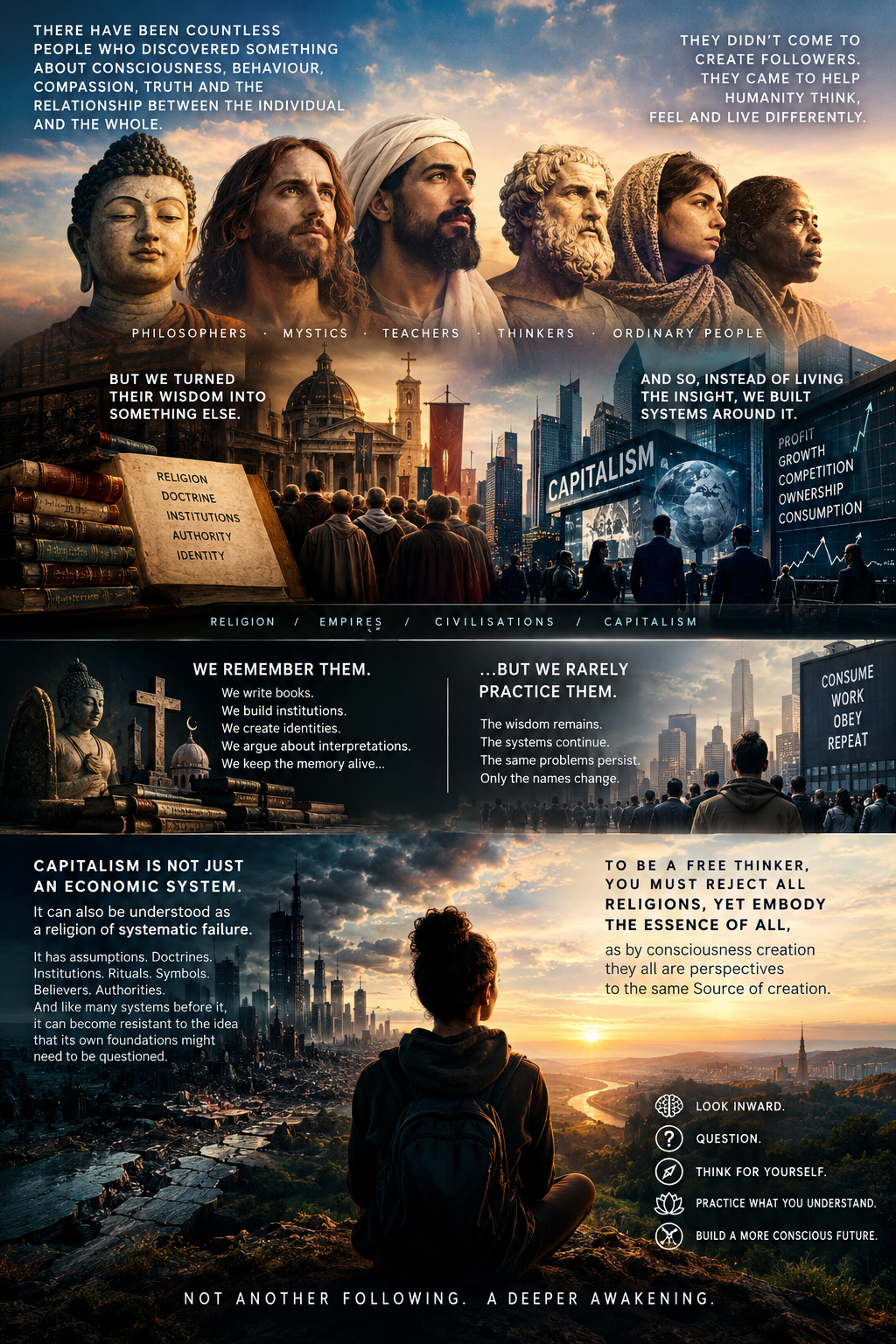
To be a free thinker you must reject all religions, yet embody the essense of all, as by consciousness ceation they all are perspectives to the same Source of creation
….
THE RELIGION OF SYSTEMATIC FAILURE
There is something connecting these three ideas that goes far beyond Buddha.
One says capitalism rests on the extraordinary belief that private motives will somehow organise themselves into the benefit of everyone.
Another says that nobody really listened to Buddha, because his insight became Buddhism.
And another reminds us that developing a mind of your own means becoming conscious of the forces that shape your thinking rather than simply becoming attached to another set of instructions.
Put those together and a much bigger pattern appears.
Buddha was not the first human being to realise that we have to understand ourselves.
Jesus was not the first.
Muhammad was not the first.
Neither were the countless philosophers, mystics, teachers, thinkers and ordinary people throughout history who recognised that human beings could relate to themselves, to one another and to existence differently.
There have been countless people who discovered something about consciousness, behaviour, responsibility, compassion, restraint, freedom, truth and the relationship between the individual and the whole.
And what did we repeatedly do with those discoveries?
We turned them into systems.
We turned people into authorities.
We turned experiences into doctrines.
We turned wisdom into books.
We turned teachers into figures to follow.
We turned teachings into identities.
We turned personal discovery into institutional belief.
And eventually, instead of living the insight, we learned how to belong to the institution that remembers it.
That is the irony.
Perhaps the person who truly understood freedom never wanted to become somebody’s permanent authority.
Perhaps the person who discovered something profound about consciousness never wanted millions of people to stop discovering it for themselves.
Perhaps the instruction was never:
“Become like me.”
Perhaps it was:
“Look.”
Look at yourself.
Look at your mind.
Look at your motives.
Look at your relationship with other people.
Look at what you are being influenced by.
Look at what you are doing.
Look at what your system produces.
And then think for yourself.
Yet humanity has repeatedly found it easier to preserve someone’s memory than to reproduce their practice.
We remember Buddha.
We remember Jesus.
We remember Muhammad.
We remember countless others.
We write books about them.
Build institutions around them.
Create identities from them.
Argue about who interpreted them correctly.
And then continue producing many of the same human problems that their teachings were attempting to confront.
That is where I see capitalism fitting into the picture.
Because capitalism is not simply an economic arrangement.
It can also be understood as another enormous system built around assumptions about human behaviour.
Competition.
Accumulation.
Ownership.
Self-interest.
Profit.
Growth.
Scarcity.
Incentives.
And the expectation that millions of individual decisions will somehow combine into something beneficial for the whole.
But how different is that from the ancient pattern of believing that if we simply organise humans correctly, the system will somehow produce the outcome we want?
We have done this before.
Civilisations have risen.
They have created hierarchies.
They have concentrated power.
They have separated those who govern from those who are governed.
They have created privileged groups and dependent masses.
They have justified the arrangement through religion, law, bloodline, wealth, conquest, race, class or divine authority.
And they have eventually failed.
Not necessarily because every person inside them was evil.
But because the structures themselves repeatedly produced relationships that could not sustain the civilisation indefinitely.
And yet rather than learning the deeper lesson, humanity keeps building another structure.
Another hierarchy.
Another ideology.
Another institution.
Another justification.
Another arrangement in which a comparatively small number of people acquire disproportionate control over the conditions of everyone else.
Then we call it progress.
That is why, in my view, capitalism can be understood as a religion of systematic failure.
Not because capitalism is literally a religion.
But because it can function like one.
It has assumptions.
It has doctrines.
It has institutions.
It has rituals.
It has symbols.
It has believers.
It has authorities.
It has rewards for conformity.
And, like many systems before it, it can become remarkably resistant to the possibility that its underlying assumptions might themselves need to be questioned.
The most fascinating part is that we already know humans are capable of doing this.
History is full of warnings.
Philosophy is full of warnings.
Religion is full of warnings.
Economics is full of warnings.
Psychology is full of warnings.
Our own lives are full of warnings.
Yet we keep building systems around the same weaknesses we already know exist.
That is the failure I am interested in.
Not the failure of one religion.
Not the failure of one civilisation.
Not the failure of one economic model.
The failure to listen.
Because what if the problem was never that humanity lacked enough wisdom?
What if the problem was that we continually converted wisdom into something external to ourselves?
We put Buddha before ourselves.
Jesus before ourselves.
Muhammad before ourselves.
Philosophers before ourselves.
Economists before ourselves.
Politicians before ourselves.
Markets before ourselves.
Institutions before ourselves.
And eventually the system becomes more important than the human being it was supposedly created to serve.
That is the point where thinking stops.
And following begins.
For me, genuine freedom of thought therefore cannot mean replacing one doctrine with another.
It means developing a mind capable of examining all of them.
Religion.
Atheism.
Capitalism.
Communism.
Nationalism.
Democracy.
Tradition.
Modernity.
Science.
Philosophy.
Every institution.
Every authority.
Even the beliefs we currently hold most dearly.
Not because everything is equally true.
But because no human being should surrender the responsibility to think simply because somebody else thought before them.
And this is where I arrive at something that sounds contradictory:
To become genuinely free-thinking, I believe you have to reject religion as an authority while still being willing to embody what is valuable within humanity’s religious traditions.
Not worship the messenger.
Not become trapped in the institution.
Not inherit somebody else’s consciousness.
Practice the insight.
Because if consciousness is the source from which human beings create their perspectives, then perhaps the great traditions are not necessarily separate absolute realities competing for ownership of truth.
Perhaps they are different human perspectives attempting to describe something encountered through consciousness.
Different languages.
Different histories.
Different cultures.
Different interpretations.
But the underlying invitation can remain remarkably similar:
Look within.
Question.
Understand yourself.
Understand your relationship with others.
Do not blindly follow.
Become conscious.
And perhaps the next stage of civilisation is not creating another religion around the person who discovers something new.
Maybe it is creating a civilisation where people actually practice what they understand.
Because the person who truly discovers freedom should not need followers.
They should want more people to become free enough to discover for themselves.
That, to me, is the difference between remembering wisdom and living it.


Leave a Reply