
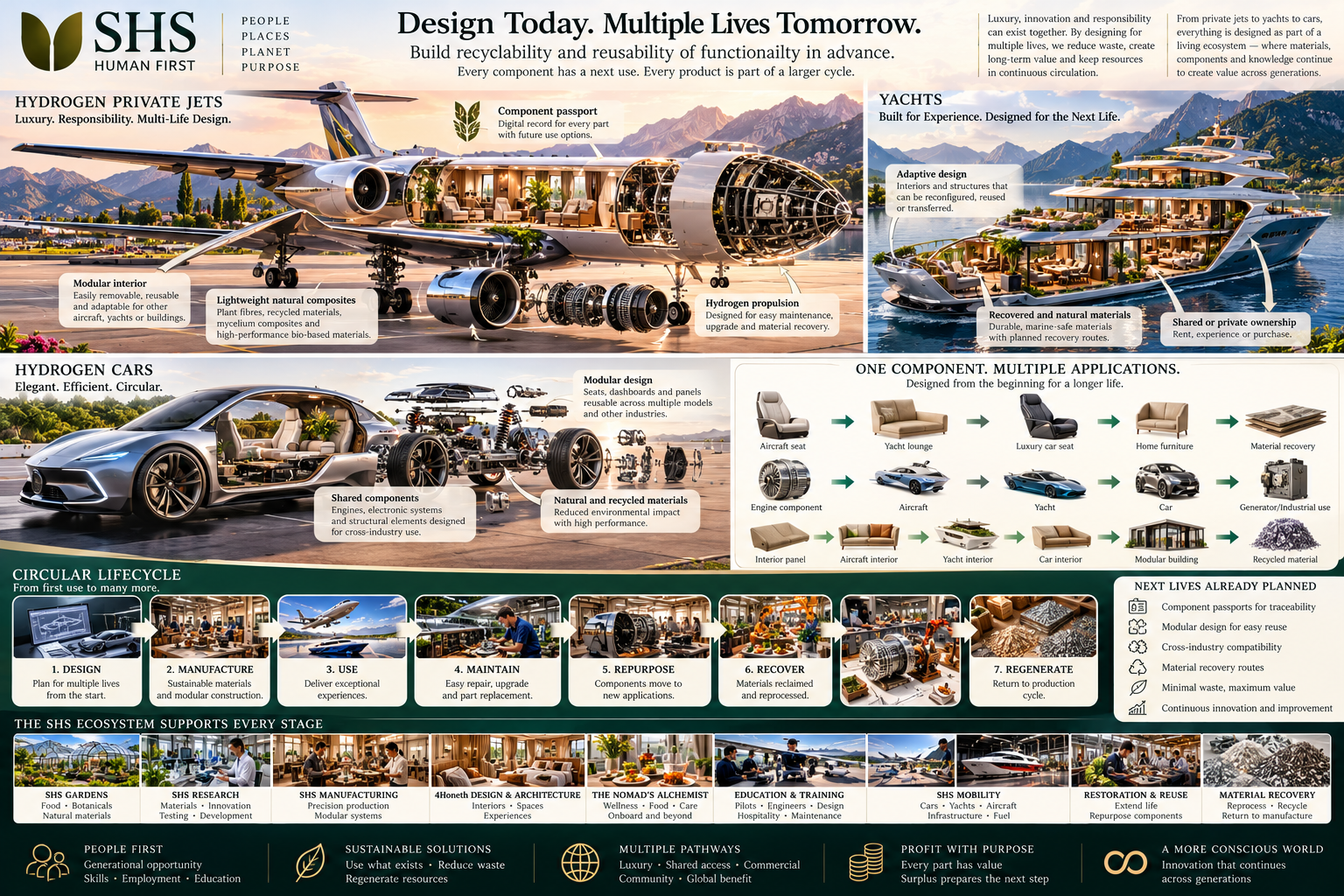
Build in advance as the pieces can be used for other machinery at its end. Creat luxury pieces that can be then used for common machinery.
SHS Luxury Mobility™
A Future Luxury Aviation, Marine & Automotive Division of SHS – Human First
Luxury Through the Universal Bar™
From Society’s Surplus to Humanity’s Most Extraordinary Experiences.
Luxury without unnecessary waste. Innovation without abandoning responsibility. Wealth creating opportunities beyond its ownership.
1. The Vision: Bringing the Luxury Industry Into the SHS Ecosystem
At later stages of the SHS – Human First ecosystem, we can extend our manufacturing, architectural design, research and transportation capabilities into the luxury industry.
Private jets. Yachts. Luxury vehicles. Bespoke interiors. Exclusive experiences. Personalised transportation.
The objective would not be to abandon luxury, but to explore how its resources, technology, craftsmanship and commercial opportunities could contribute to a wider regenerative economy.
We would serve the luxury market while using the capabilities developed through it to benefit the wider SHS ecosystem.
Imagine a private jet whose interior has been designed by 4Honeth Design & Architecture™, furnished using recovered and responsibly developed materials, supplied with fresh produce from SHS Gardens and supported by personnel whose education began years before the aircraft entered service.
Imagine a yacht constructed or restored with components designed for future recovery, refurbishment or use in other appropriate applications.
Imagine the same research used to develop a premium hydrogen-powered vehicle eventually contributing to more accessible forms of transportation.
The customer receives a highly personalised experience.
The ecosystem receives opportunities for research, employment, production, education and future development.
And the infrastructure can continue serving other purposes long after the original luxury product reaches the end of its useful life.
2. Two Markets, One Underlying Architecture
SHS Luxury Mobility™ could operate through two connected markets.
Accessible Experiences
The shared yacht concept remains available.
Customers could book stationary experiences, photography sessions, short journeys or full-day excursions.
The proposed cost-plus-5% model would remain an option for these accessible services, with transparent operating expenses and any additional SHS subsidies accounted for separately.
Over time, suitable arrangements could extend to other forms of transportation.
Bespoke Luxury Ownership
The second market would serve individuals and institutions looking to purchase or commission personalised products.
This could include luxury yachts, private aircraft interiors, premium vehicles and custom-designed transportation environments.
Through 4Honeth Design & Architecture™, customers could request interiors developed around their identity, lifestyle, aesthetic preferences and functional requirements.
The luxury offering would create a separate commercial opportunity while sharing research, materials, manufacturing infrastructure and expertise with the wider ecosystem.
One market provides extraordinary experiences. The other helps develop the resources that can make extraordinary experiences more widely accessible.
3. 4Honeth Design & Architecture™ — Beyond Buildings
This is where your existing architectural framework becomes particularly interesting.
The twelve-system design methodology need not remain confined to residential buildings.
A private jet is also an environment inhabited by human beings.
So is a yacht.
So is a car.
Each has its own spatial limitations, functions, sensory conditions and operating requirements.
The 4Honeth approach could therefore extend into mobile architecture.
A private aircraft could contain designated environments for rest, work, conversation, dining and recreation, depending on its size and configuration.
A yacht might incorporate botanical elements, creative spaces, art, personalised furnishings and facilities for social interaction.
A vehicle might use materials, lighting, seating and other details chosen around the passenger’s particular needs.
The twelve systems would inform the design, including Education, Public Health, Finance, Innovation, Infrastructure, Social Welfare, Environment and Law.
The same five representation methods developed for 4Honeth houses would remain relevant: spatial, functional, symbolic, educational and behavioural.
The result would be a recognisable design philosophy across different industries.
The property changes. The method of understanding the human experience remains.
4. Design the Next Use Before Manufacturing the First
This may be the most important addition to your proposed manufacturing architecture.
The Principle of Anticipated Material Reincarnation
Rather than waiting until a product reaches the end of its useful life to decide what can be recovered, SHS would consider its next potential applications during the original design.
Every major product could be developed with a lifecycle map.
A component might first serve in a yacht.
Following inspection, refurbishment and any necessary requalification, it may be suitable for another marine application.
A decorative panel could potentially be reconstructed into furniture.
A textile originally used in an aircraft interior might later become suitable for a less demanding application.
Electronic modules might be reused where their condition, compatibility and applicable requirements permit.
Where direct reuse is inappropriate, valuable materials could be recovered and processed for new manufacturing.
This introduces a hierarchy:
- Preserve: Maintain the original product for as long as it remains suitable.
- Restore: Repair and refurbish components rather than automatically replacing them.
- Repurpose: Transfer suitable components into other applications.
- Reconstruct: Transform components into different products.
- Recover: Reclaim usable materials for further manufacturing.
- Regenerate: Return suitable resources to productive cycles wherever technically and environmentally appropriate.
The objective is to reduce how often the ecosystem must return to virgin resources.
For aircraft engines, propulsion systems and other safety-critical equipment, reuse between aviation, marine and automotive applications would require appropriate engineering, compatibility assessment and certification. The underlying principle is to maximise recoverable value, not to assume every component can be transferred directly between vehicles.
The Component Passport
Every significant manufactured component could eventually have a digital record describing its material composition, origin, manufacturing process, maintenance history, ownership and potential recovery routes.
When a yacht, aircraft or vehicle reaches the end of a particular service life, SHS could consult that record.
Instead of asking only what should be discarded, the organisation could identify what remains useful.
Over generations, this could develop into an internal database of materials, components and their demonstrated applications.
We would not merely manufacture products. We would manufacture with an understanding of what their components might become next.
5. Hydrogen Transportation: A Future Research Pathway
The hydrogen aircraft and vehicle concepts would connect directly to SHS Mobility™, Manufacturing and Research & Development.
At an appropriate stage, the ecosystem could investigate hydrogen propulsion for road vehicles, marine applications and eventually aviation.
The intention would be to use accumulated industrial knowledge and existing infrastructure wherever practical.
However, the Universal Bar would evaluate hydrogen alongside other technologies rather than treating its eventual adoption as predetermined.
The suitability of hydrogen depends on production methods, storage, energy requirements, propulsion technology, safety, infrastructure and the intended application.
For private aircraft, SHS could begin with partnerships in engineering, propulsion research, materials and specialist aircraft design before considering complete vehicle development.
The private aviation market could become one potential destination for the research.
But the resulting knowledge might also contribute to other forms of mobility.
The luxury application need not be the final destination of the innovation. It can be one stage in its development.
6. Preparing the People Years Before the Project Launches
This is another expression of your generational continuity architecture.
Instead of waiting until an aircraft has been purchased or manufactured before beginning recruitment, SHS could begin developing the relevant skills years earlier.
Imagine an individual entering an SHS educational programme interested in aviation.
The ecosystem recognises that private aviation is one of its contemplated future industries.
It may therefore support that individual’s development through appropriate education, training opportunities, professional experience and eventual specialisation.
The same principle could apply to yacht captains, engineers, technicians, designers, safety specialists, manufacturing personnel and maintenance professionals.
A Future Workforce Pipeline
The pathway could move from COMPYE and COMPAE educational opportunities into specialist programmes, apprenticeships, professional partnerships and accredited training.
For aviation, SHS could initially sponsor training through established approved organisations. At a later stage, it could consider operating its own training provision where the required approvals, instructors, facilities and resources justify doing so.
The objective would be to create the relevant capabilities before operational demand becomes urgent.
This changes the economics of expansion.
The training is not simply an expense incurred after a new business has been launched.
It becomes part of the long-term preparation for that business.
And importantly, the individuals receiving training can contribute to other relevant parts of the SHS ecosystem while the future aviation or marine projects develop.
The people are not an afterthought of the infrastructure. Their development is part of building the infrastructure.
7. The Nomad’s Alchemist™ and SHS Gardens — Luxury Hospitality
Imagine the food and personal-care experience aboard an SHS-designed yacht or aircraft.
Instead of automatically purchasing every provision through unrelated external suppliers, the ecosystem could use suitable products from its own divisions.
SHS Gardens could contribute selected fresh produce and botanical ingredients.
The Nomad’s Alchemist™ could develop teas, fragrances, soaps, creams and other appropriately tested personal-care products.
The food research and hospitality teams could develop menus incorporating the unusual ingredient pairings and culinary experiences you’ve contemplated.
Where ingredients cannot be supplied internally, suitable external producers could provide them.
The objective would be to build a distinctive hospitality experience while supporting the wider ecosystem’s agricultural, research and manufacturing capabilities.
The SHS Experience
A customer purchasing a luxury yacht would not necessarily receive only the yacht.
They could also commission its design, onboard furnishing, hospitality systems and ongoing support.
An aviation customer could receive a similarly considered interior and service.
The environment would remain highly personalised, but its underlying architecture would be recognisably 4Honeth.
From the seating and materials to the refreshments and sensory atmosphere, the experience would be consciously designed.
8. Yacht Restoration, Design and Sales
SHS could begin its luxury marine development through second-hand vessels.
This fits directly into the existing philosophy of recovering society’s surplus before manufacturing new products.
A used yacht could be purchased, assessed, refurbished and redesigned through 4Honeth.
Where appropriate, SHS could then sell the vessel as a bespoke product or retain it for shared experiences.
Over time, the business could develop original designs or commission new vessels incorporating lessons from previous restoration projects.
The progression would be:
Second-hand acquisition → Inspection → Restoration → 4Honeth redesign → Use or sale → Maintenance → Component recovery.
That sequence would also generate practical knowledge relevant to future manufacturing.
Which materials remain durable?
Which components fail most frequently?
Which interiors are easiest to maintain?
Which modifications improve usability?
Which recovered materials retain sufficient value for another application?
Each restoration becomes a research opportunity.
Each product contributes information to the next design.
9. The Luxury Industry as an Economic Contributor to SHS
One especially interesting aspect is the relationship between premium products and shared infrastructure.
A bespoke private aircraft interior might justify investments in specialist design capabilities.
Those capabilities may later be applied to other environments.
A custom yacht could justify research into durable, lightweight or repairable materials.
Those materials may eventually become useful in buildings, furniture or transportation.
Premium vehicle production could support training, equipment and manufacturing expertise.
The resulting capabilities may be available to other SHS businesses without each division independently financing the same development.
This creates the potential for luxury expenditure to contribute to the development of shared productive capacity.
The commercial arrangements would need to account for the true costs and ownership of that capacity, but the underlying strategy is clear.
The wealthiest customers could purchase personalised, premium products.
Their purchases could help sustain research, employment, manufacturing and further development.
And the knowledge developed through the luxury business could remain available for appropriate applications throughout SHS.
Luxury becomes another pathway through which resources circulate into the broader ecosystem.
10. The Universal Bar™ Governs the Expansion
The proposed aviation, marine and automotive businesses would be assessed through all twelve Systems of Humanity.
The process would begin with Education and progress towards Law.
Implementation would then work backwards.
The assessment would consider not only the business’s direct performance but its relationship with every other relevant SHS division.
For example, an SHS-designed private jet would be evaluated in relation to passenger safety, energy systems, material sourcing, aircraft certification, financial sustainability, employment, environmental consequences and the infrastructure required to support it.
The proposed threshold remains 8/10 or higher across each of the twelve systems.
The luxury market would not receive an exemption from the Universal Bar simply because customers are willing to pay substantially more.
If anything, the wider range of resources available within a luxury project creates further opportunities to explore what responsible design and production can achieve.
The objective is to bring the entire industry into the same framework of continuity.
11. Generational Preparation: The Business Before the Business
This returns to your central insight about time.
SHS does not need to establish an airline, yacht manufacturer or automotive company immediately.
It can establish the pathways through which those possibilities may become viable.
Research can begin before manufacturing.
Education can begin before recruitment.
Design principles can be established before products are commissioned.
Material recovery systems can be developed before large-scale production exists.
Industry relationships can be cultivated before an internal operation is justified.
And financial surplus from established divisions can contribute to the preparation of future ones.
A project that eventually launches in fifty years may draw upon decades of investment into knowledge, people, materials and infrastructure.
The next generation would not necessarily inherit an unfinished idea.
It could inherit a developed research history, specialist relationships, tested designs, trained personnel and a defined route towards implementation.
That is the purpose of anticipating future business modules.
The future business begins being prepared long before it becomes operational.
SHS Luxury Mobility™ — The Long-Term Vision
Imagine that a century from now, SHS has developed several generations of experience in housing, materials, education, manufacturing, research, energy and transportation.
A customer commissions a private aircraft.
Its design comes from 4Honeth.
Its materials have been selected through SHS research.
Its suitably qualified staff have developed through long-standing educational and professional pathways.
Its onboard hospitality incorporates products from other SHS divisions.
Its components have been documented with future maintenance, recovery and appropriate reuse in mind.
The aircraft serves its intended purpose.
Years later, when particular components must be replaced, suitable materials are recovered for other uses.
The lessons from its operation influence the next generation of designs.
And the financial activity generated by the business contributes to the continued development of the ecosystem.
The cycle continues.
That would be the larger achievement.
Not merely manufacturing a luxury vehicle.
But developing the relationships through which its creation, use, maintenance and eventual recovery contribute to other parts of society.
The Founding Principle
We do not need to eliminate luxury to make society more accessible.
We can examine how luxury’s resources, creativity, craftsmanship and technology might contribute to greater accessibility.
We can design products whose value does not disappear when their first purpose ends.
We can educate people today for industries that may not become operational until another generation.
And we can establish the foundations of those industries without needing to build everything at once.
SHS Luxury Mobility™
Extraordinary experiences. Responsible resources. Generational innovation.
SHS – Human First | The Universal Bar™
The objective is not simply to create luxury that lasts. It is to create luxury whose value continues beyond the product itself.



Leave a Reply