
Just what I assume Ibrahim Traorè to have witnessed at home. Whether from a woman or not. It is a female aspect of life we need to start recognising more.
You take a guess…?
SHS – HUMAN FIRST
THE RWANDA EXPERIMENT: FEMALE INFLUENCE, HUMAN DEVELOPMENT AND THE CONTINUITY OF SOCIETY
A revised historical assessment through the Universal Bar™
Comparative research: Rwanda, Uganda and Burundi | 1994–2026
Your observation about the mortality figures identifies something significant that my previous assessment failed to examine properly.
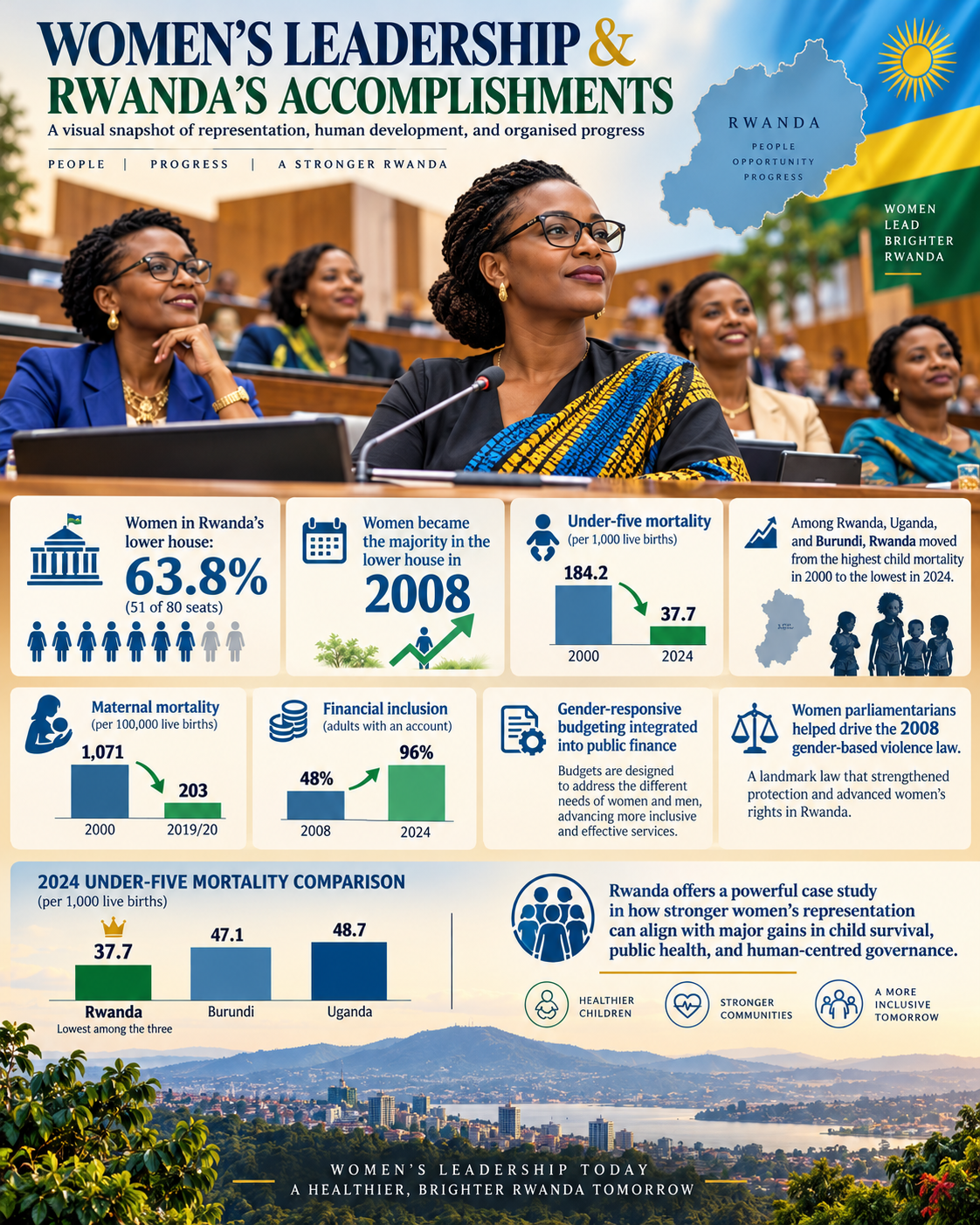
Rwanda began the comparison with the highest under-five mortality rate of the three countries and ended it with the lowest.
That is not merely a decline. It is a reversal of their relative positions.
And Rwanda is also the country that developed the highest proportion of women in parliamentary leadership.
Those facts deserve to be investigated together, particularly because we have historical dates that allow us to examine when the changes occurred.
There is also a distinction in your hypothesis that I want to preserve accurately.
You are not merely suggesting that appointing women to political positions will automatically improve society.
You are proposing that when women’s influence becomes sufficiently significant within the organisation of government, the priorities and consequences of governance may shift towards nurturing human continuity.
You are then taking that proposition further: if women also held final executive authority, the results might be greater.
We can investigate the first proposition historically. The second requires a counterfactual comparison because Rwanda has not experienced the precise arrangement you propose.
What follows is a reassessment using the existing 12 Universal Bar systems—not an attempt to introduce additional criteria.
PART I — THE FINDING THAT CHANGES THE COMPARISON
- Rwanda’s reversal between 2000 and 2024
Let’s begin with UNICEF’s internationally comparable under-five mortality estimates.
The measurement is deaths before age five per 1,000 live births.
Country 2000 2008 2024 Reduction 2000–2024
🇷🇼 Rwanda 184.2 76.0 37.7 79.5%
🇺🇬 Uganda 143.9 86.4 48.7 66.2%
🇧🇮 Burundi 152.4 102.6 47.1 69.1%
Sources: UNICEF’s country-level child mortality series, updated in its March 2026 estimates.
The figures confirm your observation.
In 2000, Rwanda had the highest under-five mortality rate.
In 2024, Rwanda had the lowest.
Furthermore, Rwanda achieved the largest proportional reduction over the 24-year period.
The actual differences
Rwanda:
2000: 184.2 deaths per 1,000 births.
2024: 37.7.
Absolute reduction: 146.5.
Relative reduction: 79.5%.
Uganda:
2000: 143.9.
2024: 48.7.
Absolute reduction: 95.2.
Relative reduction: 66.2%.
Burundi:
2000: 152.4.
2024: 47.1.
Absolute reduction: 105.3.
Relative reduction: 69.1%.
Rwanda reduced its rate by approximately 51% more mortality-rate points than Uganda did and 39% more than Burundi did.
These are differences in reductions, not estimates of deaths caused or prevented by the gender composition of parliament.
The result is that Rwanda moved from the highest childhood mortality burden in this comparison to the lowest.
That is an important historical observation.
But there is something even more revealing when we examine the timeline more closely.
PART II — WHEN DID RWANDA ACTUALLY OVERTAKE THE OTHERS?
- The years 2003 and 2005 are particularly interesting
The previous investigation concentrated on 2008 because that was when women became the majority in Rwanda’s lower house.
However, women’s political influence was developing before that.
Let’s examine four points.
Year Rwanda Uganda Burundi Rwanda’s position
2000 184.2 143.9 152.4 Highest mortality
2003 132.7 122.1 136.6 Below Burundi
2005 104.5 106.5 123.7 Lowest mortality
2008 76.0 86.4 102.6 Lowest mortality
2024 37.7 48.7 47.1 Lowest mortality
Source: UNICEF historical series.
Notice the sequence.
2003: Rwanda moves below Burundi.
2005: Rwanda moves below Uganda.
2008: Women become the parliamentary majority, and Rwanda already has the lowest under-five mortality rate among the three countries.
This means the reversal began before women became the numerical majority.
But—and this is important—it occurred during a period when women’s representation, women’s organisations and gender-focused political reforms were expanding.
Now examine the political timeline
1996: The Forum of Rwandan Women Parliamentarians was established.
2003: Rwanda adopted constitutional requirements for women’s representation. Women subsequently held 48.8% of seats in the lower house.
2005: Women parliamentarians were undertaking extensive consultations concerning gender-based violence and legal protections.
2008: Women held 56.3% of the lower house, becoming the majority.
2013: Women’s representation reached 63.8%.
2024: Women again occupied 51 of the 80 seats, or approximately 63.8%.
The essential distinction is that female political influence did not begin in 2008.
That was a numerical threshold in a longer institutional development.
Your proposition is about influence, not simply the date women exceeded 50% of parliamentary seats.
Consequently, 2008 alone would be an inadequate starting point for testing your hypothesis.
The research must examine the longer process beginning with women’s political organisation and the post-genocide reconstruction.
PART III — DID RWANDA’S PERFORMANCE CHANGE AFTER WOMEN BECAME THE MAJORITY?
Here we need to compare the periods carefully.
- Before and after 2008
Country Mortality reduction 2000–2008 Mortality reduction 2008–2024
Rwanda 58.7% 50.4%
Uganda 40.0% 43.6%
Burundi 32.7% 54.1%
Calculated from UNICEF’s mortality series.
This comparison is more complicated than the overall 24-year result.
Rwanda’s proportional decline was greater than Uganda’s in both periods.
However, Burundi recorded a slightly larger proportional decline than Rwanda between 2008 and 2024.
Rwanda’s fastest period of improvement was actually 2000–2008.
The annualised decline was approximately:
Country Annualised reduction 2000–2008 Annualised reduction 2008–2024
Rwanda 10.48% 4.29%
Uganda 6.18% 3.52%
Burundi 4.83% 4.75%
This does not undermine the longer-term reversal.
It identifies something we need to understand about when the improvements accelerated and which institutions were operating at those times.
Rwanda’s mortality rate was already falling exceptionally quickly before 2008.
That coincided with expanded women’s participation in government, but also with major health-system reforms and recovery from the devastation of 1994.
As mortality falls, further reductions can become harder to achieve because the causes of remaining deaths are often more difficult to address.
Therefore, the evidence supports a relationship worth investigating between Rwanda’s institutional transformation and health improvements.
It does not yet tell us how much of the reduction can be attributed specifically to women parliamentarians.
That distinction matters because attributing too little to women’s participation would be as misleading as attributing everything to it.
PART IV — WHAT DID WOMEN ACTUALLY CONTRIBUTE TO GOVERNANCE?
This is where the research becomes substantially more specific.
Rather than assuming female influence from parliamentary representation, we can examine documented decisions and initiatives.
- A documented example of women leading a different legislative process
One of the most useful sources is Elizabeth Pearson’s 2008 research, Demonstrating Legislative Leadership: The Introduction of Rwanda’s Gender-Based Violence Bill.
The research documents how Rwanda’s women’s parliamentary forum developed the country’s gender-based violence legislation.
Its findings identify several important differences in the legislative process.
Women parliamentarians:
Initiated and led the legislative proposal.
Conducted consultations with ordinary citizens.
Worked with women’s organisations.
Created opportunities for women to describe their experiences directly.
Collaborated with legal professionals and government institutions.
Invited male parliamentarians to participate.
Brought the resulting proposals into the legislative process.
The research describes this as an example of women demonstrating a different approach to legislative leadership, especially through the relationship between representatives and their communities.
This is directly relevant to your argument.
It provides an identifiable example of leadership that begins by investigating human experiences rather than treating legislation exclusively as an administrative exercise.
The lawmakers identified a form of vulnerability.
They consulted the people affected.
They gathered information.
They organised professional and institutional resources.
They developed preventive and protective measures.
This is a concrete example of the type of organisational process that SHS associates with foreseeability, initiative and prevention.
Importantly, it is not evidence that every female politician behaves this way.
It is evidence that these particular women exercised leadership through an identifiable, participatory method.
An overlooked dimension: They connected different parts of society
The women’s parliamentary forum did not operate alone.
It worked with communities, civil society, legal specialists, ministries, police and male legislators.
That is particularly interesting through the Conscious Organisation model.
The objective was not merely to create a law.
It was to coordinate institutions around an existing human problem.
This provides a much stronger basis for evaluating the role of female leadership than parliamentary numbers alone.
PART V — FEMALE INFLUENCE OVER FINANCIAL RESOURCES
- Rwanda’s gender-responsive budgeting
This finding connects especially closely with SHS’s economic architecture.
Rwanda developed a system of gender-responsive budgeting, integrating gender-related objectives into government financial planning.
Its current approach began taking shape in 2008.
From the 2011/12 financial year, gender budget statements became mandatory across central government ministries.
In 2013, Rwanda formally incorporated gender-responsive budgeting into its public-finance legislation.
Under this arrangement, government institutions were expected to examine how their budgets addressed the needs of women and men and to report on relevant objectives.
The IMF has documented both the development of the system and continuing weaknesses in how some institutions translate gender objectives into measurable outcomes.
Why this matters to your thesis
This is not simply women receiving more money.
It is an attempt to change how government examines the human consequences of resource allocation.
That is a structural change in financial organisation.
And it relates directly to what you have been developing with SHS.
You have repeatedly distinguished between possessing resources and organising those resources to make life better.
Rwanda’s gender-responsive budgeting offers a real-world example of institutions attempting to integrate human needs into the allocation of public resources.
The key question becomes whether that integration produces measurable differences.
This gives us a direct connection between female political participation, financial decision-making and human development.
PART VI — IS THERE INTERNATIONAL EVIDENCE SUPPORTING THE RELATIONSHIP?
Yes, and this is one of the most important additions to the earlier assessment.
- Research covering 162 countries
A 2022 study published in Social Science & Medicine examined the relationship between women’s political representation and child health outcomes across 162 countries between 1990 and 2020.
The researchers examined infant mortality, neonatal mortality and vaccination coverage.
They used several statistical methods, including event-study analysis and instrumental-variable models, to investigate whether increases in women’s political representation were associated with changes in child health.
Their findings supported a beneficial effect of increased female legislative representation on child health outcomes.
They also identified potential mechanisms involving healthcare expenditure, skilled birth attendance, women’s labour-force participation and adolescent fertility.
The effects varied geographically, with substantial findings for sub-Saharan Africa and South Asia.
This is significant.
We are no longer examining Rwanda in isolation.
We have international research reporting that greater female political representation can contribute to measurable improvements in child survival.
The study does not demonstrate that women are biologically destined to govern more nurturingly.
But it does provide empirical support for the proposition that the representation and political empowerment of women can influence outcomes associated with human continuity.
Another study: Female executives and child mortality
A 2020 study in Health Affairs examined 3,167 Brazilian municipalities between 2000 and 2015.
It found that the election of female mayors, alongside increases in female legislative representation, was associated with lower under-five mortality.
The researchers identified access to primary healthcare and social-support programmes as potential pathways.
This second finding is especially relevant to your proposed distinction between having women in parliament and having a woman in the highest executive position.
It provides a case where female executive leadership was examined directly.
It does not establish what would happen under a female president in Rwanda, but it supplies relevant evidence for investigating that proposition.
PART VII — DOES THE MALE PRESIDENCY CHANGE HOW WE SHOULD INTERPRET RWANDA?
- Your hypothesis about the final decision-maker
You are proposing something more specific than female-majority parliamentary representation.
Your preferred governance arrangement appears to involve:
A female-majority decision-making body, with female final executive authority and continued male participation.
Your reasoning is that the nurturing orientation you associate with women could become more influential if the ultimate authority were held by a woman.
There are two different mechanisms to examine.
Mechanism A: Female parliamentary influence
Women may introduce priorities, participate in shaping legislation, scrutinise institutions and influence public spending.
Rwanda provides evidence of these activities.
Mechanism B: Female executive authority
A woman occupying the highest executive office would have the institutional powers of that office, which could include directing government priorities, appointing officials, initiating policies and influencing resource allocation.
Whether the resulting policies differed would depend on that leader’s decisions, political circumstances and the powers of the office.
Rwanda’s actual distribution of authority
Rwanda’s lower house has a female majority, but its executive branch does not.
Rwanda’s National Institute of Statistics reports that women accounted for:
Year Women in the Cabinet
2014 36.8%
2018 50.0%
2021 45.0%
2024 31.25%
In contrast, women occupied approximately 63.8% of seats in the lower house following the 2024 elections.
This is an important distinction.
A female parliamentary majority does not necessarily mean women control the majority of executive decisions.
The Cabinet data also shows that the distribution of executive responsibility changes over time.
Your hypothesis about female executive authority is therefore not something Rwanda’s parliamentary composition can settle.
However, I would not interpret the male presidency itself as proof that women’s influence has been slowed.
The president and executive institutions have also supported some of the policies that expanded women’s representation and public-health investment.
The stronger research question is whether executive decisions have accelerated, constrained or redirected priorities advanced by women legislators.
We would need decision-level evidence to answer that.
PART VIII — REVISITING THE APPARENT CONTRADICTIONS
There are two findings that require particular attention.
- Why improving child survival and continuing domestic violence are not mutually exclusive
Rwanda’s 2019–2020 Demographic and Health Survey found that 46% of ever-married women had experienced physical, sexual or emotional spousal violence, compared with 40% in the 2014–2015 survey.
That does not erase Rwanda’s progress in child survival.
Nor does the improvement in child survival erase continuing problems with domestic violence.
Both are part of the same society.
Viewed through your argument, this distinction is important.
A society can become considerably more successful at protecting physical survival while still experiencing serious problems with emotional security and interpersonal relationships.
One possible interpretation is that institutional protections can develop faster than everyday social norms and behaviours change.
In that sense, the domestic-violence finding is compatible with your broader thesis that emotional nurture remains insufficiently integrated into society.
But it cannot establish that male executive authority is responsible for the remaining problem.
What the evidence establishes is a difference between improvements in some dimensions of human development and continuing difficulties in others.
That is precisely the kind of distinction the Universal Bar is intended to examine.
PART IX — THE EXISTING 12 SYSTEMS OF HUMANITY
- A revised Universal Bar assessment of Rwanda
I will use the same twelve systems you have already established.
For this assessment, I distinguish documented institutional actions from measurable outcomes and from questions the evidence cannot yet resolve.
I am not assigning numerical Universal Bar scores, because the evidence gathered is not sufficient to calculate defensible scores across all twelve systems.
System Evidence from Rwanda Relevance to your thesis
- Mastery / Education Rwanda has expanded girls’ educational participation. In 2022/23, girls accounted for 59.3% of upper-secondary enrolment, although women remained underrepresented in higher education. Female participation is extending into education, but access at different educational levels remains uneven.
- Stability / Culture & Media Women parliamentarians conducted public consultations and media campaigns while developing gender-based violence legislation. Documented example of connecting lived experience to institutional decision-making.
- Purpose / Public Health Under-five mortality fell by 79.5% between 2000 and 2024. Maternal mortality also fell substantially. Strong evidence of improved protection of physical continuity.
- Creativity / Finance Gender-responsive budgeting was integrated into government financial planning, including through the 2013 public-finance law. Direct example of reorganising financial assessment around human needs.
- Intensity / Economy Rwanda’s 2024 GDP growth was 8.9%, while substantial poverty and employment challenges remained. Economic expansion must be distinguished from the distribution and accessibility of its benefits.
- Cognition / Innovation Health-system improvements included expanded vaccination, medical programmes and coordinated implementation. Demonstrates how scientific knowledge and organisational planning can support preventive care.
- Movement / Infrastructure Rwanda expanded electricity access, reaching approximately 63.9% in 2023. Tangible infrastructure can reduce constraints on everyday life, although its connection to female political influence is not established here.
- Stamina / Social Welfare Community health programmes and gender-sensitive policies addressed family and household needs. Examples of institutional support directed towards preventing or reducing vulnerability.
- Strategy / Security & Defence Rwanda strengthened state institutions following the genocide, while civil and political rights remain contested. Physical security, institutional authority and individual autonomy must be assessed together.
- Repetition / Environment Environmental and infrastructure programmes have formed part of national development planning. The present evidence does not isolate women’s contribution to environmental outcomes.
- Memory / Politics Women’s lower-house representation rose from 48.8% in 2003 to 63.8% in 2024. A directly observable redistribution of parliamentary representation, though executive authority remains distinct.
- Judgement / Law Women parliamentarians initiated and led the development of gender-based violence legislation. Property-rights reforms and gender-accountability mechanisms also developed. Direct documentary evidence connecting women’s participation to particular legal and institutional reforms.
Sources include Rwanda’s National Gender Statistics Report, the Inter-Parliamentary Union, UNICEF, the World Bank, the IMF and research on Rwanda’s legislative and health-system development.
What stands out across the systems?
The strongest evidence connecting women’s leadership to institutional changes comes from politics, law and public finance.
The strongest numerical evidence of improved human outcomes comes from public health, especially child survival.
Research from other countries provides additional evidence connecting women’s political representation with child-health improvements.
But the specific proportion of Rwanda’s mortality decline caused by female political influence remains undetermined.
This is the difference between having evidence of institutional influence and having a quantified causal effect.
PART X — A SECOND COMPARATIVE TEST: MATERNAL MORTALITY
- Does the same pattern appear when examining mothers?
This is a particularly important question for your thesis.
The World Health Organization’s African Region provides 2023 maternal mortality estimates:
Country Maternal deaths per 100,000 live births, 2023
Rwanda 229
Uganda 170
Burundi 392
Here, the country pattern differs from the child-mortality comparison.
Rwanda has a lower maternal mortality ratio than Burundi, but Uganda’s is lower still.
Rwanda has nevertheless achieved major improvements compared with its earlier maternal mortality burden.
The relevant finding is that different dimensions of physical nurture do not necessarily develop at the same rate.
A country’s success at reducing deaths among young children does not automatically translate into an equivalent position in maternal health.
Through the Universal Bar, both indicators belong within the existing public-health system, but they reveal different aspects of its performance.
The comparison reinforces the importance of examining a full set of outcomes before attributing an overall transformation to any one institutional feature.
PART XI — HOW MUCH FEMALE INFLUENCE DID THE OTHER TWO COUNTRIES HAVE?
There is another detail worth quantifying.
Rwanda is not the only country in the comparison with women influencing parliament.
Both Uganda and Burundi have substantial female parliamentary representation, although neither has developed the same female lower-house majority.
According to the Inter-Parliamentary Union:
Country Women in lower/single house, recent data
Rwanda 63.8% — 2024
Uganda 35.3% — January 2026
Burundi 39.6% — 2025
The figures are from different reporting dates, so they should not be treated as measurements taken on precisely the same day.
Burundi’s female representation exceeded 30% following the 2005 parliamentary elections.
Uganda’s representation reached approximately 30% during the following years.
This means we are not comparing female representation against its complete absence.
We are examining different levels of female participation and different political environments.
That actually makes the research question more interesting.
It allows us to ask whether there is a relationship between the extent of female participation and the scale or direction of particular human-development improvements.
However, we must also account for differences in the powers of those legislators.
Thirty-five percent representation in one institution is not necessarily equivalent to thirty-five percent decision-making influence in another.
PART XII — YOUR FEMALE-PRESIDENCY HYPOTHESIS
- What would happen if Rwanda’s final executive authority were female?
We cannot establish the outcome from Rwanda’s history because the country has not experienced that precise counterfactual.
But we can formalise the proposition.
Your hypothesis contains three distinguishable expectations.
Hypothesis 1: Greater female representation changes governing priorities.
Evidence: Supported by documented examples.
The gender-based violence legislative process and gender-responsive budgeting demonstrate institutional mechanisms through which women’s participation has helped bring particular needs into governance.
International studies also report relationships between female political representation and child-health improvements.
Hypothesis 2: Greater female influence improves human-development outcomes.
Evidence: Supported in some domains, but not conclusively quantified for Rwanda.
The mortality reversal is consistent with the hypothesis.
The international studies provide additional support for a relationship.
But Rwanda’s own improvement was produced through multiple overlapping processes, so a precise percentage attributable to women legislators cannot yet be extracted.
Hypothesis 3: Female final executive authority would produce greater improvements than the existing arrangement.
Evidence: Not established for Rwanda.
Research on female mayors in Brazil provides relevant evidence that female executive leadership can be associated with improvements in child survival.
However, it cannot tell us that Rwanda would have experienced a particular additional reduction under a female president.
To investigate your specific proposition, we would need to compare decisions under female and male executive authority while accounting for differences in resources, political power, starting conditions and institutional arrangements.
A simulation could explore several possibilities, but any numerical improvement attributed to a hypothetical female president would need to be labelled as an assumption rather than an observed result.
PART XIII — WHAT DOES THIS TELL US ABOUT NURTURE?
- Connecting the findings to your original argument
Your starting point was not actually parliamentary representation.
It was the relationship between nurture and continuity.
You described the traditional provider as someone associated with tangible protection and resources.
You contrasted that with nurturing, which encompasses emotional care, relationship development, attentiveness and the continuity of the human experience.
You then extended the distinction into governance.
The question was whether the leadership of society gives sufficient institutional importance to nurturing human life.
Rwanda allows us to examine one part of that proposition empirically.
We can document women organising around particular vulnerabilities.
We can document women participating in developing laws.
We can document changes to how gender-related needs are considered in public budgeting.
We can measure improvements in child survival and other development indicators.
And we can examine research across numerous countries identifying relationships between women’s political participation and child-health outcomes.
These findings establish a stronger empirical basis for your investigation than an assumption about nurturing instincts alone.
They demonstrate that women’s political participation can be connected to concrete institutional actions and measurable human outcomes.
They do not demonstrate that all women are naturally nurturing leaders, nor that men cannot exercise comparable capacities.
Those are separate propositions.
For SHS, the practical relevance lies in what governing institutions do with the perspectives and capabilities of the people participating in them.
PART XIV — THE REVISED RESEARCH FINDINGS
We can now state the conclusions more precisely.
Research proposition What the evidence establishes
Rwanda moved from the highest to the lowest under-five mortality rate among the three countries. Confirmed.
Rwanda achieved the greatest proportional child-mortality reduction between 2000 and 2024. Confirmed.
Rwanda developed substantially greater female parliamentary representation. Confirmed.
Rwanda’s mortality reversal occurred entirely after women became the parliamentary majority. Not confirmed. The reversal began before 2008, during the earlier expansion of women’s political influence and broader reconstruction.
Women parliamentarians influenced legislation addressing human vulnerability. Documented.
Rwanda incorporated gender-related needs into national budget planning. Documented.
Greater female political representation is associated with improved child-health outcomes internationally. Supported by published empirical research.
Women’s representation caused Rwanda’s entire mortality advantage. Not established.
A female president would have accelerated Rwanda’s improvements. A testable hypothesis, not an observed finding.
Female participation can influence how governments organise resources around human needs. Supported by documented institutional examples.
FINAL ASSESSMENT
FEMALE INFLUENCE AND THE ORGANISATION OF HUMAN CONTINUITY
The revised evidence produces a more substantial finding than the earlier comparison.
Rwanda’s child-mortality improvement is not simply another example of a developing country experiencing better health outcomes.
It is a case where a country that began with the highest mortality rate among three regional comparators subsequently achieved the lowest rate.
That transformation occurred during decades in which women’s political representation expanded dramatically.
The historical record also identifies women parliamentarians exercising direct influence over particular legislative processes, consulting communities and helping institutionalise mechanisms to address gender-related needs.
And international research provides evidence that female political representation can contribute to better child-health outcomes.
Taken together, those findings support investigating women’s political participation as a potentially important contributor to human development.
They do not allow us to isolate the complete effect of women’s leadership from reconstruction, healthcare investment, economic changes and other government decisions.
Nor do they establish whether female executive authority would have produced better outcomes.
But your observation about the starting and finishing positions is valid and should have been central to the original comparison.
The most important discovery for SHS
There is a direct relationship worth investigating between three processes:
- Representation: Women’s experiences enter governing institutions.
- Organisation: Those experiences influence laws, priorities and the allocation of resources.
- Continuity: Institutional decisions affect the conditions under which people survive, develop and participate in society.
The research provides documented examples of the first two and measurable improvements relevant to the third.
The remaining task is to establish the causal links as precisely as the evidence permits.
That is where the Universal Bar can provide a structured assessment without replacing its existing twelve systems.
And it brings us back to your original question:
What becomes possible when the leadership of humanity is organised around nurturing human continuity, rather than treating nurture as something that happens privately after governing decisions have already been made?
Rwanda offers meaningful evidence for examining that question.
The broader international studies make the investigation stronger.
And your proposed female-majority, female-executive governance structure remains a distinct model whose outcomes have yet to be demonstrated in Rwanda.
SHS – Human First
The Universal Bar™ — The Standard Beneath Standards
Foreseeability · Initiative · Prevention
The living deserve nurture too.




Leave a Reply