
What changes when people can live, learn and work closer to one another, while still moving freely through a connected network?
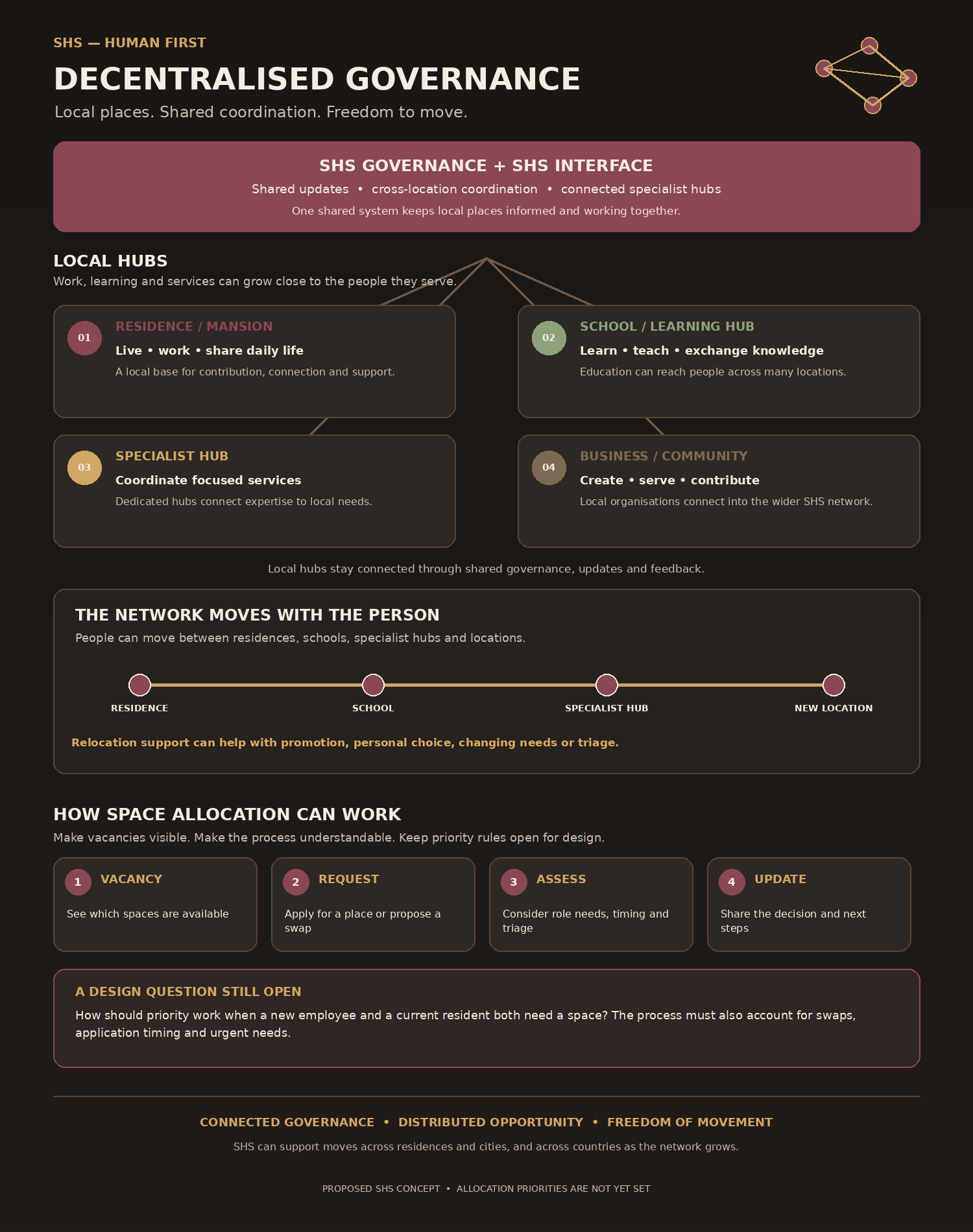
This is one of the possibilities within SHS: a decentralised way of organising industries, businesses, services and communities. Each location can become a place where people contribute, learn, work and build relationships. A mansion, school or specialist hub can serve its local community while staying connected to the wider SHS system.
The coordination remains connected through SHS Governance, shared hubs and the SHS interface. Updates, opportunities and available spaces can be made visible across the network. Specific hubs can look after particular functions, while the wider system keeps information and support moving between them.
A person’s place in the network does not have to be permanent. Someone may want to move to another residence, take up a promotion, join a different team, respond to a change in their life or move closer to a particular opportunity. SHS can support relocation between residences, locations and, as the network grows, countries.
This gives people more choice about where they live and work, while allowing organisations to grow across many places. It also means that a new school, residence or business can strengthen its local area and still take part in something wider.
How spaces are allocated will need careful design. People should be able to see where vacancies exist and understand the application process. A new employee may need a location to begin their role; someone already living within the network may have a reason to move; and a mutually agreed swap may make sense. Triage may also affect priority. The exact order of priority is still to be worked out, with clear information about availability and decisions.
The aim is to make movement possible while keeping people connected to their work, community and support. The network can grow close to the individual, and the individual can move through the network when life or opportunity calls for it.
SHS can become more than a collection of businesses and buildings. It can be a connected geography of human activity, where resources, learning and work are distributed across locations and people have room to move between them.



Leave a Reply