
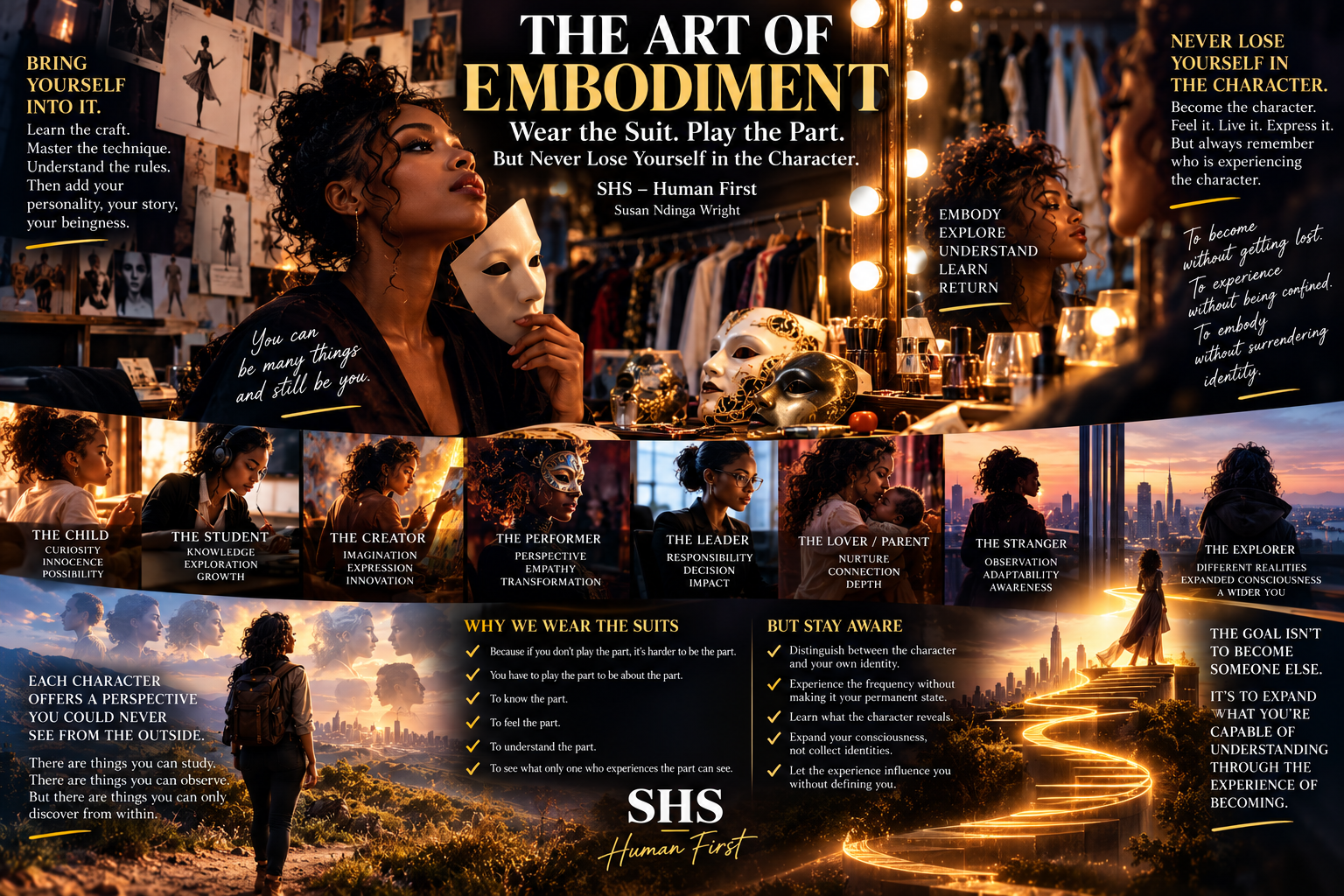
Yet, though they say to put your personality into it, it’s also imperative that one never gets lost in it, whilst fully embodying the character. And I feel like this has been at the back of my mind and my subconscious, playing as one of the patterns that allowed me to embody essences and characters with almost second nature, without thinking about it and having to identify things after, which is something— it’s a pattern that I’ve already been dissecting for the past couple of years. But it’s interesting to see every different frequency, how it manifests, and what I get to see in it. But it is important to wear the suits because if you don’t play the part, it’s harder for you to be the part, you know? You have to play the part in order to be about the part, know the part, feel the part, understand the part, see the part in what only one that experiences the part can only see
I tried being your Jesus but like always, I’d rather be me.
….
Wear the Suit. Play the Part. But Never Lose Yourself in the Character.
SHS – Human First | Susan Ndinga Wright
There’s another aspect of art that I find particularly fascinating.
Because while teachers of the arts encourage their students to bring their own personalities into their performances, they also teach something equally important.
Never lose yourself in the character you’re embodying.
And isn’t that interesting?
You’re supposed to become the character, understand its emotions, experience its perspective, reproduce its behaviours, and allow yourself to express something that might be completely different from who you naturally are.
Yet, throughout the entire experience, you must remain aware of who you are.
You must become without forgetting who is becoming.
And I feel like this particular understanding has been operating somewhere in the back of my mind, within my subconscious, for quite some time.
Because I’ve noticed that I have an almost second-nature ability to embody different essences, personalities, characters, and frequencies without necessarily having to consciously identify what I’m doing beforehand.
Sometimes, I only recognise the patterns afterwards.
And this is something I’ve been dissecting for the past couple of years.
Observing the different frequencies.
How they manifest.
How they influence expression.
How they change what I notice, what I feel, what I understand, and ultimately what I am able to see.
And what fascinates me is that each character offers access to a perspective that might otherwise remain inaccessible to the person observing it from the outside.
Think about it.
You can study a character for years.
You can read about its motivations, analyse its behaviour, understand its history, and develop an intellectual explanation of why it does what it does.
But there’s something different about actually playing the part.
About wearing the suit.
About allowing yourself to move through the experience as though you were the person whose existence you’re trying to understand.
Because there are things you can observe from the outside.
And there are things you can only discover from within.
This is why I believe it’s important to wear the suits.
If you don’t play the part, it’s harder to be the part.
And if you never experience being the part, how much of the part can you truly claim to understand?
You have to play the part to be about the part.
Know the part.
Feel the part.
Understand the part.
See the part.
And, most importantly, discover what only someone experiencing the part would have the opportunity to see.
Because understanding something intellectually isn’t necessarily the same as understanding it experientially.
And that’s where embodiment becomes such an extraordinary instrument of consciousness.
It gives us the possibility of moving beyond simply knowing that another perspective exists.
We get to explore what existence might look like through that perspective.
But here’s where the distinction becomes imperative.
You must know the difference between the character you’re experiencing and the consciousness experiencing the character.
Otherwise, how do you know where one ends and the other begins?
How do you know which emotions belong to your own experiences and which have emerged through the character you’re exploring?
How do you distinguish between the behaviours you’re studying and the behaviours you’ve chosen to make part of your own identity?
And perhaps, most importantly, how can you examine what you’ve experienced if you’ve forgotten the perspective from which you entered the experience?
This is why I find the ability to embody something without becoming permanently attached to it so interesting.
Because the objective isn’t necessarily to become every character you encounter.
It’s to expand what you’re capable of understanding through the experience of becoming.
And the more I’ve observed this pattern within myself, the more I’ve come to appreciate the extraordinary relationship between consciousness, identity, imagination, and experience.
I can wear the suit without believing the suit is the entirety of who I am.
I can explore a personality without having to surrender my own.
I can experience an emotional frequency without having to make that frequency my permanent state of existence.
And I can allow the character to show me something without needing to remain the character once the experience has ended.
Because the point isn’t to collect identities.
The point is to expand consciousness through the experiences that different identities make possible.
And perhaps this is another reason why art has always fascinated me.
Because what we call acting, performing, or embodying a character might also be one of the most accessible demonstrations of something consciousness does throughout our lives.
We move between roles.
The child.
The student.
The lover.
The parent.
The teacher.
The employee.
The leader.
The creator.
The stranger.
Each role introduces a different relationship with our surroundings.
Different expectations.
Different responsibilities.
Different emotional frequencies.
Different things to notice.
Different things to understand.
And while we may bring our personalities into every single one of those roles, the experience of embodying each role can also introduce something new into our personalities.
The consciousness influences the character, and the experience of the character influences the consciousness.
And what happens when we become aware of that exchange?
When we begin to recognise the patterns rather than simply move through them?
When we can distinguish between who we are, what we’re experiencing, and what the experience is teaching us?
I believe that’s where embodiment becomes more than performance.
It becomes an instrument of exploration.
Of education.
Of self-discovery.
Of understanding the existence of others through something more intimate than observation alone.
And perhaps that’s what I’ve been unconsciously practising and consciously dissecting all these years.
Not simply how to play different characters.
But how to experience different expressions of existence while remaining capable of observing what each expression reveals.
To become without getting lost.
To experience without being confined.
To embody without surrendering identity.
To wear the suit, understand what it allows me to experience, and recognise that I am still the one wearing it.
Because there’s a difference between being capable of playing a thousand characters and needing a thousand characters to know who you are.
And the beauty of consciousness is that it allows us to explore the former without necessarily losing the latter.
Learn the craft. Bring yourself into it. Wear the suit. Experience the character. Discover what it reveals.
But never forget who entered the experience.
After all, how else are you going to recognise what you’ve learned when you come out of it?
SHS – Human First
Susan Ndinga Wright



Leave a Reply